
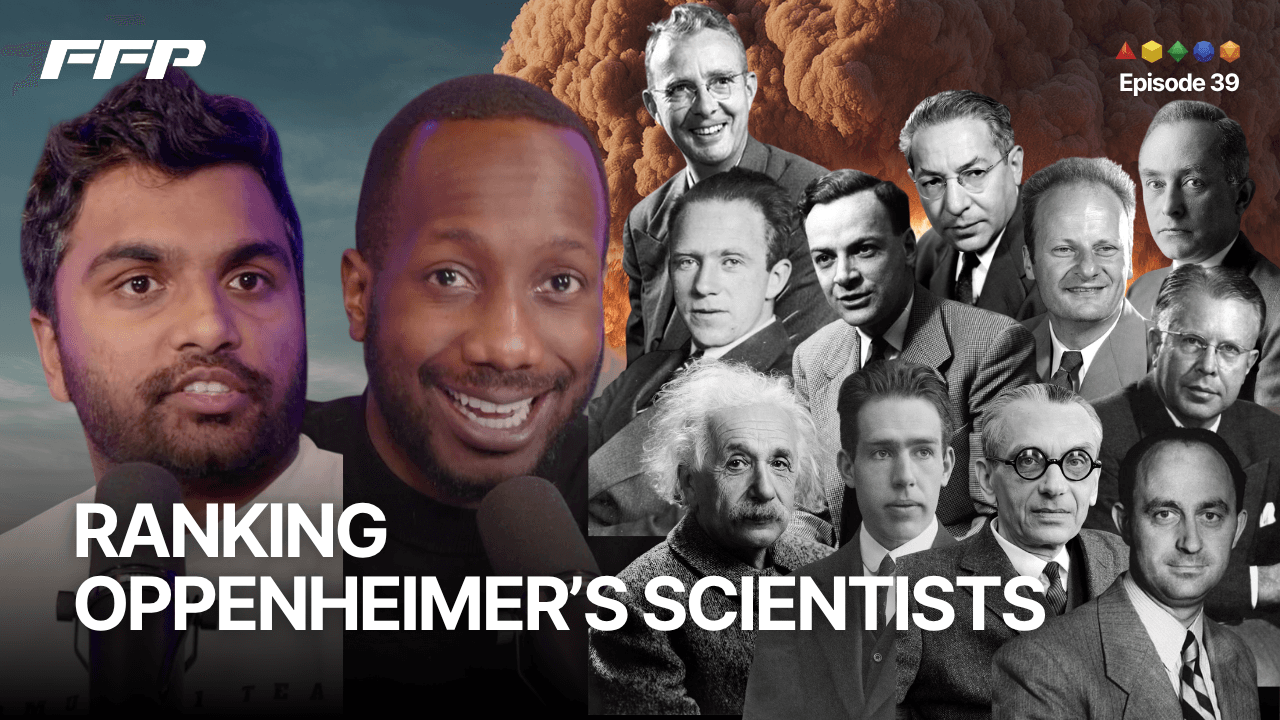
Krishna Choudhary and Lester Nare discuss J. Robert Oppenheimer's scientific work alongside his much better-known leadership of the Manhattan Project. They focus on gravitational collapse research with Hartland Snyder and the Born-Oppenheimer approximation, which separates electronic and nuclear motion in molecular calculations.
736 words · auto-generated from the episode video
39:23real. But it's same same in the sense that like there's energy and then that energy creates particles. >> Blackett, 1897 to 1974. >> Yes, and he was played by James D'Arcy. >> Hm? >> A British actor or a British >> Yes. >> physicist. >> Yes. >> Makes sense. >> Yeah. Number 12. >> This is shocking. This is >> Number 12 is >> J. Robert Oppenheimer. >> This is shocking. You said number three, bro. >> I I said top three. >> Yeah. >> This is I would like an explanation. >> Well, I guess you're going to get an explanation for all of the 11 to one because I'm going to make cases about why they deserve to be higher than J.
40:04Robert Oppenheimer at number 12. Obviously played by Cillian Murphy, who was the star of Oppenheimer. >> You're right. He was the The of the atomic bomb. I think >> Cillian and they might kill you for mispronouncing it. >> Oh, is it Killian? >> I >> Oh, dude, I think it is Killian. Oh my god, the Irish are going to come after me. >> It's Killian Murphy. >> Killian Murphy. >> Apologies. >> We're going to need to I'm going to need to splice that together when we do when we do um socials, or maybe I keep the original one just just so everyone goes to consternation. >> Anyways, he was considered the father of the atomic bomb. >> Yes. >> Um he's a chain-smoking polymath, as they say. Um in the cinematic role, I mean, the
40:46movie is about Oppenheimer, right? So, I don't have to get into that. A great leader. Post-war, he was a public intellectual. He was actually the director of the Institute for Advanced Study at Princeton. >> Yes. >> And really built that to what it is today. Because before him, it was just like, "Oh, Einstein's there." When he came up and like sort of chaired that institute, it became a center for >> research. You know? Um he opposed the H-bomb, and he opposed like the McCarthy stuff. That's probably why he got the clearance rev- revocation at the end. >> Yes. >> There. Um in terms of the physics that he did, I'm going to highlight two
41:27things that he's most known for. His most cited papers. The first one is that gravitational collapse paper that we mentioned earlier with his student Hartland Snyder. This predicted black holes, those massive stars that collapse. It's the first time that black holes have ever appeared in scientific literature. And the other thing that he's very much known for is the Born-Oppenheimer approximation. This is the assumption that when you want to do quantum mechanics of molecules, you can basically assume that the nuclei don't move. >> Okay. >> Okay? Like, if you've got a if you've got the hydrogen atom, for example, you can very easily just go into the reference frame of the proton in the middle, and then talk about what is the
42:09electron doing around it, right? When you've got a bunch of let's say the O2 molecule, right? You've got two nuclei and then you have electrons buzzing around. Well, sometimes you got to worry about the what happens to the nuclei as they interact right? He created the Born-Oppenheimer approximation with his PhD advisor, Max Born, because he wanted to solve what the electrons were doing in these molecules, and he said that the electrons and the nuclei could be treated separately because the nuclei are just so much more massive than the electrons moving around that really we don't have to care about it as much. Um there's a famous scene in the movie where he meets Heisenberg for the first time, and the thing that Heisenberg says is, "Ah, Oppenheimer, I
42:51liked your paper about molecules." Do you remember that? >> That was quite good. >> Yeah. >> That was quite good. >> this is the paper that he's talking about, the Born-Oppenheimer approximation. >> That makes sense. >> He also knew Max Born because, uh you know, Heisenberg worked very closely with Max Born, which we'll get into later on. >> Yes. >> Um but those are really the two sort of fundamental physics contributions that he made. >> Which is fair, and so in that context for how we're ranking, uh Robert
History of SciencePhysicsNuclear Physics