
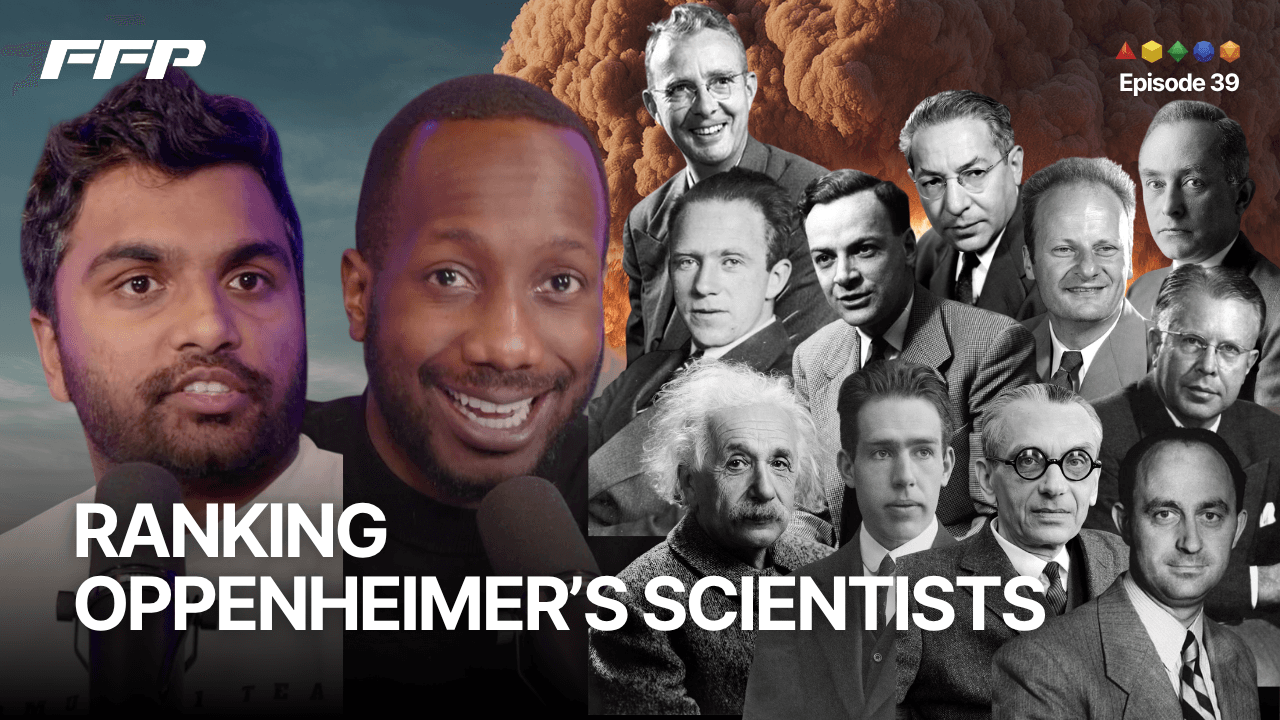
Werner Heisenberg's work on matrix mechanics helped establish modern quantum theory. Krishna Choudhary and Lester Nare discuss that contribution and the uncertainty principle as they place him in their ranking, while also addressing his involvement in Germany's wartime nuclear research.
521 words · auto-generated from the episode video
1:12:28>> 100%. Yeah. Richard Feynman, 1918 to 1988. And we'll be sure, if we do the deep dive, to send it to Dave Chang. As we know, he's a big Feynman fan. >> Yes, of course. And that is the end of the A tier. >> Yes. >> Okay? >> Okay. >> So now, Feynman is not in the supers. >> Yeah, I mean, the A The A tier is That's like the Avengers already. I don't know how you >> The A tier already has Feynman and Beta. All right, now we're getting into the S tier. >> Okay. >> At number five >> Yes. >> is Werner Heisenberg. >> favorites. >> Yes. He was a German theoretical physicist and he is the architect of quantum mechanics. >> Yeah. >> Right? >> Yes. >> Um he remained in Germany during World
1:13:09War II to lead the Nazi nuclear project. Wasn't very good. And there's debate about whether he like, you know, fudged the calculations on purpose. I don't think so. I think he was just really bad at calculating and doing experiments. Um he was famous for that. Um he was a peer to Robert Oppenheimer. He's played by Matthias Schweighöfer. >> Mhm. >> Um a very famous um German actor actually. Um he's kind of an ominous off-screen threat. Um but in this race mentality, they keep saying that he was 18 months ahead because Heisenberg is just so good >> Yeah, yeah. >> at anything physics related. And truly in terms of theory, he really was. Um
1:13:52the German project actually failed because lack of resources, lack of support, and also a calculation error, which we're not sure if it was real or not, right? But in terms of physics, there's no doubt that Heisenberg is someone who belongs in the S tier, okay? He's not someone for the A tier. >> Yes, yes, yes. He's not of the bottle as we like to say in in Europe. >> His 1925 paper in quantum mechanics, the one that we covered in one of our earlier episodes, >> that paper started the modern quantum revolution, >> Yes. >> right? This idea of linear algebra coming into quantum mechanics and the fact that he figured that out without having any training in the mathematics, he just invented it on his own while having an
1:14:35allergic attack on an island. >> Hay fever. >> Yeah, hay fever, right? >> Astonishing. >> Yeah, just insane, right? And that was in 1925. Just that paper alone would put him, I think, in the S tier, right? On >> top of that, he developed this thing called the uncertainty principle, the Heisenberg uncertainty principle. Yeah, that fundamental property that you can't know both the position where something is and how fast it's moving, the momentum, with arbitrary precision simultaneously. A central tenant in quantum mechanics and really one of the things that sets it apart from classical mechanics. The fact that there are observables that are completely separate, you know? Um, so
1:15:17won the Nobel Prize in 1932 for this mathematically complete version of
History of SciencePhysicsNuclear Physics