
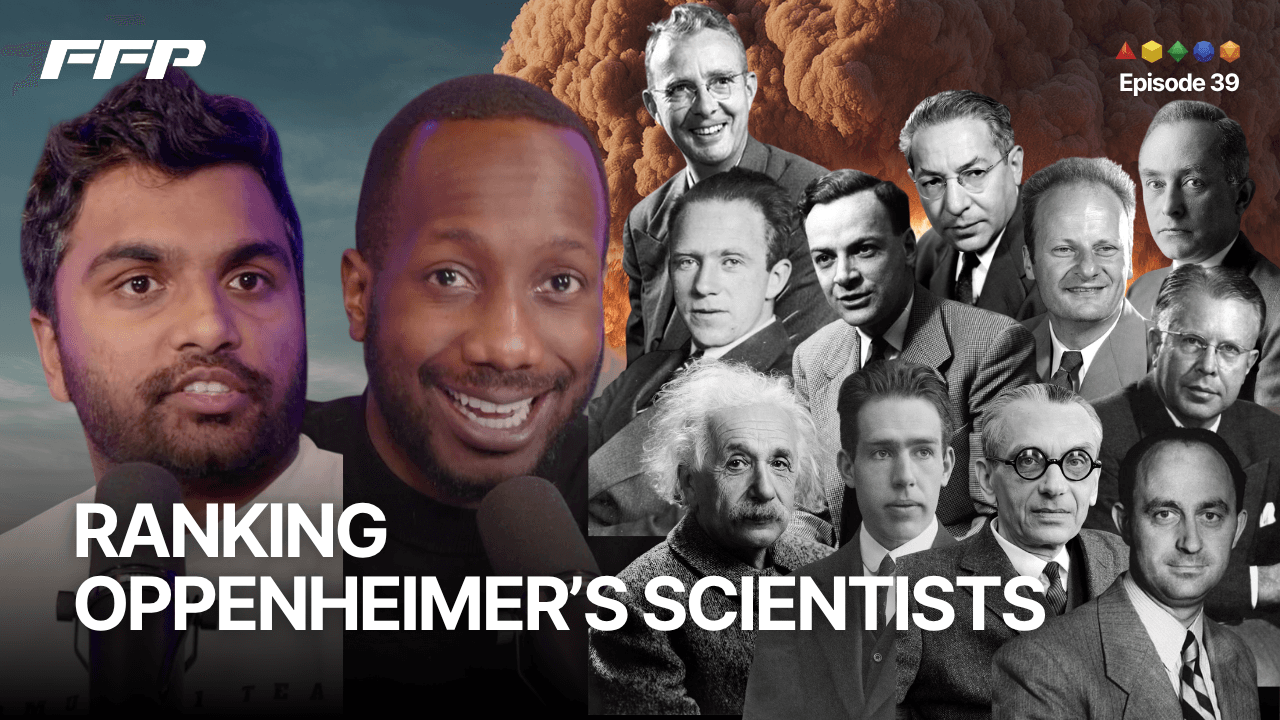
Isidor Rabi helped establish the physics of magnetic resonance, showing how atomic nuclei respond to an oscillating field. Krishna Choudhary and Lester Nare connect that work to Rabi oscillations, the driven transitions between quantum states used to control qubits, and to the development of atomic clocks. Their discussion explains why Rabi ranks highly in their assessment of the scientists portrayed in Oppenheimer.
- 01
Rabi's 1944 Nobel Prize recognized his resonance method for measuring the magnetic properties of atomic nuclei.
- 02
Rabi oscillations describe driven changes in the populations of quantum states and provide a way to study and control a two-level system.
- 03
Magnetic resonance helped lay the groundwork for later MRI technology, while atomic clocks provide the precise timing used by GPS.
733 words · auto-generated from the episode video
50:51>> Okay. >> some experimentalists are going to be mad that he's not higher. >> Okay. >> But I'm going to put him at number 10. Okay. He was played by David Krumholtz, another very famous actor. >> Yes. Yes. >> He was Robert Oppenheimer's confidant and refused full-time Manhattan Project residency but served kind of like a consultant. Um you know, he grew up in the Jewish ghettos in New York City known for his moral clarity. He won the Nobel Prize in 1944 for nuclear magnetic resonance which is the bedrock of MRI imaging, right? Magnetic resonance
51:32imaging. This method for measuring the magnetic properties of atomic nuclei. Huge for >> every application of MRI >> Yeah, I mean that's pretty big. >> That's pretty big. >> Right? That's not why he's number 10 though. If he only did that, he would not be number 10. >> Okay. >> His main contribution to me is something called the Rabi oscillations. >> Okay. >> Which is really nuclear magnetic resonance at the end of the day. Nuclear magnetic resonance is an application of some of his fundamental work when it comes to two-level quantum systems that are subject to some type of drive, some type of oscillatory drive. Now, with
52:13nuclear magnetic resonance, that's a two-level quantum system in terms of the spin. >> Yep. >> And a kind of radio wave that's going in and interacting, right? But basically, any two-level quantum system in the presence of some kind of wave-like oscillation, he developed the theory and the experiment to deal with that. >> Okay. >> And a great variety of physical processes have to do with that. Quantum computing, condensed matter, atomic and molecular physics. They're all two-level quantum systems. Quantum computing, especially, right? >> Yeah. >> A qubit that's either in a zero or a one. >> Yep. >> Um every quantum computing system, they rely on these things called Rabi oscillations to talk about, okay, how
52:56how good is my qubit? How long can my qubit remember what it is? How good are my gates when I switch from zero to one and back to zero? Does it really go back to zero? >> The other thing that this was really key for is atomic clocks. He's the first guy to propose that there is something that we can use other than like quartz crystals and things like that. We can use the atomic nature of reality to make a clock and create extremely precise time resolution, right? So, very huge in the field. He basically he he was at Columbia University the whole time and made Columbia physics department like one of the greatest of all time. Yep. >> A question A brief question I have on
53:37the atomic atomic clocks pieces is was that a prerequisite for us having GPS? >> Yes, very much. >> Right. Like because the only way you get the precision etc. is it required atomic clock. >> atomic clocks, yeah. So, it required not only an atomic clock, but one that we can put in space. >> right? Um but the whole the whole idea of getting resolution such that an atomic clock only like decades 1 second every billion years, which we have now. We're actually pushing way beyond that, which we'll get to in another episode, but all of those fundamental physics of two-level systems of these oscillations at the quantum level um Isidor Rabi was was key for that.
54:18>> So, you can thank Isidor Rabi for your ability to order Uber and DoorDash, and use the card, and be able to scroll on TikTok, and all of that cuz none of that would be possible without among other things. >> Among other things. Among um the, you know, cryptography that's going away because of the quantum computing that's coming through. So, your Bitcoin going to zero, that's all Isidor >> Uh born 1898, passed away 1988. >> All right. And now we get to number nine, Max Born. This one I had to kind of sneak in >> Okay. >> because he's shown in the movie just as on the blackboard.
54:58>> Right. >> Okay? So, I don't know who the um >> actors >> Actually, this is something that, you know, if you're watching till now and you have any idea of who the actor is
History of SciencePhysicsNuclear Physics