
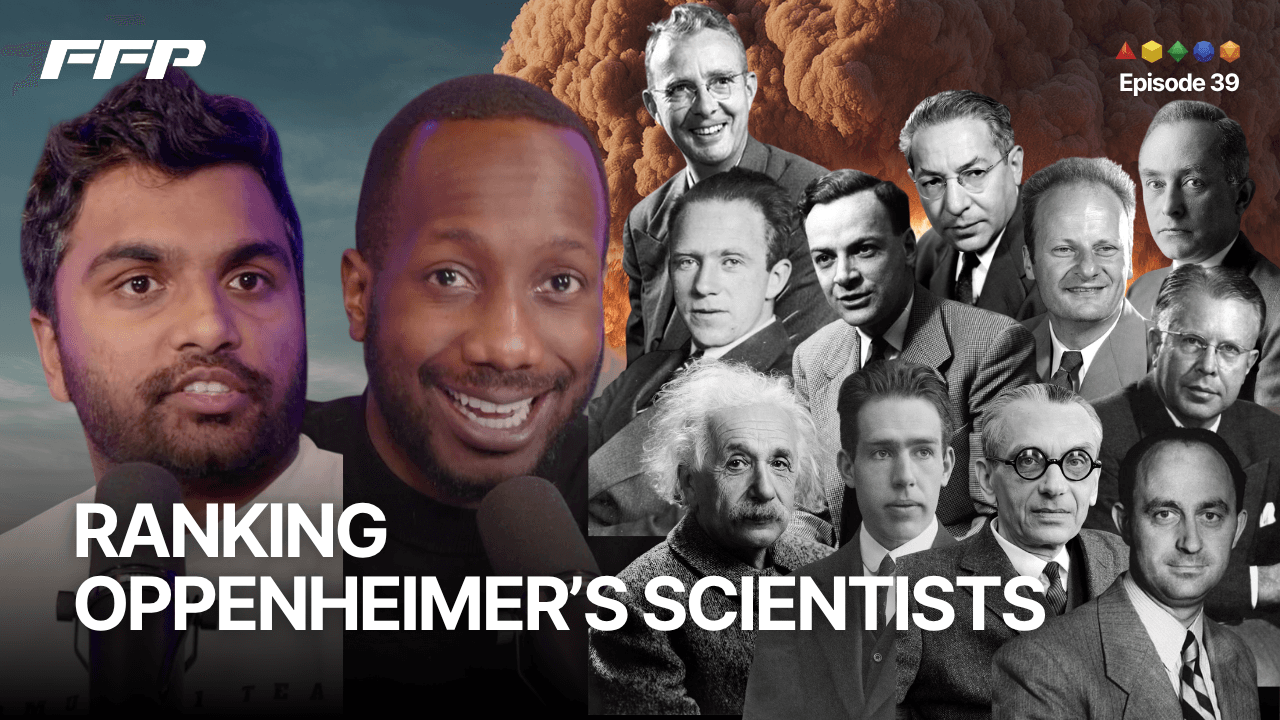
Hans Bethe helped explain how nuclear reactions power stars, including the proton-proton chain and the carbon-nitrogen-oxygen cycle. Krishna Choudhary and Lester Nare discuss that work alongside the Bethe ansatz and his calculation of the Lamb shift, a small difference between predicted and measured hydrogen energy levels. His range across stellar physics, quantum theory, and wartime research is central to the hosts' assessment of his scientific legacy.
- 01
Bethe's 1967 Nobel Prize recognized his contributions to nuclear-reaction theory, particularly energy production in stars.
- 02
The proton-proton chain and CNO cycle are pathways that convert hydrogen into helium and release energy.
- 03
The Bethe ansatz provides a method for obtaining exact solutions to certain quantum many-body models.
- 04
Bethe's Lamb-shift calculation was an important step in the development of quantum electrodynamics.
1,244 words · auto-generated from the episode video
1:01:02>> Yeah. >> Just give me the money. >> We need the power of the universe in our hand. >> Yeah. And that requires a lot of money. >> Yeah, and and a big room. >> And a big room. >> Like, give me a whole building, please. >> 1901 to 1958. >> Yeah, so that's number eight. Number seven. It pained me to put Hans Bethe at number seven because I want him to be number one, but given everyone else who's coming, he's going to have to be number seven. Still in the top 10. >> Yes. >> One of the greats, honestly. >> Hans Bethe. >> Um he was played by Gustav Skarsgård in the film. >> Yes. >> The head of the theoretical division at Los Alamos. So you can imagine, the theoretical division at Los Alamos, >> Yeah, yeah.
1:01:42>> and he's the head. >> Yeah, yeah. >> Okay? >> Yeah. >> That's >> The egos in that room. >> Yeah. >> Yeah. >> And they all were okay with Hans Bethe >> Says a lot. >> being the head. That says a lot about who this man is. >> Yep. >> Right? >> Yep. >> Um He was a refugee from the Nazis. He had a Jewish mother. He had encyclopedic knowledge. >> Mhm. >> I have a soft spot for Hans Bethe myself because I am part of his academic progeny. >> Right. >> So my PhD advisor's PhD advisor's PhD advisor was Hans Bethe. >> Right. >> So I'm his like great grand kid, I guess. >> Great great or great one great. >> One great. >> One great. >> Yeah, in terms of >> That's pretty >> Yeah, so I'm close enough. So Hans Bethe always, you know, a soft spot for him.
1:02:24Um crucial in terms of doing things like um oh, is there going to be atmospheric ignition? >> Mhm. >> Hans Bethe did the calculation and said no. >> Right. >> And everyone was like, okay. >> This is the whole sky on fire burn the world thing. >> Yeah, yeah. Uh in the film, uh Robert Oppenheimer goes to Einstein to be like, "Hey, did you can you check these calculations?" And Einstein was like, "Well, who did these?" And he's like, "Hans Bethe." He's like, "Okay, why do you want me to check? I'm worse at >> math than Hans Bethe. >> You know, and and that's actually true. Hans Bethe was just ridiculous at math. So let me go through some of the stuff that he was known for because there is a lot. >> Mhm. >> The thing that he won his Nobel Prize for in 1967
1:03:05is he figured out the birth of the elements. >> Okay. >> How are elements made inside stars? He discovered the proton-proton chain reaction, which is how the sun makes helium out of hydrogen and keeps us all alive through nuclear fusion. >> Mhm. There's a very specific pathway where four protons have to come together to create a helium nucleus and a neutrino or I think two neutrinos that go out and a bunch of photons that go out. And there's specific pathways where like in the middle there's like a deuterium that happens and then there's two deuteriums that come together. That entire process is what he figured out and the mathematics of that process was exactly right for how big we know the sun is and how bright we know the sun is. All of
1:03:46the math was mathing. You know? >> Yep. Yep. >> He also discovered the CNO cycle, which is the carbon nitrogen oxygen cycle, which is how larger stars, you know, the blue stars, that's how they burn fusion. They go from carbon, then hydrogen and helium come in to become nitrogen, then it becomes oxygen, and then the oxygen spits out a helium nucleus to go back to carbon. And this cycle of carbon nitrogen oxygen is what powers those higher stars. You can't sustain that kind of luminosity with just proton-proton >> Right. >> helium fusion. >> Right. >> Okay? So, he won the Nobel Prize for that. He explained why the sun shines. That's a huge deal. >> That's pretty Something that's been sort
1:04:27of just idolized by society, civilizations, religions for millennia. >> Yeah. >> And now it's like, "Oh, no, but now we know why." >> Now we know why and it's because of Hans Bethe. The other thing he developed was something called the Bethe ansatz, which is this method for guessing and then from that guess figuring out what the correct answer is. He specifically used it to find the exact solutions for quantum many-body problems. >> Mhm. >> But, that Bethe ansatz is still a technique that is taught in graduate level physics today to figure out, you know, like if you've got a problem kind of just try to guess at a right answer, but have enough knobs that you can tweak to get to the correct one as long as your logic is sort of there.
1:05:08Um, the physicist Freeman Dyson, who was once his doctoral student, called him the supreme problem solver of the 20th century. >> Mhm. >> And he was Dyson's the man, too. >> Yeah, and Dyson's the man, too, right? And Edward Kolb called him the last of the old masters of physics. >> Mhm. >> Um one of the big things that he's known for, actually, is quantum electrodynamics. So, before Feynman and all of these guys perfected quantum electrodynamics, post-war America was the crucible of experimental physics. This is where all of the big experimental experiments were happening, right? You had the Lawrence large particle accelerators. And on the other hand, you had on the Eastern Seaboard,
1:05:49you had extremely precise experiments because we had because we had gotten really good at radar. And so, we can use really precise microwave signals to start probing the spectra of atoms, right? And the the light that's coming out of the atoms. So, from there, um Lamb, Willis Lamb, discovered something called the Lamb shift, >> Yes. >> which showed that in the hydrogen atom, there's actually the the energy levels of the hydrogen atom are slightly off from what Paul Dirac had predicted from his equation. Slightly as in like it was like one part in a million type thing. But, he had really honed in. And one of the one of the possibilities
1:06:31that people were floating around was, "Oh, maybe that has to do with the fact that the electron is like interacting with its own electric field." >> Okay. >> But, when you do that, you have this kind of recursion math that's happening. It quickly blows up and you get infinity in your answers, and nobody really knew how to work it out. Um Beta went to that symposium in Long Island, and then on his way back on the on a train, he figured out how to do the calculation. And his calculation is called by Richard Feynman, not no less. It was called by Richard Feynman the most important discovery in the history of the theory of quantum electrodynamics. Yeah, and Paul Dirac said this is Paul
1:07:12Dirac >> Yeah, right. >> said the most important calculation in physics for decades. Right? >> Number seven. >> And he's at number seven. Yeah.
History of SciencePhysicsNuclear Physics