
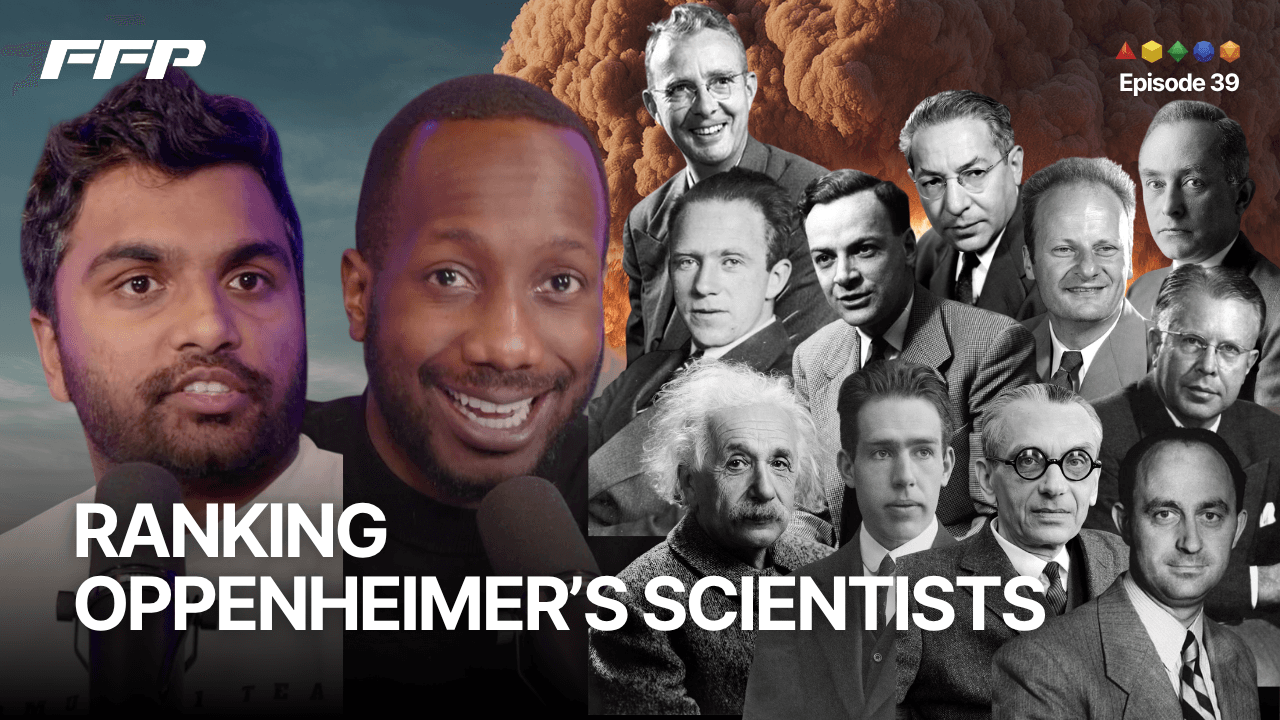
Krishna Choudhary and Lester Nare begin the lower tier of their Oppenheimer scientist ranking with David Hill and Klaus Fuchs. They compare scientific contributions with the prominence of characters in the film, emphasizing that their placements reflect a particular criterion rather than a complete assessment of each person's life.
3,450 words · auto-generated from the episode video
2:47not in mine. I'll tell you that. >> Okay. >> Okay, because my ranking has everything to do with the greatest, according to me. And what that means is their contribution to fundamental science and fundamental research, okay? Not clout, not vibes, not hype, anything like that. So, we're going to make a list. It's going to start with D. This is one of those like, you know, tier lists that we have. It's going to start with D and it's going to go all the way to A. And then there's going to be like an S tier right? >> Yes. For For For some folks who may be not as very online as we are, S tier is better than A. >> Yes. >> like D is >> super. >> Yes. >> That's what the S is. >> So, it's it's sort of like grades, but S
3:28tier is the best. >> Yes. And let's get started with number 26. That is David Hill. He was played by Rami Malek. And he is at the bottom of this list. Okay, even though um the character himself had a pretty big presence in the actual film. He was a nuclear physicist from America, graduated from Caltech, and then earned his PhD at Princeton under John Archibald Wheeler, who we talk about a lot. Great gravitational research person who sort of revi- made He made general relativity cool again at Princeton. In the movie, he's featured delivering testimony against Lewis Strauss, and he
4:11has that epic moment where he like slam dunks on Lewis Strauss about how he was trash, effectively. Lewis Strauss is the character played by Robert Downey Jr. >> Yes. >> who went after Oppenheimer in the proceedings, right? Um In terms of actual history and what he did, he worked on the Chicago Pile 1, which was the first nuclear reaction that was sustained at the University of Chicago under Enrico Fermi. And he also signed the Szilard petition, which is something we're going to get into, but that's the sort of petition that said, "Hey, maybe we shouldn't be dropping this bomb on anyone." His big deal in the movie was that his testimony effectively tanked Lewis
4:52Strauss's nomination for Secretary of Commerce, right? Um but in terms of the actual physics that he did >> Yes. >> in his life, not like that much. Still quite a lot quite a lot. Like, who am I to talk? But, you know, we're we're talking about some of the greatest of all time on this on this list, and that's why he's at the bottom. He's known for the Hill-Wheeler formula, um which was kind of this way to develop a generator coordinate method to mathematically describe nuclear fission and collective motion in some sense, right? Um not like hugely influential, but still very much a respectable scientist in his in his own right. But, among all the scientists
5:33here, he is at the bottom at number 26. >> Number 26, David Hale, born in 1919, passed in 2008. >> Okay. Next, number 25, Klaus Fuchs. This was the rat >> Okay. >> in the Manhattan Project. And that's not why he's number 25. Again, I said we're only ranking based on scientific achievement, not based on personal history. But even given that, he's number 25. He was a German German theoretical physicist turned Soviet spy. He fled the Nazis to Britain, and then he was sent to Los Alamos as part of the British mission. It's the British, dude. They just trust too much.
6:13I guess. He was kind of a background figure in the T division. He was played by a Christopher Denham in the movie. And his treachery, his sort of leaking of secrets to the Soviets was revealed in the third act when he passes the bomb design to the Soviets. In his own right, he was a brilliant physicist. Um and most of the stuff that he worked on was shockwave theory, which is the idea of how shockwaves moves through material. >> Mhm. >> Um he came up with this Fuchs-Nordheim method for calculating um implosion assembly energy yield. Implosion was this new atomic bomb design where a bunch of charges would push in on the
6:56fission material all at the same time from all these different angles to create that critical mass of uranium in the center. So he was working on that in the Manhattan Project. And that's really what he's known for. >> It's interesting, you know, the likes of Klaus and others during this time period in the Manhattan Project where the paranoia the secrecy and leaks was because the stakes were so high, was incredibly high. It's part of the reason why we the current national security state and security apparatus is as locked down as it is. Um was because of the failures of the Manhattan Project to remain under
7:37wraps. And so it is >> the reason why why like like compartmentalization and like classify and top secret all this other stuff. >> special access programs, unacknowledged wave special access programs. Fuchs born in 1911 passed away in 1988. >> All right, number 24. This is Frank Oppenheimer, Robert Oppenheimer's brother. >> Mhm. >> Honestly, probably one of the only reasons why he was on the Manhattan Project is because Oppenheimer pulled some strings. >> Nepotism is alive and well. >> Yeah, because I mean this guy was a former Communist Party member. So, that plagues both brothers, but I think him more, but Oppenheimer was like, "No, I need my brother here to to make this
8:18happen." And um the general at the time was like General Groves was like, "All right, fine. Whatever." Um he was played by Dylan Arnold in the Christopher Nolan movie. He worked on uranium enrichment. So, this is the idea of there's only one isotope of uranium that is truly fissionable in terms of like creating an atomic bomb, and that isotope is very rare in naturally occurring uranium. So, in order to get enough, you have to do a lot of tricks. He was working on that. If you remember from the movie, they have a jar with marbles, and they're populating the marbles to see how much uranium do we
8:58have, how much plutonium do we have for the two bombs. He was part of the group that was trying to figure out how to actually get that uranium, right? He actually founded the Exploratorium museum in San Francisco. >> that's pretty cool. Again, doesn't really contribute to his scientific um rigor, but in terms of science communication huge. >> Bonus points. >> He was blacklisted post-war because of McCarthyism >> Yes. >> because of that whole Communist Party affiliation. >> Yes. >> Um in cosmic rays, he participated in the discovery that cosmic rays contain heavy atomic nuclei. So, that's a pretty big deal. And he was really gifted with instrumentation. He contributed to the calutron, which is
9:40uh California particle accelerator, one of the very first. So, you know, very much um someone who contributed a lot to science, but again, we're dealing with some of the greatest of all time. So, he is at number 24. >> Yes, number 24, uh Frank Oppenheimer, born in 1912, um passed away 1985. I will just note on the uranium enrichment point. It's interesting in the current zeitgeist news cycle, this has been argued as one of the justifications for the US's current excursion into Iran around trying to get control over their
10:24uranium deposit their uranium stash. >> Yeah. >> Because there is a fear that they're going to begin to enrich that uranium, and this was sort of the structure of the JCPOA, which was the Iran nuclear deal that Obama had put in place to allow inspectors to go in to ensure there wasn't enrichment happening. So, just it speaks to just having possession of uranium does not mean you can make a nuclear weapon. >> Yeah. >> You have to get that certain type of flavor of it, and that enrichment process is what motivates a lot of geopolitical conflict >> Yeah. >> uh as it relates to nuclear weapons. >> Definitely, and you know, he This guy's one of the OGs >> Yeah. >> of doing that. >> Yes. >> All right, coming in at number 23 is
11:06Donald Donald Hornig. He was an American physical chemist, played by actor David Risdal in the movie. >> No relation to Kai Risdal, who's NPR announcer. Anyway. >> Uh yeah. He earned his PhD at Harvard and later served as president of Brown University and science advisor to President John F. Kennedy and President Johnson. So, very much in on the political stage for most of his life. He designed the high voltage capacitors and the electrical switching on the implosion bomb. So, if you imagine for the implosion bomb, right? You have a bunch of charges that need to detonate so that the whole thing gets compressed and the
11:47plutonium gets compressed from all different sides at the same time. There's a lot of really cool electronics that goes into doing that because if you imagine just like one piece of wire, there's going to be um if you if you have just one piece of wire that's going in, the delay between the signal from where you press go do the explosion to the closest part of the bomb is going to be less than the delay to the other side. And so you're going to get an asymmetric kind of implosion because this side is going to go first and then the signal is going to go to the other side. So they had to figure out how to time it such that the implosion was entirely spherically symmetric, right? The the most famous
12:29job that he had was actually babysitting the bomb at the top of Trinity Tower on the stormy night before the test to prevent sabotage. So in the movie, remember there's like there's a storm and like it's raining. This dude was on top of that 100-ft tower the whole time just babysitting, making sure nobody was sabotaging, which is hilarious, right? And when they were when he was asked about it, he he said that they asked for volunteers and he was the youngest guy present, so he was selected. >> It's kind of like a frat. >> Yeah, hazing. >> Yeah, you just okay, it's like the freshman. Yeah, you you go do it. And um I don't know if it was it was because I was expendable or I was the best person to climb the 100-ft tower. That's what
13:10he said. >> Everyone had bad knees. >> Yeah, it's pretty funny. Um in terms of physics, he did shock wave theory, some foundational work in shock waves that produce that are produced by air explosions. So, very cool. Also infrared spectro- spectroscopy. Um his spectroscopy research was conducted post-war and he figured out how to do spectra of crystalline solids, which is very good for figuring out, you know, it's kind of like x-ray spectroscopy, but in the infrared. There are challenges there, but again, you can discern the nitty-gritty crystal structure of solids that way. So, that's most of the research that he
13:50did. >> And we have past episodes where we touched on this. Donald Hornig 1920 to 2013. >> That's right. And now we get to number 22. This is Vannevar Bush. He was on the cover of Time magazine. This guy was highly influential, I'll have to say. He was an American engineer and science administration. He was the director of the Office of Scientific Research and Development, which is kind of the the the thing that was there before NSF. >> Right. >> Okay? >> Yep. >> And he was actually one of the people who advocated for the NSF. He published this report called The Endless Frontier in 1945. It was a
14:31report to the President of the United States where he called for an expansion of government support for science and he pressed for the creation of the National Science Foundation. So, scientists all over this country owe him a lot because he created the National Science Foundation, which is kind of the bedrock for a lot of fundamental science research here in this country. In the movie, he served as the interface between the scientists and the White House. He was played by Matthew Modine. He facilitates this early Manhattan Project. He's the guy who comes in and tells Robert Oppenheimer to leave the room when they're talking about the project because Oppenheimer didn't have clearance at the time and he wasn't on
15:11the project at the time. Everybody knew what they were doing, but out of formality. So, a really huge guy. One of the cool things that he did after the war was actually um he wrote another memo called the Memex. It conceptualized machines for storing and linking information. He had this essay called As We May Think in 1945, and it was a precursor to a lot of the ideas behind computation and connecting computers and a precursor to the World Wide Web and the internet. He had all of those ideas in the very beginning. So, very much an influential person person um
15:52but in terms of influence, not in terms of you know, straight-up research. >> Yes. I I will note that probably the most well-matched casting from what Vannevar Bush looked like and Matthew Modine it's it's almost identical. They could be twins. It's quite good. It's quite incredible. And just a note on the NSF in terms of why is the NSF so important for fundamental science research? Among other things in terms of continuing to make it important within the DC bubble in the political architecture, it's capital and funding which is needed for this and it's the number one funder of fundamental research in the US and so that entity
16:39Um I'm just going to pick up. Um And so that entity And so, you know, that entity is really the bedrock not only for the advocacy piece but also for the capital and funding piece. >> Yeah, very much hugely influential person. >> Uh born in 1890, passed away 1974. >> Yes. All right, now we get to number 21, Richard Tolman. He was played by Tom Jenkins in the film. He's a physical chemist and mathematician at Caltech. Um he was the chief scientific advisor for General Leslie Groves. And he was
17:21again this bridge between military and scientists. In the movie he visits Berkeley with Vannevar Bush to recruit J. Robert Oppenheimer. Um, instrumental in the decision to pursue the implosion method, which is that second bomb that they tested at Trinity. And does a lot of work in the theoretical thermodynamics of cosmology and the universe. He comes up with something called the Tolman-Oppenheimer-Volkoff limit, which calculated the upper mass limit for a neutron star. And above this, the star must collapse into a black hole. So, that was pretty fundamental research for astrophysics in general. And he's also one of the first to propose
18:01this model of a cyclic universe, where the universe is born and then it dies and then it implodes on itself and then it's born and it dies and implodes on itself. So, instrumental in cosmological theory. Very much, uh, one of these top dogs. >> Yes, Tolman born 1881, passed away 1948. So, one of the older gray beards of the group. >> exactly. He was one of the old guard during this time. Finally, number 20, Robert Serber. He's very famous among those at the Manhattan Project. He was played by Michael Angarano? I I've seen him a lot in movies, actually. >> Um, he was an American physicist. He was
18:43Oppenheimer's closest Protoje, they would call him Oppenheimer's intellectual shadow. He was constantly at Oppenheimer's side, and he actually gives orientation lectures to the new recruits. He would joke about naming the bombs Thin Man, Fat Man, and the device The Gadget. So, all of those names come from Robert His lectures got compiled into something called the LA1, which was the Los Angel the Los Alamos Primer. It's this top secret handbook on bomb physics. You know, whenever you join a company or a new research project, you need some kind of material that's going to get you situated into the science, right? He was
19:24the guy who was responsible for giving these lectures to the new recruits being like, "Hey, this is what we're doing. This is the science behind it. These are the open questions that we need answered, and this is what you need to work on, you know?" >> Yes, Mr. He's the guy who onboarded everybody. Which >> Exactly. >> Which is not is not trivial. >> No. >> Like it >> For something for something as cutting edge >> Right. >> as building an atomic bomb >> Right. >> onboarding is not just HR, right? >> Right. Right. There there's there's a level of He had to have his own technical sophistication at a high enough level to also understand how to delineate details and etc. etc. >> Exactly. And after the bomb, he contributed to the Betatron, which was a particle accelerator theory, and also in quantum electrodynamics, he did a lot of
20:04work on vacuum polarization of strong electromagnetic fields. So, a lot of very fundamental research in quantum field theory was done by him after the Manhattan Project. >> Robert Serber, born in 1909, passed away 1997. >> All right. And number 19, Snyder, Hartland Snyder. He was a graduate student of Robert Oppenheimer, and the collaboration was decades ahead of its time. In the movie, he's one of the first students in Robert Oppenheimer's class. He actually is shown to like do really poorly in mathematics of quantum theory, but um he published a paper with Oppenheimer that's one of the most influential of
20:46all time. The paper was called continued gravitational contraction. It's the first one to show a black hole is something that could happen according to Einstein's theory of relativity. Um it's a legendary paper, right? It's not definitively showing that a black hole could happen because the assumptions of this paper were you have a uniformly symmetric object a spherically symmetric object that's not rotating it's just kind of sitting there and if it has enough critical mass it's going to go through past the Chandrasekhar limit past the electron degeneracy pressure keep contracting keep contracting until there comes a point where the escape velocity is going to be
21:26faster than the speed of light and that means nothing can escape according to Einstein's general relativity. The critics of this paper say that well the assumptions are kind of unreal right because there's no such thing as an object in space that is not rotating that is completely spherically symmetric. All of these assumptions aren't really true which is why Roger Penrose later on about 10 years later um showed definitively that even without those assumptions you will get gravitational collapse you will get a point of no return and you will get something like an event horizon beyond which nothing can escape. Roger Penrose won that Nobel Prize won a Nobel Prize for that paper. Um this one not so much because there
22:08were all these assumptions tied to it but in any case it's the first time that we have a mathematical description of something like a black hole. So that's a very big deal. This is the first time something like a black hole shows up in science. >> And this this is the get points being first does get you points even if not perfect in this ranking. >> Yes because I think that's a huge deal right and that's why yeah and that's why I think he's um in front of all of the all of the other guys because I think I think the concept of a black hole is a very big deal right or even fundamental physics because now you're saying the universe has like regions where there's a point of no return. That's a pretty big deal. >> Yes. Hartland Snyder born in 1913 passed
22:49in 1962. >> And that marks the end of our D tier. >> Yes. >> So here we're going to be showing the scientists we're actually going to be showing the
History of SciencePhysicsNuclear Physics