
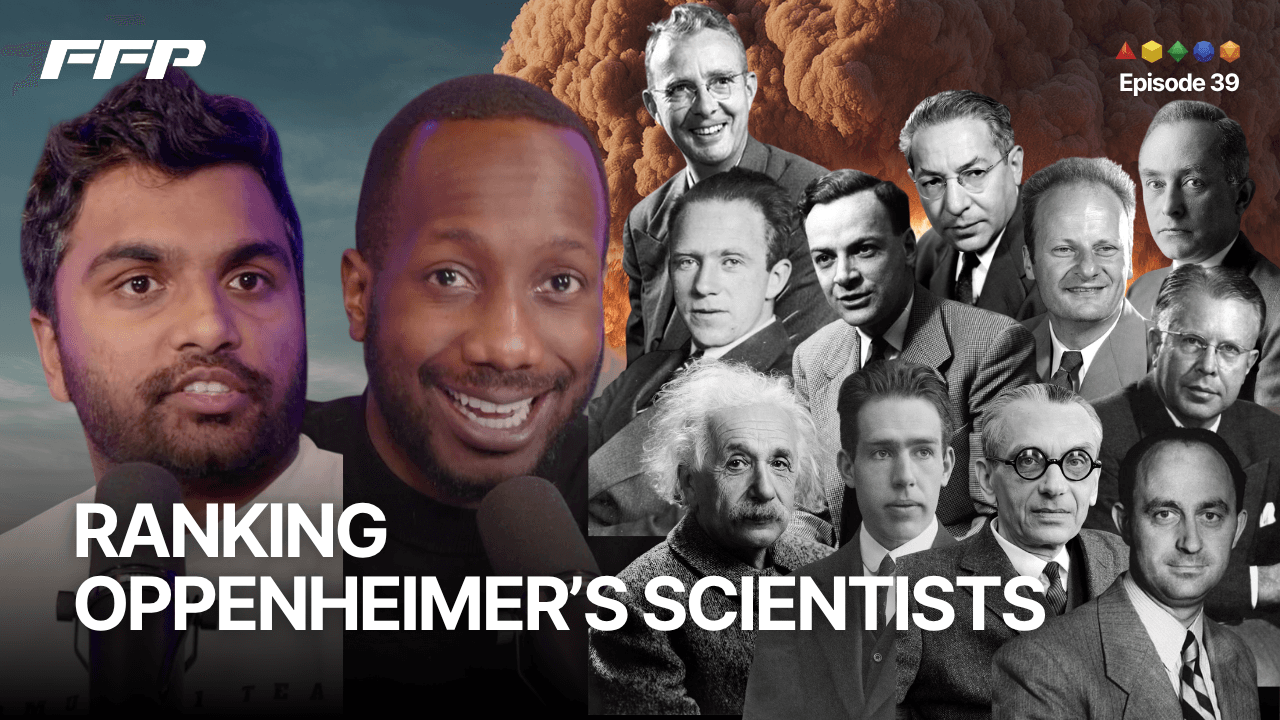
Niels Bohr's atomic model introduced quantized electron orbits and explained important features of hydrogen's spectrum. Krishna Choudhary and Lester Nare discuss his role in the development and interpretation of quantum mechanics, along with the influence of the research community he built in Copenhagen.
479 words · auto-generated from the episode video
1:27:35theorem and its surrounding subject matters. But I Anyway. >> Yeah. And Kurt Gödel is played by James Urbaniak. >> Yes, 1906 to 1978. I'm mad you brought that up cuz now my brain won't stop thinking about it. >> Yeah. Well, let's get it through just the last two, right? At number two, Niels Bohr. >> Yes. >> Played by um the very famous Kenneth Branagh. >> Yes. >> Um obviously the philosopher king of the quantum revolution. >> names, by the way. Like the pope of physics, the philosopher king, the father of the bomb. >> He was really the philosopher king. Um he obviously he created the Bohr model in 1913, which is the fact that
1:28:17electrons have discrete quantized orbitals around um an atom. So, one of the big things that explained hydrogen spectral lines used this idea of quantized energy levels, the fact that I make jumps from one to the other without ever being in between. He's kind of a mentor to a lot of physicists, including Oppenheimer, but there's Heisenberg, there's Wolfgang Pauli, there's Ernie Erwin Schrödinger at a time. So, really this like scientific godfather of that era of physicists. >> Yep. >> He championed something called the Copenhagen interpretation with Heisenberg. The Copenhagen
1:28:58interpretation because he had an institute called the Niels Bohr Institute, or I think it was called a Institute for Theoretical Physics, but everyone knows it as the Niels Bohr Institute in Copenhagen. And that's where everybody It was the Mecca of theoretical physics. Everybody would go there to sort of pay their respects and learn from the master himself. >> Right. >> Um that became sort of standard quantum mechanical interpretation, and the properties are definite for a system only upon measurement, otherwise they're in this weird wave space. >> to observe for the wave function to collapse. >> Exactly, yeah. Otherwise, it's just a wave function. So,
1:29:38all of that was Niels Bohr. >> Mhm. >> Um and I really think, you know, given his sheer influence in physics, >> Yeah. >> right? On top of his just contribution as the Bohr model, which is the first sort of quantum mechanics of matter, >> Yes. >> I think I think he deserves to be at number two. >> I think this is fair. Uh Niels Bohr, 1885 to 1962. And I do think it's important that you know like that we are are putting value on he instilled the framework and the fundamental like state of mind and way to think
1:30:19that then was utilized by so many of even other people on this list and beyond this list in a way that's really hard to to beat. >> Yeah. >> Yeah, in in the modern >> Exactly. >> in the modern era. >> Yeah, no, exactly. >> So very much well deserved. Number two.
History of SciencePhysicsNuclear Physics