
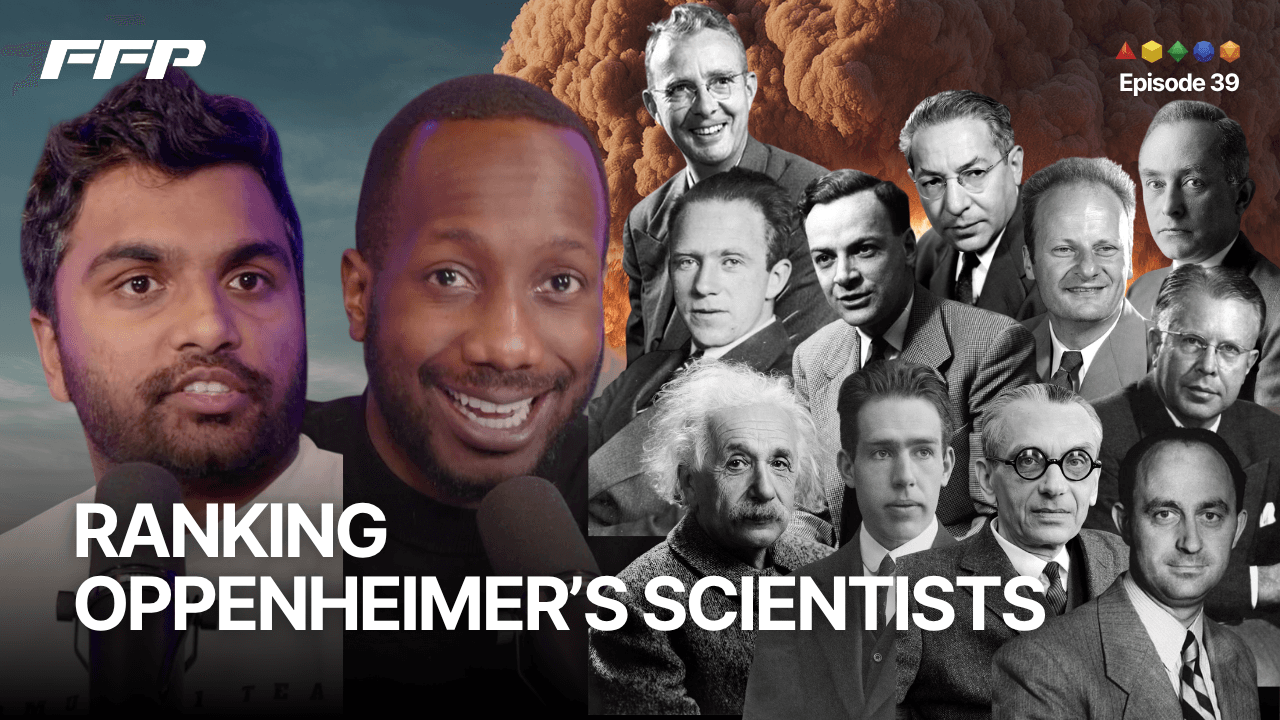
Enrico Fermi combined theoretical physics with experiments that helped establish nuclear energy research. Krishna Choudhary and Lester Nare discuss his neutron experiments, his leadership of Chicago Pile-1, and the quantum statistics that bear his name. They also explain the appeal of Fermi problems, rough estimates that turn an apparently impossible question into a series of manageable assumptions.
- 01
Fermi's 1938 Nobel Prize recognized neutron-induced radioactivity and the effects of slow neutrons, not the later Chicago Pile-1 experiment.
- 02
Chicago Pile-1 achieved the first controlled, self-sustaining nuclear chain reaction in 1942.
- 03
Fermi-Dirac statistics describe particles that obey the Pauli exclusion principle, including electrons.
- 04
Fermi problems use approximate quantities and clear assumptions to estimate an answer.
1,400 words · auto-generated from the episode video
1:15:22quantum mechanics. Um, very much deserved and very much deserved to be in the S tier even though, you know, he's a Nazi sympathizer and everything. I told you from the beginning, right? This is a ranking about their contributions to physics regardless of Yeah, that's a different that's a wholly different thing. Uh, Werner Heisenberg 1901 to 1976. All right, coming in at number four, Enrico Fermi. This guy is, I think, the last Renaissance man of physics, okay? He's the last guy to be simultaneously a goat in theory and a goat in experiment.
1:16:03Like the theory guys would look at him and be like, "Wow." And then the experimentalists would look at him and be like, "Wow." I think he's really genuinely the last person to hold that Mhm. Um, ranking. In both communities. Yes, yeah. Um, they used to call him the Pope of physics because he was Italian. Um, I just a kind of a side note, um, when I visited Rome, um, I got there through the train station, right? Because you can take a you can take a train to the central train station and his birthplace is right next to the central train station. So, I went there and there's a little plaque that says Enrico Fermi was born here. Um so I posted on my Instagram
1:16:45story, I took a photo of that and said, "Enrico Fermi, the greatest contribution of Italy to the world in the 20th century." And I got a lot of hate cuz people were saying that oh I'm saying that like the Italians haven't contributed anything. I'm like no no no, I'm saying the Italians contributed Enrico Fermi. >> yeah yeah yeah yeah. I know I know what you mean. I know what you mean. >> You know what I mean? Like you don't understand what I'm saying. >> I'm saying that this guy is one of the greatest physicists of all time and it is an honor that your country contributed someone like Enrico Fermi to the world. Okay, so just for the people who were in my DMs after that Insta story, here's why, okay?
1:17:26So he was treated with reverence by the entire community. And again, we've been through some of the names on this list. Those guys are looking at Fermi like oh. Okay. >> Okay okay okay LeBron. >> Yeah yeah exactly. Um he's played by Danny DeFerrari. That's a good name. That's a great name. Let's go Ferrari. I still hope I I still have hope in 2026. Um his arrival signals the transition to engineering reality, okay? Um when he got to America, that's when everyone all of the physicists in the Allied countries were like okay. >> Yeah yeah we're doing yeah yeah.
1:18:06>> Like we're actually doing this. The way he got there was pretty crazy because I believe his his wife was Jewish, okay? And so he needed to get out but he's like under an embargo and all this other stuff, right? It's hard to get out. And so he he won the Nobel Prize in I believe it was like in the late in 1938, okay? They expedited his Nobel Prize because the Nobel Committee was literally like asking him, "Hey, do you need a way to get out?" Because he was going to win it. >> Yeah, yeah, yeah. >> Right? >> Yeah. >> And they're like, "Why don't we do that this year? >> Yeah, yeah. >> So that you can have an excuse to come to Sweden, >> Yeah, yeah. >> accept the Nobel Prize, >> and never >> and then just go to America and just get
1:18:48the hell out of there." >> Yeah, yeah. Yeah, I love >> Isn't that so amazing? >> And it's incredible how these little This is the butterfly effect, right? Like had that not transpired, >> who knows? >> Who knows? Yeah, if the if the Nazis captured him and made him work on their Who knows? >> Who knows? >> Okay? Um he was the leader of the Fermi division. He had his own division named after him, the F division, at Los Alamos. Okay, >> I want I want to get a Fermi division >> Yeah, dude, that should be one of our merch. Yeah, exactly. Um in the movie he's depicted uh directing the Chicago Pile 1, the CP-1, which is the first self-sustained chain reaction under the Chicago
1:19:31um football field. >> Oh, the the Bears? >> Yeah. >> Wow. >> No, no, the University of Chicago. >> University of Chicago. >> He's like, "What?" >> But under the University of Chicago football field >> Yeah. >> is where he had this giant like basement room >> Yeah. >> and he built a pile of uranium >> and graphite. >> uranium and graphite to create the first self-sustained chain reaction. When that happened, everyone was like, "Okay, this is real." >> Cuz that that was the first necessary step to be able to actually get to the end goal, which was the bomb, which required >> which is a runaway chain reaction. >> Right? >> Right. >> Um but controlled in some sense, because you wouldn't want that happening everywhere. >> Right. >> Um a lot of balls to actually do it in the center of a city, right? Because if that chain reaction became runaway, >> And it started to run away.
1:20:12>> It's like, "What are you It's like the first time that you're doing it, but that's how much trust the people had >> Right. >> in Fermi's calculations, right? Where he was just able There's also, you know, the famous um Fermi problems. I don't know if you've heard about these, where it's like, "How many piano tuners are there in Los Angeles?" That all comes from him. He was incredibly good at like doing these kinds of back of the envelope calculations. >> Yes. So, in terms of the the theory and the physics that he did, obviously the first self-sustaining chain reaction, huge, worth a Nobel Prize. The second thing he did was induced radioactivity, the idea that I can shoot neutrons at stuff at a stable element, and that stable element will become a radioactive
1:20:54isotope. That's the first He's the first guy to show that. He's also the first guy to show that slower neutrons are better at inducing radioactivity than faster neutrons. Okay? And he developed a theory for that. Kind of makes sense because if you're slower, you get captured. But if you're faster, you'll just like sort of bounce bounce right through, right? But he developed some of the principles behind these nuclear reactors and why we need moderators, right? Where like you have like graphite pads to slow the neutrons down. Um He also developed something called Fermi-Dirac statistics. He took the idea from Pauli, which is this idea of the exclusion principle, the fact that, you know, two electrons can't occupy the same state, so one has to be spin up,
1:21:36one has to be spin down. You can't pile on like a boson where you get the Bose-Einstein condensate. Fermions don't do that. So, what do fermions do? Well, he They are like ideal gases in the sense that they have to bump into each other, and when they bump into each other, they go their opposite direction. So, ideal gases are Fermi-Dirac. And they obey Fermi-Dirac statistics. So, from first principles, you can figure out the equation state of the gas in this room using Fermi-Dirac statistics. And now the fermions, which are like electrons, quarks, things like that, all of these people all of these um particles that have half integer spin, they're called fermions named after him.
1:22:16>> It's crazy that fundamental particles of our reality you get to have the whole family of them named after you. >> you. >> That's crazy. >> Yeah. >> That's crazy. >> Fermions. >> Yeah. >> Right? >> Ferm >> It's it's >> And that's and that's like electrons >> F E >> R >> Like electrons, protons, neutrons, all of it named after Enrico Fermi. >> That's so sick. >> He also authored my favorite book on thermodynamics. >> Okay. >> Um it's called thermodynamics. >> Yeah. >> By Enrico Fermi. Tiny little book. If
History of SciencePhysicsNuclear Physics