
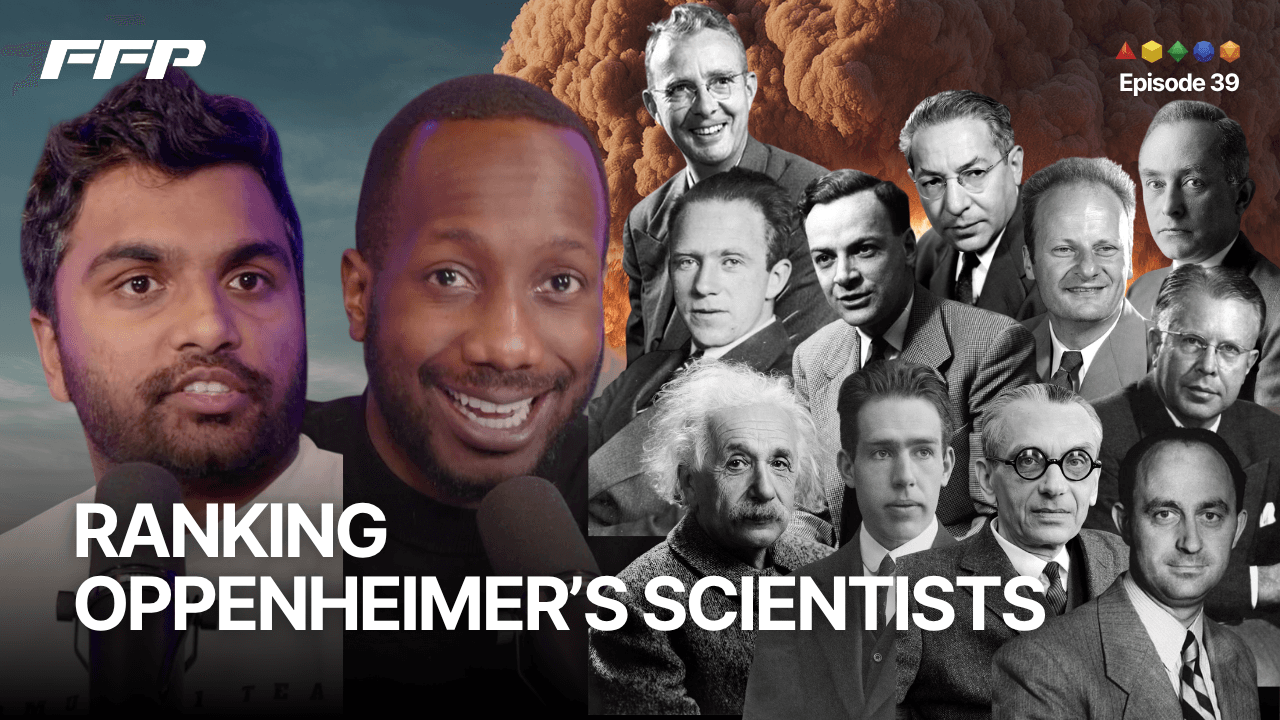
Krishna Choudhary and Lester Nare move into the next tier of their ranking, beginning with Leo Szilard. They discuss his work on nuclear chain reactions and the connection between information and thermodynamics before continuing through the scientists represented in Oppenheimer.
2,894 words · auto-generated from the episode video
23:00photos of the actors who played those scientists >> Yes. >> in the movie and it's going to be in ascending order going to the left. So, that marks the end of D tier. >> Yes. >> Which is a pretty >> star-studded D tier. >> Yeah, already already like the guy who the guy who invented the concept of a black hole, right? The guy who did cosmic rays. >> Right. >> Very very big deal. >> Not a bad not a bad place to start. >> Yes. Okay, now we get into some of the real bigwigs. >> Okay. >> And number 18 is Leo Szilard. He was pretty prominent in the movie. >> Mhm. >> He's an Hungarian-American physicist. And he came in quite early because he urges
23:40US action about the bomb. He drafts the letter for Albert Einstein to sign. >> Mhm. >> And that letter gets sent to Roosevelt and that's what starts the Manhattan Project. So, he's pretty instrumental in terms of history of just the world because this is the guy who sort of started nuclear weapons. >> Yeah. >> You know? >> He was the baby daddy. >> Yes. He he actually conceived of the nuclear chain reaction and he coined that term. He tried to get a patent for it. He also has one of the first publications on the concept of an electron microscope. >> Crazy. >> This guy was trying to get patents all over the place. So, he has patents on the electron microscope, on the
24:22cyclotron, on the linear accelerator. >> Jesus. >> And he patented he patented the nuclear reactor with Enrico Fermi who's down on the list. Um >> Woo. >> So, a lot of really good things. >> I mean that's I mean that's pretty tough to beat. >> Yeah, and we're at 18. Right? Um one of the coolest things that I think he did was so, not just the chain reaction which is the bedrock of nuclear energy and the atomic bomb. One of the cool things that he did was resolve this paradox about acquiring information and making a perpetual motion machine. >> Okay. >> So, consider the following thought experiment where you've got um this is
25:02called Maxwell's demon, okay? Consider you've got a box and you've got two halves of the box with a single particle moving around, okay? If I know which half of the box the particle is in and I put a little barrier in the middle, so I confine the particle to one part of the box and then I put a piston on the other side and then now I remove the barrier, that particle, because it's on one side, as it expands, it's going to do work on the piston and maybe I've just created work out of nothing. >> Mhm. >> Right? So, isn't that a perpetual motion machine? The way he resolves it is he says, "Well, actually the information of you knowing that it's on one side or the other is itself a resource."
25:44And you're going to have to take work >> Oh. Oh. Oh. Oh. >> and the amount of entropy that is in the system just by someone having the knowledge of knowing one way or the other. >> And so, he he does this fundamental connection between information >> Yeah. Yeah. >> and thermodynamic entropy. >> Yeah, this that's interesting. >> And that's and that forms the basis for later work by Claude Shannon where he starts talking about information theory and using the physics of thermodynamics to then talk about, "Okay, how many lines can I fit in a telephone line?" Right? How many individual bits do I need to encode a certain amount of information? And that's really the bedrock of now all of information theory
26:25>> today. >> Right. >> Right? So, a visionary of his time. >> That is fascinating. And like a non a a a a a step in thinking that is not necessarily obvious to make until you say it. >> And then once you say it, it's like, "Oh yeah like >> Yeah. >> obviously." >> Yeah. Yeah. >> Um but that leap is very interesting. >> Yeah, I thought that was a so so very very very cool. It was a rudimentary calculation and a lot of people later on like refined it, but that first like sort of, you know, >> insight >> insight is very, very nice. >> Uh Leo, born in 1898, passed away in 1964. >> Yes. And he was played by um Matty
27:06Hauman. Yes, in the film. Yes. Okay, at number 17, we've got Edward Condon. >> Oh, yes. >> Okay. And he is a distinguished American nuclear physicist. He was played by Ollie Hasheve. He's the guy who was complaining about all the compartmentalization and like, "Oh, I can't like go to the Chicago, you know, Art Institute because I'm involved in this and blah, blah, blah." There's conflicts between General General Leslie Groves over this compartmentalization. He resigns after only 6 weeks because he refuses those conditions. So, didn't do a lot with the Manhattan Project but
27:48he was instrumental later on in developing a theory of alpha decay. Alpha decay is the process by which a heavy nuclei spits out a helium nucleus, two protons and two neutrons. We knew that that was happening because alpha particles were discovered. They were used by Ernest Rutherford to discover the nucleus in the first way, way in the beginning of the 1900s. Um but the theoretical assumptions of how an alpha particle actually leaves is something that he figured out. It was through quantum tunneling, which is something we've talked about especially with the Nobel Prize last year. The idea is you've got a barrier in the nucleus that usually you shouldn't be get able
28:29to get through, but the alpha particles have just enough energy that they'll just shoot right through this barrier in the process of tunneling. So, it explained how particles escape the nucleus and that's pretty huge for a theoretical understanding of nuclear fission. >> Yes. Uh there is um an interesting other thing that he is very popular for, uh particularly within the UFO community, which is the Condon Report, >> Okay. >> which was a report that was compiled after Project Blue Book, which was a government program to look into all these foo fighters and UFO sightings that was led by Dr. J. Allen Hynek. >> Mhm. >> And there was a huge conflict amongst
29:11about his engagement in the creation of that report because effectively the public report said, "There's nothing to see here." But now, since other of the internal deliberations have been declassified, also if you just actually read the Condon Report, the executive summary says there's nothing to see here, but then the actual data that's in there is like there's clearly something to see here and a lot of folks who, you know, it really kind of ended the popular um engagement in the subject at the time because it was a definitive scientist who had the credibility and the clout >> Mhm. >> saying there's nothing to see here and everyone kind of looked in the other direction. And so, it's just another interesting side note in his legacy that
29:52I know the UFO community is very uh very aware of. >> Okay, great. Yeah. Well, he comes in at number 17. >> Yes. >> Number 16, Kenneth Bainbridge. This was the man played by a favorite of ours, Josh Peck, from Drake & Josh. >> You know, everybody everybody our age group remembers Drake & Josh. >> Such a shocking casting. He did great, though. >> He did great. And honestly, the the um the casting for this film is just amazing. >> Yeah, yeah. >> Um really, really well done in terms of like getting actors who look a lot like their historical counterpart. He was an American physicist at Harvard. Um he was the director of the Trinity test. So,
30:32that's why in the movie he comes in with the with the key and he's got his hand on the red button in or in case he wants to abort the abort the test. Um he supervises the countdown at the Trinity test. Um, after the blast, he delivers a very famous line to Robert Oppenheimer, which is not featured in the movie, but and it's not very family-friendly, but it's a quote, so I am going to say it. He goes to Oppenheimer and he says, "Now we are all sons of bitches." >> Yes. >> Because everybody there realizes, "Well, we just did it." >> Yeah, yeah. >> The atom bomb is real and nukes are real. >> Yep. >> Here we go. >> no going back. >> And what's interesting is everybody at the Manhattan Project knew that at the end
31:14of the day the engineering and the physics wasn't really that hard. It took a lot of resources, but this is something that everyone is capable of doing, you know? And that's why it's like, "Oof." >> Yeah, yeah. >> If we can do it, literally everyone can do it. This is not going to be pretty. >> Yeah. >> Um, in terms of the physics that he did, one of the really key things he did was perfect the science of mass spectrometry. >> Huh. >> He can do high-precision He He built high-precision spectrometers. And in 1933, this is before he actually came onto the Manhattan Project, he made the first precise measurements of the mass difference between nuclear isotopes.
31:55>> Mhm. >> And that was an experimental verification of E = mc². Yep. So, experimentally, this guy was like really high >> Top notch. >> right? To to straight-up verify E = mc² using atomic nuclei, that's quite good. >> Oh, that's that's tough. Not good enough to get you in the top 15, but but but tough nonetheless. >> nonetheless, yeah. >> Um, born 1904, passed away in 1996. >> Yep. Number 15, Seth Neddermeyer. He's an American physicist at Caltech and Los Alamos. Um, he first proposes the implosion idea, which is using these explosives to go in and crush subcritical
32:36plutonium. He was played by Devon Bostick. Oppenheimer actually removed him from being group leader because he wasn't able to manage the complex engineering. >> Mhm. >> But, nevertheless, that insight saved the plutonium bomb and it was huge for the project. In terms of the physics and the research that he did, this guy was pretty pretty big because at Caltech, he was under the tutelage of Carl Anderson who won the Nobel Prize for discovering the discovering the positron, which is the first antimatter particle. He was involved in that research. So, he was probably either a post-doc or graduate student involved in that experiment. Later on, he was
33:18instrumental in discovering the muon, which is the first subatomic particle of that next generation. We had discovered protons, neutrons, and electrons. The muon was very weird because it was just like the electron, but it was more massive and it puzzled physicists and it still kind of puzzles physicists today because why are there three versions of everything? Right? There should there should just be one, but apparently the universe created three. It was so weird that Isidor Rabi, who will discuss later on, one of the quips he said was about the muon was like, "Who ordered that?" Right? Like Like we we have things on the menu.
33:58Why >> Why did you bring breadsticks? We already have salad. >> Yeah, yeah, yeah, exactly. So, that was a huge surprise to physicists and a very big deal for fundamental physics research, the discovery of the muon. >> Yes, the muon, positron, Seth Neddermeyer, 1907 to 1988. >> And that ends our C tier. >> Yes. >> So, now we've got two rows. >> Yes. >> And we still got a long ways to go. We got 14 other scientists to get through. >> We've gone through 12. The 12 are in the bottom two tiers. I'm very fascinated. There's some names that I knew wouldn't be there. >> Mhm. >> Uh I'm interested to see how this progresses.
34:39>> All right. So, let's start with number 14, Edward Teller. >> Yes. >> A big villain. >> Ed- Eddie. >> In the um in the Manhattan Project, a villain in the Oppenheimer movie. He's the guy who betrayed Oppenheimer at the hearing and said, "Oh, maybe I would have done things differently." And let me tell you, in history, after he >> he never held another academic position again. Like >> That's so good. >> Yeah, yeah. Not not great. Not great. Not not a good look, mate. >> Oh, it was Benny Safdie? >> Yeah, Benny Safdie. >> think I actually put two and two together. Yeah. Um that's interesting. Okay.
35:19>> Yeah, Benny Safdie played um Edward Teller. Great Hungarian accent, by the way, by Benny Safdie >> Okay. >> in in playing that. I really like that, because if you if you watch um videos of Edward Teller's interviews, the he nails the accent. >> Okay. >> It's it's very very good. >> Okay. >> Um as part of the atomic bomb he really just wanted to make the super, which was the fusion bomb, the hydrogen bomb. And Robert Oppenheimer indulges him. Uh they meet at once every week to talk about how to build a fusion bomb. And that was really just so that Oppenheimer could like get him out of the way, so that they could focus on building the atomic bomb. Um in terms of the physics
36:00he worked with Stanislaw Ulam to make the Teller-Ulam design, which is the thermonuclear weapon design for creating the hydrogen bomb. He also worked on the Jahn-Teller effect. This is what he's most known for in fundamental physics and chemistry. It's basically a theorem that talks about the geometric distortion of molecules to low energy. And it uses these distortions of molecules and ions to talk about all the different electron configurations and then fundamentally what are the chemical properties given the kinds of symmetries that molecules hold within them. Like, you know, kinds of like flip symmetry this way or this
36:41way, things like that. It was an a very important mechanism and currently it's responsible for a variety of phenomenon in spectroscopy, stereochemistry, crystal chemistry, solid state physics, material science. So, it's still being used today when >> people go in and try to make you know, computer simulations of these types of materials. Very much >> Really low-hanging fruit, you know, if you do we talk about it. >> Yeah, exactly. >> Uh Edward Teller 1908 to 2003, which is quite recent actually. >> Yes, yeah. Um very recently he passed away. Never won the Nobel Prize because he never would because he betrayed Oppenheimer. >> Right. >> Can't do that. >> Can't do that. >> Yeah. And now we start getting into Nobel
37:21Prizes. Speaking of Nobel Prizes, number 13 is Patrick Blackett. He was Oppenheimer's tutor in Cambridge. There's the famous scene where Oppenheimer tries to poison him because Blackett is being kind of mean. >> Yeah, yeah, yeah. >> That like apparently like actually happened, although it wasn't like that bad as it was in the movie. Obviously, you know, the writers and the producers take a little bit of liberty, but it's still a great scene. >> Yes. >> He is famous He's no longer involved in the Manhattan Project, right? This is just someone who was mentioned in the movie and not involved in the Manhattan Project. Um he perfected the Wilson cloud chamber, which is a chamber built out of some kind of condensation.
38:03Usually it's like alcohol and alcohol vapor. So, when a particle goes through, it'll leave a track of condensation and you can watch particles. This was the first time that we could watch particles, right? >> Mhm. >> Not just with like uh film where like, "Oh, the particle hit this part of the film. Now we can actually watch a track of the particle. >> it's movement through space. >> It's movement through space and that's super important because if we can apply a magnetic field, we can watch it curve and we can figure out things like what is the charge to mass ratio of this particle, right? Things like that. Very much super important. That's why he won the Nobel Prize. He confirmed that the positron existed.
38:44>> Mhm. >> And he demonstrated pair production, which is this idea of um two particles, an antimatter particle and a matter particle, like electron and a positron, coming out of nowhere and then sort of curling opposite directions, okay? And they can spontaneously come up if two bits of photons interact and that has just enough energy to create two particles. >> Is this the arises out of nothing thing that we've talked about previously? >> Yeah, it's very related. >> in and out. >> very related, very related. Those are virtual particles and these are actually
History of SciencePhysicsNuclear Physics