
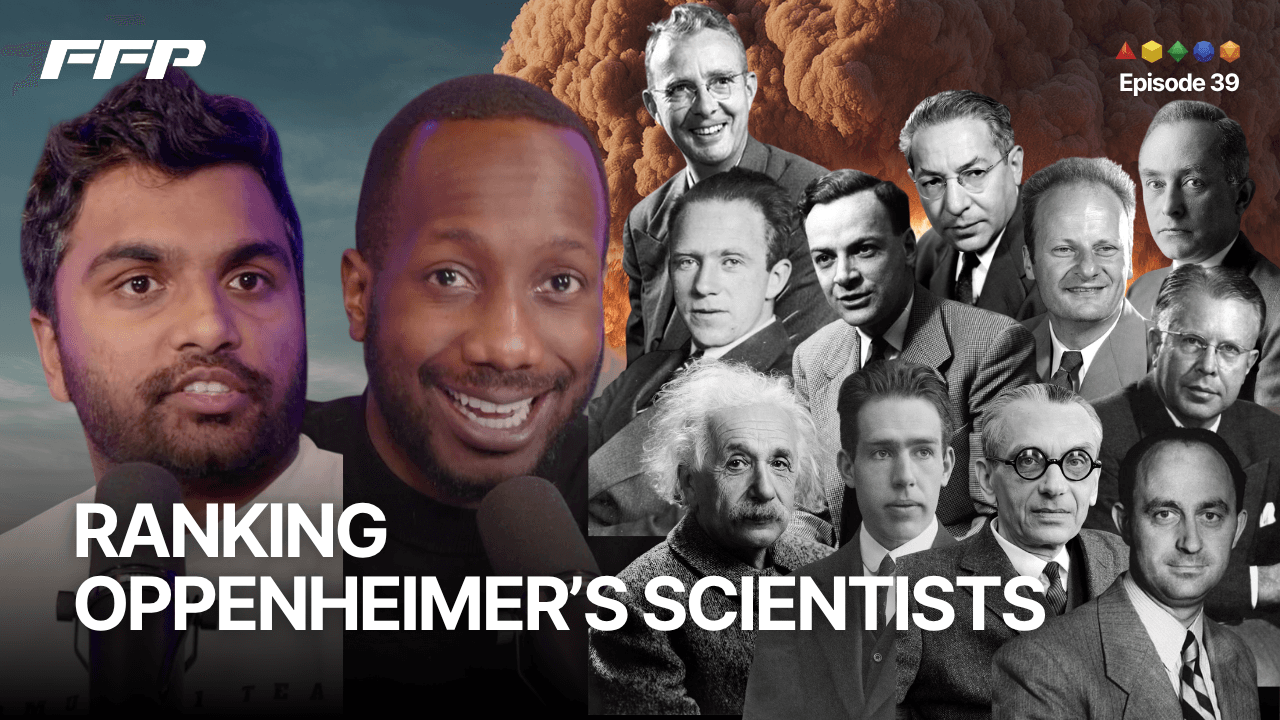
Luis Alvarez's research ranged from particle detection to the evidence for an asteroid impact at the end of the Cretaceous. Krishna Choudhary and Lester Nare discuss his work with hydrogen bubble chambers, the use of computers to analyze particle tracks, and muons as a way to investigate the interiors of large structures.
1,331 words · auto-generated from the episode video
43:17Oppenheimer 1904-1967 is our number 12. >> Yeah. >> Okay, let's see. >> All right. So, now we're going to go with number 11. This is Luis Alvarez. We've talked about Luis Alvarez all the time on this podcast for multiple reasons. He was >> played by Alex Wolff, great actor, um and again, great casting. Um Luis Alvarez's role in the movie is just uh post-doc of Ernest Lawrence at the time when he was at Berkeley. There's that scene where he rushes in with the news of fission being discovered, and he goes and replicates it in the lab
43:58while Oppenheimer's busy trying to show why it's not possible. Um and you know, that's the whole theory only takes you so far kind of thing, right? >> Um in the Manhattan Project, he was leading the group that developed the exploding bridge wire detonators. Those are the detonators that were used to implode in that implosion device right? >> Yes. >> Um, and he was actually there for the Hiroshima mission to measure the blast yield. So, he was on the observation plane >> Yes. >> when the, you know, Enola Gay dropped the bomb. There was another plane that was trying to measure how much the yield was. >> Can I make a quick insertion here because I think this is in the recent
44:38book uh I believe it's called nuclear war scenario by Annie Jacobsen, who was who was who basically interviewed a lot of the staff and former both intelligence, military, and scientists in and around the nuclear infrastructure we currently have today >> Yeah. >> referenced that, you know, we don't really have a lot of data on the impacts of the dropping of, uh, a nuclear atomic weapon on like a highly populated area. And there was only one scientist that was present on the military plane that was that was able to actually look at that scientific data. >> Luis Alvarez. >> Yep, and that's Luis Alvarez. >> And and and it's kind of, you know, and
45:21it's all still super classified and yada yada yada. It's, you know, so people don't know what the impacts are, but that must have been again, given the moral quandaries that arose in and around the team, the jux the position of, you know, your life's work kind of thing and then the human and, you know, emotional toll must have been hard to process. >> Yeah, yeah. >> Definitely. I can't even imagine, right? >> um, so let's get into the physics because I do want to make a case to you as to why Alvarez is number 11 and Oppenheimer is beneath him. So, the first thing he won the Nobel Prize for developing the hydrogen bubble
46:01chamber. This was an upgrade of the cloud chamber that was developed by Blackett, who was number 13 on our list. This bubble chamber lets you analyze short-lived particles. For the cloud chamber, you need something that's long-lived in order to actually see this thing. Um a lot of times in particle physics, these particles last for fractions of a second. So, it presents two challenges. One, how do I capture that track? And then, two, once I capture that track, um how do I get enough data to know that it's above noise? And so, the other thing that he did was with his team take millions of photographs of
46:41these particle interactions. He came up with the ingenious way to trigger photographs on these particle interactions, and then develop um computer systems to measure and analyze these interactions. And then, he discovered an entire family of new particles and new resonant states, just putting particle physics research years ahead. And this is really the first instance of how we do particle physics research today, which is we bomb a bunch of particles together, but most of the work is done not by the eye and by a brain, but by computer algorithms, right? Even at the end of CERN, inside CERN, you have the two jets
47:22of protons that are coming together, and you get this flurry of particles. All of those flurries of particles are then analyzed by computer programs, machine learning programs today, to figure out what I am seeing, right? This is that first instance of using computation to your advantage. This was very big deal at the time. That was the first thing he did. Second, he's very famous for side quests. >> Okay. >> Okay? So, the first side quest he did, um with his son, he came up with the Alvarez hypothesis, >> Okay. >> which is how did the dinosaurs die? He found evidence for iridium deposits all over the earth
48:03between where the Cretaceous and the I forget what's the next one, the the Paleogene? This something PG, right? It's the Cretaceous and the Paleogene boundary. All over the earth there's a layer of iridium and that iridium is very rare on earth but very much present in meteorites. So, he was the first one to say, "Hey, maybe the dinosaurs died because a giant meteorite slammed into earth." >> He's the first guy to do that. >> That's interesting. >> Right? And then years later, decades later, oil companies in Mexico figured out, "Hey, there's a crater here that matches exactly the profile that you guys are thinking and the age that you
48:44guys are thinking." So, even before we we discovered the crater, he was the guy who said, "Hey, I think it's probably a meteorite." >> That's that's really fascinating. >> his first um side quest. The second side quest, we've talked about this on the podcast muon tomography. >> Yes. >> He invented the idea of using muons to chart the inside of the pyramids >> Yes. >> to see if there are any hidden chambers. Effectively, what you do is you stare at a piece of sky to count how many muons are coming through and then you stare at the piece of sky going through the pyramids to see how much fewer muons are coming through. And the muons are getting blocked by, you know, stuff
49:25that's inside the pyramids. But if there's a hole, then there's going to be part of the pyramid that's going to let in a lot more muons and then you can chart the inside of giant mountains now. We can do muon tomography of volcanoes and things like that using this technique. He's the first guy to think of that. >> This is also a This was our story where we talked about using the sort of muon detector for analyzing the T-Rex >> Yes. or T-Rex fossils. >> It was that was one of them and then the other one was there was a story about how Berkeley and the Lawrence Berkeley Lab had come up with a muon gun effectively. So we don't have to wait for cosmic rays, we can just like have a
50:07gun on one side that's shooting a bunch of muons and then we have a muon detector on the other side. So that we don't have to wait like months because his particular his particular experiment to chart the pyramids took like months because you just got to wait for muons. >> That's this is >> a long time. >> Luis Alvarez 1911 to 1988. I I'll I'll I'll give that. >> Okay. Okay. >> And with that we end B tier. So Oppenheimer is on the B tier >> Okay. >> along with these distinguished gentlemen. >> Yes. >> Edward Teller at least is not above Oppenheimer cuz I was never going to do that. >> You know, that would have been a riot. >> So that's the end of B tier. Okay. Now we start getting into the true greats. >> Yes, the top 10. >> The top 10. Okay.
50:48At number 10 is Isidor Rabi.
History of SciencePhysicsNuclear Physics