
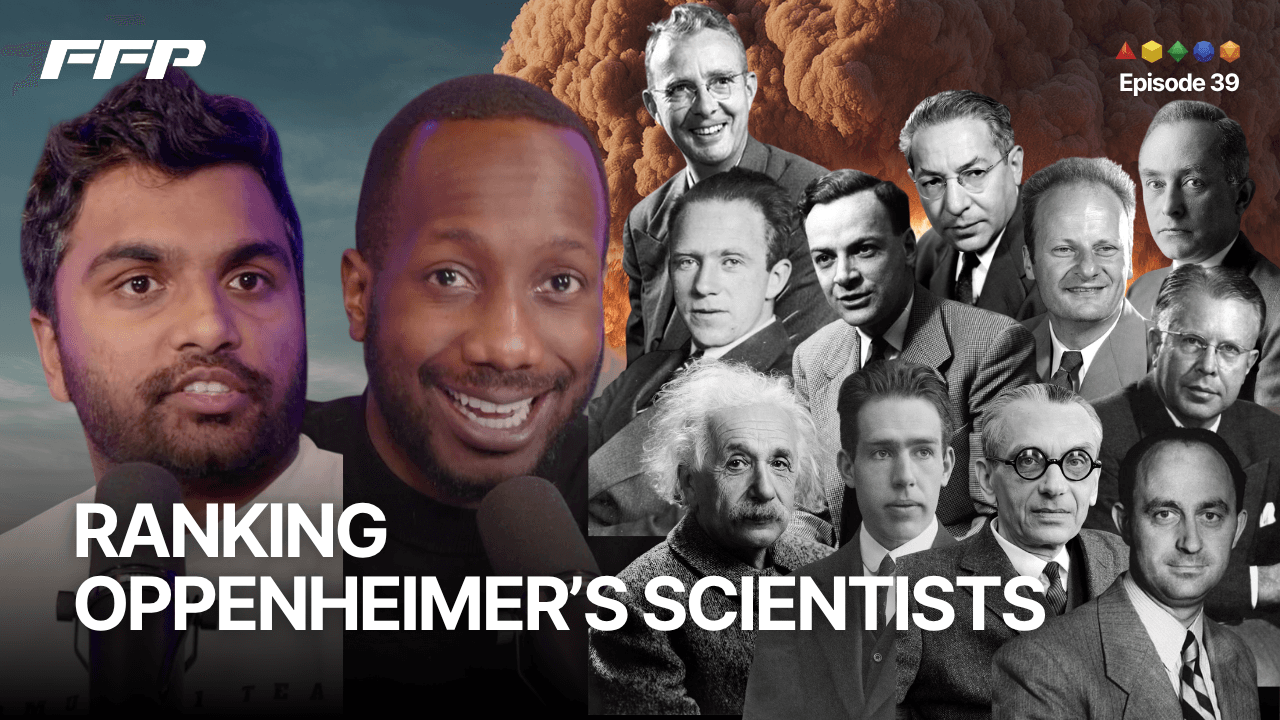
Richard Feynman's scientific legacy includes the path-integral formulation of quantum mechanics and a diagrammatic approach to calculations in quantum field theory. Krishna Choudhary and Lester Nare discuss those contributions alongside his work at Los Alamos, his teaching, and his ideas about computing and information at small scales.
970 words · auto-generated from the episode video
1:07:22This is this is and sorry I cut you off. You were going to say because I would if you want to finish that thought. >> yeah, no. I mean basically I mean it's because it was before quantum electrodynamics, this is the seed that led to all of it. >> I got you. >> comes up later because the next guy is going to be the guy who perfects it. >> Hans Bethe 1906 to 2005. >> Mhm. >> Yeah, very recent. >> Very recent. >> Yeah, very recent. Um Number six, Richard Feynman. >> Got to be on the list. >> Richard Feynman, he's at number six. He did not make top five. >> It's okay. >> But he's at number six. This is a photo of him at Princeton actually. >> I don't know why he's um walking past the humanities and language building.
1:08:02>> right. >> But I guess that's because I mean yeah, I get it, right? >> the building is prettier. >> Right. >> But there's no reason why he would be in that part of campus >> I I was going to say >> talking to General Groves and Robert Oppenheimer. But I see you, Christopher Nolan. I get it. I'm I'm glad you used the pretty part of our campus, you know? >> As you've talked previously about your feelings about the physics and math building. >> Yeah, well, at the time at the time the physics and math buildings were Frist. >> Yes, that's true. That's true. >> That's still like kind of pretty, but no we're not no nearly as pretty as, you know, where the chapel and >> Yes. >> like Nassau Hall are. >> Very cinematic. >> Yeah, so very cinematic. Anyways, he was a young junior physicist at Los Alamos, very young. Was like in the middle of
1:08:44his grad school, in the middle of his PhD when he was doing this. He was recruited by Hans Bethe to do this. Incredible intuition and later on in his life just becomes a behemoth for physics. Probably one of the most famous physicists of all time, you know? Um He's played by Jack Quaid in the movie. He's seen playing the bongos, challenging security, um, and he watched the Trinity test through a truck windshield. Do you remember they're all sitting there watching the Trinity test and he goes behind a windshield and he's like, "Oh, the the glass is going to stop the UV." Right. Right. And the funniest thing is Edward
1:09:24Teller who's like putting on a bunch of like, um, sunscreen to stop the UV. He's like, "What's going to stop the glass?" Which is hilarious cuz that's a real thing. Like that shockwave, you you don't know how big it's going to be, right? Um, so he was one of the group leaders of the theoretical division, not the leader. That was, of course, Hans Bethe. He developed formulas for the fission bomb yield. He's one of the first guys to manage the IBM machines that were put in Los Alamos to numerically calculate things like the yield of this bomb. In terms of the actual physics,
1:10:04great work. He developed the path integral formulation in quantum mechanics, which is the idea of an interpretation of quantum mechanics where a particle and all of your experiments go from one end to the other end. A particle moves from one end to the other end by going through all of the paths. I don't have enough time to explain it to you, but effectively it's like a really good way to interpret quantum mechanics, I think. >> Yes. >> Right? >> Yes. >> Specifically, he also developed Feynman diagrams, which are a visual tool that are used in all sorts of physics. Actually, not just in particle physics and high energy physics, they're also used in condensed matter physics and
1:10:44things like that. Um, it's a visual language for simplifying really complicated integrals. >> Yes. >> Effectively. >> Yes. >> So, that's what he won the Nobel Prize for. He is he figured out how electricity and magnetism He figured out the theory behind how electrons and photons interact effectively. Quantum electrodynamics. >> has >> I mean, that's the nature of reality, right? What is light? He tells you what is light, okay? >> On top of that, he also did theory on liquid helium. There are some amazing lectures by him on what is computation. He's very famous for saying that all of the Encyclopedia Britannica should be able
1:11:25to fit in a box this size. Because he was saying, "Let's get down to the atomic scale. We need bits. This is how small atoms are. Even if we do hundreds of atoms, I'm telling you that all of that information should be able to fit on my fingertip." People thought he was crazy, but we're pushing that boundary a lot, right? He also came up with the idea of quantum computing. >> Mhm. >> Um he one of the first people to write a paper saying that, "Hey, if we want to simulate physics and reality, we need a computer that is quantum in nature. We can't be doing it with like >> classical >> classical transistors and things like that. >> Which makes a lot of sense. >> Makes a lot of sense. Great teacher. He did the Feynman lectures in physics. We
1:12:06can do an entire deep dive on him. We probably will. Where we will talk about some of the you know issues >> As we always do. >> do. He's not a perfect human being. >> As men of his time have known to have have things. >> glaring sexist. But um still a giant in the physics community.
History of SciencePhysicsNuclear Physics