
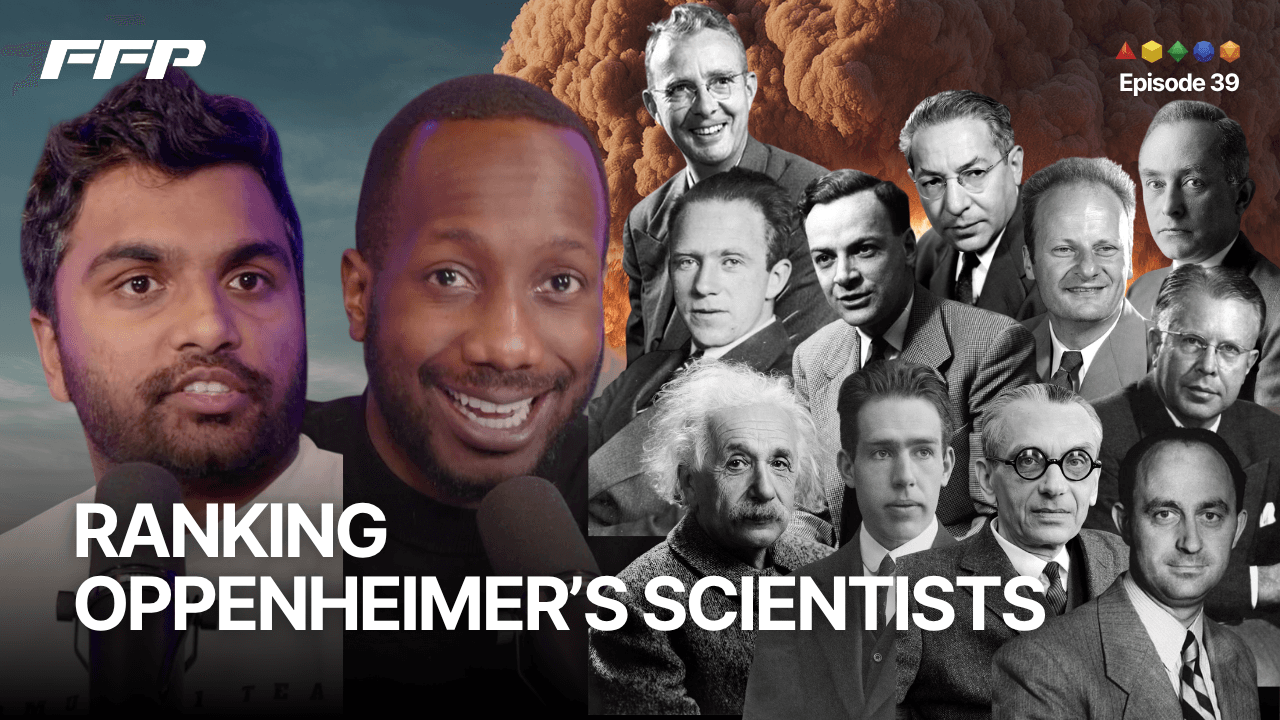
Kurt Gödel's incompleteness theorems establish limits on what sufficiently powerful formal systems can prove. Krishna Choudhary and Lester Nare discuss the implications for mathematics and use Gödel's appearance alongside Einstein in Oppenheimer to include a mathematician in their ranking of scientific contributions.
- 01
The first incompleteness theorem applies to consistent, effectively axiomatized systems capable of expressing elementary arithmetic.
- 02
It does not establish that every conceivable system of mathematics is incomplete or prove a theory of consciousness.
820 words · auto-generated from the episode video
1:22:46you guys really want a nice read on how like just Carnot engines work and work, pressure entropy that textbook is amazing. When we when we get our shelf shelf, that's one of the first that's going to go up there. >> Uh Enrico Fermi 1901 to 1954. Uh short time, hugely impactful. >> impactful. Yep. Um number three our first non-physicist >> Uh >> Kurt Gödel. >> Okay. >> Okay? >> Is it >> He was a mathematician, but he's mentioned in the movie on his walks with Albert Einstein outside of the campus of the Institute for Advanced Study, so I had to put him in here. Um yeah, he's at
1:23:27number three because what he did was something so fundamental that I still have trouble trying to figure it out. He had nothing to do with the Manhattan Project. >> Okay. >> Okay? Pure theory, pure mathematics, more about logic than about mathematics. He came up with something called the incompleteness theorem. >> Mhm. >> Okay? This is the idea that if you have a system of logic like mathematics purports to be, right? Mathematics is something where let's say I've got axioms and I've got ways to prove or disprove statements based on
1:24:09those axioms. The axioms can be stuff like numbers exist. Right? From that, can I now prove from first principles that 1 + 1 = 2? Or can I prove from first principles like the Pythagorean theorem? Um that's this idea, right? The idea that you've got an axiomatic system where there's a finite number of axioms and from that can I prove all of mathematics? That's the question. It's a big question. >> It is a big question. >> question, right? It's a nature of logic. Not even reality has nothing to do with whether atoms exist or we exist. I think for me this is like just logic is on another level of like can we actually just prove true and
1:24:51false? Okay? He showed that a system like mathematics is one of two things. It is either incomplete in the sense that there are statements which are true which you can never prove or it is inconsistent. Meaning you'll be able to prove things that are not true. You will never be able to create a complete system of logic. >> Okay. >> That's quite insane to think about. >> Yeah. Yeah. And >> like there are statements that I can write down in mathematics that I will never be able to prove.
1:25:33But I know to be true because of the way that I've written it down. >> Right. Okay. >> Right? But it's outside of my level of proof or my ability to prove things. >> Prove. Right. >> It's it's something that I think we need to go on a deep dive about. >> This is this is actually something because I have so many questions and it's not the I'm like holding back so much. >> Yeah, there's there's a lot that goes into this. >> But I understand the conundrum that is presented by that the theorem as is described. Yeah. And it triggers so many questions. >> Yeah, it's it's like it's really really weird dude.
1:26:14Um and it's something that I really can't get into here. What >> I want to really sort of convey is that it's probably one of the biggest results in the history of mankind. >> Okay. >> That one statement. >> Okay. >> That like the mathematics itself is not what we think it is, which is like this just like true thing. >> That it that that we discovered math, it is not an invention. >> It has to do with that. >> Right, like the difference between is is it a fabric Is it a fundamental fabric of the reality and we found it? >> Yeah. And And it's so fundamental that like Roger Penrose, you know when he talks about how consciousness is like a quantum phenomenon?
1:26:54>> Yeah, yeah, yeah. >> It comes from this. >> Ah. >> From incompleteness theorem. >> Okay. >> Like that line of thought comes from the fact that there are things that are not computable. >> Right. >> Like there are statements that I cannot prove using deterministic algorithms. And so if all of physics is just deterministic algorithms, how do we get things like consciousness where a conscious entity can make sense >> Right. >> of a statement that he or she wrote down. >> Right. >> Right? >> Oh, this is deep. >> It's very deep. >> I like it. >> And I I I just want to put him at number three because he deserves to be number three. >> Fair. And in the comments, let us know if you want to come back on a on a deep dive uh both on the incompleteness
History of SciencePhysicsNuclear Physics