
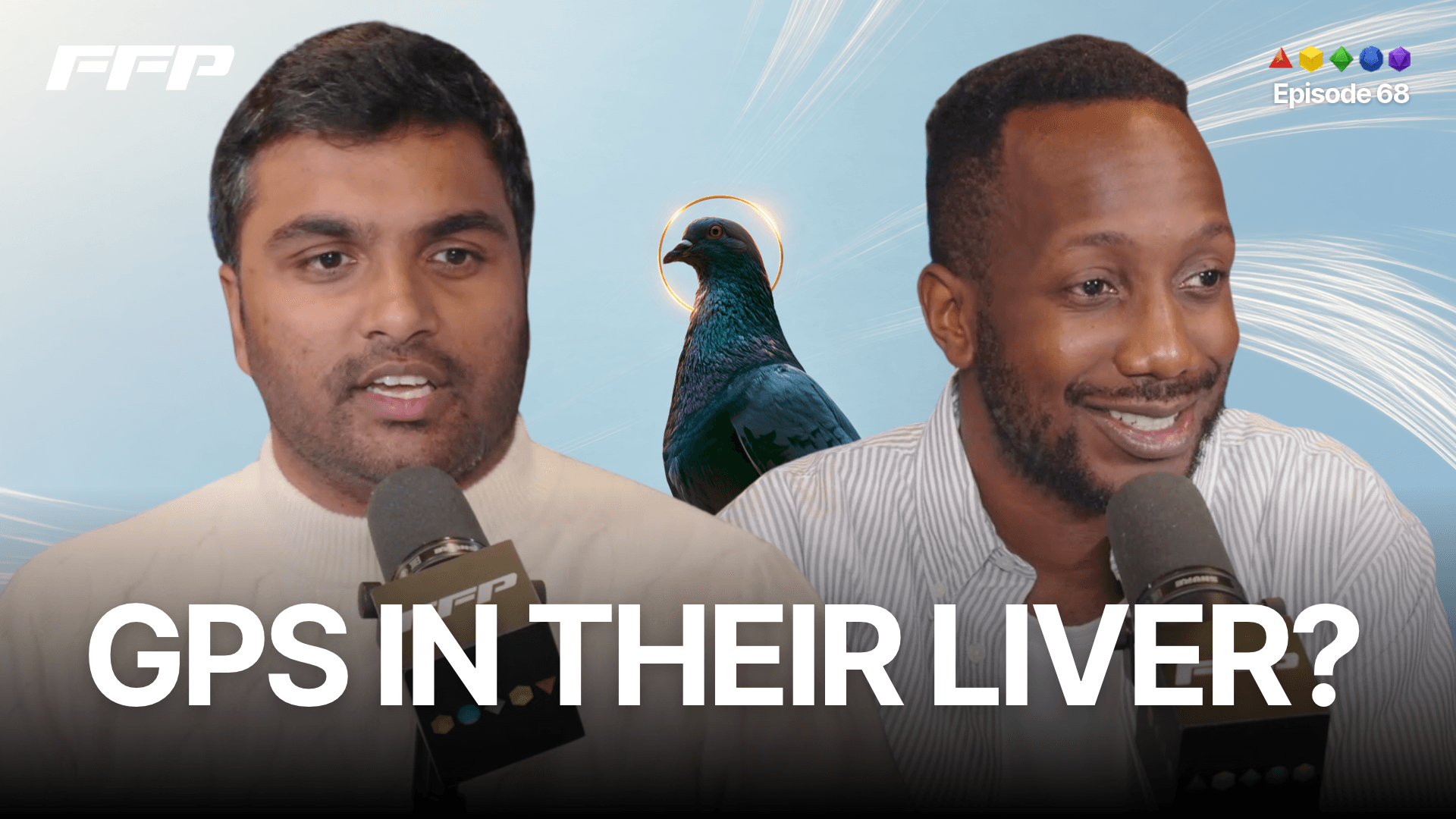
The chapter walks through a Science paper claiming that iron-rich macrophages in a pigeon's liver, not just its beak, could serve as a magnetic sensor. Researchers from the University of Vienna found that liver macrophages contain enough magnetic material to show superparamagnetism, meaning that below a very cold threshold the iron can hold its alignment to magnetic north the way a paperclip briefly holds a magnet's influence before thermal jiggling erases it. Electron microscopy showed these macrophages sitting right next to a myelinated neuron connected to the vagus nerve, offering a possible route for a magnetic signal to reach the brain. To test whether the liver mattered for behavior, the authors used clodronate liposomes, a drug delivery method that selectively kills macrophages without harming other cell types, setting up the behavioral experiment discussed next.
- 01
The paper is titled 'Homing Pigeon Navigation Relies on Superparamagnetic Macrophages Under Overcast Conditions.'
- 02
The superparamagnetic effect only appeared in liver tissue and not in any other tissue the researchers examined.
- 03
The threshold temperature for the iron material to retain its magnetic alignment was below 12 kelvin, which the hosts flag as a physics puzzle to be addressed later as a rebuttal.
- 04
Clodronate works by being packaged in liposomes that macrophages eat; its breakdown produces non-hydrolyzable ATP analogs that destroy the cell's mitochondria and kill it.
1,574 words · auto-generated from the episode video
1:07:04it's pretty crazy that we don't really know. We know. Yeah, b- but, like, how, right? And so finally we get to, um, the paper that we're gonna talk about here, which is Homing Pigeon Navigation Relies on Superparamagnetic Macrophages Under Overcast Conditions. And now- Paper out in Science and now we also understand why under overcast conditions- Matters matters. Yeah exactly. Um, we're gonna get into what that superparamagnetic means. We know what macrophages mean. Yes. Let's, let's try to understand that part, okay? The, the background here is, um, this is an immunologist, an animal behaviorist.
1:07:44They merged iron-accumulating immune cell research with animal navigation tracking right? So it's this multidisciplinary thing that's happening from the University of Vienna. Um, and a lot of the competitors are also European, from Continental Europe. They're all And it's, like, University of Munich, Frankfurt, Vienna. They're all I bet they go to the same conferences. It's the Champions League- Yeah. of, of figuring out bird- Yeah bird navigation. Yeah yeah yeah exactly. It's so funny. So, um, first step, let's just try to, uh, uh, th- these authors figured, like, "Okay, let's just see where the magnetic response is happening in the blood." Uh, sorry, in the bird. Okay. Okay? Like, where in the body of these birds is a magnetically sensitive organ,
1:08:33okay? Yeah. Um, kinda the same thing that they did with the beak, right? Where the, uh, the beak had these magnetically sensitive parts. They're asking, "Is there anywhere else?" Mm-hmm. Um, th- one of the key results is they identified that the liver, in fact, has a lot of magnetically sensitive cells. Kind of makes sense, because the macrophages there are doing the same thing. They're cleaning out the blood. And- Same thing we talked about in the beak. Same thing we talked about in the beak, right? Um, they also show this idea of superparamagnetism, which means that if they were to take the ferrous material that is in these macrophages, they were to distill it down, and then they were to ask, "As I reduce the amount of
1:09:15temperature, can my magnetic material remember which way is magnetic north?" Okay. Okay? Let, let me, let me- Let's talk- talk about that in a little more detail. So, you know, like, paperclips, they're not magnetic. But if I rub a paperclip with a magnet, it's gonna become magnetic. Classic grade school experiment. Yeah yeah. if you just leave it on the table, after, like, 20 minutes, it's gonna no longer become magnetic. In fact, if you heat it up with, like, a ray gun or something, put it out in the sun, it's gonna take even less time to become not magnetic. And that's because temperature has this effect of jiggling all of the atoms together. So even the tiny bits of iron that are in there that are aligned to create
1:09:56this magnetic field, 'cause that's how magnetic fields happen, is, like, all of the iron atoms kinda align to create a gross magnetic field. And so what you're doing with the paperclip when you're rubbing this magnet together is, like, the magnet is influencing the atoms in the paperclip to align in some sense and create a gross magnetic field. But if you remove that external force, the temperature is gonna make them jiggle, and they're gonna r- they're gonna lose the memory of which way is magnetic north. But if you cool that thing down, the jiggling is going to go smaller and smaller, and it's gonna jiggle less and less until the energy between adjacent spins that are aligned is going to be greater than the jiggling
1:10:38energy. Mm-hmm. Right? So at some low enough temperature, the jiggling- Ah is not enough to overcome, like, the alignment energy- Right of these atoms, right? And, and that's what they found here. That's called superparamagnetism, where below 12 K, the thermal flipping freezes out, and you can actually get a magnetic material at 12 kelvin that remembers sort of what it is, okay? This is n- this is not an effect that they found anywhere else in any other kind of tissue. The liver tissue had this. Th- there was a finite threshold where it could actually stay magnetic. So I think what's interesting in comparing this back to the beak thing you
1:11:21talked about earlier is we've said that to detect the magnetic field, it is very weak. And so you need high sensitivity, something with high sensitivity. And would this aspect of what's in the liver and its ability to maintain its alignment- Mm-hmm even at low temperature speak to this idea of the sensitivity piece, or is it a different way to think about it? No no no. So that's what the authors are arguing. Okay. The authors are arguing that in no other part of the body did we observe this superparamagnetic effect. The liver had enough of these magnetic ferrite materials in the macrophages, and enough density of macrophages to actually create this aggregate effect- Mm-hmm where I can, like, now, like, remember which way the magnetic north is.
1:12:04But we are gonna come back to that. Because it begs a physics question, right? 12 kelvin is awfully cold. Yeah. Right? So we, we are gonna That's actually one of the rebuttals that we're gonna get to. Okay. It, it's a good point that you bring up. Okay okay. Okay? So, so first we've established that th- the liver has a bunch of this magnetic material- Mm-hmm and it can remember the magnetic field- Mm-hmm in some sense, right? Now, um, if it's sensory, they're, they're, they're arguing that this thing is going to be involved somehow in sensory navigation, right? That means it need, there, there needs to be a neuron involved, 'cause n- Look, uh, you, you, you can say the liver senses the magnetic field, but
1:12:45the, the planning of where to fly to is happening in the brain, okay? That's, that's a no-brainer- in some sense. So e- w- we've gotta get that signal from the liver to the brain somehow. So the next thing they said was, "How, how would that happen?" And they did some anatomical mapping. This is a transmission electron microscope, and it's showing the macrophage in blue- Mm-hmm there. And right next to it, do you see the, the little, uh, crescent there? That crescent is a neuron. It's, it's stuck to that neuron. It's, it's maybe 2 microns or less, um, difference. Well well well. Right? So it's, it's, it's right next to that neuron that's myelinated- Yes
1:13:25that's, uh, that's taking signals to the brain. I, i- it's going to the vagus nerve, which is the nerve that goes down to the gut. Mm-hmm. And w- we already have a lot of literature that shows that the vagus nerve controls the brain in a very fundamental way, right? Like, your gut health controls your brain health. Well, maybe this is a gut feeling- that the, the birds have, right, of like which way the You know? Did you write that? Yeah, I did. I did write that. Yeah. That was, that was pretty good. I, I, I borrowed it from a news. It wasn't, it wasn't me. Anyways, but it's kinda good, right? Like, it's a gut feeling that is going to the brain and that's telling the brain which way the magnetic field is pointing. So for that big missing gap, this, it's starting to get a little- Yeah
1:14:080 It's starting to get good. I mean, look- Okay this thing was published in Science. You can't just Uh, it's, you've gotta have um, a good amount of evidence, right? But that's, that one's Okay. That one's a good one. We can communicate. Yeah yeah. We can, we can get to the brain somehow. And the final one is, is really the one that, that got them into the, the journal itself and got them past peer review. The ultimate test for any sensory hypothesis is behavioral disruption, meaning you've got to mess with it somehow, and that has to mess with the downstream behavior. Yeah. Right? And you have to do this in a controlled way. The same way that the magnetic coils around the pigeon created this localized magnetic field that then messed with its navigation, can we show
1:14:51the same thing but this time now messing with the liver macrophages? The gut feeling. Right? Yes exactly. And the, the pharmacological tool they used was clodronate liposomes. So clodronate liposomes act as a kind of Trojan horse, okay? They encapsulate this drug called clodronate inside liposomes. Those liposomes are then eaten by macrophages, and the breakdown of that produces non-hydrolyzable ATP analogs. Meaning ATP is like the cash currency of energy in our cell. This is creating fake monopoly money in some sense. The cell gets really confused, it destroys the mitochondria, and it causes
1:15:33cell death. Sounds like the US economy. Yeah, in some sense. If we just keep printing, that's how we're that's how it goes. Being facetious, but- Being facetious. Clodronate kills macrophages. It doesn't kill other cell types. Which is imp- which is k- Which is- which is key which is good, right? Because now this is a way for us to kill the macrophages and see if this has some effect on the behavior.
Animal BehaviorScience PolicyResearch Fundingmagnetic fieldsMagnetoreceptionQuantum Biology