
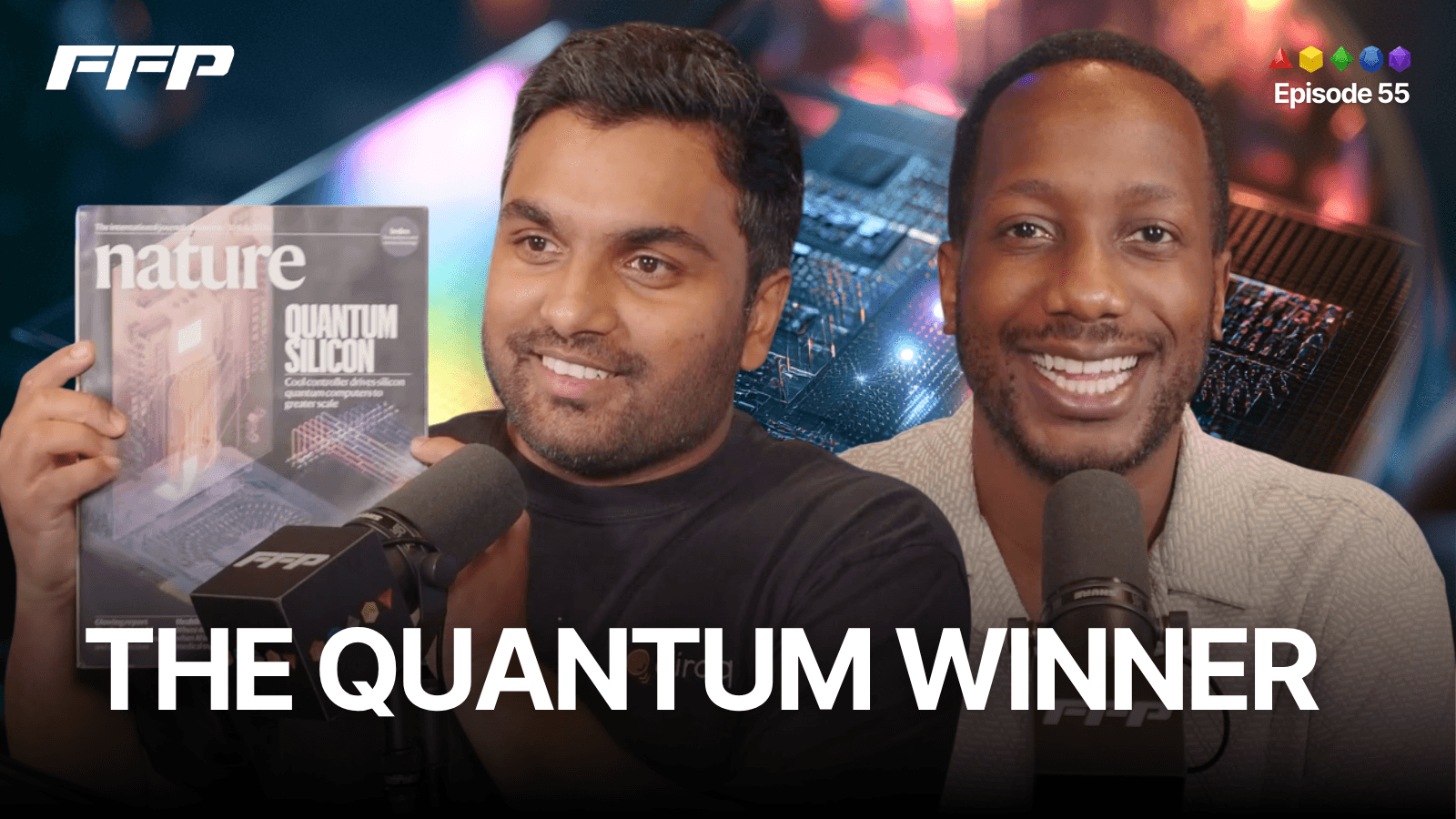
Quantum algorithms use gates to shape how probability amplitudes interfere before a measurement is made. A qubit's state includes relative phase as well as the probabilities associated with its measurement outcomes, and multi-qubit gates allow more complex operations. Building useful hardware requires preserving and controlling that information while making a larger system practical to operate.
1,928 words · auto-generated from the episode video
22:52That's right. And before we get started dragging all the neutral atoms people and everyone else through the mud, um, which I promise we are going to get to, don't [laughter] you worry. Um, we do need to establish some ground rules, right? Because if we're going to evaluate whether a quantum computing architecture is a legitimate computational platform that can scale or if it's just a multi-million dollar physics art installation, um, we need a rigorous scorecard. All right, we need a scorecard. So, first let's kill the hype and I'm going to just briefly review last episode, >> okay? >> To catch everyone up on what is a quantum computer and what is it not. A quantum computer is not a machine that
23:32tries every single answer at the same time because a cubid is a zero and a one simultaneously. No. Okay. A quantum computer is a giant interference machine. There's more details in the last podcast, but effectively the entire game with quantum algorithms, whether it's Shor's algorithm to make Bitcoin go to zero or Grovers or simulating some electronic ground state of some new compound that you've made. Um, you're applying unitary transformations so that the wrong answers undergo destructive interference and the right answers undergo constructive interference. And that interference effect is going to tell you one way or
24:13the other what the answer is. And a good quantum computer is something that can do all of this. It can store quantum information one and then it can manipulate quantum information. It can read it out. So I can get an answer out and it can be very large. It's something that is small now but might be easy to scale up. >> Okay. The fundamental unit of a quantum computer is a cubit. We're used to classical bits, which is just a bit that can be either a zero or a one. Usually, it's the transistor. Um, it'll either let current through or it won't. A cubit you can imagine is um in a superp position of 0 and one. And really
24:55mathematically what you can do is say a bit is basically whether I'm on the north pole or the south pole of a sphere. Mhm. >> And a cubit is anywhere, any location, latitude and longitude on the sphere. The sphere is called a block sphere. And this represents all of the different states that a cubit can be in. Okay. So, crucially, there's there's two there's two um numbers that we have to keep track of. One is the is this way? This way is latitude. Yeah, this way is latitude. North south. That's going to tell you how much it's aligned in 0 or one. That's going to tell you if I were to measure the cubit, what's the probability that I'm going to get a zero and what's the probability that I'm going to get a one. If if the cubit is
25:37at the north pole, then I'm going to get a zero all the time. If the cubid is on the south pole, I'm going to get a one all the time. And then there's also a phase right? >> There's the longitude. And that phase is how the cubits interact with one another. It might not have to do with the probability at the very end, but it does have to do with how things get entangled, how they interfere, so on and so forth. And the phase is even though we're looking at this visual as zero or one basically northern hemisphere or southern hemisphere. >> Yeah. The phases the phase still matters for other types of interactions that are going to impact the system even if it's not determinative of R0 or one. >> Exactly. Yeah. So the cubit is that quantum version of a bit. It's some thingy that's in your quantum computer
26:19that can do this. That can be a two-state system with quantum mechanics governing it. Yep. >> Okay. And a quantum computer effectively is a set of cubits that can be manipulated using quantum gates. Now quantum gates we talked about in the last episode there. These are unitary transformations that will rotate the cubits and put them together and things like that. Um they do not destroy information. Yes. >> Right. They are reversible. >> Yes. >> So they're not like the conventional andgate. You need you need to have other strings attached in order to get this thing to work. >> You can go from either the question to the answer or the answer to the question in both ways. in both ways. >> A lot of times when we talk about endgates, you can only go from the question to the answer. Exactly. >> But you can't go back to the question.
27:00>> Exactly. Very good. Um and for for a single cubit, we've got a lot of gates. Um you can rotate the cubit as as you showed in the in the block sphere. And here in this case, this is called a hatamard gate. Um this takes a single state, a quantum state from a zero or a one. So it's in a pure state either in the north pole or the south pole and it puts that block sphere on the equator. Okay? So either you've got um the the zero goes to the sum of 0 + 1 and the one goes to 0 minus one. Okay. Um now that's for single single cubits you know that's the hatamard gate. You can also think of these things as rotations on the block sphere as I was saying right
27:42um in this case the hat had gate rotates along some direction in the block sphere. The Zgate rotates along the north south axis and then the hatamard gate again rotates along one of the off axes. So in order to get a X gate for example an Xgate is something where you rotate along the X-axis of your sphere you can put a bunch of cubits I mean sorry a bunch of gates together to get an Xgate for example. >> This is like one of those desk chachki where you have the little sphere thingy and it has the three axises of rotation and you move it around. >> Yeah. Yeah. Yeah. like the the toy gyroscopes if you've ever seen. Yeah. >> This is as a visual representation of what the math is doing or what we're talking about as we make these transformations.
28:23>> Exactly. Yeah. And and that's that's what these single cubit gates do. Okay. You also need the cubits to interact >> though, right? So you can have two cubit gates and you can put a bunch of these two cubic gates together [clears throat] >> to create a quantum circuit. And this circuit is going to implement a quantum algorithm like your shores, like your grovers, like your Deutsch Josa or whatever you want. And here you can see like you know based on the state of one cubit the the the block sphere of another cubit will rotate in one direction you know and they can get entangled and and so on and so forth. All of the quantum magic that happens. >> The idea is the the single gate is like a single instruction in a recipe. Um, and then when we get to this idea of the
29:06entanglement display we just showed, it's like now we're stacking multiple individual instructions to be able to go and they're interacting with each other. [clears throat] >> Exactly. Yeah. And so now let's get into like what the classical cubits are today. Sorry, the classical bits I should say. Transistors are the classical bits of today. Transistors are the stuff that's in our computer, >> right? On our iPhone, in our D, the car. This is why everyone loves Taiwan. >> Yeah. Right. Right. TSMC. Shout out. >> Yeah, shout out to TSMC. Um, and this is why geopolitically it's such an important thing for us because TSMC makes all of our transistors, all of our chips. Now, they were not the only classical bits out there, though. >> Historically, there's been a lot of
29:48different types of computers. There's been um the imitation game um with Alan Turing. He created a computer out of electronic relay switches. It does the same thing that a transistor does. It holds a zero and a one. And based on that it can it can make logic on and you know he defeated the Nazis code with um his giant computer. >> Was it Enigma? >> Yeah. Yeah. The Enigma code. Exactly. And on the right hand side we've got um John von Noman standing in front of his giant computer. This made out of vacuum tubes. He's standing next to Robert Oppenheimer. Again, another type of computer. These things were giant though. If you remember from the movie, they took up an entire warehouse. The vacuum tube stuff also took up an entire warehouse. And it wasn't even like a
30:28megabyte worth of memory or maybe it was like a megabyte but like a few. >> They the basically they were they worked but were inefficient because they required such size and scale that >> were not going to be practical to be able to create iPhones. >> Exactly. Then we got the transistor out of Bell Labs won the Nobel Prize and lo and behold all of these other technologies went into the museums. And what is a transistor made out of again? >> Oh silicon. >> Oh right silicon. That's that's interesting and and I I do want to make the I think I'm seeing the parallel you're drawing here which is again when you have a frontier technology there are a lot of ways that people think are the best way to go about it but there's a difference between what works and what
31:09works at scale. >> Yes. >> And we had vacuum tubes tubes and uh >> electric relay >> electric relays that both did work. >> Yeah. >> No one's saying they didn't work. However, >> um they would not have birthed the internet. they would not have birthed Door Dash, Uber, uh little robots you have for your kids every day because it could not scale, >> which is both a performance problem and a size problem among other things. And so I'm I'm just trying to re rebrun
31:48goal. >> Yeah. But it might not be the most efficient or best way to accomplish it if you ultimately want to make this a productized something >> something right. >> You said it, not me. [laughter] >> This wasn't even my opinion. Um I guess we're both drinking the Kool-Aid now. [laughter] >> I just it logic the logic is falling the game. So, so with that in mind, right, with that with that with that background in mind about how classical computing, how the history of classical computing has unfolded, let's get into some of the history behind quantum computing. So, in the previous episode, we went into Fineman's lecture at MIT where he talked about um quantum simulation using a quantum computer. >> Mh.
32:28>> Um and that sort of started this, it was in 1980, I think. Um 20 years after that, in those 20 years, people had started thinking about how to make a quantum computer. And there were all these different um proposals out there.
Quantum HardwareQuantum InformationSemiconductor PhysicsCryogenic Electronics