Quantum HardwareQuantum InformationSemiconductor PhysicsCryogenic Electronics
Part II of our quantum computing deep dive compares the leading hardware architectures, and asks whether silicon’s greatest advantage is not simply making good qubits, but making quantum computers that can actually scale.
Which quantum computer will actually scale? In Part 2 of our quantum computing deep dive, Lester Nare and Krishna Choudhary move from quantum theory to hardware, comparing superconducting qubits, trapped ions, neutral atoms, and silicon spin qubits before going inside the new Nature cover paper Krishna co-authored with the HRL Quantum Team and collaborators. The central question is deceptively simple: what makes a good quantum computer? We build an FFP scorecard around three problems every architecture has to solve: qubit quality, qubit control, and scalability and economics. That means understanding not only whether a qubit works in the lab, but how long it preserves information, how accurately it can be manipulated, how error correction works, how it is cooled and controlled, and whether millions of qubits could ever be manufactured economically. First come superconducting qubits, the architecture behind systems from companies including Google and IBM. They offer extremely fast gates, but face challenges involving microwave control, frequency crowding, cryogenic wiring, physical size, and scaling. Then we turn to trapped ions, where individual atoms can preserve quantum information for extraordinary lengths of time and be manipulated with lasers. The tradeoff is speed and the increasingly complex optical engineering required as systems grow. Neutral atoms offer another radically different approach: optical tweezers hold individual atoms in configurable arrays, while Rydberg interactions provide entangling gates. Their flexibility is impressive—but atom loss, laser engineering, correlated noise, and execution time all enter the scalability equation. Finally, we arrive at silicon. Beginning with the Loss–DiVincenzo proposal and exchange-only qubits, Krishna explains how individual electron spins can be confined inside semiconductor quantum dots, manipulated through exchange interactions, and read out using single-electron transistors. That leads to the new Nature cover paper: “A digitally controlled silicon quantum processing unit.” The HRL system integrates 18 encoded qubits built from 54 quantum dots with cryogenic control electronics, a superconducting interconnect, automated calibration, and a silicon-germanium heterostructure engineered to suppress some of the longstanding physical problems facing silicon spin qubits. The result is something unusual in quantum computing: a machine whose path toward scaling begins to resemble the semiconductor industry we already know. And that is Krishna’s admittedly biased thesis for the episode: the first useful quantum computer may not ultimately win the race. The architecture humanity can manufacture at scale might. Opinions expressed in this episode are those of the hosts personally and do not represent the views or positions of current or former employers or other organizations discussed.
Transcript
Show →Hide44,287 words · auto-generated
Opening
0:00If you want to build a 100,000 cubit trapped ion machine, you're going to have to invent a 100,000 laser optical miracle. >> Yeah. >> All right. But if you want a million superconducting cubits, you're going to have to build a warehouse style sized cryostat. >> But if you want a million spin cubits, you just put it on a standard 300 mm silicon wafer. [music] You run it through the exact same photoiththography machines at TSMC, ASML, Intel. Scaling is the key.
Quantum Computing, Part II
0:30>> Yeah. >> And scaling is the future. >> Hello internet. This is your captain speaking Lester Nar joined as always by my co-host and our resident PhD Krishna Chowdery. This is part two of our two-part deep dive on quantum computing. We are covering the recent nature cover story volume 655 issue 8125 released on July 30th 2026 and featuring our resident PhD Krishna as one of the co-authors. For those of you joining us from part one in the last episode we did a deep dive into the theoretical
1:11foundations of quantum computing. Now we get to the beef. We talked about what is it? Why would we want to build quantum computer? In this episode, we're going to take a deep dive into how to actually make one. And Krishna is going to make the case that there is only one way. Make it silicon. As a brief note, the opinions expressed in this episode are those of us personally here as the hosts and do not represent the views or opinions or positions of any entities that may be mentioned throughout this episode. As we talked about in the last
1:51episode, this is a burgeoning trillion dollar industry. We are talking about this from our personal viewpoints and the opinions expressed in this episode are our own. As always, we are going to talk about the science from the ground up today because this is from first principles [music] only right in [music] the night. [singing] Exchange only cool and clean. Next logic [music] and a low noise scene. Exchange only bits. Do it with [singing] ease.
Krishna’s Nature cover paper
2:25on the >> longtime listeners of this podcast might recognize that the intro music today is different from our usual music and that's because today is a very special episode. We're going to repeat the song at the very end of the episode in the credits and you can take a listen afterwards and hopefully you'll understand the lyrics. The reason why this is a special episode is because, you know, we've covered probably a hundred scientific papers on this podcast over the past year. And after a whole year of doing that, I finally get to talk about a scientific paper where I am co-author. I'm one of 250. It's a very large list of co-authors because it took a lot of human power, a lot of
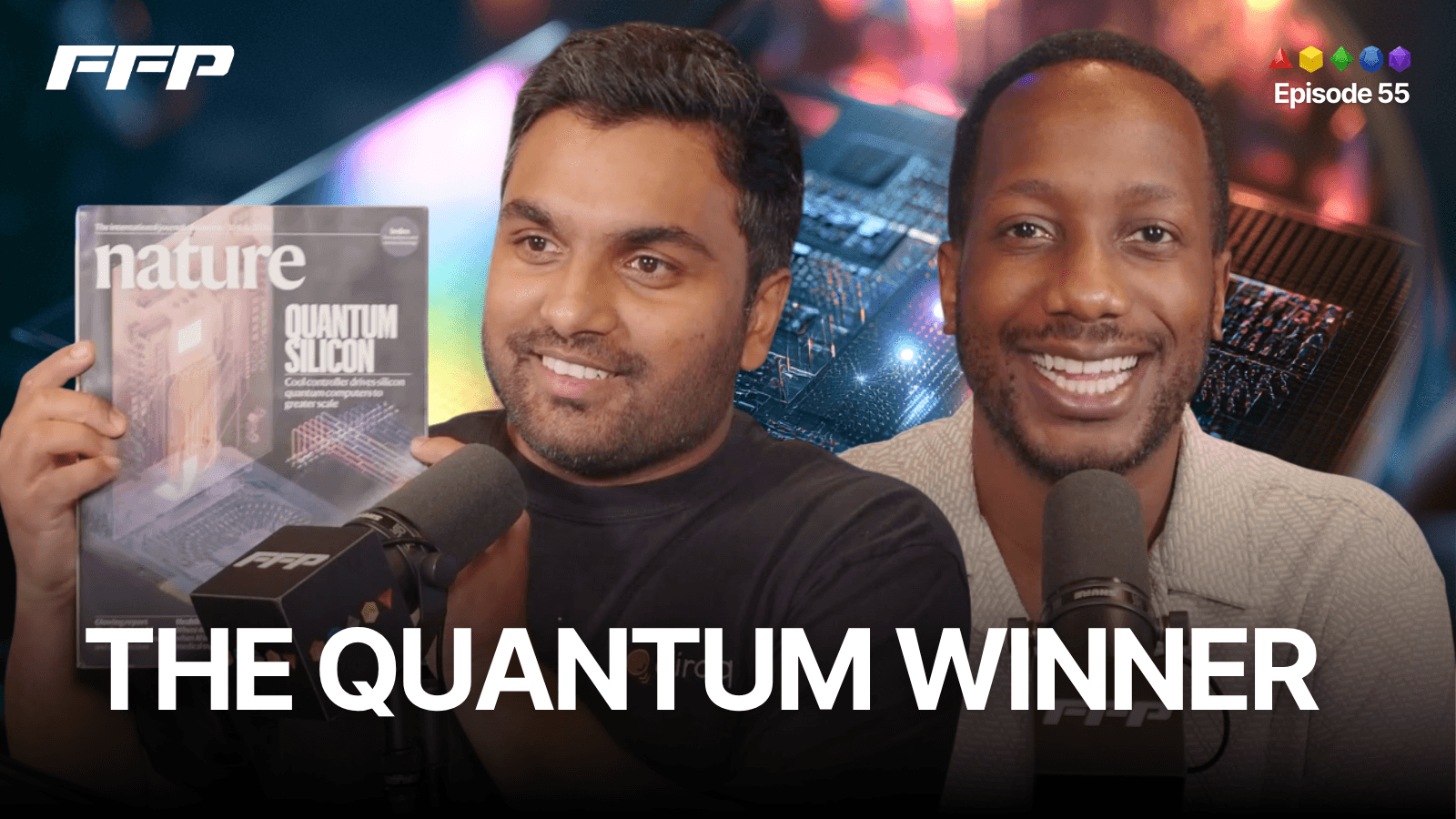
3:08resources to do what we've done. But it's a special day. It's a special episode. I'm holding it right here. Nature's volume 655, issue 8,125, Quantum Silicon. >> All right. Look, look, look at look at [laughter] >> Shout out to John Carpenter for the visuals on the cover. Um, so this is a paper out of HRL Labs in Malibu, which was my former workplace, and it was recently announced that IBM has acquired the place. So hopefully By the time this episode ends, it'll give you a little bit of context about why that is a very interesting move. [clears throat]
3:48>> Okay. Now, this is not the first Nature cover story to have quantum computing or adjacent things. Okay. We've got several. Mighty Adams is a trapped ion story. Quantum supremacy. That's the Google one about quantum supremacy. There's the weird like holographic wormhole thing. I don't know if you remember, but like some people did some quantum experiment on a computer that suggested that they've they finally realized the Einstein Rosen Bridge and like wormholes exist. We tapped into that and it's like no, you know, that's not what happened. But in any case, the the current cover that I'm holding here is in a long line, but >> it's kind of the debut of a type of MVP.
4:31You know that they they say in VC circles, >> minimum viable product. >> That's right. This is an MVP for a type of quantum computer that I think will be the future quantum computer. Okay. Um why? Well, because it's in the name right here, quantum silicon. It's made out of silicon, which means that it can be made using the same machines and the same infrastructure that makes all of the classical computers that are in my phone, that are in this laptop, and in everything that we know and love. Whenever we have some new technology or some new paradigm, the question becomes, okay, you can prove it in the lab, but then how do you scale it uh in a production environment to actually make it viable for business use cases?
5:12>> Yeah, graphing [clears throat and laughter] >> and and to that point, you know, there's a there's a gap between uh the theoretical application and the production scale application. That's right. And so part of where I think you're saying we are is there are different approaches. >> Yeah. >> To how can we make this work at scale? >> Yes. >> And you're going to make the argument today that this debut is the way to make it work at scale because there's been promise around quantum computers for some time >> and we will have an fundamental understanding of why this is the way forward. >> Exactly. Yeah. And um to be clear I you
5:53know you've already given the disclaimer but I'll just say it again. This is not a normal episode and that we will be covering a lot of cool science. I mean it it is kind of a normal episode because we will be covering a lot of cool science and science history from first principles but it will be unlike other episodes >> um because it will not be unbiased science journalism. Now, I don't know if the other episodes were unbiased science journalism to to be preer perfectly honest, but um here I definitely have an agenda and the agenda will become pretty obvious as the episode goes on, but I want to make it explicitly clear here so there's no confusion and debate and people are in the comments being like, "You're biased. You're drinking the Kool-Aid." Yeah, it's my Kool-Aid. [laughter] >> I made it >> and I'm drinking it. Yeah. Purple,
6:33>> red. >> Exactly. So, th this will be an opinionated episode and the opinions are entirely our own. I do want to also just note for those who are audio listeners, as we were setting up the production for this episode, this episode has the most visual overlays of any episode we ever we've ever done. Yeah. >> Um it's quite there's a lot of complex ideas that are only best expressed by looking at it visually. And so to the extent that you can catch it on YouTube or on Spotify where we'll have the full video available, I do encourage folks after maybe a first listen via audio to do so because it is going to be very visually heavy.
7:13>> Yeah. Yeah. Yeah. And um it's going to be a lot of fun. I mean, I had a lot of fun planning out the notes for this episode. >> This is going to be fantastic. >> Um I mean, it's it's you know, it's a paper that I'm on. So [laughter] um and we're actually going to go into a deep dive not just about silicon quantum computers which is the um subject of the paper but quantum computing hardware in general and I want to answer the question how do you make a good quantum computer and what does that word good mean in this context right um there's going to be a shallow deep dive on other quantum technologies you know we've got superconducting circuits trapped ions neutral atoms and then I'm going to make the case for why this technology quantum is going to win >> there's is the agenda. >> Yes, that's that's the agenda.
7:54>> The agenda. >> Yeah. And um I used to work at HRL, which is where the paper comes from, but now I work at a company called DACA. Great name, by the way. Um and DAC also works on spin quantum computers in silicon. So, it's always been spins for me. >> That's fair. There's these other options, but you've been in the spin universe in terms of this is the way. >> Yeah. This is the way. This is the way. Um because it's still early in this race to make the first quantum computer. Okay. Um, other players might want you to not think that, right? Quantum supremacy on the cover of Nature. They did it. >> Well, okay. You simulated a probability distribution that is designed for a
8:34quantum computer to simulate because it was a quantum probability distribution. [laughter] Okay. All right. Cool. Um, there are different strategies. Um we've got superconducting circuits as I said trapped ions um neutral atoms and for a very long time actually the technologies um those those
Silicon: quantum computing’s underdog
8:54technologies have been members of like the premier league of quantum tech >> the premier league of quantum >> get in yeah and silicon has been like the underdog like what's the what's the >> championship the champion >> under the premier league the championship >> the champ so what's under championship >> oh uh uh we'll just say third division Yeah. Yeah. I would say Silicon has been like it hasn't even been in the championship. The Premier League, the Championship, and then there's one more and everyone's going to hate me for not remembering this. >> We've been We've been like Rexom, >> you know? You know, the Ryan Reynolds thing. [laughter] Yeah. Yeah. There's been like like it's been like Manchester United, >> uh Arsenal and Chelsea or Chelsea. They
9:34that's been superconducting circuits, trapped ions, and neutral atoms. And then silicon has kind of been like Rexom. >> Okay. No, that's really good. who's who's basically every season Yeah. gone up. >> It's gone up from being in non-league play, which is like below six anyway. >> Yeah. And um to really demonstrate that that world view, let me share a story with you. Okay. So, I'm going to bring you back to March Meeting 2026. We're going to go back to this event a lot, but the American Physical Society, APS, has a March meeting every year. I remember this. And um this 2026 I got to present on some of the work that actually contributed to my um getting on this paper. So I was giving a talk on behalf of HRL.
10:14There I am and I'm actually um wearing the FFP pod. >> Uh that that was I think the first like sweater that we had made to like try out like whether merch would work. And so I had the platonic solids and I was wearing it. I was representing [snorts]
The APS March Meeting story
10:29um this was a meeting where this technology had its big debut to the outside world. All of the stuff that you see on this paper for the first time the outside world got to see it at this meeting. >> Okay. >> Um there's a juicy little backstory that we'll get into. But that night, okay, so after that after that um presentation, I'm feeling good. A lot of people said it was a great presentation. You know, I'm having I'm I'm I'm riding high, right? So, I snag an invite to the Allison Bob party >> at a bar in Denver. Allison Bob is a quantum computing company out of Europe. >> Yes. >> And um they like, you know, I guess rented out a bar and then you
11:09you got to get get like mailin invites and then one of my friends um from PhD days, Elliot Boore, shout out to Elliot. Elliot, long time fan, long time listener. >> Yeah. And he he got me the he forwarded me the email invite. So then I I got to go. They had some great drinks at the bar, by the way. Um, and they were all quantum themed. So, I took a photo of the cocktail menu. You got Mango Collider, uh, Strawberry Field Theory, >> Bellini Barrier, >> Bini Barrier, >> like a tunneling barrier, um, uncertainty principle. That one's kind of lazy. Just the uncertainty principle. Dark matter. >> Um, mocking bellini. I didn't understand that to be honest. If someone if someone has an idea of why that's quantum related. Um, anyways, I wanted to be a
11:51good guest, [laughter] >> right? You got to be a good guest. So, you got to try everything. They put a lot of thought into the cocktail menu. So, I got to try every single cocktail. You're not trying to disrespect. >> I'm not going to disrespect as a guest. Um, I try every single cocktail. I'm feeling good. Just had a great talk. Um, been getting compliments all day and this is a nice like day ender. Um, me and my friends, we see the traditional group of Europeans outside the bar in the smoking section. This is true for any um international physics and even just science conference in general. There's going to be a gaggle of Europeans outside the bar just chain smoking. Okay. And um I wanted to enjoy some fresh air in Denver. So we we head
12:34over there to to socialize. >> Yes. With our international collaborators. >> Yes. Ex Exactly. Um to to for our colleagues to to get some fresh air straight into my lungs. And um again, I've had a couple of beers, so I'm away from home, so uh some fresh air in my lungs is not, you know, >> it's it's >> it's it's it's permissible. And I had a great talk, you know, whatever. We join them. >> We get to socializing, find find out that they're all from Munich, Germany. >> Okay. Um the conversation turns to work. >> Okay. >> And one of the scientists, yeah, one of the scientists asked me, you know, what do you work on? And I said, automation in spin cubits. >> And they go, spin cubits? What's that? And it's as if I had said like like
13:15cubits made out of cheese. >> Yeah. >> Like they just had no idea. >> Right. >> Right. They never even heard of spin cubits. Um I'm like okay. You know I try to keep the conversation going. I return the courtesy. I'm like all right. What do you work on? They say neutral atoms. And I say oh yeah, okay. And then the killer, this German person, they say, "Yeah, see uh you know about my technology, >> but uh I don't know about yours. So maybe that says something. There is a reason. Yeah. [laughter] And everyone starts laughing and I'm like an idiot, you know? I'm I I don't I can't like it's I'm I caught off guard so much that I'm just laughing at myself. I was so illprepared.
13:55>> Yeah. >> For this ambush. >> For for the quip. >> Yeah. For the quip. I I thought we were having a good time. >> It was a cool whip. >> Yeah. Like you could you could have just been nice, >> right? Like if somebody if somebody comes up to me at APS and they're like, I work at Microsoft on topological cubits. I'm not gonna be like, "What topological cubits?" Right? I'm not gonna say I'm not gonna say, "Are the topological cubits in the room with us?" Right? Like I mean, it's I could think it, but I'm not going to say it. And the background around that joke is Microsoft has these things that they call topological cubits. Not not everyone in the industry is convinced that it's even a cubit. It's a two-level system, but they might have something. They just haven't shown it yet. And there's a
14:35there's a running joke that the only people who believe that Microsoft has a cubit is Microsoft. Microsoft. >> Okay. So that's a joke. But if if I'm at a bar like I'm having a good time, I'm not going to say that. >> Yes. Right. >> But you also don't have a German sense of humor. >> Yeah. Yeah. Yeah. And these Germans, right, it's it's also hard to have a comeback to I haven't even heard of that. >> Yeah. Yeah. Yeah. >> Right. Like >> he doesn't even go here. >> Yeah. Yeah. It's like remember in Pirates of the Caribbean when um the Jack Sparrow gets captured by the British dude and the British guy's like, "You must be the worst pirate I have ever heard of." And then Jack Sparrow goes, "But you have heard of, [laughter] >> you know, I couldn't even do that.
15:16>> That's good. >> Never even heard of me." >> Yeah. Right. Right. >> Right. Right. And so what do you And so what do you There there's no clapback. >> There's no like possibility. Even Even in the moment, I couldn't think of anything. So, I go back to my hotel room and I don't know if you do this, but whenever like things like that happen, you take a long shower and you just start like fantasizing and rehearsing like all the different ways that that could have gone down like like Doctor Strange in all the all the multiveres. >> All the many worlds. >> Yeah. All the many worlds that we don't exist in. >> Yeah. Yeah. Yeah. Of like where I'm like I look like Shah Ruk Khan [laughter] and I'm like I'm I'm just you know there's a comeback after comeback. I started thinking about like stuff I could have said, you know. Um, one of them could
15:57have been like, you know, okay, so you haven't heard m you haven't heard of me. Maybe I know more than you. >> That that was the that was the like the the layout. >> Yeah. Like maybe like maybe read the literature. >> Oh, I'm sorry that you're not well verssed in the >> subject. [clears throat] Yeah, exactly. It's like it's like I thought like not knowing stop being cool in like middle school. Remember those guys who just like love to not know? Like I don't know. Like, [laughter] how is that something that we're still doing at APS March meeting? >> Sorry, I'm I'm getting a little >> No, it's okay. The I The PTSD is palpable, >> bro. It's it's it's ridiculous. >> But guess what? Who's on the cover of Nature? >> That's right.
16:37>> Do you like apples? Well, I got a nature cover. [laughter] How about them apples? >> I I guess I guess you should have known, >> right? I Yeah. I mean um so what I what I would like the audience to do right now is try to figure out just using neutral atoms right like some something I could have said it doesn't have to it it can be about Germany and how they lost the war it can be just anything I want to read these comments because I don't pay attention to my mental health and this is going to be my therapy to get over this okay so in the comments drop something about neutrality neutral atoms Switzerland anything I want to read all about it you you don't have to know about the physics A little later I'll get into the physics and maybe you can work that in. But this is a ask for
17:19the audience for for help in my uh in in my PTSD recovery. And I I think part of what you're sort of setting up here is the methodology that you all were working on was below zero even in just theor like awareness idea that it was possible. Yeah. You were you were not even in the boat that was in the race. >> Yeah. Like a lot there's really like people say there's three. Maybe photonics can be the fourth one, but for a long time it's just been those four and those are the four that are taken seriously. Now the serious practitioners in those four know what a dark horse quantum silicon is. Okay. And what
18:00silicon cubits can do. I think this person was just like maybe a early grad student, you know, just starting out trying to trying to be funny in front of his [clears throat] lab, >> whatever, you know, like >> Yeah, >> whatever. I'm I'm over it. No, I'm not. But, you know, it's >> I've been thinking about that event ever since >> because I think it sort of reflects the idea of this the state of play in the race. >> Yeah. >> For what is the best approach? >> Yeah. >> And that person clearly thinks it's it's Neutral Adams, right? It's been in the back of my mind ever since that day because I knew that I'd be doing this episode. I knew that the the work was going to come out. I knew that it was big enough that it was definitely going to get into one of the top journals. I
18:41there it was it was it's always a crapshoot to get on the cover, but there was a chance that we would be on the cover and I knew that, you know, at some point I would cover it on the podcast. And I was just trying to think like >> how the clapback episode like how how was I going to structure this in that one hourong shower, you know? I was thinking about all the different ways [laughter] that I could that I could clap back. And so this this is um that clapback. Yeah, this episode is that clapback, you know. Um I think that story, right, it gives a good sense of like where the field was and what people thought about spins. Um but now um I get to talk about it on my show. >> Yes. >> So with that, let's actually get
19:22started.
The hardware race
19:24I'm going to repeat the agenda for the rest of the episode. The agenda is the following. First, we're going to talk about what makes a good quantum computer. What are the criteria that a good quantum computer needs to satisfy? Next, we'll go over the other computing technologies, superconducting circuits, trapped ions, and of course, neutral atoms from our German boy. And then finally, we'll get into quantum silicon, this paper that's out in nature. We'll go over the history of the field briefly and where the recent paper fits in. And we're going to make sense of this cover photo because this cover photo has a lot of really cool tidbits that I think will be cool to understand like why certain parts are highlighted, things like that.
20:05>> It's quite nice. >> Yeah. Um there's if you if you notice there's three parts highlighted here. There's there's this square up here. Then there's this like um sort of >> half pipe a quarter pipe >> quarter pipe looking thing. It's like a ribbon. >> And then there's this tiny little square down here. So those are the three that are the big three that came out of this paper. and we're going to talk about all those um and what this paper means for the future of quantum computing in general. So that's going to be the episode. Um and before that, let's do some housekeeping. >> We'll do some brief housekeeping. For those joining us for the first time, welcome. This is the best science show on the planet. For those who really want to understand the fundamentals of the
20:46latest breaking frontier science research, as always, the best way that you can support the pod is a like, a share, a comment, put it in the group chat, uh, fivestar if you're listening on any of the podcast networks. Really helps us get this show to more people. We are available in video on Spotify and YouTube. As we mentioned again, we are waiting for Spotify creators to do video distribution to Apple podcast for those commenting on it. We have not forgotten. It is just in process by late 2026 and so we should see that hopefully before our Christmas time wishes get done. I'll try to keep this tight today. So, a
21:27couple of quick other points of order for our uh winners of our oneyear uh merch anniversary episode. We have just sent out those emails to you and so you should have a link to claim the merch from our shop. We appreciate again those of you who responded and have been here with us for some time and uh it was really incredible to hear a little bit of feedback again for what folks want to see from us in year two. We also have just put out our transfer portal. Again, it is uh the transfer season in science just like it is in sports. And after our
22:07last episode, many of you said you'd be interested in seeing this evolve. So, we've put out a first test at ffpod.com/transfers. You can see some of the latest highlevel transfers happening all across the world into the US, out of the US, uh and where are the best and brightest going to build the future of science. If you would like to donate, you can also donate at the website ffpod.com/donate. We are not going to do any other science stories in a brief rundown this week because we have so much to cover and so with that we are going to get back to the quantum no quantum mania bad Marvel movie but to uh this idea spin cubits.
What makes a good quantum computer?
22:52That's right. And before we get started dragging all the neutral atoms people and everyone else through the mud, um, which I promise we are going to get to, don't [laughter] you worry. Um, we do need to establish some ground rules, right? Because if we're going to evaluate whether a quantum computing architecture is a legitimate computational platform that can scale or if it's just a multi-million dollar physics art installation, um, we need a rigorous scorecard. All right, we need a scorecard. So, first let's kill the hype and I'm going to just briefly review last episode, >> okay? >> To catch everyone up on what is a quantum computer and what is it not. A quantum computer is not a machine that
23:32tries every single answer at the same time because a cubid is a zero and a one simultaneously. No. Okay. A quantum computer is a giant interference machine. There's more details in the last podcast, but effectively the entire game with quantum algorithms, whether it's Shor's algorithm to make Bitcoin go to zero or Grovers or simulating some electronic ground state of some new compound that you've made. Um, you're applying unitary transformations so that the wrong answers undergo destructive interference and the right answers undergo constructive interference. And that interference effect is going to tell you one way or
24:13the other what the answer is. And a good quantum computer is something that can do all of this. It can store quantum information one and then it can manipulate quantum information. It can read it out. So I can get an answer out and it can be very large. It's something that is small now but might be easy to scale up. >> Okay. The fundamental unit of a quantum computer is a cubit. We're used to classical bits, which is just a bit that can be either a zero or a one. Usually, it's the transistor. Um, it'll either let current through or it won't. A cubit you can imagine is um in a superp position of 0 and one. And really
24:55mathematically what you can do is say a bit is basically whether I'm on the north pole or the south pole of a sphere. Mhm. >> And a cubit is anywhere, any location, latitude and longitude on the sphere. The sphere is called a block sphere. And this represents all of the different states that a cubit can be in. Okay. So, crucially, there's there's two there's two um numbers that we have to keep track of. One is the is this way? This way is latitude. Yeah, this way is latitude. North south. That's going to tell you how much it's aligned in 0 or one. That's going to tell you if I were to measure the cubit, what's the probability that I'm going to get a zero and what's the probability that I'm going to get a one. If if the cubit is
25:37at the north pole, then I'm going to get a zero all the time. If the cubid is on the south pole, I'm going to get a one all the time. And then there's also a phase right? >> There's the longitude. And that phase is how the cubits interact with one another. It might not have to do with the probability at the very end, but it does have to do with how things get entangled, how they interfere, so on and so forth. And the phase is even though we're looking at this visual as zero or one basically northern hemisphere or southern hemisphere. >> Yeah. The phases the phase still matters for other types of interactions that are going to impact the system even if it's not determinative of R0 or one. >> Exactly. Yeah. So the cubit is that quantum version of a bit. It's some thingy that's in your quantum computer
26:19that can do this. That can be a two-state system with quantum mechanics governing it. Yep. >> Okay. And a quantum computer effectively is a set of cubits that can be manipulated using quantum gates. Now quantum gates we talked about in the last episode there. These are unitary transformations that will rotate the cubits and put them together and things like that. Um they do not destroy information. Yes. >> Right. They are reversible. >> Yes. >> So they're not like the conventional andgate. You need you need to have other strings attached in order to get this thing to work. >> You can go from either the question to the answer or the answer to the question in both ways. in both ways. >> A lot of times when we talk about endgates, you can only go from the question to the answer. Exactly. >> But you can't go back to the question.
27:00>> Exactly. Very good. Um and for for a single cubit, we've got a lot of gates. Um you can rotate the cubit as as you showed in the in the block sphere. And here in this case, this is called a hatamard gate. Um this takes a single state, a quantum state from a zero or a one. So it's in a pure state either in the north pole or the south pole and it puts that block sphere on the equator. Okay? So either you've got um the the zero goes to the sum of 0 + 1 and the one goes to 0 minus one. Okay. Um now that's for single single cubits you know that's the hatamard gate. You can also think of these things as rotations on the block sphere as I was saying right
27:42um in this case the hat had gate rotates along some direction in the block sphere. The Zgate rotates along the north south axis and then the hatamard gate again rotates along one of the off axes. So in order to get a X gate for example an Xgate is something where you rotate along the X-axis of your sphere you can put a bunch of cubits I mean sorry a bunch of gates together to get an Xgate for example. >> This is like one of those desk chachki where you have the little sphere thingy and it has the three axises of rotation and you move it around. >> Yeah. Yeah. Yeah. like the the toy gyroscopes if you've ever seen. Yeah. >> This is as a visual representation of what the math is doing or what we're talking about as we make these transformations.
28:23>> Exactly. Yeah. And and that's that's what these single cubit gates do. Okay. You also need the cubits to interact >> though, right? So you can have two cubit gates and you can put a bunch of these two cubic gates together [clears throat] >> to create a quantum circuit. And this circuit is going to implement a quantum algorithm like your shores, like your grovers, like your Deutsch Josa or whatever you want. And here you can see like you know based on the state of one cubit the the the block sphere of another cubit will rotate in one direction you know and they can get entangled and and so on and so forth. All of the quantum magic that happens. >> The idea is the the single gate is like a single instruction in a recipe. Um, and then when we get to this idea of the
29:06entanglement display we just showed, it's like now we're stacking multiple individual instructions to be able to go and they're interacting with each other. [clears throat] >> Exactly. Yeah. And so now let's get into like what the classical cubits are today. Sorry, the classical bits I should say. Transistors are the classical bits of today. Transistors are the stuff that's in our computer, >> right? On our iPhone, in our D, the car. This is why everyone loves Taiwan. >> Yeah. Right. Right. TSMC. Shout out. >> Yeah, shout out to TSMC. Um, and this is why geopolitically it's such an important thing for us because TSMC makes all of our transistors, all of our chips. Now, they were not the only classical bits out there, though. >> Historically, there's been a lot of
29:48different types of computers. There's been um the imitation game um with Alan Turing. He created a computer out of electronic relay switches. It does the same thing that a transistor does. It holds a zero and a one. And based on that it can it can make logic on and you know he defeated the Nazis code with um his giant computer. >> Was it Enigma? >> Yeah. Yeah. The Enigma code. Exactly. And on the right hand side we've got um John von Noman standing in front of his giant computer. This made out of vacuum tubes. He's standing next to Robert Oppenheimer. Again, another type of computer. These things were giant though. If you remember from the movie, they took up an entire warehouse. The vacuum tube stuff also took up an entire warehouse. And it wasn't even like a
30:28megabyte worth of memory or maybe it was like a megabyte but like a few. >> They the basically they were they worked but were inefficient because they required such size and scale that >> were not going to be practical to be able to create iPhones. >> Exactly. Then we got the transistor out of Bell Labs won the Nobel Prize and lo and behold all of these other technologies went into the museums. And what is a transistor made out of again? >> Oh silicon. >> Oh right silicon. That's that's interesting and and I I do want to make the I think I'm seeing the parallel you're drawing here which is again when you have a frontier technology there are a lot of ways that people think are the best way to go about it but there's a difference between what works and what
31:09works at scale. >> Yes. >> And we had vacuum tubes tubes and uh >> electric relay >> electric relays that both did work. >> Yeah. >> No one's saying they didn't work. However, >> um they would not have birthed the internet. they would not have birthed Door Dash, Uber, uh little robots you have for your kids every day because it could not scale, >> which is both a performance problem and a size problem among other things. And so I'm I'm just trying to re rebrun
31:48goal. >> Yeah. But it might not be the most efficient or best way to accomplish it if you ultimately want to make this a productized something >> something right. >> You said it, not me. [laughter] >> This wasn't even my opinion. Um I guess we're both drinking the Kool-Aid now. [laughter] >> I just it logic the logic is falling the game. So, so with that in mind, right, with that with that with that background in mind about how classical computing, how the history of classical computing has unfolded, let's get into some of the history behind quantum computing. So, in the previous episode, we went into Fineman's lecture at MIT where he talked about um quantum simulation using a quantum computer. >> Mh.
32:28>> Um and that sort of started this, it was in 1980, I think. Um 20 years after that, in those 20 years, people had started thinking about how to make a quantum computer. And there were all these different um proposals out there.
The DiVincenzo criteria for a quantum computer
32:41In 2000, David Devvenenzo, he published um his famous five criteria. The the paper was titled the physical implementation of quantum computation. He was actually at the IBM Watson research center. >> That'll come back in the future. >> That'll come back. So the IBM has a a rich legacy in quantum computation. Um, so he wrote this paper and he wanted to lay down the baseline physics for what you need to build one of these things. Okay. Um, and it was brilliant for its time mostly because it was designed to politely tell the liquid state NMR crowd, the nuclear magnetic resonance crowd, hey, um, let's not pretend that your little physics experiment is
33:23actually a big step towards quantum computation. it was it was mostly like targeted specifically for these guys who were using NMR to say oh we've got like you know that we can use this as a cubit um in particular he was skeptical of approaches of this liquid state NMR quantum computing which in the late '90s 1990s um it had achieved small logic gates but highly mixed not fully pure quantum quantum states [clears throat] um so NMR could perform computation on let's say an ensemble of molecules but it couldn't even initialize ies a zero or a one. >> Mhm. >> Right. So Dvenenzo is writing there um and he explicitly includes the terms scalable
34:04>> Y >> fiducial which means pure initial state >> um and these are warning phrases that were pointed at the NMR crowd. >> Yeah. He's he's basically saying you you don't you don't have the juice. >> Yeah. Yeah. >> Uh you can't like handwave your way out of not having the ability to scale and not having pure initial states. Exactly. Yeah. And so over 20 years on, the Dvenenzo criteria is still very relevant, but it's 2026 now. And um almost every modality can demonstrate a cubic cubit in a vacuum. Not everything can can do what Dvenenzo's criteria is doing. But you know, in line of Danchenzo targeting a specific >> um modality,
34:46>> you know, for the negative, >> yeah. >> Um we here at from first principles have created an FFP audit. >> Yes. that is going to also target a specific modality but in the positive. >> Yes. >> Right. Because we can do that. This is the FFP criteria. >> Um this is Dvenenzo 2.0. Um FFP criteria trademark pending >> pending. So don't come at us. We're going to sue you whether we got the legal system at our back. [laughter]
Qubit quality and control
35:14>> Um so so we're going to we're going to think about three criteria >> about what makes a good quantum computer. Okay. cubit quality, cubit control, and the scalability and the economics of the thing. >> All right, so let's get into what each of these things mean. Yep. >> So cubit quality. All right, so you've made a cubit. >> Question is, how hard is it to keep isolated? >> Um, how long does it last? If your cubit doesn't last very long and you need more time to poke it around with your quantum circuit to get an answer and by the time the circuit has ended, your cubid has failed. Well, you're kind of done,
35:54right? Yes. So, the gates that you saw in the those rotations, those rotations need to happen much faster than the cubit >> can forget what it is. the entanglement states that we had seen in the previous Yeah. Um the idea again here is is uh efficiency and and uh data fidelity. >> That's exactly right. Yeah. It's the the cubic quality is is effectively how efficient is the is the circuit that you're going to implement in relation to um how long your cubit can last. Right? If for example like for example if you take a a bunch of transistors and you're trying to do and gates on them, right? If the transistor forgets if it's a zero and a one before you can even implement
36:34the ANDgate, then the thing you're going to get out of the ANDgate is not really going to be the end of the two. It's going to be some random zero or one, right? I' I'd like to actually do computation. And so the transistor better be stable. Well, in the quantum sense, it's very similar. The decoherence time is what we call it. Um, of how long the cubit can remember itself >> and not get messed around with all of the outside noise. um that needs to be much larger than the gate time, >> right? Um and that brings us to another question which is how does it compare to your like what's the noise sources that has to do with the cubic quality? What are the noise sources and can you get rid of them? >> Exactly. Exactly. So that's cubic quality. Then there is cubit control which is can you initialize, manipulate
37:16and read out the state without your control rack um setting on fire. >> Right? Initialize meaning like state preparation. >> Mh. So, you know, preparing all of your cubits in the zero state. Yeah. That's something NMR couldn't do. Yeah. Which is why Denzo wrote that thing in the first place. >> The pure initial state point. >> Exactly. >> Where we see the blue and the left where it's like we all have we have to start everything at >> Yeah. >> a a known base. >> Yeah. Like it better like I better know the states of my system before I start doing quantum logic. Right. Otherwise, like what what are we doing? Um >> and then can I manipulate them with my gates? And then can I read it out? Can I measure what the thing actually is?
37:56Right? Um, now when it comes to manipulation and gate fidelity, this middle part right here, um, here's where the noise directly translates into error rates because the the question is, um, can you reliably hit, let's say, two cubit gates, two cubic gates where you take one cubit and another cubid, and let's say you want to entangle them or you want to rotate one based on the based on the, um, state of the other. Like if the other one is near a one, then I rotate. If not, then that's called a controlled knot. >> Can I just take a moment here because I think this is a really key idea to make sure that people are are getting right. Right. So, you know, we talked about earlier when we have these >> cubic gates that there's two um there's two states.
38:37>> One of them is let's again to simplify it north northern north pore south pole and then the other one is like where in that north or northern >> where in the longitude you are east west how far we can even just call it that. Let's just call it that. north and east. And so part of it is like north south can be uh just a zero or one. It can just be a functional answer that >> we can then move on in whatever our process is. >> But when you just talked about for example when we start having >> two uh like two uh of these states, two of these cubits interacting with each other. >> Yeah. >> Um the phase is maybe what matters more. The east west is maybe what matters more
39:18than the north south. >> Yeah. I mean sometimes well it depends on the gate really sometimes the but but I think what your point being that like both of these directions matter >> right right in terms of what the next >> one >> does or does not do >> and the the ability for those two things to interact >> successfully in this quantum state >> um is meaningful like that's this orange band >> that's the computation part >> that okay and I just wanted to >> that's that's exactly right and the the point that I'm trying to make over here is that when we do these gates, >> they're not going to be 100%. It's not like classical computing where the transistor, if I wanted to flip that transistor, unless like a cosmic ray
39:59comes in or some nonsense or unless I'm operating the computer at like 200° C, >> if I want to flip the bit from a zero to a one or back back and forth, that thing is going to flip, right? It's extremely reliable because it depends on like bulk electronics. Here it's depending on single cubits, right? These are very finicky things. >> And so there's a chance that you try to flip something or you try to rotate something and it just doesn't work >> because of whatever reason >> for sure. >> Right? You need to bring that chance down. You need to be able to do this >> reliably. This is the cubic control
40:41point which is the criterion number two because this is a highly um volatile system >> or or a highly um >> uh maybe volatile is not the right word but >> no volatile yeah I would say >> and so but this is and I'm trying to nail down this point which is by nature it's not like transistors no where you're always going to get a zero or you're always going to get a one based on some macro >> and if you want to flip it it's going to flip >> flip because of that the cubic control really does is like a very important in this computation layer >> uh especially >> is like a lot of there's a lot of meat there >> to actually nail down. >> Yeah. And and you better be good at it.
41:21>> And you better be good at it. >> Yeah. And you know you're not going to get perfect. >> You're never going to get perfect because quantum mechanics is a probabilistic thing. You're living not at absolute zero blah blah blah. So one of the tricks that people use is um they use
Quantum error correction
41:37>> redundancy effectively. Okay. >> Where where several cubits are performing a computation >> and like loosely speaking you you you do you do like a voting type thing of like all of these different cubits are performing a computation and then you vote on what the actual thing is. That way if some if some people failed you can still have a a sense of what the algorithm actually is. Right? This is called error correction cuz there's going to be errors, but there's ways to mitigate for that error by um by assigning multiple physical cubits to a logical cubit. A [clears throat] logical cubit is your block sphere. That's the thing that the algorithm is operating on, right? And if you've got multiple
42:17physical cubits that are kind of keeping track of this information, >> um loosely speaking, >> you can you can form a redundancy. Now, it's it's it's a little bit trickier than that because there's there's this famous thing called the no cloning theorem in quantum mechanics where you can't clone information, but you can get around it. You're not really cloning information, but you're still keeping track of it on multiple physical cubits. Physical cubits meaning whatever your superconducting circuit, your trap ion, whatever. You got a multiple of these to create a single logical cubit. And the logical cubit is the thing that is doing the algorithm. And so there's almost that now in a system level case and I know maybe we're getting a little ahead of ourselves. We can come back. There's this idea that there are cubits that
42:58have different functional purposes. One might be tracking and one might be doing the the actual calculation. Yeah. >> And you can have some combination of these different types of cubits to get to a system because in order to have a system you need a goalkeeper, you need back four, you need your midfield, you need the guys who are going to score goals. Exactly. And so cubits sort of take roles accordingly. >> Very good. Yeah. No, that's a really good analogy. >> Yeah. Um and so that's exactly right. And so when when we think about like you know noisy physical cubits versus >> the logical cubits that we're trying to emulate in this like logical space. Yeah. >> Um the only thing that really matters is fault tolerant
43:38>> quantum computing. Um, this is this is kind of a big thing these days, right? Which is, >> you know, suppose there's a like a bit flip error >> or there's a phase flip error where like it's on it's on it's on east, it's like 90° east and then whoop, all of a sudden it's like 90° west because I don't know, some random photon came in from from somewhere or there was like a some charge blah um bit flip air. It was in the north axis and then went to the south axis. No reason, right? >> Just quantum stuff. Yes, lot of stuff happening, right? Um in in if that happens, you better have these error correcting codes. These are this is a fancy way of saying that there's there's some um computational machinery that I
44:21can implement that is going to um keep track of the lost information and keep track of where I'm trying to go with the algorithm. And with that redundancy, I'm still able to compute whatever algorithm or circuit that I was trying to compute in the first place. Right? This is not like a no-go um deal breaker >> if if one of [snorts] these errors happens. >> Makes sense. There's the ability to detect and fix in post. We'll do it in post. >> Yeah, exactly. So, I better be able to do this very well, right? Because every single physical cubit is going to have these types of problems. And this is this idea of fault fault tolerant quantum computing. >> Yeah. So whenever you hear fault
45:01tolerant quantum computing the fault >> is this >> is these errors. >> It's either going north when it should be south or east when it should be west >> or Yeah. And it can be more complicated than this. Right. It could be like multiple cubits are doing weird things >> for sure. >> Right. Um to keep it simple. >> But to keep it simple, this is like one of the common ones, right? Yeah. It was north, now all of a sudden it's south. >> Fair enough. >> But if all of its neighbors are like, "Yo, you should we're all north." It's it's a combinatorial thing where it's like it [clears throat] because Yeah. So it is both at an individual level and then you have to zoom out to then how does that impact the system and so the complexity can get quite ridiculous. >> Exactly. Yeah. And one of the key things that matters with these types of um fall
45:42tolerant computing is what is the connectivity of your cubits. >> For example, like if you're only if if you're all on a line, >> I can only talk to the cubit behind me and in front of me, right? Um, if I'm in a square lattice, then I can talk to like four of my nearest neighbors, right? But if I'm all to all connected like some of the ones that we're going to um see claim, then I can talk to literally every single one somehow, right? And then and then my error code can be that much more efficient. So maybe I don't need that many physical cubits to encode a logical cubit, right? Because I've got larger quorum sensing in some sense. In um a side note, in biology we like biological systems do this all the time. Um, for example, when
46:25you're an embryo and like your cells are just a ball of of stem cells, right? But then each cell has to decide, I'm going to go be the head. I'm going to go be the tail. I'm going to go be a hand. I'm going to go be a liver cell. So on and so forth. How does the cell know where it is in the embryo? Right? How come I don't have a liver in my skull? >> Right. >> Right. How come a cell near my skull didn't decide I'm going to go be a liver? It's because there's this idea called quorum sensing in biology where in order to figure out where they are spatially in an embryo and who gets to do what they they they start aggregating votes from their neighbors to try to
47:06bring that noise down and figure out okay so I'm I'm definitely liver right guys and then everyone around is like yeah cuz I'm going to be spleen I'm going to be stomach so you better be liver like like it's it's kind of cool that like like that's the kind of stuff that I used to study in a little undergrad project and Now you know the you know physics is connected even from biohysics to to quantum physics. >> This is why when you're playing on a squad with 11 players you have to communicate because the difference between a team that communicates and doesn't is players that are in their >> the right and correct position to execute the tactical approach of the day versus a team that doesn't communicate and then players in the wrong spot. And then >> yeah and we saw that live with Belgium versus USA. [laughter]
47:49We we will not talk about it. It was depressing. Um >> that was that was pretty bad. >> But but that's exactly what happened. >> But that's exactly what happened. And so this is actually very helpful because now now we're kind of setting the basis of like okay we now this criteria we talked about two points so far, right? We talked about cubit quality >> uh the ability to maintain itself and then cubit control over those like three stages, right? Right. The initialization, the actual computation and the measurement. Uh like how well are you able to control? >> Yeah. >> Even if you have good cubic quality, you can have bad cubit control. You can have good cubic control but bad cubic quality. >> Exactly. So you better be good at both. >> You better be good at both.
48:29>> And then that's leading us now >> to the final one to the final piece >> in our FFP criteria trademarking. [laughter] >> Um which is scalability and economics.
Scalability and economics
48:39Okay. This is where the the this is where the startup pitch decks collide with reality. They collide with the laws of thermodynamics and the laws of economics which are not real laws. Which is why the economics Nobel Prize is not a real Nobel Prize. Okay. Had to say it. But when someone says we've got 100 cubits today and our road map is that we're going to have a million cubits um in 5 years. Okay. Really? Are you? >> Are you? >> Um I don't believe you. >> Yeah. Yeah. Yeah, you're there should be some salt >> in that. >> Um, so first of all, how much cooling are you going to need? >> That's a big question that you should ask because quantum things are finicky.
49:22>> Okay. And you have to talk about the biggest, loudest, and most obnoxious problem in the universe when it comes to maintaining quantum information and that is heat. So heat is the amount of jiggle and the amount of entropy um sorry the amount of energy in any degree of freedom of a system. For example um the heat in this room right now the the the room is about 70° Fahrenheit. So I don't know let's say um 200 like 300 no like 290 290 Kelvin above absolute zero. So 290° C above absolute zero. What that means is that the u molecules in our room have um an average amount of kinetic energy that is proportional to
50:05270 the number. >> Yeah. >> Multiplied by something called Boltzman's constant. Okay. And the the Boltzman's constant is literally just a um it's like a a a tally trick for us to convert from temperature to energy. Okay. If if I were to if a physicist were to invent a new society, we would be measuring temperature and energy with the same scale. There would not be a Kelvin and a jewel. There would just be uh FFP. >> That's what we call >> which represents it both across both. >> Yeah. Because both things are the same thing really. Temperature is is the amount of energy on average in every single degree of freedom. Now in
50:46classical computers, this doesn't matter so much. Okay. Um, unless you get up to like 100 degrees Celsius, 400 Kelvin. I mean, you know, we did cover a recent paper where it got all the way up to a,000 Kelvin. >> Yes. Which is >> and it was fine. >> It was fine. >> But that was a that was a weird um meister made out of graphine >> and tungsten and all this other stuff. But like our normal computer like it's going to fail, right? Because the there's going to be so much movement of electrons and so much jiggling of the atoms that it's going to destroy whatever computation is happening. Yep. >> Right. Yep. Now, but that's at like 100° C, 400 Kelvin. A cubit is incredibly delicate, though. Okay. The energy
51:26difference between a cubit's zero and its one state is microscopic. We're [clears throat] we're measuring this stuff in terms of electron volts, which is the amount of energy that it takes to move an electron up one volt, a single electron, right? It's it's minuscule. And if the ambient energy of the environment >> is larger than the energy gap of your cubit, right? Imagine, imagine I've got two states, my zero and my one, which is the cubit, um, whatever thingy, whether it's superconducting, and we'll get into what these states are, but imagine I've got a two-state system where the system can be in this spot or it can be in another spot. And the energy difference to jump from one to the other is some amount,
52:06but the amount of energy in the environment that's knocking you around, >> right, >> is larger than that amount. Well, then if I prepared, right, I want I'd like to prepare my cubid in the zero state. Well, pretty soon it's just going to go into a mix of the two. It's going to bounce around between the two, right? Um, it reminds me of um like imagine for example, you're in a car and you've got like a one of those beach balls, Earth beach balls in the passenger seat >> as opposed to those Mars Mars beach balls. >> Yeah. Yeah. Yeah. No, I I ain't going to Mars. I'm trying I'm trying to get Earth beach ball and the north pole is pointing north in your passenger seat and the south pole is pointing south in your passenger seat. If you're on a pristine road in I don't know like
52:48Switzerland, right? And there's no curves and you're just going straight that beach ball once you prepare it in the zero and one. So in the north pole facing up, right? The earth looks like this the earth and I just keep driving because the road is so smooth the the beach ball is going to stay in that in that right. But if I if if I go into a New York City ridden pothole street, which Mom Donnie fixed, good for [laughter] him, by the way. >> Good for him. >> Good for Good for Mom Donnie that he fixed all those potholes. But before the fixing of the potholes, if I was driving down a New York street, >> the road would be bumpy [snorts] and the bumps would impart an energy into my beach ball. >> Yeah.
53:28>> Right. That would start turning it. >> And there's some amount of energy that's required to keep this thing upright. But if I'm bumping enough, >> then this thing is can be in any way which >> I need to isolate thermal noise from my system. >> And this goes back to the how good is your cooling? Because basically you're saying how good is the suspension in your car when you hit a pothole? >> Exactly. Right. Is it really nice where you don't need a little and get rid of the jiggle for the beach ball or you know are you in a you know >> are you in a Jeep? No, that's No, where you feel where you want to feel every like I mean maybe that's part of the
54:08point of the Jeep, right? But like a Jeep would not make a good uh cubit controller, right? A Rolls-Royce might or Bentley might, >> right? Because that's what they optimize for is a smooth luxury uh riding experience. >> Yeah. And so for for a lot of these solid state cubits, you're operate that means you got to operate at 10 millichelvin above absolute zero, which is colder than outer space. Outer space is at like 3 Kelvin. So this is an order of magnitude if not more colder than outside like outer space >> and this is where you have to operate the computer. So it's like okay you're going to create this environment at scale to get a million cubits and you're going to do it at an order of magnitude cooler than deep space. >> And [clears throat] then the other challenge is in order to operate my
54:49cubit I got to send in electricity >> or stuff right to to like move it around like whether it's lasers or we'll get into that. Well, that better not heat up the the computer, >> right? >> Right. So, so that's a challenge that is going to affect how well you can scale stuff. >> Yes. >> Okay. And if you've ever seen a picture of a quantum computer, you've probably seen like those giant steampunk golden chandeliers um with the wires coming down and things like that. Yes. >> Um, all of that is the the well the the infrastructure of a lot of it is the dilution refrigerator where you're you're using helium and helium a mixture of helium 3 and helium 4 to get down to
55:31that base temperature of tens of millichelvin. >> Okay. >> Yeah. Who who knew being a quantum computer architect was uh similar to being a butcher who needs to keep their beef frozen. >> Yeah. Yeah. Effectively >> managing refriger managing refrigeration. Dude, you I have so many horror stories about about dilution refrigerators and that is for another time. Let's just say um but >> the point is you got to keep it cold. >> Okay. >> So, um that's why we got to freeze these things >> to that to that cold and and it better be frozen, >> which is non trivial like the big nonrival right? >> Okay. And that's going to that's going to come in later. Okay. The other thing is how big is the thing going to be? Yeah. >> Right. The whole if I want a million cubits, how big is it going to be?
56:12That's a question that you need to ask. Um, how much power are you going to need? If you got a bunch of fridges, you're going to need a bunch of power. You're going to need a bunch of helium. There's not a lot of helium 3 out there. There's a lot of helium 4. There's not a lot of helium 3 out there in the world. >> And we're not yet bringing it back from the lunar surface to Earth. Exactly. Which is also expensive. >> Yeah. That would also be right that that's not a solution for scalability. Correct. >> Right. At that point, just put a quantum computer on the moon. Are you serious? We're seeing the same issue with AI where it's like oh we want to do you know whatever all but it's like okay but the power power is the limiting factor more than compute is >> and it's the same issue >> exactly and then finally it would be
56:53like how are you going to manufacture this thing at scale >> okay so so those are the three criteria cubit quality cubit control and then scalability and economics okay and with that now let's get into our first leading modality okay this would be our Manchester city, let's say. Okay, so
Superconducting qubits
57:12with that in mind, let's start with our first big modality, superconducting cubits. And let's analyze superconducting cubits using the FFP criteria. >> Superconducting cubits have made a name for themselves. These are the big players, Google, IBM, Regetti Computing. They had the big quantum supremacy. Um, this is the Willow chip that you see on on there on on on that hand. Um, so what is the cubid itself? A cubid has to be a two-state system that can be in a quantum thingy. >> Yes. Yes. >> It's effectively a fancy LC circuit, an inductor and a capacitor. Um, from classical electronics, we visited this a lot. An LC circuit is effectively a
57:53electronic pendulum of sorts. The inductor gets charged, then it gets discharged. During that time, the capacitor gets charged and then discharged. So you have this back and forth where the energy is moving from the inductor into the capacitor into the inductor into the capacitor. Um and this becomes a harmonic oscillator is what we call it in physics when you've got like a oscillating system that just obeys you know >> a sine wave >> now >> which is what we're seeing in this bottom left. >> Yeah. That's the that's the the current the current is going one way then it's going the other way then it's going one way then it's going the other way. Right? You can also track the voltage. Whatever whatever um variable you want
58:36to track, it's going to look like a >> sign. It's going to have a harmonic. >> Okay. Now, this is a classical harmonic oscillator. >> Yes. >> If I take this harmonic oscillator and I cool it down, I put it inside a dilution refrigerator, then everything becomes quantum. Okay. Everything is actually quantum at the end of the day. It's just classical. There's enough temperature and there's enough modes that you know it obeys classical mechanics. But if you cool it down enough, you're going to start entering quantum mechanics level. And um for those who have taken undergraduate quantum mechanics, there's a famous photo in the Griffiths textbook of a cat going up a ladder. These are the ladder states of a quantum harmonic oscillator where each rung of the ladder is a different state that your quantum harmonic oscillator can be in.
59:17Crucially, the rungs of the ladder are equally spaced. Okay, that um and the the spacing is h bar omega. H bar is um plank's constant divided by 2 pi. Omega is the resonant frequency of your harmonic oscillator. Um the problem here is that all of the rungs are equally spaced. >> Okay. >> Okay. One of the questions with how good is your cubit? it. One of the questions that comes up with that question, how big how good is your cubit is, um, is it really a two-state system that's isolated? >> Mhm. [clears throat] >> Or do can I accidentally go and go and access some other some other spot? >> Is there noise in this? >> Yeah. Yeah. Is there noise such that
59:58like I leave my computational basis is what they call it. I've got a zero and a one and I want to stay within this zero and one. I don't want to go to two >> or three, [clears throat] right? because Q bits bit two two >> um but if there's equal rungs on the ladder and let's say I poke it with enough energy to go from 0 to one I could also poke it with enough energy to go from 0 to two because the the spacing is equal or if I'm at one and I want to get down to zero I could poke it it could go to two and and this comes to the idea of we have these systems at this very low temperature if it was at a slightly like at a higher temperature for example Would that be the equivalent of this poking where it could go from a
1:00:39zero to a two as one that's one way that that it could practically do this? >> Yes, one way. But actually what what's worse is even if that's even even if you're at a low enough temperature, there's something called stimulated emission of radiation. That's the s in laser. >> Um and so you can literally go from like >> one to two even though you wanted to go from one to zero and there's no temperature effect. >> Okay. if the if the states are equally uh the rungs are equally spaced, right? The the photon could just be like, "Oh, I'm just going to absorb this instead of absorbing and then emitting two >> and now now I'm at state two." So you got to you got to do some finickiness to to remove that equaleness in the latter
1:01:23>> because the point there is the equalness allows the easy transition from these states and you basically want to make it so that the zero and one and one and zero is equal but every other state transition is harder. >> It's like not equal. It's like something different. >> Yeah. Yeah. Some something different. >> It's something different. So that I can very precisely control my transitions from 0 to one and back. But I can also very precisely say that I'm not going to go elsewhere. >> Yeah. Yeah, that makes sense. >> So, so in order to fix that, they replace the inductor with a Joseph's injunction. >> Ah, back to our Josephson's injunction. >> That's right. So, um, last year we had a great episode
1:02:04about the Nobel Prize winners in physics. Um, Michelle Devore, John Clark, and John Martinez. They showed for the first time that you could have macroscopic quantum tunneling >> in a Josephson junction at Berkeley. It was a it was a really good episode and I encourage people to watch it. Um >> this sort of started that idea of using a Josephson junction cooling it down >> and using that as part of your cubit. >> Okay. So now if we replace a Josephson junction in in place of the inductor, what happens? Well, instead of a perfect quantum harmonic oscillator, which is on the left, that's a parabola. Yep. >> The that's the potential of a parabola.
1:02:45Um, you know, and on on the right hand side, instead of a parabola, we introduce a cosine. >> It's the bottom of a cosine. Now, the bottom of a cosine crucially kind of looks like a parabola, >> but the farther out you get, it it diverges from a parabola, >> right? What that means is your 0ero to one has a certain spacing, but the other ones >> have different spacings, >> right? And it continues. So because our are >> Yeah. The the it's continuing to diverge farther away from the parabolic. >> Yeah. Yeah. Yeah. In a parabola, it would be exactly spaced. >> Right. Right. >> Just because of how the math works. >> Right. Right. Right. >> But with a cosine now, you've got different spacings. And now I can very exactly hopefully toggle between zero
1:03:26and one. and I don't have to worry about going into two and things like that. [clears throat] >> So this this would be a great cubit, right? If if exactly I could always do 0 to one and so on and so forth. >> Fair enough. >> Um so that that's what we're doing. We're going to replace the inductor with a Joseph's injunction. And this is what it looks like in practice. So this is called an Xmon. The these these cubits are called transmons, the ones that Google and IBM uses at least. Um and under a microscope, this is what it looks like. So on the left hand side we've got like a cross. >> Mhm. The big cross is the giant capacitor. Okay. And zooming in there, there's the Josephson's injunction. >> And um effectively this is your cubit.
1:04:08There's a little circuit that runs inside. It's superconducting, which means that if you let it run, it's just going to keep running, which is nice because you want your cubit to sort of stay cubidy. Um, and that interference device, the squid, that's called a superconducting quantum interference device. It's it's creating the zero and one. This this entire ensemble is creating your zero and one. Now, how do you talk to it? >> This is my cubit. This is the substrate. This can hold my zero, which is one state of the circuit, and the one, which is another state of the circuit. The sort of a little bit higher frequency or yeah, higher frequency. And >> would you say that this is speaking to
1:04:49the cubit uh quality uh variable in the criterion? >> Yeah. Yeah. I'm trying to define the cubit itself. >> Right. Right. So like by defining it now we can then speak to this this we can then judge it against the criterion because we understand its structure and what it's actually doing. >> Made of >> made of and what the zero and the one state is. So then we can begin to as we go through this process ask the questions about quality control. >> Exactly. >> And and scalability. >> Yeah. And the one more thing before we start judging with the criteria is I'd like to talk about how do you actually talk to the thing. >> Yes. >> Right. Um once we define the cubit and how we talk about it or how we talk to
1:05:30it then we can get into the criteria. So that's going to be the format of all of these sort of audits. Yep. >> So to speak. >> So how do we talk to the thing? We use microwaves in the gigahertz range. So here we've got a chip that has four transponds cubits. Those are on the bottom there. Those four, they are connected to um a drive line on the bottom. Those are little lines that send in microwave pulses to change your cubit from a zero to a one. >> And then you see the top squiggles, those are your readout resonators. Okay? And if the cubit is in one state or the other, it's going to resonate with a microwave that's inside that. You can
1:06:12imagine like, you know, in fiber optics, fiber optics like carry light. >> Yes. >> Through it, right? This is a fancy mini fiber optic thingy. Okay. That's going to hold a microwave inside. And if the microwave is exactly the right frequency, it's going to resonate with each of these little squiggly wave guides. >> Okay. And so basically where we read is in these readout resonators. Yeah. If if the if the cubid is in one state or the other, the readout resonator is going to resonate and then my line up top is going to go back up to my electronics and tell me what state is each of the four in >> because we have four cubits. >> And so we want and then we have each of these resonator uh readout like
1:06:54basically line like you know lines that connect to our piece that's going to send it back up to us. So we can independently read each of the four >> exactly >> cubits. And so this is this is a 4 cubit >> system >> transmon um computer a 4 cubit superconducting circuits >> computer [clears throat] right and and the way they talk to each other is just through cross capacitance meaning like the if there's a circuit over here and a circuit over here they're going to affect each other using electric fields >> just by proximity >> just just by proximity straight up right >> and I mean so does that does that kind of make sense the drive [clears throat] line sort of tells you how to poke it >> the cubits are in the middle they can be in either a zero or one and the resonator that's up top is going to let
1:07:35you read >> Mhm. >> what the state it's in. So there's my you know initialize manipulate readout. >> Yes. >> Okay. It's just going from bottom to top. >> Makes total sense. >> Okay. Now we know that how the we know about how the quantum computer works. Now let's do the audit, right? How does it hold up to the FFP criteria? Well, what are the strengths? The strengths are that superconducting cubits have very fast operations 10 to 30 nanconds. You know those rotations on the block sphere that I was showing earlier, those gates, they can happen within 10 to 30 nonds. That's fast. Okay, that's very fast. And crucially,
1:08:16>> um, if you have two cubic gates, it's maybe a little bit longer, like 60 nonds. But the coherence time, how long a cubit remembers itself is quite long. >> Yeah, it's nice. >> Okay, it's nice. We we actually covered a paper by Princeton um earlier in this podcast season where they described a cubit with 1 millisecond of coherence time, >> which is fantastic. >> Which is fantastic compared to nanconds. If you're doing tens of nanconds to to like move stuff around, if the thing can remember for a whole millisecond, that's there's 10 to the six nanconds. There's a million nanconds in a millisecond just to [snorts] give you the like you've got a lot of time to poke around with it,
1:08:57>> right? And basically make sure you like can read what's happening, right? Like the the the coherence time effectively is how long do you have to read >> and manipulate >> and manipulate before the system collapses and you have to start again. >> Yes. Exactly. Um, and that the that Princeton paper used tantelum which is I always find it hilarious that like you know in high school when we learned about the periodic table >> there were all these elements that we were just like who >> who uses tantelum [laughter] >> but yeah in quantum computing industry there's so many exotic materials like tantelum um we're going to get into uturbium later which is you know I
1:09:38didn't think when I was in high school I was like why why would I need to know about uturbium. There's there's good reasons for it, right? So, okay, that's that's a strength. The gate speeds are really fast. The um the coherence time is pretty long compared to the gate speeds. So, you can implement an algorithm pretty quickly. What are the negatives? Well, one, remember I told you about that that harmonicity meaning it's drifting away from harmonic. Harmonic meaning >> the parabola >> parabola. But I've introduced this cosine term that sort of gets rid of that degeneracy in the energy spacing. So only 0 and one is a certain energy spacing. The other ones are not that
1:10:20energy spacing. So when I want to talk to 0 and one, I send a microwave pulse that is exactly that energy and I can toggle between 0 and one. >> And and [clears throat] this is the latter rung distancing. And it's like you want to be able to know which rungs of the ladder you're on. And that's why you want there to be a difference between the different distance between zero and one and others >> and others. >> However, >> yeah, there's a problem. >> Okay, >> there's a tiny problem which is as I'm the gates like how I manipulate this cubit depends on microwaves getting sent in. Right now, if I could send in a pure tone, right? Like uh um uh you know those uh tuning forks that have a pure
1:11:02tone. If I could send in a pure tone at exactly that frequency, that's the difference between the zero and one, then I'd be fine. But a pure tone necessarily means a very long time to send that frequency, right? >> Yes. >> Now, as I start squishing the frequency, right, I I start doing a or a that's a very >> Mr. AC capella, everybody. But [laughter] >> but uh notice over there right what I did was I was trying to access different notes in sound but I was trying to make it very short. >> Yeah. >> Now if you were to take that microphone that that sound readout and then you
1:11:44were to um ask some computer algorithm what are the frequencies in when Krishna did beep versus boop. There's going to be the main frequency, which is the note that I was trying to get to, but there's also going to be off frequencies. Okay? There's going to be other frequencies in there because I'm trying to squish all of the notes into a very short time scale. This is actually straight up Heisenberg uncertainty principle. There is a trade-off between your accuracy and frequency and your accuracy in time. So, if I make the time window smaller, the frequency bandwidth gets larger. That's a problem
1:12:24>> because now >> if I'm trying to only toggle between 0 and one, but I'm sending these really short pulses, there's a chance that I toggle the other frequency like there's a chance that some of the other frequencies have made it in into that short pulse >> and so now I might be accessing the other states. >> Yes, this this this tracks the the idea is because uh we need to communicate at a very fast rate >> because of other limitations of the system. um the accuracy by which we can uh read this between the zero and one it kind of gets fuzzy necessarily needs to get fuzzy because we're trying to communicate so quickly. So it's like this is like a trade-off, right? It's
1:13:05one or the other. You can't have both. >> You can't have very fast and then high fidelity uh like u understanding of the frequency that you're sending like it's it's if you do it very fast Yeah. then frequency is a little fuzzy. >> Yeah. Yeah. And so you need to control it really well. And just to show how much you want to control it, right? The thing the the difference between these states, the zero and the one is at a gigahertz range. >> Okay. >> Okay. That's [clears throat] 10 the 9. >> Yeah. >> But um the difference between So the difference between 0 and one is a gigahertz. The difference between one and two is also in that gigahertz range. It's different from the first one by only like hundreds of megahertz. >> Mhm.
1:13:45>> Right. >> Yeah. Yeah. Yeah. So the two the two rungs of the ladder are not all that different. >> Different. Yeah. Yeah. In terms of how we're able to actually read the difference based on what we just talked about. >> Exactly. So that that's a problem, right? And the other thing is something called um microscopic defect coupling. Effectively, there are these two-level systems in any interface. And this is a problem in sort of any solid state electronics. Whenever you have like interfaces like for example the Josephson junction let's say the Josephson's junction is made out of aluminum with some aluminum oxide in the middle and then aluminum. Okay. Now the aluminum and oxygen they form these bonds but those bonds can be maybe in one of two states like that's the red circle and the pink circle. If the
1:14:27energy between those two states is about the same as your cubits 0 and one then when I'm trying to talk to the cubit sometimes instead of talking to the cubit I will talk to this bond >> and the bond will toggle between one bond and the other and then it's like ah >> so it's like you end up reading the substrate rather than the system. >> Yeah. Yeah. I'm trying to talk to this one thing but like as I send my microwave the microwave is going to spread out because microwaves have a large wavelength. they're going to spread out and maybe it'll it'll like poke this other thing >> and it just happens to be in the right state and phase to send a response back. Okay. And so the point here being um >> from cubic quality we have um
1:15:11>> gate speed is great but the inability to distinguish between zero and one and other states. >> Yeah. >> And it might be interacting with your substrate. >> Yeah. Yeah, some other stuff >> is problematic. >> Is problematic, right? Okay. So, now that was cubic quality. Now, let's talk about control. Now, um the strength is that you've got direct microwave interfacing. Okay. The energy splittings are firmly in the microwave domain. And that means that like control and readout can leverage modern telecom and radio frequency equipment, right? We're we're really good at radar. We're really good at radio and things like that. >> The negatives though, one is planer
1:15:52connectivity. The transmons rely on nearest neighbor 2D coupling. Okay. So the the types of error codes that you can kind of implement here are limited by the connectivity of your chip. >> Meaning only certain types of connectivity can we really effectively use this for. >> And this is this is honestly like I mean it kind of makes sense. This is something that um that a lot of things have to deal with. That's totally fine. Okay, >> the the the the one that I want to kind of focus on is um cross talk and frequency crowding. Okay, here's the photo again of our 4 cubit computer. I want you to notice something. You see those resonant readout cavities, the
1:16:36squiggles, >> they're all different. >> Mhm. >> You see them? >> The one on the left is like uh taller. Like it's like thinner. >> Yeah. Yeah. >> And the one on the right is is larger. >> Yeah. Yeah. Yeah. >> Right. >> Yeah. >> Okay. There's a very good reason for that. The reason is suppose I send in a microwave at a certain frequency at a certain energy difference to the one on the left. to make sure that that microwave doesn't bleed out and talk to the other ones. Each of the microwaves, each of the transmon cubits need to have a unique
1:17:17resonant frequency. >> Yeah. >> Does that make sense? >> It does. No, it does. >> Right. Cuz if I want to talk to to this guy with one language, >> the other ones better not be able to understand me. >> It's like a walkie-talkie with different channels. >> Exactly. >> You need different channels otherwise everyone's going to >> Yeah. Or straight up the radio. Right. There's a reason why 89.9 is uh KPCC and 91.5 is KUSC for classical for those for those who live in Los Angeles, right? Yeah. And and there's a I think there's a 0.2 megahertz like gap between all of our radio stations, right? Because when I tune to one, I better hear the one that I want to listen to. >> Yeah. >> And not the other ones. >> And so you need them to have they're not
1:17:59trying to all listen to >> Yeah. And this is the problem with like AM because AM can bounce from the atmosphere sometimes when you like drive out, you know, you'll get like these you'll get like the the talk radio from Sacramento and also and so depending on where you are in the mountain, you'll like switch between someone talking in Sacramento or someone talking in Los Angeles, right? Yes. >> Um but that's the idea. >> That makes sense. >> Now this this creates a challenge because you've got a certain bandwidth where you can put all of your unique frequencies, right? Like for radio for example, I think it goes from what a like let's say 87 to 106 there. That's a numbers game. >> Yeah. >> And if I've got a spacing of 0.2,
1:18:40there's only a certain number >> that I can put. >> I can't put more >> because you need at least that two mez gap. >> Yeah. So the this this idea is called frequency crowding. >> And cross talk. I got you. >> Now there's ways to fix it. For example, you could have like a flux biasing that like you like pump some voltage into each of the cubits and then that raises or lowers the resonant frequency, but then that introduces like one over f noise and all sorts because you're not introducing more electronics into the system. Right. So, there's ways around it. I'm just saying this is like a kind of a mathematical thing that [clears throat] you need to worry about. >> Yeah. Right. >> Okay. >> Which foreshadowing some other systems
The superconducting wiring problem
1:19:21might not have to >> might not have to. Right. Um, so finally, let's get into the scalability in electronics. >> Yep, there's a wiring problem. This is the Google Willow computer. All of those lines that you're seeing, those are coaxial cables that bring the microwaves down to the cubit. Okay, that's not the refrigeration. The refrigeration is mostly in the metal. All of those lines are microwave lines. >> Oh, that's interesting. >> Okay. Okay. >> That's the microwaves that are talking to your cubits. Yeah. Yeah. >> Um and a lot of these lines are fat. They're semi- rigid coaxial cables um made out of like stainless steel or like um superconducting nobbium. And they
1:20:02deliver some resonant frequency to these individual cubits. And this is the stuff that goes all the way down to the cubits. So there's a wiring problem in terms of there's a bunch of wires and I don't know how many more wires I can fit >> into this thing. >> Yeah. >> Okay. Um >> and we live in a wireless world. No, I'm kidding. [laughter] >> Effectively now the other the other problem is um the cubid itself is at tens of millichelvin. >> Oh yeah. >> Right now if and this is what a dilution refrigerator looks like. A dilution refrigerator you can think of as a Russian nesting doll of uh big and then and then you use the big as a heat dump for
1:20:42>> at the top >> at the top. At the top you have like a 55 Kelvin, right? I mean at the top I guess you have room temperature. That's where the heat is getting dumped. Um, you use the room temperature to dump heat and get down to 55 Kelvin. And then you use another stage to get down to 4 Kelvin to dump heat to the 55 Kelvin which dumps heat up back to room. So you have this Russian nesting doll of like cooling stages, right? All the way down at the very end is the 10 ml stage which is where your cubits sit. But all of your control lines, the microwaves and everything have to go all the way down to 10 millichelvin in order to talk to your cubits. That means you're heating up that 10 millichelvin stage
1:21:23>> with your microwave >> with a bunch of microwaves. >> Yeah. And there was a lot of them. >> And there was a lot of them. So the question is like how many how many can I can I get in this? >> There there's some limiting capacity based on the need to be able to control the levels of heat at some very very low level. Yes. And so there's some like upper limit theoretically. Exactly. >> Like how many microwave lines can you actually put there before it becomes >> there's no room there's no room. >> There's no room and there's no more cooling capacity. Right. >> Right. Um and the other thing is each of those transmons that you saw earlier, they're at the scale of a millter. >> 1 millimeter. It's actually quite big. >> It's quite large. >> It's quite big. Um if you're trying to fit a million of these things, it's not
1:22:04going to fit in a single dilution refrigerator. >> Okay. So, one of So, there's there's there's a bunch of problems here. Um, the cubid itself is too big. There's too many wires that are going down. Um, and there's a frequency crowding, right? For a single sort of chip, there's not that many that I can do mathematically even. Um so in each dilution refrigerator, I can't actually fit that many cubits. What I'd have to do is get a bunch of dilution refrigerators and rig them up. >> It's kind of like a server rack where you have multiple individual servers into this rack system. >> Exactly. And um actually IBM is kind of
1:22:46working on that. >> Okay. >> They've made a modular dilution refrigerator. This came out very very recently. >> Okay. um where they're showing that you can take a bunch of single dilution refrigerators, fit fit everything inside of it. And then these quantum fridges, they're 200 times colder than deep space, but that's just every dilution refrigerator. So that's part of that headline and could way pave way for fall tolerant quantum computing because you've got a bunch of these. You connect them together. Now the communication between one dilution refrigerator and the next better be very very good. >> That's another layer. That's another layer that I have to worry about >> because now you're creating this uh multi like this in individual component now in a larger system that was already its own system. >> Mhm. Yeah. And and effectively if I rig
1:23:27a bunch of these dilution refrigerators up, I'm going to need like a data center type of warehouse. >> Yeah. Yeah. >> With a bunch of dilution refrigerators all rigged up. >> Yeah. And we already can't get data centers. >> Right. We already hate data centers. >> Right. Right. And we're using that as a as a as a structure an architectural and structural point. It's not literally a data center. >> No. Um it's a quantum I guess it's a quantum I don't know if you >> but the point is you're talking about the scale and the size of power, water, physical space that's necessary to actually have this >> helium 3. Where you going to get the helium 3? I will say it looks really nice. It does. >> The marketing photo looks great, >> right? And like ju just for one of these
1:24:08there's going to be a lot of helium 3. And now you want to scale this to multiple, right? Where are you going? There's questions. >> There's resource constraints on the architecture. >> There's there's questions that need to be answered. Yes. >> Okay. And so now um and you can do these estimates. Other people have done these estimates. For a thousand plus cubits um for a thousand plus logical cubits, >> which is not the million we talked about earlier. >> No, it's just a thousand >> thousand logical cubits, you need 10 million physical cubits of these transponds. And um you need like 10 million dollars, right? For a million, you you you're talking like billions of dollars for a single quantum computer. >> Yeah. >> Yeah. That's tough. >> It's tough. It's tough. Billions of
1:24:49dollars for a single computer. >> It's not going to that's not right. And the footprint is the size of a warehouse. Um Yeah. So, let's let's look at the final verdict. >> Final verdict. >> The FP criteria for superconducting circuits. Cubid quality I'm going to say is 5 out of 10. Cubit control is 5 out of 10. scalability in economics 1 out of 10 for a total of 11 out of 30. Um the quantitative criteria about which we judge this is of course propri proprietary this prop proprietary FFP uh IP um if you claim that I made these numbers up uh I will sue you. I guess [laughter] that's that's what uh >> you are making claims against our
1:25:30proprietary uh trade secrets. >> Yeah. Yeah. Yeah. if you if you claim that I mean you you'll see how these numbers get when we go to neutral neutral atoms let's just say that um but 11 out of 30 not not great really struggled in the scalability and economics category which goes back to this whole point we talked about earlier about uh electric relays and vacuum tubes yes they could operate as transistors however uh if you want an iPhone you cannot have an iPhone made of vacuum tubes And ultimately what is going to matter in these spaces because of the way we engage with technology in general and
1:26:12the use cases for how people want to use this stuff is that the economics and the scalability matters just as much as the fundamentals which is where a lot of the energy has been put so far. But then and then the problem is you go down a route and then you've invested so much in that route >> that then you get this inertia of like well we have to commit to this is so we have to make we have to like >> make the economics fit >> into this path we've already spent billions of dollars on and this is where you get a lot of the tension in these corporate environments of like well we can't like pivot. >> Yeah. And it like to be clear, I mean, we're not trying to make an iPhone out of quantum computers, but we're trying
1:26:53to have a lot of quantum computers. And if a single quantum computer is billions of dollars, that's not great. >> We we Where's the Helium 3 going to come from? >> Yeah. Yeah. Yeah. Yeah. Exactly. >> I mean, there's like there's like functional >> Yeah. >> Even if you just had one. >> Yeah. And like you can't make this in a in a TSMC, for example, right? And things like that. >> So, okay. that that was that was >> like it's it's it's been great for the quantum computing industry because it's been able to get to like this um intermediate scale quantum computer where they can show quantum supremacy and things like that. I just don't think it's the future. >> That's fair. Superconducting cubits 11 out of 30.
Trapped-ion quantum computers
1:27:29>> So, next up, trapped ions. Quantum just had its IPO $15 billion. >> Quant Quantinuum. >> Yeah, Quantinuum. >> I love that. >> Um it debuted on the NASDAQ. IPO. >> Yeah. Um it's another one is ion Q that's based out of Maryland. These two companies do trapped ions. Lots of UCLA physics people actually um are involved with Quantinum. Their chief quantum architect is Anthony Ransford who told me himself that he's a fan of the podcast. >> Uh shout out Anthony. Shout out Bruins. Bruins Nation. >> Yeah. Yeah. But you still got to go through the audit. [laughter] Hopefully hopefully you still you still agree to come on the podcast. >> We shall see. >> So what is the cubit? Okay.
1:28:11>> Now, this is not a man-made circuit. They are using an actual literal atom. >> All right. Um, usually it's something like uturbium or barerium. >> Um, what they do and in this case it's barerium, right? Barryium's got these two ion, two electrons on its outer shell. You remove one of them, then it becomes a positive ion because now there's more protons in the nucleus than there are electrons around it. And now the whole thing has a positive electrical charge. Now, because of that charge, you can now move it around using electromagnetic fields. Um, >> there's a key way to do this, though. You can't use a static electric field. You can't just put a bunch of like electrodes at certain voltages and trap them because the ion's going to figure
1:28:52out a way to to to just like shoot out. So, instead, you have to oscillate the electric fields. Um, you can find in one direction and these two other directions, you like, you know, you go positive, negative, and then you switch from negative positive. And this back and forth is sort of massaging the ions to stay in a certain spot. And that is [clears throat] how you um confine a bunch of ions in a single location. This is called a pole trap. >> And this is basically how we're trying to create the cubit states. >> Yes. Yeah. We're trying Well, first you got to localize it. Right. Right. Right. Right. >> Right. With the transmons, it's like, oh, it's on a circuit like it's like right there. Right. >> Right. But with with atoms now, I got to put them I got to keep them in a spot.
1:29:34And so the way you keep them in a spot is using this oscillating electromagnetic field that like oscillates at a certain frequency. >> It's funny because before we were talking about oscillation from like the microwaves and how it coming back to that same idea. You have to maintain the state via oscillating somehow >> somehow. Yeah. It's there's harmonic oscillators are everywhere >> in in physics to be honest. Um so that that's how you like keep the ion in a certain spot. Okay, the cubid states, the zero and the one. These are two very specific stable energy levels of the atom's outermost electron. Um, we've seen this photo before of the hydrogen hyperfine transition. This was sent on the Pioneer probes and the Voyager
1:30:14probes where the electron on the outside of the hydrogen is either parallel to the spin of the proton or it's antiparallel to the spin of the proton. And the difference between those two is 1420 megahertz. Um, and that's sort of that set the time on the pioneer record that we sent out for the aliens if they wanted to decipher where we're from and how to locate Earth and things like that. This is called a hyperfine transition. It's when the electron is parallel to the nuclear spin versus opposite the nuclear spin. The trapped ion people, at least in quantum, they're using these two as their zero and one. >> Okay. >> Okay. That's their zero and one. And the way you um interact between them is
1:30:56using lasers. >> Laser beam, >> right? And um the energy scale between these guys is about 12 GHz. So it's in the microwave frequencies. >> Um and that temperature is equivalent to about 600 ml. >> Okay. >> Okay. So the the temperature difference or the energy difference between your 0 and one in this case is less than a Kelvin. >> Okay. >> It's it's larger than the superconducting So larger than superc conducting but still less than a kelvin. >> Yeah. My my point is here this stuff still operates at room temperature though. >> Okay. >> The question is why? Um it's because it's you suspend it in a vacuum. >> If you put it in a vacuum then nothing is interacting with it. There's no atoms that are jiggling around that are like
1:31:37poking it hopefully, right? if the vacuum is good enough and all of the electrons I mean sorry all of the photons because remember at any given temperature there's not just degrees of freedom at the with the atoms that are moving around but also there's degrees of freedom with photons and the electromagnetic field and so in this room itself in our for example in our body there are photons that are jiggling around at around infrared because we are at about 300 Kelvin now there's going to be a bunch of photons that are poking this ion thing right at 300 Kelvin. It just so happens though that a lot of those photons are in the infrared. [clears throat] >> And those infrared photons are very different from the energy gap between
1:32:19the zero and the one. So they just sort of >> coast through. >> Coming back to our rungs of the ladder. They're not in the at the range that matters for us in what we're looking at the rungs of the ladder. >> Exactly. Yeah. Uh that was a question that I had when I was researching this. It's like, okay, fine. Like, it's a vacuum, but like you're still you have an ambient heat bath of photons. How come how come that doesn't destroy you? Well, it's because these guys just aren't sensitive to that. The rungs of the ladder are very different from the the poking that's happening, right? >> Mhm. >> Okay. So, um, how do you talk to them? Well, you use lasers. You line up a chain of these glowing ions in a trap so that you've got chains of ions. Um, single cubit gates are done using
1:33:00precisely tuned laser beams on the individual ions. Um, and then two cubit gates are where it gets kind of wild. Okay. >> Okay. So, two cubit gates are done using effectively sound waves in your ion mesh. >> Okay. >> Okay. Um, these things are charged, right? Which means if I move one guy the positive it's positively charged so it's going to repel everything else >> because we've removed the two uh one of the outer shells. >> So it's like just a barryium plus. >> Okay. >> And um and we use the remaining outer shell as the hyperfine right got it. >> Um but if I move one of these barium atoms that's going to cause a coolum repulsion and electrostatic repulsion on the other one because you know like charges um
1:33:43do not attract repel that's the word. Um, and so if I if I move one of these guys, that's going to move one of these guys that's going to move one of these guys, right? And those phonon modes, those sound waves are how you start entangling and doing two cubit gates. It's kind of interesting, right? >> That's interesting. >> That's interesting. >> Yeah. Yeah. I I thought it was pretty cool because now now it's just another means of Is this now I'm trying to think about it. This is how we measure. This is the measure the >> No, this is how this is how we do two cubic gates. So, how we entangle them, how we get them to talk to one another is using sound waves. We read them out and measure them using the lasers.
1:34:23Again, it's it's effectively imaging. It's like you you poke it with and and you try to see is it in a this state or this state. Is it zero or the one? >> That's interesting. But the the the way in which we're having them entangle or interact is via sound waves. >> With sound waves. >> That's interesting. Isn't that cool? Yeah, that's that's quite nice. >> Yeah. It's called the um mulmer sorenson gate. >> Okay. >> Okay. >> Okay. >> Um and and that's it's the jiggling >> of of the sound waves between these ions that's actually doing this. So, okay. How does this hold up with the FFP criteria? And this is a chip that that shows right in the center. You've got this line. >> Yeah. Yeah. Right in the middle. Okay. Okay. Okay. >> Um Okay. So, how does it hold up with the FFP criteria? The strength.
1:35:07This is mother nature's ultimate cubit in some sense because every single cubit is identical. Before with the superconducting thing, you know, you got to manufacture it. Each thing is going to be different kind of by design because you want the resonant frequencies to be different. Here everything is exactly equal and as long as I can point my laser accurately, >> right? >> I can be like, okay, talk to this guy now talk to this guy and so on and so forth, right? So every single cubit is actually the same. There's no like two-level system causing headaches that are in the background. Um the other thing is the coherence time is pretty ridiculous on these guys. >> How long again coherence time being how long it remembers the zero and one so you can then ch manipulate or read.
1:35:49>> Yeah. >> And I ultimately mess with and mess with it. Ultimately we want as long of a coherence time as possible. >> Yeah. This thing can get to 10 hours. >> Okay. That's >> right. I So I I I take an ion. >> Yeah. >> I put it in the zero state. I come back several hours later and it'll still be in the zero state. >> That's that's quite nice. >> That's quite nice. >> That's quite nice. >> Right. >> Okay. [laughter] >> That No, that >> that's that's quite nice. >> That's a big That's a big deal cuz that's that's a totally different category than what we were talking about with superconducting cubits. Yeah. >> In terms of coherence. >> Yeah. Yeah. They're like they were they were happy with a millisecond, >> right? This we're we're just in >> here. We're we're doing hours. >> Okay. >> But >> okay, >> there's a caveat. >> Okay. with the superconducting um a
1:36:31millisecond was great because the gate times were nanconds. Yeah. >> Right. >> Here the gates are really really slow. Okay. >> Because we're using sound. >> Yeah. And sound waves are >> sound waves are kind of slow and there's actually an upper limit to how fast you can do these gates and it has to do with how fast the the p traps are going. like you know the the the the thing I was showing you earlier with the electromagnetic fields like kind of maintaining these ions in a geographic position. >> Those things are are creating like a sort of bowl that is like it's it's really a saddle. You know those saddles it's like creating a saddle that is rotating around. The rotation rate of that saddle is kind of like an upper
1:37:13limit on how fast my gates can be >> because the the the ions are moving around in that saddle. Right? If you try to like it's kind of like imagine if you're like um two people on a swing, >> right? And and you're swinging back and forth. >> That swinging back and forth, let's say, is the electromagnetic saddle that is keeping you there, but you're trying to communicate using the beam that is connecting you. >> Mhm. >> Um in the playground, right? You're trying to communicate with the person next to you based on like how you can vibrate the beam above you that is holding you together. >> Yeah. Yeah. >> There's going to be a limit to how fast you can make it. And and part of the then what this means is because that gate time is now slower.
1:37:53>> Yeah. >> Um you know even though our coherence time is very long, you can just do less. >> Yeah. >> Right. Like the >> Yeah. Yeah. Like the coherence time is way longer but you can do less with the same amount of just physical time in the lab. >> Right. Right. Right. >> Right. Right. And so just because you have you would ideally want a longer coherence time and really short gate time. And so we're like yeah we have long coherence. But we're now having a much longer from as compared to superconducting cubits longer gate time. So you can just basically cycle to do stuff less frequently. Is that >> Yeah. Yeah. Yeah. So it's like it's like the scale of the quantum circuit that you're trying to implement might actually be the same, >> right? Yeah. >> Cuz both of the things have scaled,
1:38:34>> right? Exactly. Exactly. Exactly. Okay. Yeah. Yeah. Yeah. >> So um so that so that's that's one of the caveats, right? Um
All-to-all connectivity
1:38:41>> now what about the control? So we did cubid quality and sort of gate quality. Now the control there is a strength here there you can get all to all connectivity. >> Ah >> okay you don't have to do nearest neighbor because what you can do is move around the ion so that any ion can talk to any other ion right um and for helios from quantinium. Helios is their latest processor that that is also out in nature. They had a um they had a a nice paper out in nature. >> Not on the cover though. [laughter] >> Yeah that was me. That was me. >> That was Lester. Okay. That was Lester. first author on this. So, congrats. >> Congratulations. Congratulations. >> Yeah. So, anyway, this is what the This is what the cubid chip looks like. So,
1:39:22on the right hand side, it's printed out. You can see there's like a ring. >> Mhm. [clears throat] >> And then there's like a sort of two two trains that are going into the ring. The these are where all the ions sit. Okay. The ring is kind of like ring storage. Um and the >> and that's your memory. The ring is your memory. And then on the right hand side where you do the logic is your processor. Looks very vonomani >> you know vonoman architecture. You've got the separation between memory and processing. So I thought that was kind of cool. That is nice. >> Um >> I just think yeah the the implementation of like >> there being a separate storage for processing and a separate storage for memory. And you can have this kind of memory because your coherence times are
1:40:02so long. You can like mess with stuff and then just move it into into the memory and it'll kind of just remember where it was. And what you can do is move stuff around so that there's an interaction zone. >> Oh, in the middle >> where you can like make the two interact. You can put any two ions right next to each other. And that's where it's that that's where they get their all to all connectivity. Now they out here saying >> that it's all to all connectivity, two at a time, right? Because it's really you got to put two next to each other. >> Okay. >> And then you interact those two. It's just you can choose any two. >> Two. Okay. >> Right. >> So it's like >> it is all toall connectivity. Yes. Yes. >> But it's two at a time. >> Okay. >> Right. >> But it's it's still pretty good.
1:40:43>> Okay. >> Um >> so I thought that was really cool. And then this this is the quantum logic the processing part of their paper. Um one other really cool thing that I that I thought of actually when I was when I was visiting this. So they use barerium as their computational cubit right the barium ion the hyperfine. So the outer electron being either aligned or not aligned. That's your zero and one. Um, but if you want to cool this thing down, you still need to cool it down, right? Like you still need it to not jiggle around and access like like the ion itself is going to have other states. Just like how the superconducting cubit had all these twos, threes, and fours, the ion itself, the electron could do random other nonsense, right? So there's
1:41:23other states that you don't want it to get to, which means you got to cool even the ion down, >> right? >> Um, but you don't want to cool it down by poking it, >> which is independent of it being in a vacuum. >> Yeah. Yeah. Yeah. Yeah. That's an independent thing. >> Yeah. If it's in a vacuum, that means no atom is going to bump into it, >> right? But still, >> but there's still, as I said, these photons and things going around, right? And you don't want it to access like all these other spots. Um, >> you don't and and the the electromagnetic trap is also moving it around, right? The the little rotating saddle is also moving it around. So, you got to be able to cool this thing. And when you're moving it around in this ring and the processor, right, you're physically moving these ions around. That's going to introduce heat into the system. So, you need a way to cool it down. >> Okay. Um, but you don't want to poke the
1:42:04barium >> ion because that would destroy the quantum information. So, every single barerium ion has a partner utbium ion right next to it. And what you do is you cool the uterbium ion with a different laser at a different frequency, >> right? And then because the uturbium ion is cooling and the berium ion is like interacting with the ion, they're all in the same trap. >> The berium ion is also going to get cooled, but it's not going to lose its quantum information. M >> I thought that was kind of cool and that's why you see the circle there's like a small circle and a bigger circle. The bigger circle is the uterium ion that that we're using to cool down the barerium. >> I thought that was a cool trick. >> It's like a conduit. It's it's basically it becomes this like this companion that
1:42:48offloads the cooling function uh that gets passed on to the barerium but uh in a such a way that allows the barerium to retain its quantum information. Yes. Um but you basically it's always paired the barium's always paired with the in order to be able to in the quantum logic part of the system >> uh manage >> everywhere >> and even in the memory >> even in the memory part to basically manage this cooling uh aspect to it which which is which is quite that is quite cool. Uh as a small side note, this is maybe unrelated when we've talked about uh the vonoyoman bottleneck when you separate your memory from your processor. Is there a similar problem in
1:43:29this type of system because we're separating the two where where there you get some inefficiency because you have to translate >> I mean I think kind of yes like you know what I'm trying to ask that question >> I I think totally because I mean you you have to move stuff around >> and so you >> in order to get into the processing part right and so this is the whole all connectivity two at a time >> two at a time >> right because the in the processor part you can only have these things two at a time and then you're applying these logic gates using your lasers right >> yeah yeah and so in part the AR But you can do this with trapped ions because the coherence time is long enough that you can move this stuff around and it'll like kind of retain that information. >> That makes sense. No, that makes sense. Okay. Okay. Yes. Yes. >> So, I I thought that was kind of cool. >> We've talked about quality. Uh very
1:44:11high. >> Yeah. >> Quality is very high. The gate times might be a little too long. Um control is pretty cool, but again, you have the slowness associated with moving stuff around, >> but some cleverness in implementation. >> Scalability and economics. Scalability and economics is next. This is where I think the architecture kind of hits the wall. >> Um, what they did with Helios, Quantinium, what they did with Helios, I think they know that they can't do this for larger systems. >> Okay. >> Okay. Because you can only really fit like 30 to 50 ions in that linear chain. I don't know how many they fit actually with no with Helios obviously it was like 98, right? So they had much more than let's say it's like 200ish. But if you want to get to many many more, >> that thing is not going to work. um that
1:44:52that sort of architecture is not going to work to scale up. Um you know, you need this atomic highway to do all sorts of weird things. Um and it might be a real nightmare when it comes to optical engineering. Lasers
Can trapped ions scale?
1:45:10are not great to work with. >> Laser beam >> laser beams are not great to work with. I'm gonna be honest. Okay. Um, if you want to do arbitrary grates, uh, arbitrary gates on millions of ions, you're going to need like a bunch of really perfectly aligned laser beams. Okay. Um, there's going to be these like spatial light modulators. There's going to be massive lenses that are all going to be pointing inside this vacuum chamber. If now that's going to heat stuff up first, >> you're you're pumping in lasers into a thing that's supposed to be cold. you're heating stuff up. >> It's like the more lasers you add, it changes the the economics of the equation, right? It just it's not like a
1:45:52linear where it's like, oh, one additional laser means just like one additional >> it it becomes more comp anyway. >> Exactly. Um and you know if if let's say like some random thermal expansion changes the lens shape. >> Right. Right. Right. Then everything else >> then like the laser is not pointing somewhere. Right. Now you got to deal with that. Lasers are just tough. >> Yeah. >> Okay. Lasers are tough. Um the other the other thing about the economics part of things, right? Um with superconducting circuits, I told you that you know it's going to be big. These things are going to be massive. >> Yeah. >> Well, with this, the algorithms are going to take a really, really long time. >> Because the gate times are so long,
1:46:32>> right? They're like a thousand times longer than the superconducting circuits. There have been estimates that show and obviously these are biased estimates but this is a biased show so we're [laughter] gonna we're going to talk about the biased estimates um it shows that like a superconducting arrays if they want to crack 20 48 bit RSA encryption >> it's going to take them about 8 hours >> okay with like a scalable fall tolerant quantum computer >> here even if we achieve scale >> because the gate times are so slow it might take like on the order of a year to to decrypt >> 248 RSA >> which defeats the purpose of why we want these. >> Yeah. Yeah. Yeah. I mean you say that
1:47:12Yeah. Yeah. It's one of the reasons, right? You could say there are other uses for quantum computing, but as I >> as I um talked about last episode, >> um the one that's like clear to me is Shor's algorithm. >> Yeah. >> Right. Yeah. >> It's like everyone wants to decrypt stuff >> and that's also the um geopolitical incentive. >> Exactly. >> Which is a driver of the investment. Yeah. >> Into the space. >> Yeah. I mean the So Quant continuum they have a lot of private funding. Um I think Honeywell is one of the big like computer chip uh technology firms is I think one of the big sponsors. Also, um JP Morgan, I think they want to do like
1:47:54financial algorithms and like portfolio management with quantum computers. More power to them. >> I'm not convinced. Um but you know, so there are there are use cases for it. Um and there they obviously have the like the backing, private backing, and now public backing with the IPO. And I'm I'm actually excited to see what they're going to come up with for their next iteration after Helios because um one of the things that we're going to get into later is like the fact that algorithms are getting more and more efficient. So maybe you don't need that many cubits and that many gates to do that. >> It could be irrelevant. >> So it's an open problem, right? But um
1:48:34in any case, as of now with all of the optical engineering, like if it takes a year for you to do RSA, like in that year, your lasers have to be perfect, right, for a whole year, like it's it's tough, right? So, um again, opinions are all my own. Final verdict, um the same as superconducting. If you say that I copied the slide and just replaced it, that is actually exactly what I did. [laughter] Um but again proprietary >> the standards for by which we uh judge things is proprietary. Cubid quality 5 out of 10 cubic control 5 out of 10 scalability and economics 1 out of 10 to get 11 out of 30.
1:49:14>> What I would say just as a brief side note is that being said with the same score the lever in which superconducting cubits versus trapped ions could change uh the levers they would pull are different. >> Mhm. Um yeah right like with with trapped ions if the algorithm problem goes away the scalability in economics very quickly >> is a solved problem >> as an example and so while they're they're similarly scored the levers of changing are fundamentally different. >> Yes. Yeah. And as as time goes on there's a there's an interesting plot. Oh I wish I had this overlay you know but maybe I'll put it up uh in the clips later. Go on go on Instagram. Um there's
1:49:55a plot that shows um on the on the x-axis time and on the y- axis like the efficiency of the algorithm effectively like how many cubits do you need or how many gate how many clifford gates do you need to or whatever gates that you need to implement and like it's steadily decreasing as time goes on. People are finding more and more efficient ways to to implement this kind of stuff. >> It's like the uh not quite but it's like the inverse of Moors law. Um not quite because Moors law is a little bit the numbers. >> Yeah. Well, it depends. I mean if you do Mors law size of transistor >> oh >> that's going down right >> that's going okay >> MOS law is traditionally number of transistors in a chip and that goes up but you could do it one way or the other so that's trapped ions >> so we we've covered superconducting
1:50:36cubits we've covered trapped ions and then uh the next thing we're going to look at >> neutral atoms >> neutral atoms >> I didn't even want to do this >> but >> but we got it >> for our audience we're always going to give you >> the best you can get anywhere. This is the best. This is the best. >> So, we're finally going to do neutral atoms. Um, there's a bunch of companies
Neutral-atom quantum computers
1:50:59that are actually trying to do neutral atoms. Qera, Pascal, Atom Computing, or atomic is a new one um that came out of Caltech actually and it raised like $300 million on low cubit quantum computing. Their idea is that they actually don't need that many cubits. >> Okay. >> Um, their physical to logical cubit ratio is very low. >> Okay. >> Okay. That's the that's the claim they're making. >> Okay. >> Um, but let's let's try to get behind the PR hype here. Okay. So, what is a cubit? >> So, like like trapped ions, the cubit is a real pristine atom, but it's not ionized. U most of the time it's like a rubidium atom or a cesium atom. These
1:51:39are coincidentally the same atoms that are used in atomic clocks >> and for a very good reason because they're highly tunable um highly precise. the transitions are like highly precise and you can manage them very well with like lasers. Um there's no electric charge and because they're neutral we can't confine them using that paw trap trait right with the electrostatic um fields. >> So instead you trap it in midair using optical tweezers. I shouldn't say midair really it's mid vacuum >> right um but you trap it with an optical tweezer. It's a highly focused laser beam where because of the physics of the laser beam being focused, the neutral atom wants to live at the focus of that
1:52:21laser beam. There's like a dipole force that happens that restores like every time the atom moves away, there's a dipole force that restores it back. >> The cubid states are 0 and one. And again, it's the hyperfinine clock states. >> Is it? So, it's just we basically can point at it and be like, "Stay right here." >> Mhm. Yeah. There's like a laser. You concentrate it. You make it stay right there and it's the same super stable spin transitions that are used in atomic clocks. It's like a tractor beam. It is kind of actually a tractor beam is like Yeah. Uh [laughter] that's exactly right. It's a it's a it's a tractor beam. >> Um >> now the problem um actually before we get into the problem, how do we talk to it? Well, we
1:53:03use lasers. Just like trapped ions, we use lasers. Single cubit gates are driven by two photon um ramen laser pulses. We don't have to get into it. Two cubit gates are a bit different. Now instead of using sound waves like we did with trapped ions, >> we are going to use something called a Ryberg state. >> Okay? >> And the Ryberg blockade. Here's the idea. >> You pump a laser into it >> so that the electron that's on the outside gets knocked to a really high energy level. >> Okay? [clears throat] >> Okay. Like imagine you're taking um an electron that's in the orbit of like Earth near the nucleus and you're knocking it all the way out to Pluto. >> Oh, yes. That's quite quite some distance.
1:53:43>> You've increased the size of the atom by a massive amount like almost by a factor of a million >> because now the orbit of the electron >> is like it's like out where Pluto is >> kind of right now because this atom is now very big and its neighboring atoms are still the same size. Let's say it's going to start having effects on the neighboring atom. The neighboring atom is going to start getting nudged. That physical volume is going to start nudging this atom and that massive shift is going to make the other atom shift its energy levels. >> Yeah. >> Okay. And then whatever laser can no longer excite the other atom.
1:54:26>> This is how you do entangling effectively. You're making them talk based on something called a Vanderwal's force which is like volume like becoming fat and making the volume do the talking. So again so previously we use sound as the basically the vector by which we you know had the communication between the cubits. Now we're seeing this like very like fast almost instantaneous uh massive change in volume has these derivative impacts on the other cubits in the system and like that's what's communicating. Then we're going to make it go from the current size to very very big in a very particular way because we then know how that volume change is
1:55:07going to impact the other cubits and then we re that's the way to communicate >> the zero one the two to communicate in this two cubit >> plus states >> plus states. Yeah. Yeah. It's how how you make the cubits talk to one another is >> blow it up and then because this thing is blowed up the other stuff is going to be like whoa and that's your entangling and that's your two cubit gates. >> Interesting. Interesting. I mean, I wouldn't do it that way, but whatever. >> Look, you know, >> interesting. >> Um, so one of the problems here though is that um so with the with the trapped ions right >> because it was an ion hyperfine frequency and like the difference between the zero and the one is very far
1:55:48away from the infrared stuff that we see at room temperature. Right >> here though, the thing is not ionized. It's just at a really high Pluto orbit. And there was this goes back to the rungs of the ladder. >> Yeah, the rungs of the ladder. Before the rungs of the ladder were very big. So then if infrared came in eh doesn't matter here though because you're now at a at Pluto's orbit. >> Yeah. >> Um Pluto plus one is actually kind of nearby. >> Yeah. >> So the infrared bath that I'm in might actually start knocking you into these other registers >> in a way that entrapped ions it did not. >> It did not. Right. So that's a problem that they need to deal with. Okay. >> Um, oh, let's go into cubic quality now. Let's go into the FFP audit. Um, the strength here,
1:56:30>> you [snorts] can pack thousands of them into a tiny 2D or 3D array. >> Okay. >> Okay. You can have a bunch of these optical tweezers and you can make a grid. Like this is kind of cool. You've got a grid of neutral atoms [clears throat] >> that are all together, >> right? That are like packed in. And each of those is a single atom that you're looking at that's like that's like suspended in a checkerboard pattern >> in a sunbeam. >> It's kind of cool. Um and each of these each of these is spaced just like five or four or five microns apart. >> Okay. So it's quite small. >> So it's quite small, right? Yeah. And the physical [clears throat] density is quite large, right? That that's actually pretty cool architecturally. >> Architecturally, right? And now a lot of these a lot of these groups, they report
1:57:11fidelities that are really high. 99.5% gate fidelity. like the the way that they're moving these things around, it's like very very accurate. But you read the fine print.
Atom loss and post-selection
1:57:22You read the fine print. What's actually happening is the following. Um during their experiment, they will lose atoms because the atoms are in this like this this tractor beam. Sometimes they'll leave, sometimes the photon will come in, they'll leave, another atom from the vacuum will come in, they'll leave. They're going to lose atoms. every time they lose atoms, they just throw away that experiment. >> That doesn't count. >> Yeah. They're just like, uh uh, you know, we have so many of them. >> Let's do it again. Let's just do it again. And then so the the there's this post selection >> and many of the published fidelity figures calculate on calculate
1:58:04conditioned on atom survival. They throw away the trials where the atoms died, >> which doesn't count, >> which is like I mean there's a reason there. Okay, there there might be a good reason for for you to do that, but then at the same time, I should be able to say, "Ah, is that the same as the numbers that other people are reporting? If I'm running a 100 meter dash and I can run it a 100 times >> and just throw out the ones I don't like [laughter] does it still count?" >> Yeah. Yeah. >> I'm I I don't know. >> I don't know. >> I'm a layman. I'm just asking the question cuz that's what it sounds like. >> That's what it sounds like to me, right? But but please convince I can be dissuaded from this perspective. Yeah. Anyway, so that's cubid quality, right? [laughter] The quality of the cubit. All
1:58:45right. What about control? Um control like the fact that you can use these laser beams. You can create you can bring any two atoms together. >> Um and you you can make the tweezers sort of grab this atom and this atom and bring them together. Grab this atom and this atom. This is a experiment where they showed like using these tractor beams they can create like a 3D sculpture. Yeah, that's cool. >> of stuff, which is which is kind of cool. >> That's very cool, >> right? Um, and so this is to show you that you can physically move them across the array. You can park them right next to new orbits midcircuit. So you can have like this all to all connectivity type of thing. And because you have all toall connectivity, you can now um >> not limited by two. >> Not limited by trapped ion.
1:59:25>> Exactly. Yeah. Yeah. So now you can um you can you can do error codes that are like way more efficient, >> right? Um because you can harness this all toall connectivity. Yep. Um the readout however is kind of destructive because you do it by shining a laser and capturing the fluorescent photons, but the light pressure from this readout can heat up the atoms and then again they'll like leave. But then I guess you can just throw it out. >> Yeah. >> Would would this then sort of mean like the idea is that we're solving for lack of coherence time in this kind of system which was great in trapped ions but is not necessarily as great here by just saying we can scale this so much. We can just have so many that coherence time is
2:00:05not no longer as important of a variable. >> Yeah. It's like I mean coherence time is might not be the correct idea but I think what like survival cubit survival is like yeah it might not be because because maybe the gates are a little bit more faster and they I mean the the community is saying that they are working on it. >> Okay. >> Okay. They're working on this problem and they've got like they've got these ideas where they've got a reservoir where they can take the atom from the reservoir and put it in where the where it was missing. The key thing is it's it gets pretty obvious to know where the atom left, right? >> Yeah. Yeah. >> Right. Because you've got a grid or whatever right? >> And because you know exactly where the atom left, the error codes where you know where the error happened are really
2:00:45efficient. >> Yeah. And that makes sense. And and again, these systems sort of have optimizations for different things uh or are successful in different arenas that >> you know maybe other methodologies don't do as well. But the idea again going back to our initial original original analogy of like the transistor versus vacuum tube versus electric relays it's still unclear right now you'll make the argument otherwise right now >> which path is going to be cuz there's there's going to be maybe there are use cases for some niche areas for some of these if there's not an outright winner that's just good for everything like maybe that's true >> but it's also very possible that one of
2:01:27these is just going to solve each of these layers >> and just be the best for everything. >> Um, and the architecture for this neutral atoms >> is really nice because you have a lot of fine grain control. >> Yeah. And that's why I think a lot of people think that this is the current sort of front runner. >> Okay. >> Okay. Because it's out there. Yeah. You've got all these nice little knobs that you can like tune, right? [laughter] >> Um, and then to to scale them like how how scalability? Well, to scale them, you've got an, you know,
The neutral-atom scaling problem
2:01:59>> how many atoms can I can I put in my array? >> Yeah, >> that's the idea, right? Um, you can take a singular electron beam and split it up into a bunch of optical tweezers >> and then that's normally what we see when we saw that like grid of of atoms. That's really a single electron beam. I mean, sorry, single laser beam that you're splitting into a bunch of optical tweezers, a bunch of tractor beams, and then each of the atoms are in that. Um, one of the problems though, there's two problems really with this. One is there's a laser power wall. Like how powerful can you make your laser? All right, you've got a thousand, >> right? Can you like 10x your laser power? >> If you 10x your laser power, um can you not impart heat >> right
2:02:40>> into the system? And two, if you 10x your laser power, but the laser has some noise because the laser is not magically tuned to some frequency, right? There's a jitter in the frequency. And that frequency noise is going to be correlated across all of your beam splitters, right? Each of the atoms is going to be receiving the same noise because it's coming from the same laser. And crucially for a lot of the error detection error um detection algorithms that for the fall tolerant computing that relies on uncorrelated noise, the assumption that the noise on all of these cubits is uncorrelated. >> Ah, that's a good point. So if it's all correlated because it's coming from the same source, >> same source, then like you know
2:03:20>> that's good >> might might be a problem. >> Yeah. >> Right. Um there was also this really nice um paper that came out in March 2026 that said that with just 10,000 quantum quantum bits, you might crack inherent encryption schemes. This is um >> internet internet internet encryption schemes. >> Yeah, internet encryption schemes. But also Bitcoin is going to go to zero. It's going to get your crypto wallets, everything. the whole as as headlines tend to. >> Yeah. This was out of Harvard, Caltech and Cera. Um, naturally, the tech lost the the press lost lost its mind. Um, but yet mathematically, let's go into the paper. They've got a little figure that shows you the space-time trade-off.
2:04:01You're shuttling the atoms, and that's mechanically slow in order to do the error correction and things like that. um even if you've got a 10,000 cubit array um it's going to take you a really really long time. Okay, under if if you've got a 100,000 physical cubits even then with mathematically optimal assumptions it's going to take you about 3 months to crack RSA >> RSA. >> Okay. >> Yeah. >> With 10,000 it goes into like years >> which is again not fine. Your computer isn't that big. >> Right. >> Right. >> But you're it's taking a year now.
2:04:43>> Yeah. Yeah. And this goes back to the same issue we had to trap ions. >> Yeah. which is this this this cycle time is still uh you know in my head again as someone who doesn't live in this space all I keep hearing is like this will allow us to do what you couldn't do in the entirety of the existence of the universe >> in the snap of Thanos's finger. Yeah. >> So that's that's where my expectation level is around around time efficiency specifically independent of all the other details. Exactly. And so when I hear it's still going to take I thought this was going to be instant. As soon as it's done RSA will just be over. Everyone can be hacked immediately. >> No, I mean those those headlines would
2:05:25have would have made you think that, right? >> But you go into the figures and it's like no, it'll still take a year. >> Yeah. Yeah. Which again not it's not not a year. >> It's not not a year, but also that means no one's targeting me, >> right? No one has like the one quantum computer and they're targeting my wallet. >> It's it basically only gets critical infrastructure. >> Yeah. >> Except it becomes like a war thing. >> Yeah. Yeah. Right. And and no one's going to use this to to to find the next room temperature superconductor, >> right? Which is not which is what we want to do. >> No, that's the whole point, >> right? And not just targeted for weapons systems please. >> So So now we do the final verdict on neutral atoms. Um cubid quality, I give it a negative 1,000. >> Okay. >> Out of 10. >> Yes. >> Uh cubic control, negative 1,000 out of
2:06:0710. and uh sustainability and economics. Another 1,000 out of 10 for a total of -3,000 out of 30. Um I think this is fair. I think this is a totally fair uh again the the metrics are proprietary FFP uh proprietary IP >> uh for all the neutrals community. I could never have thought um you know since that night at Alice and Bob [laughter] that neutral atoms would end up at -3,000 out of 30, but I that's how the cookie crumbles. [sighs] So what can you do? >> This is where we started and and [clears throat] it's just not it's not
2:06:48good. >> Yeah, it's just not good. >> And you can complain about it in the comments, >> but there's just nothing you can do about it. And so we've we've now covered all of the top contenders but for the star of the show. So we we started at super uh no we didn't start we started yeah superconducting uh cubits then we went to trapped ions then we went to neutral atoms. the worst. >> Yeah. Of the worst. Negative 3,000. Negative3,000. Right. >> And all of them we now have a very fundamental understanding of how they work across our three criteria. >> Yeah. >> Which is cubit quality, cubit control, and scalability and economics, which I
2:07:29think are is a threeaxis system that is really relevant to really try to understand >> what when we're talking about building a quantum computer, what actually matters. And from our part one, we have fundamentals of understanding all of the different weirdness that goes into the quantum mechanics and quantum algorithms and cubit state 01 but with the phase and then the north south. So we now are going to get to the most important part of this two-part series which is going to be an explanation
Silicon spin qubits
2:08:03of spin cubits. something that people at the frontier didn't even know about. >> That's right. During your talk. >> Yeah. Yeah. It's not made out of cheese. >> It's not made out of cheese. >> Made out of silicon. >> And it's also on the front page of nature. Unlike >> trapped ions. Unlike >> neutral atoms. >> Trapped ions have been on the front. >> But but we're talking about in 2026. In 2026 before the before times. >> I don't know if neutral atoms have. I know superconducting has. I I didn't see in my research if neutral atoms have if if they have definitely put it in the comments >> supremacy which is the superconducting super that's been on there. So we've seen everybody you know make their claim
2:08:43on the cover. >> Now it's time to see what the supreme cubit is going to look like. I'm giving a lot of setup here because this has been a Christian this has been a lot of hard work. Yeah. You've put a lot of blood, sweat, and tears not only into the work to be a part of this project, but to kind of put this series together to really give all of us as the audience a real understanding of of what it is this means and why in a biased way you believe that this is the best option. And so we are going to get now into understanding spin cubits. >> That's right. We're finally here. Spin cubits.
2:09:23>> All right. the the Nature Cover Quantum Silicon, which we will hang on the wall. I think we're going to now replace our downtown LA with a gallery wall. This will be our first addition. >> Mhm. >> To the gallery wall. Something that is very important. >> Yeah. Um we've covered the three big technologies and now I want to get here. The story actually starts >> in 1998. We're going to do a little bit of history. >> Okay. Um the year 2020 it marked the physical
The Loss–DiVincenzo proposal
2:09:53review A's 50th anniversary and as part of the celebrations the journal um presented a collection of milestone papers 50 milestone papers this was one of them it was listed as a milestone paper quantum computation with quantum dots by Daniel Loss who was at UC Santa Barbara and Bassel and um Danchenzo who was at IBM and UC Santa Barbara. So in this paper loss and devenzo they laid out a proposal for quantum computation based on quantum dots. Quantum dots meaning little tiny like localities of charge that are in some kind of solid state device. Um and it was a detailed investigation into how you can do one
2:10:35cubit gates, two cubit gates with these quantum dots, single electrons that are localized in some solid state device in some like piece of metal. Okay. Now, the idea is you're going to use some piece of metal to confine the electrons into a geographically isolated place. This thing is going to have to be small, something like tens of nanometers for each electrons room, so to speak, because the electrons wave function is, you know, that big. You don't want to fit too many into. So, so this thing has to be really small. >> Um, it's going to be confined in the Z direction by the material itself. And I
2:11:15think we've got a um a thing that shows that. >> So in the you know you can imagine you have a silicon substrate like some kind of chip >> and you do something to the silicon such that all of the electrons want to live in a plane. So you get a two-dimensional electron gas a two is what they call it in the industry. Um this can be either because you know you do silicon and then you put some silicon oxide and then and then you put some more silicon or you put silicon and then germanmanium and then you put some more silicon. Some kind of heterosructure that makes the electrons want to live >> in a plane. >> Everyone wants to live on the second floor of the apartment. Not the third, fourth and fifth, not the first, but for
2:11:56whatever reason we all want >> for whatever reason >> we all want to live on the second floor. >> We all want to live on the second floor. Now crucially that means that one dimension of confinement has already been taken care of because of the material >> it's at at the architecture level we've already confined the system to some variable we know >> yeah right what that means is I only need to confine it now in these two dimensions into this spot and this spot and this spot and this spot like kind of like a chess checkerboard >> as opposed to when we talked about trapped ions and neutral atoms they're in a 3D threedimensional space. So the complexity of maintaining, you know, X,
2:12:36Y, and Z, pun intended, uh is significantly more difficult. >> Exactly. Specifically with trapped ions, right? Cuz they're kind of related to electrons. Electrons have charge just like trapped ions. And one of the fundamental um theorems that you learn about in undergrad electro magnetism is this idea that a static electric field cannot confine you in three dimensions. That's why the trapped ions needed that rotating saddle. >> But here I've already got 1D confinement. And so in order to confine in 2D, I can use static electric field, >> right? I don't need to >> oscillate stuff in order to localize a charge here and here. >> We don't need a harmonic oscillator.
2:13:17>> No, >> that's quite nice. >> That's quite nice. No harmonic oscill Well, there's still going to be a harmonic oscillator, >> but like you know what I mean. >> I know what you mean. I know what you mean. Um, so what what we can do there and if you could bring up that >> 59 again. Yeah. Yeah. >> If you could bring that up. So so you you're confining it into 2D. >> Okay. >> And now what you can do is in the 2D you can you can create an egg carton potential landscape. Okay. For example, you can have an electrode like a little wire that goes up top here, pops down. On the left you see a electron microscope of all of these wires that are going down from all these places and that are going to plop down at a certain spot. I can have the wire go down,
2:13:58maintain that wire at plus 5 volts, have another wire right next to it that goes down, maintain that wire at negative 5 volts, right next to it, plus 5 volts, neg 5 volts or millolts or whatever. You know, the idea is not the scale. The idea is that the sign I can switch >> such that I create um a mountain and a valley and a mountain and a valley and all of the electrons are going to want to sit at the valley. >> Mhm. >> Mhm. And so now I've got a way to confine single electrons. >> Okay, that's the idea. >> Okay. >> Okay. So all of these electrons are now confined in these single electron wells is what we would call it >> because we've been able to confine
2:14:40everything to floor two >> and then we have these rooms >> that that we can basically decide which has a twotory >> on the second floor and we can just turn off the twotory second floor room or not. >> Or not. That's very good. Yeah. Um and yeah, it's like we can open the door to the room or not based on like the the voltage there >> that's coming in >> right the the cubid itself in the in the original proposal the law Steven proposal in that original proposal the cubid itself was the spins of individual electrons. So you can split them up using a magnetic field like if the spin is this way and then the one neighboring it is also spinning in one direction you can split them up with a magnetic field. Um and how do you talk to the cubits?
2:15:21How do you talk to these like LD cubits? you apply a microwave magnetic field that's going to switch them from one spin to another. And the you can make them talk to each other by simply lowering the voltage barrier between two adjacent spins. >> So you've got one electron, let's say in this egg >> um depression and then the one right next to it. >> There's a barrier in between that's keeping them separate. >> If you want them to talk to each other, just lower the barrier, >> right? There's a there's a little electrode that is maintaining that barrier. It goes negative 5 volts positive 5 vol 5 volt. Actually, it's opposite because electrons have negative charge, but whatever whatever that barrier is, just lower it and now the
2:16:03electrons mush together and they can talk to one another. >> Would it be like in those hotels where they have the two doors on each side of the hotel room and you open that door? >> Yeah, you just open that door >> to allow them. So, it's like the first level is like opening the door to get into the room. The second level which is creating the well and the second level is the door in between the two wells like the hotel room. Yeah. To allow them to communicate. >> Exactly. And that's called the exchange interaction. It was um it was first proposed by Heisenberg when he was trying to talk about um magnetic fields. But here's the idea with the exchange interaction and why that works so well. First, >> it is a DC signal. [clears throat]
The exchange interaction
2:16:38>> Okay? It's just DC voltage where I'm like setting the voltage to this and then I'm moving. There's no oscillating stuff that's happening, right? when I want the electrons to talk to one another. And that exchange interaction is really um the way it works is it it sounds kind of like a magnet magnetism interaction like you know if you have two bar magnets that are aligned the same way they're going to kind of repel one another. Um quantum mechanically it's not really a magnetic interaction so much so as it's really electrostatics like the the electrons don't want to be next to each other cuz they're both negatively charged. And um there's a pi exclusion principle that's happening where if the
2:17:19two electrons are spinning in the same direction, if they have the same spin, they're not going to want to be close to one another. But if they're spinning in the opposite direction, they're okay being close to one another because they have opposite spins. And this is how the periodic table works. This is why there's two for every um energy state, any every angular momentum state. You can you know you populate it one this way and then you put the next electron in the down state. So one up state one down state and then you populate the the periodic table that way. In the same way even in these wells the electrons want to be close to one another only if they have opposite spin. If you have this in this hotel room analogy I don't mean to keep making this dumb but like if you
2:18:01have a a soccer tournament and you have two teams the door opens you have red team and blue team right? If the door opens between red team and blue team, they're not going to want to talk to each other because they're on opposite teams. But if you have between red team and red team, again, in this analogy, they're going to want to talk. >> It'll be somehow opposite because what I'm saying is the electrons are opposite. They want to talk to one another. >> So, fair enough. So, maybe they want to fight the red team and blue team. >> Everyone's Yeah. Everyone's Everyone's Everyone's agitated. They want to get So, and I know >> they'll keep their space if they're the same team. I'm mixing metaphors here because I know your point that you're saying that the the it's the positive or negative or the spin one versus another direction. And so if it's the same, they're not going to want to. And so in
2:18:41the analogy I'm talking about, you know, red and red and blue and blue are not going to want to. >> Uh but if they're opposite colors, they will want to exchange words. Banter say it's the banter uh the banter gate. Um, and so if they're opposite colors, they're going to want to um, uh, jaw at each other. But, but again, just to keep try to simplify that, >> there's the complexities about how those spin states exist. But the I think part of the point we're getting at is like we just just like every other system we've talked about, you have the the potential well has two uh, the the entanglement state has two this zero and one is very well defined.
2:19:22Yeah. >> By the dynamics of spin. Yes. >> In in these systems as is already exist and is well defined. >> Yes. Yeah. We we understand electrons and how they interact with one another very very well. And so if we can create these these electron wells where they're sitting and we can move them around in these wells and make make them talk to one another, >> we've got a very good handle on how these electrons will talk to one another, how those spins will change as they talk to one another and so on and so forth. Okay. Um how do we read them out? >> Okay. Right. >> Right. Uh like how do I tell if the electron is spinning one way or the other way? >> Because we know we understand how these things could but then how do we see that
2:20:02they are >> exactly like with the with the superconducting circuits there was a resonator that if it's in a zero or one it would resonate with that microwave cavity and then I'd be able to read it out whether it's one way or the other. Um with ions and with neutral atoms you basically just image them in some sense. You like use a laser and you try to image what the the light that comes out. Now, um, with spins there, it's a little bit tricky, right? Because I don't have direct access to which way they're spinning. >> Okay. >> But from the dynamics that I just told you >> Mhm. [clears throat] >> if they're both spinning in the same direction or if they're spinning in opposite directions, I'm using this very very colloquially in some sense because usually it's like there's um this the
2:20:45spin states are not like just straight this and this or this. Um there's combinations between them. There's something called the singlet state and the triplet state, which is the the spins going this way and this way. You either add them up or you subtract them. And those are the two states that are our zeros and ones. But the the dynamics that I told you earlier about why they how they they want to be together or not is still the same. If they're in the singlet state, then they have no problem being in a single spot. If they're in the triplet state, they have a problem being in the same spot. Okay? because of the poly exclusion principle >> is part of what you're saying that what puts them in the singlet or triplet state is there a lot of options. Yeah.
2:21:26>> There's a it's not just up or down. >> Yeah. >> But to simplify >> there's like two options but like it doesn't matter for this discussion. What matters is that those are the two states. >> Yes. >> And for the singlet state the the polyexclusion principle lets them hang out in the same spot >> but the [clears throat] triplet state it does not let them hang out in the same spot. So now what you can do is if I have two wells Yeah. And now I raise one of them so that I try to put both of the electrons in the same room. If they're in the singlet state, it's going to be way easier for them to get into the same room. But [clears throat] if they're in the triplet state, they're not going to want to get into the same room. Okay? It's going to take a lot more time. >> And if I sense >> whether there are two electrons or just
2:22:08one electron in that room that I tried to shove everyone in, >> then I've got a readout mechanism to tell whether I'm in the zero or the one, whether I'm in a singlet or a triplet. That's [clears throat] what's happening here. So on the on the top you've got kind of a triplet state in the sense that the electrons are not aligned and when I try to or they they are not aligned right and so in the singlet state when they're not aligned if I try to shove them into one it's allowed >> but if they're in the same >> then when I try to shove them it kind of gets blocked because the electrons don't want to talk to one another. And the point is, if I can tell what the charge is, if there's two electrons in that second room or just one, then I can tell whether it was in the zero or the or the
2:22:48one. And that's my readout mechanism. So, so you basically uh do something to change the environment. And then when you look at it, if the two electrons are together, then you know it's zero. If they're not, then you know it's a one. >> It's the to keep my annoying analogy together in the movie Inception when the the hotel room started rotating. when it started. If [snorts] it was sticking to the wall and refusing to go into the room when the whole was rotating rotating, >> you're you're in your one state here. >> Exactly. Um, now this introduces a
Reading single electrons
2:23:25caveat though. It's kind of magical that we can even tell that there are two electrons in the room in the first place >> in the in the well, >> right? like what am I how am I how how do I tell >> if there's two electrons there or one electrons there right like I imagine again this is a solid state like piece of metal >> it's a piece of metal where we've confined it single electrons I need to know where the electrons are >> in a metal >> yeah sounds >> there's a lot of electrons everywhere >> I was going to say how yeah which one >> right like how how do I tell where the electron is and how many there are and so on and so forth Okay. So, to actually see the thing, I mean, we're talking
2:24:06about single electrons again, right? You can't use the resonant cavities and you can't use the lasers and all that other stuff. >> Oh, no lasers. >> Um, instead, we use something called a single electron transistor. This was one of the coolest things that I had to get used to um once I was like getting involved in this project. >> Single electron transistor. >> Yeah, it's such a cool sounding thing, right? >> Um, so here's how a normal transistor works. there's a source and a drain. And um if there's current flowing between the source and the drain, that's your one. And if the current is not flowing in your source and drain, that's a zero. And the way you make the current flow is you you um control the gate, the voltage on the gate, and you lower and lower the
2:24:47barrier. If you lower the barrier enough, there's a bunch of current. If you don't lower the barrier enough, there's a barrier, and it stops the current. That's how transistors work. >> Yeah. Yeah. Yeah. Now, there's going to be a point where you lower if you if you manufacture this stuff so cleanly and so closely such that there's a source electrode and a gate electrode that are right next to each other. Okay, maybe a few nanometers, tens of nanometers apart, okay? You've also got a little gate in the middle that controls that voltage. If you lower the gate just enough, single electrons are going to go through on the left hand side. Clever dog, I see
2:25:27it. Yep, I get it. Yeah, I get it. >> Basically, just creating a gap that's only the size of literally the shell of an electron. >> Yeah, this is a review paper [clears throat] that was actually written by um Michelle Devore, who is um one of the Nobel prizes >> last year. >> Yeah, that's quite nice. >> Um he he's been working in like quantum tech for a long time and he's saying, you know, you can amplify quantum signals using the single electron transistor. Here's the idea. If I've now got this sensor, this is effectively a sensor right? >> Right. I've got a little single electron transistor that is moving these electrons from one spot to another. >> If now I start changing the environment
2:26:08in my device, >> right? The rooms, let's say your hotel rooms >> are all on the let's say there's a lot the you know where the elevators are on the second floor, right? [clears throat] Let's say those elevators are where the single electron transistor is, >> right? You've got a source elevator and a drain elevator and you've got this like shuttling that's happening, [laughter] right? Um, if the rooms start moving around with electrons, >> the electron that is doing this single transistor effect is going to feel the effect because this is negatively charged and all the other electrons are close by and negatively charged. And if I can sense that
2:26:49>> very precisely, >> I can get little tiny deflections, little blips whenever the states in the rooms change. >> Yeah. >> Okay. So, by watching my single electron transistor very precisely, I can tell all of the stuff that is happening on the second floor. >> Would it be almost like hearing footsteps when you're in the elevator of someone running up and down the hallway? >> Kind of. Yeah. Yeah. Exactly. like you like the idea that you can sense at distance something that's happening from your single electron transistor which is this elevator shaft. Again trying to create a very crude analogy here but effectively >> effectively >> that's what we're trying to say is you can sense what's happening in these
2:27:29wells these potential wells at distance because the charge of what's happening in the wells will impact the electron gate that you have. >> Yeah. that you're sensitive to >> that that that you have is your sensor. >> Yeah, exactly. So, I've got a sensor right here and that's like got a little tiny bit of current that I'm sensitive to. And as the electrons move around in my device, this thing is going to start changing. >> It'll jiggle. >> It'll jiggle. And if I'm sensitive to that jiggle and I know my physics well enough about what each jiggle represents, I can tell what's happening everywhere. >> You can translate it into position of all of the >> Yeah. Okay. It's kind of when when I like first like got my hands on one of
2:28:10one of these devices and I was like, you know, I had a single like I made a call it a charge sensor or a single SCT. It's just it's so cool >> to think that that's what you're doing. >> Um it was one of those moments I think like in my life when I was like this is like really cool. >> That's really that's >> like I'm watching like single electrons move around from one compartment to the another on this nanop fabricated device >> that's been fabricated. >> Yeah. Yeah. It's it's it's really cool. I mean, it's like you're you're sensing quantum stuff. >> Yeah. >> Right. That's happening. >> Yeah. >> Yeah. >> I That's quite nice. >> It It was really cool. I still I I will never forget the day that I had my first uh sing. I made my first SCT and then I saw like my first tunneling event and
2:28:51things like that. It was It was really cool. Um >> so that's one way to implement it, which is in this case, every single electron that's in my checkerboard, eggshell, whatever you want to call it, is a single cubit, right? It's either spinning one way or it's spinning the other way based on a magnetic field. I talk to it based on microwave frequencies. Now that there's an argument to be made that like you don't want any microwaves >> whatsoever, right? Even [clears throat] you could have just a single microwave that's talking to these guys and then you can tune um all of them based on the single microwave. But what if you don't want any microwaves whatsoever? What if all I want to do is lower the
2:29:32barriers? >> Mhm. Okay, [clears throat] that's all I all I want to do is exchange >> open hotel room. >> Yeah, remember before the exchange was for two cubit gates. >> Yes. >> But in order to do one cubit flipping, I still needed the microwave and I still needed the magnetic field. What if I want to do everything based on just opening and closing doors? >> Mhm. [clears throat] Mhm.
How exchange-only qubits work
2:29:52>> So Danchenzo came up in 2000 in 2000 with this nature paper along with a bunch of his colleagues with the exchangeonly cubit. >> Mhm. >> Okay. [clears throat] This is a cubit where both single cubit gates and two cubit gates are mediated only by the exchange interaction. >> Meaning we now no longer need two separate basically vehicles for interacting with the or controlling the system that are almost related but independent variables that when you come to like the experimental apparatus >> like need to be controlled. >> Yeah. And maybe it's better, maybe it's better if there's just only one thing we
2:30:33do, which is just exchange. It's all DC, right? There's no there's no microwave signal that's going in. It's only one thing that we got to get really really good at, >> right? Which is ideal. >> Yeah. The caveat though >> is that now >> your cubit is not a single electron. You need three electrons in entangled states >> and then you can now have a singlet and a triplet be your zero and one. Before it's like this was a zero and one. Now it's like this is your zero and then another set of spins is your one. >> Okay. >> Okay. So the caveat is you've made your problem a bit bigger. >> Mhm. Right now, instead of a single
2:31:13electron, you're worried about three electrons at a time >> because that's what's required to give you a >> That's the trade-off. >> That's the trade-off. Um, and this is where the exchange only interaction comes in and this exchange only cubit. Three electrons now. >> Yeah. >> Okay. the the first two whether the first two are in a singlet or a triplet state these two different spin states that we don't have to worry about for this episode that's going to be your zero and one [clears throat] okay and um the third electron is there to give you full cubit control on the block sphere meaning like you know for for a full
2:31:54cubit I need to be able to rotate on two axes right I need to access this and I need to access every longitude and every latitude and so the exchange on the First two is going to let you rotate on the north south. >> Yeah. Yep. >> And the exchange on the second two, two and three, is going to let you rotate somewhere near the equator. Not actually at the equator, >> but somewhere off the equator, just based on how the um the algebra of the space works out. >> This is interesting. And so, so you it requires three electrons >> now to basically define the two states of zero and one. Yep. based on how the first two of those three interact versus
2:32:35the second two of those three interact. Yeah. And so we're basically deriving two states from a threebody system. >> Yes. Now with the threebody system, right, there's actually one there there's um an another advantage here. So the first advantage I've already told you which is that um everything is DC. All you have to do is lower the barriers in between them. So everything is DC control. Yeah. Yeah. >> So you don't have to worry about like AC >> oscillating electromagnetic fields and all that other kind of crap going in. Um the other thing is that because this is um there's three the algebra also works out such that you are insensitive to global magnetic fields. If there's a giant magnetic field
2:33:16>> that's going through this >> um you don't care because all of these spins are rotating in the same way. It's kind of like remember in um Interstellar that scene where they tried to dock with a rotating >> like spaceship. It's like tar we need to we need to match the rotation and then like tar makes the thing spin in a certain way and um whoever well who's the actor? >> Matthew McC. >> Matthew McConna is like he's like he's like pushing his head in the other direction to counteract the G forces and they're spinning in such a way that they match the rotation and then they can dock. Similarly in this case like the magnetic field a big magnetic field is going to come in as long as it's the same across all three spins everything
2:33:57is going to rotate in the same way and your quantum information is going to be preserved and now because because we have that third body in the system it's partly is why like the that that enables um >> it's the system is large enough locally >> that a larger external factor is going to impact but the system still has enough >> yeah there's like there's there's like an algebra in here that is going to just be invariant to all of the big rotations, right? Crucially, if there's local magnetic fields, that's still a problem, right? Like if the third one is rotating >> in a different way than the first two, >> still a problem. >> That's still a problem. But a global magnetic field, like the Earth's big magnetic field, you don't care about it
2:34:37because it's mostly >> going to be the same across these three, like a few tens of nanometers. >> Um, so it's like gauge hacking. I call it gauge hacking. >> Um, because there's like a weird gauge theory that happens here. Ah, gauge theory made it in. >> Exactly. So, so that's kind of cool, right? >> Okay. >> Now, why are people initially excited about just spins in general? Okay. When Denzo came out in um 2000 with this paper or in 1998 with the first paper, people were excited because silicon is nice and you can do this in silicon. This was a proposal to make a quantum computer in silicon, >> right? which means I can now leverage
2:35:18all of the silicon manufacturing that humanity has gotten really really good at. >> Right? >> This is a single silicon wafer. It's a piece of I don't know 99.999999% pure silicon that then you you you plug through an ASML um EUV lithography machine and then you print chips. This is where your GPUs come from. This is where the chips in your laptop come from. Everything y >> is made out of silicon in today's economy >> and and so the idea is this methodology of spin cubit like of sorry of what Denenzo had come up with at the time the substrate you could build it on top of
2:35:59did not require lasers did not require barerium it did not require uh what was the other one um uh the y the the >> um neutral atoms >> yes yes it didn't utum did not require any of these things. >> Tantelum like all of that >> it's just silicon. >> It's just we can and the part of the point here is our entire uh current >> economy. >> Uh yes uh manufacturing base as it relates to computing systems are well suited for scaling silicon. That's convenient. >> This was in 2000 which wasn't even at the point where this is that big yet.
2:36:40>> Yeah. But nowadays it's even more clear or more robust. >> Yeah. >> So in terms of scalability, this seems like >> already like there's there's there's ways that this could work. Right. >> Now, why have people been skeptical though? >> Yeah. >> Right. Cuz clearly that guy at Alice and Bob didn't even know about spin cubits. And even the big higherups who know about spin cubits, they're always like, "Yeah, but probably not." M >> there's there there has been good reason for skepticism. >> Okay. >> Okay. Um for one, the fabrication requirement here is difficult because you need to you need to use one of these major fabs, right? That has this like so so um
Why silicon qubits were doubted
2:37:23unlike for example trapped ions on neutral atoms, you can create like small cubits, small numbers of cubits using bespoke physics machinery that is found in the lab. Lasers are very common in labs. um superconducting circuits also you can kind of just like PhD students can make their own because it's it's the size of a millimeter you can like use a light microscope and like make stuff with this you need a fab it >> you need a fab that's like willing to >> you know be like okay let's print this thing so that's difficult you can't just make this in grad school >> at least not the big uh at least you can't make like big ones in grad school right um and there's there's certain
2:38:05problems. There are like inherent problems that have to be solved. For one, I told you about the magnetic field problem, which is that a global magnetic field is fine, but local magnetic fields are a problem. Now, silicon, normal silicon, the stuff that's in your computer, has a lot of local magnetic fields because silicon comes in two isotopes. It comes in a 28 and a 29. That's the number of protons and neutrons in its nucleus. Um, with 28, because of the PI exclusion principle, all of the spins are going to cancel each other. That's how they're on top of one another. And so there's going to be no net magnetic field inside every single atom. But for 29, there's an odd number. So there's going to be a tiny
2:38:47magnetic field because of the spin of the nucleus. >> So we want 28. >> We want a lot of 28. We don't want a lot of 29. But naturally occurring silicon has about 92% 28. And for the 29 there's about 5%. Now for normal silicon that doesn't matter. For normal classical computing it doesn't matter. But here >> here it's it's fun. >> Your quantum quantum information is going to be lost. There's too much. >> Yeah. >> Okay. >> Okay. >> So that's one reason. >> Charge noise is a thing, right? If you have like random stray charges, your fab isn't good enough or something, then you're going to have some random electromagnetic fields. That's going to cause a problem. And then finally, there's this demon called the valley
2:39:28splitting. Okay, this is something that I'm going to be honest. I do not understand. I am also going to be honest. A lot of practitioners in spin cubits don't understand. And a lot of the people outside of spin cubits who say that valley splitting is the problem also don't understand. It's kind of just this thing where the real theorists are like, "Yeah, it's clearly a problem." >> Here's from what I gather from from reading about it. Okay, the idea is that silicon has this really weird band structure. Like remember in in previous episodes we talked about the veillance band and the conduction band and how the difference between these two is what gives silicon all of its nice um
2:40:09properties as a semiconductor. Now, part of that band structure means that in bulk silicon, the electrons actually can choose to live in one of six different states that all have the same energy. >> For classical computing, this doesn't matter. But for quantum computing, we only want two states. >> Okay? >> Mhm. [clears throat] >> Which means we only want one of the valley states where the electron can live in either a spin up or a spin down. If there's six and in each of them they can live in a spin up or spin down. Now all of a sudden I've got 12 different things that I need to worry about. I only want two.
2:40:51>> Okay. Yeah. This is this is uh for as us living in the valley. Uh there's six different ways to define what is the valley >> in Los Angeles. And we want one way to define what is the valley. The valley is Los Angeles. Yeah. >> But the problem is part of the valley is in Los Angeles, the city. Part of it's not in the city of Los Angeles. What we're kind of saying is we just want the part of the valley that's in the city of Los Angeles. >> Exactly. [laughter] >> And not the other stuff. >> And not the other stuff. >> Not Burbank, Glendale. >> Right. Right. Not Thousand Oaks and all that. However, it that's not how it physically. >> Yeah. Physically all of these the electrons can't tell the difference between the cities. >> Right. Right. >> We're in the valley. So like
2:41:31>> Oh, it's we're in the valley. Exactly. >> Anyway, now um that's in bulk silicon. You get six. Now if you if you do the heterroructure that we've been talking about that like confines the electrons into this 2D plane you put like I don't know a layer of germanmanium or something um then that lifts the degeneracy and now you're only worried about two things [clears throat] because the two dimensions in x and y are in one state the z dimension which is the one that like has the different symmetries in the other state. So now you're worried about two >> but that's still two. And if the electron lives in a spin up spin down in the top or a spin up spin down in the bottom, >> there's still still >> there's still a problem because now you got four again. I only want two. >> Yeah. >> Okay. >> Okay. And that's been kind of a problem.
2:42:13This is this this is a limiting factor because the um the position uh like this impacts everything else downstream. Yeah. from an accur from a cubit quality and cubit control perspective. Both. Both. You're very correct. Both cubit quality in terms of I don't really have a well- definfined zero and a one and cubit control because if I try to kick my zero >> to a one, how do I know I didn't go to the other zero of the other valley state or some nonsense, right? And when I'm reading it out specifically like and I'm trying to do this poly spin blockade thing where I like shove the like what if the stuff goes into the other valley
2:42:53state, >> right? >> This is like kind of an existential >> it's fundamental. It's a fundamental problem >> because if you don't solve this then you you can't get to sustainability in in cubic quality or cubic control. >> Yeah. Yeah. And then scalability is the matter thing. >> Right. Right. Right. Right. Right. Right. Right. Because we still have this there's a there's a physical it's about the material itself. This this is a problem that arises out of the actual physical manufacturing of the material both in like the the quality of it and then anyway. >> Exactly. This is a big deal. >> So this is a big deal that needs to get solved. Right. I can understand why people are like, "Ah, yeah, cuz it seems like just like a this magic trick that Silken does that first of all, they don't even understand." So then when someone tells them, "Oh, it's
2:43:33impossible." They're like, "Oh, yeah, okay. I'm going to go do my neutral atoms nonsense [laughter] in Munich, Germany." >> Sorry. So anyways, there's that. And then finally, there's also a wiring problem because each of these gates, you know, as I told you, there's a wire that has to go in and control the plus 5 - 5 + 55 - 5. Each of these have to be independent wires that go in. And so you're sort of met with the same wiring problem that you had with superconducting except it's a little bit better because with superconducting cubits you had coax cables that were like semi- rigid. Here at least you've got like just wires, right? So it's a little bit more tractable. Inherently though, there is still a wiring problem. >> Okay. >> Okay. Now let's finally talk about HRL
2:44:14in this particular paper. Yes. >> Cuz that's that's sort of where we landed. >> Yes. >> Right. With why people think spin cubits ain't going to be it. >> Right. >> Okay. Now, HRL um for for those who don't know um it started its life out as Hughes Research Labs after Howard Hughes, who is the um Leonardo DiCaprio character in The Aviator. Yes. >> And if you've seen that movie, there's like this uh >> there's like this gaggle of engineers and scientists that are trying to make him this crazy a this crazy airplane. And he goes to them and he's like, "These rivets are on the airplane. They need to be completely flushed." and they spend their time like
The history of HRL
2:44:52sanding down the rivets on the airplane and then he takes it for a ride and he like lands in a cotton field and crazy things like that. Those engineers and scientists are what became Hughes research labs. Now at the time of the movie there was no HRL but I I feel like that's that's HRL. >> Okay. Was like Howard Hughes going be like me this and then and then they do it. He he got this nice little plot of land right above Pepperdime University in Malibu and he built that lab. Um, it's very famous because it actually also, um, fun fact, >> it invented the laser way back in the day. Didn't get the Nobel Prize because the Maser won the Nobel Prize for microwave amplification. The laser was the optical version of that. So, the
2:45:32Maser had already won. I think that's why the laser didn't win. Um, kind of weird because like other places, other laser things have won for a lot less. >> So, HRL has been working on encoded um, spin cubits for a while. They've had a lot of papers um, over the past decades. Um, a big one came out in 2023. It was submitted I think in 2022. Um, this one was in 2023. Universal logic with encoded spin cubits in silicon. Here they showed an instance of the first universal logic meaning universal computational logic like you can do anything you want with two cubits. But remember two cubits with exchange only means six electrons.
2:46:13>> Electrons. So there were six electrons. Yeah. Right. Okay. And we've got a little video that shows exactly how that works. So here you've got your six cubits, the six sort of potential wells, and the blue are the exchange gates, the barriers in between. >> Okay, >> this is the wiring. And here you can see sort of the wiring problem already, right? >> Um even with those six cubits, there's all these wires that need to go in to control the voltages in that little environment, >> right? Yeah, >> these are the gates >> that go through the silicon heterosructure as you can see. >> And right in that layer there is where the electrons are confined. >> Okay, >> three at a time for a single cubit. It's
2:46:54called a DFS cubit here because it's decoherence free subspace. That's that's the whole idea of I don't care about magnetic fields. So I'm free from decoherence due to magnetic fields. >> Um and now you can see the voltage pulses come in. They mix the electrons together and that is everything that is needed >> for all logical operations. >> And then what we're seeing with the squiggles is it kind of similar to the resonance lines we saw in I guess it would have been the superconducting cubits. >> Oh, this the these squiggles over here. No, that's a representation of um which which two electrons are getting mixed at a time. >> Okay. So, it's basically giving us our zero or one.
2:47:34>> Yeah. Yeah. It's giving us our Yeah. like the zero and one is um the the three the three here being in either a singlet or a triplet, the three here being either singlet or a triplet plus whatever. Um and the squiggles are telling you like if the if there's six independent lines that tells you that you're you're doing nothing. If two of the lines come together that's telling you that you're removing the barrier in between those two lines. And so this is a quantum sort of like a simple gate operation that you're performing. That's it's a two cubit gate operation that you're I don't I don't actually know what exactly the gate is that is being represented in this video. Again, if there are um former colleagues in the
2:48:15comments, let me know what exactly this gate is. But in any case, that's the idea right? >> The golden gate now playing. [laughter] >> Yeah. So the the the golden electrodes are what maintain the the valleys. Yep. >> Right. And then and then the little blue pulses come in to make the the electrons mix together. And whenever a blue pulse comes in, those two lines sort of come together. >> Again, come together. Basically, our hotel rooms are where the pink is. The door in between the hotel rooms in our analogy from earlier is when they start coming together. That's when the doors open and that's being triggered by the pulses that were coming exactly having down the gold. And then we were reading out again the state based on whether they're >> and then these two on the left that's
2:48:55the that's the single electron transistor on the left here. Those are that's that's the thing that is sensing right. >> Okay. That's the M1 is the Z M1 Z2. Those are the single electron transistors. Got it. Got it. Okay. >> Um >> that are sensor because they can sense what's the elevator shaft. >> Exactly. And then they can sense like when we finally want to read it out we'll shove the the two into one. If they if they get shoved together, then you've got a um single it. If they don't get shoved together, then you've got a triplet. And you can you can figure that out. >> Makes sense. >> Okay. So, this is this is the quantum computer, >> right? Okay. It's made in silicon. >> Okay. Yes. >> Right. It's printed in silicon. >> The gate electrodes are all like printed the same way that you sort of print a chip. >> Yep. And it works. >> And it works, right? For two cubic
2:49:36gates, it totally works. This was in 2022. >> And this is right around the time that I started my job. >> Yep. >> At HRL. Um, I got involved about a year in into my career at HRL. I was having a great time. Um, more on what I did specifically later. And then came early 2026. Um, when HRL lost significant program funding. I know I can say this because um, Thaddius Lad, who's one of the um, corresponding authors on this on this paper, he went on um a podcast with Sebastian Hassinger called the New Quantum Era podcast. If you want to hear it from uh one of the corresponding authors on this paper, go check out that podcast. It's not that long. This is going to be a three-hour long podcast,
2:50:17but uh you know, that one's only 40 minutes. Um and it was announced to the world in February. There's a bunch of headlines from the great journalistic powerhouses of the Malibu Times and the Los Angeles Daily News talking about how um HRL had to lay off 376 employees. Um, Malibu's HRL labs cuts that many jobs after losing government work. So, HRL was kind of in a crisis mode and they transitioned from um, you know, working on this stuff to now we need to commercialize this. We need to have we need to bring in some outside work to commercialize this. Maybe someone's going to buy us and that's when IBM
2:50:57comes in later. >> I I want to make a quick note here about when we talk about funding conversations. is there's a difference between basic research and applied research or applied technologies and this is kind of that line that is being straddled here because >> and correct me if I'm wrong here to some extent in its initial conception >> it was still it was going to eventually be applied somehow but the context was let's just do this as a basic research function and figure out how to get to stability here um however the government is cutting basic re more re generally yeah is cutting basic research in uh favor for applied research. Which basically means where can we go invest our money and make billions of dollars?
2:51:39>> Yeah. >> Uh how can we productize stuff? How can we create this golden age of American technology? That is kind of the thetick right now. Yeah. And as such right um IBM in the chips act was given a prop around this idea of we need to create reonshore chip manufacturing and >> yeah Intel too I think >> and Intel and and IBM are two great American chip makers right and how do we compete and blah so I'm just this is the background context in which this is happening where there's a huge >> federal policy funding shift to putting
2:52:19money where it is perceived that it can boost stock prices basically. >> Yeah. I mean I don't know much about that but that that's the that's the that's the context. >> That's the context. Yeah. >> Um and it's it's not it's very explicit in the documentation coming out of the executive office of the president in terms of how they've defined you have the this uh project with the department of energy where they're doing the same idea. They're the idea is we want to decompress the time from research to application. That's how it's framed, >> right? Um and application means monetization ultimately. Um and how do we make this something that actually can
2:53:01generate GDP value because they want to mimic what's been done with AI >> ah in terms of boosting growth GDP growth in the US in every other industry much more quickly. >> Yeah. >> So that's the context. Uh again a separate issue and a separate topic >> and my viewpoint on this not that of Krishna for those who are listening >> who are still listening who are his teammates. Um and again it's weird people get weirdly emotional about this subject in ways that it doesn't make sense to me because it's just it's literally what they're saying. >> Yeah. [laughter] I mean the White House is very explicit in its executive orders and its website white house.gov. You can check it out. Right. So in any case um
2:53:42HRL loses significant program funding and so um this is when HRL decides to sort of come out with this work. Um and during that reduction force I had to move on to other places. So APS March meeting is also coming up right after this this event. And so at APS March meeting, we're all giving our talks and there was we had already sort of applied to give the talks, but now there's this kind of urgency to give these talks, right? Um and we're we're I we're not presenting the stuff that's in this paper. We're we all have like our own talks. And I had I had the last talk before the big talk of that lad um who's
2:54:23one of the corresponding authors on this paper, right? And um we were presenting stuff that's adjacent to it. But I got um but there's rumors at March meeting that Thaddius's talk is going to be this big talk. Okay, it's going to he's going to present some like really cool results. Um I had the last HRL talk before Thaddius's and in my last slide I snuck in a photo of some of the stuff that's shown shown here and it was really funny actually um just to give you guys kind of an insider of like you know how conferences work and things like that. Um this was a this was a talk in the automation section. Um and spin cubits is quite a big field. So there it was quite a crowded um event. Uh people
2:55:03came and in the last slide I I showed like a little sneak peek of this stuff and I dropped it like it was like you know in a Nickelodeon shows that they'd have those celebrity cameos and like they'd stop and then the audience would like go crazy. It was like when that happened like everybody took out their phones and started taking photographs um in the audience cuz this was all new stuff. And I said, you know, more on this, go to Thaddius's talk. It's going to be a banger. And a lot of people showed up to this was a in a big conference room, one of these like big spin cubit um exposees where you had um HRL giving a talk, Intel giving a talk, um Drock, which is where I'm currently at, giving a talk. And that goes up on
2:55:47stage and he drops this image. This is one of his first slides that he drops. This is
Inside HRL’s integrated silicon quantum processor
2:55:55the quantum silicon. Okay, it's got 18 cubits now. >> Okay, >> so 18 * 3, there's 54 electrons that are moving around in this thing. And this thing has enough wiring that is comparable to Google's Willow. >> That's crazy. >> That's actually crazy. >> Yeah, >> we don't need microwave coax. >> That's so crazy. >> Right. >> Right. This just looks like a PC. >> Yeah. In Yeah. Right. >> Right. I mean, it's a lot of metal >> instead of like plastic. >> Sure. >> That's like in the gaming PCs, but it kind of just looked there's a printed circuit board. There's like these like >> the the you know, ribbon uh cables that
2:56:37are coming in, flex cables that like connect your GPU to your monitor and things like that. >> It looks like a custom PC. >> It just looks kind of boring. >> Yeah. >> And that's kind of the point, >> right? Boring is good because boring is scalable. Okay. Now, the next photo we have, it's labeled. Although, I don't know if you can see. So, on the bottom, you've got the the chip itself, right? Before before you had just three and three. Now, you've got 54 down there. >> Um, >> and a bunch of single electron transistors on the bottom. Yep. >> So, that's your cubid chip. And, um, >> they call it a daughterboard. Yeah,
2:57:18that's the daughterboard at the very bottom. Okay, that is being held up like this from the two sides and then the bottom. That thing is at the millichelvin temperature, >> right? Which Yeah. And only that needs to be maintained at that >> at the millich Kelvin temperature. That is key. >> That's kind of nice. >> That is key. >> That's kind of nice. >> But the the the green part that you're seeing behind [clears throat] it that's coming down there, that thing is actually not connected to the side and the bottom. >> Okay. >> Okay. except for a little tiny cable at the at at the back there. And I don't know if you could see this, but um actually, let's remove the the thing so I can I can show you. >> So, here we've got the daughterboard on
2:58:00the bottom. >> Yeah. >> You see that square that's highlighted? >> Yep. >> That's the chip. That's the quantum chip with the 54 electrons, 18 cubits. >> Yep. >> This is the 4 Kelvin stage. >> Mhm. that [clears throat] has something called a cryo controller which we're going to get to. But the key thing is this bottom part is at 10 like tens of millichelvin. This top part here is at 4 Kelvin. And the only connection between these two is this highlighted part here. >> A little a little corner pipe. >> Yes. All of the electronics that if this electronics wants to talk to the daughterboard, it only has to go through this superconducting ribbon cable. >> That's actually really nice. That's really nice because there's no thermal
2:58:41loading >> into the daughterboard. That's the key, >> right? These are separated inside a vacuum chamber and the dilution refrigerator, the helium that's pumping is pumping on this bottom part >> that is going to create that tens of millichel. >> That's actually really clever. Yeah. >> Uh you've basically created like a Lincoln tunnel of where everything needs to go through to get to New York City. >> Mhm. And and but there's the thing is it's like it's like very it's like a wide Lincoln tunnel with a lot of like road like lanes. Yeah. And then you don't have congestion problems or anything. It's just like if Lincoln tunnel was actually efficient >> is if it was actually efficient. Right. And the if you if you go back to that um photo 73. >> Yep.
2:59:21>> Right. So on the bottom that's the millkevin stage that's got your cubits. >> Yep. >> The cryocontroller is another big part of this setup and that's at the top there. We're going to get into what that actually does. And the way that cryocontroller controls the cubits at the bottom is through the ribbon cable >> which in this in this kind of diagram we can kind of see in that smaller golden box at below in the white diagram. >> Yeah. It's going like behind it. You can't see it because it's behind. >> It's like outlined with like a little It's the same thing as here. Like it literally it's it's like Yeah. No, that that makes it that's okay. So I can already I can already see now >> where this is going >> because of what we've previously laid the table for why that architectural or
3:00:04structural design choice is going to be meaningful in terms of our criterion. >> And now let's let's go to the um let's go let's take a look at the actual cubits. >> Okay. >> Okay. So this is just a bigger version of that six cubit thing that we had seen. I mean sorry six electrons that we had seen earlier. Now we've got 54. Again there's there's wiring. >> Mhm. But all of this wiring is silicon. >> Yeah, >> you can print it like a chip. >> We know how to do this with the lithography stuff that ASML does as an example. >> As an example, right, this is not done with the same like EUV lithography, but there's no reason why it wouldn't be able to, right? For sure. For sure. >> Um, and so here you've got 54 um electrons that are being controlled.
3:00:46There's like two there's like two wires in each cuz there's a barrier and then there's a there's a spot where it sits. There is the 2D confinement of the electrons. >> Quite nice, >> right? >> Each of the electrons are sitting under these plunger gates, we call them. Those are the purples. >> Those that's a single cubit. There's three. And control pulses come in in the barrier gates >> to give you >> Oh, this is dude. This is nice. >> Yeah, >> this is nice. >> We We already know how to do all of the engineering of the substrate. >> Yeah. the what was really missing was the like what you needed it to look like and do architecturally and then
3:01:26obviously the larger system around it. But like >> but but this you you can see that maybe this can probably scale. >> I I can one already from just >> again the how can we uh uh control and read uh make sense. Yeah. based on what we've talked about this like with the potential wells why we're doing the singlet and triplet and like the the lack of uh global interference but there's still local interference which can be handled with all the things we've talked about um but the I think the ability to do this in silicon is is like a huge again not knowing
3:02:06really much otherwise seems to me to be a huge enabling layer >> for all of the reasons we've kind of talked about Yeah. >> And the fact that the insilica like works like still has its own unique benefits for the quality and control aspects that are independent of the scalability, but it's not just >> there's the chip and then and then you zoom out that goes inside the daughterboard looks like a computer. >> Yeah. And you can handle the cooling separately. >> Mhm. And there's going to be aspects of the cooling that I'm going to talk about that are that are that are really cool. The cry controller has a lot to do with that. And but all of this sits inside of a dilution refrigerator.
3:02:47>> And there's plenty of space for more cubits. >> Yeah. >> Each of these things is tens of nanometers. >> Unlike superconducting cubits that are millimeters, >> right? There's plenty of space on a wafer >> for more stuff. >> We can fit a lot into our data center and your data center. >> Yeah. [laughter] And all it requires is like a single dilution refrigerator or maybe two. You don't need a whole data center worth of a data center can now have multiple quantum computers, not a single one, >> which is again the scalability, but let's we'll get back to that. >> Yeah, I mean there's there's a lot more to talk about, right? Unfortunately. [laughter] >> No, we're going to get >> No, we're we're we're doing well. Um and I mean I love talking about this stuff. So, okay, how do you keep that cubit
3:03:28chip isolated thermally? >> Right. >> Right. Um and I kind of I kind of alluded to this with the ribbon cable and so on and so forth, but let's actually get into it. So, um,
Cryogenic control without the wiring nightmare
3:03:39over here we've got, as I said, on the bottom is our cubit chip with the 54 quantum dots that's connected via ribbon cable to this cryo controller. Here's what's actually happening. The cryo controller from room temperature, room temperature is on the is outside of the dilution refrigerator, right? I have a computer where I'm talking to all of the electronics that's going all the way down into this stuff. Now, I don't want my room temperature wires to go all the way down to millich Kelvin stage, >> right? >> That would be really bad. >> Mhm. >> Because again, on one end is room temperature 300 Kelvin and on the other end is something colder than outer
3:04:21space. >> It's going to be really hard to maintain that thing at colder than outer space. >> So instead, >> you've got this intermediary called the cryocontroller assembly. >> Yeah. where you feed the cryocontroller all of these communications, the digital communications, um the instructions on what to put the gate >> yeah yeah yeah >> biases to like what are the algorithms what are the circuits that I want to implement and furthermore you don't even have to furthermore you don't even have to give it instructions on exactly what the circuit needs to be the [snorts] cryocontroller itself is a chip >> that has memory and processing so you can give it a instruction instruction on
3:05:01implement this. It's got some like memory and processing to be able to know what signal signals to then send through the ribbon cable to our daughterboard. It's it's it acts like an air traffic controller to some extent which has people in it. It's not just like routing without intuiting it on its own. Like it has the ability to route but also be like ah that doesn't make sense like you know you can >> there's there's some headlines that say that it's autonomously controlled. This is kind of what they mean by that is like is like the cryocontroller is given some instructions but then it's making its own >> decisions based on the the context. >> Yeah. >> Okay. I like that. >> Okay. And I like that >> because there because the cryocontroller is this like middleman. Yeah.
3:05:42>> You can isolate the room temperature electronics to go to that and then this thing when feed when it feeds it through the ribbon cable that is superconducting the amount of thermal leakage is at a minimum. >> Yeah, that makes sense. So we're basically splitting out the we're splitting the journey that the instruction goes to get to its destination. We're decoupling the thermal impact from the delivery of the information. >> Exactly. One of the reasons why this is important is if we go back to our discussion about superconducting cubits. >> Yeah. >> All of those microwave lines had to go all the way down to the chip. >> Yep. >> There wasn't a middleman. >> Yep. >> It had to go all the way down to the chip. And if it goes all the way down to the chip, you're heating up the most
3:06:23delicate part, the part that is the coldest. You don't have a lot of power to cool the part that's the coldest. It's much easier to cool something that's 4 Kelvin than it is to cool something that's at tens of millichelvin. >> Y'all got too many wires, man. I don't know what to tell you. >> So, even though there is a wiring problem, >> it's kind of okay, right? >> At least for this many, right? Yeah, >> there's there's arguments to be made about okay, like let's if we get to a millions of cubits, the ribbon cable isn't really going to work, and we can get into that later. Okay. >> Right. So, it's it's an MVP for a reason. >> Okay. I I see path, but I understand. >> Yeah. Um, so now that's all fine, but it's not going to amount to anything if you don't get all of the problems that
3:07:04we talked about down. >> Yeah. With the >> the valleys, the charge noise. >> Yeah. >> The magnetic noise, >> all of that stuff. I mean, you're scaling, but if your cubits are not good, >> yeah, >> if the cubits are trash, if the gates are trash, if there's so much noise, you're not going to get anywhere. >> Yeah. You can't actually do that. >> So, the fidelity has to go up. The gates, like when when I say flip this thing, it better be flipping this thing 99.9% of the time. >> Okay. Now, if a gate has an fidelity of
The fidelity breakthrough
3:07:3499.9%, what that really means is the error rate is 0.1%. Right? It's just one minus that. So, um, one in 1,000 operations are going to result in the wrong state. And because quantum algorithms string together a bunch of gates, it compounds. >> And so, you really need that fidelity to be really, really high. >> That makes sense. >> Okay. >> Now, this is kind of a interesting little part of this current paper. The fidelity has gone down gone up by a lot. The error rate has gone from that previous 2022 2023 performance 3.7% error >> down to nice 0.09%. >> So just under that.1%.
3:08:15>> Right? So the performance has really really gone up >> and this makes it possible to now really start doing error correction algorithms and things like that because now I can reliably >> do gates. >> Yes. Yes. Okay. And also the your pace of improvement if you were extrapolate moving forward >> that does we've not necessarily reached the ceiling yet on that performance improvement. Actually it's kind of interesting that you bring that point up. >> So how do they reduce this error? Right. What is the ceiling for example? >> Yes. >> Well there could be two sources to error. There could be an intrinsic and an exttrinsic source. Intrinsic means it's the stuff that we've talked about. It's the charge noise. It's the magnetic noise. It's this valley nonsense. This is stuff that is intrinsic to the
3:08:56physics. Um, exttrinsic noise is stuff from the engineering, [clears throat] >> right? This is stuff like, um, how good are my controls pulses? Are they are they squares? Are they calibrated correctly? Um, how good is it to go from room temperature down to there and then from the cryocontroller through the ribbon cable down to this thing? Am I losing am I losing like electricity and stuff as I move through there? So, that's the exttrinsic part. Okay. >> Yes. Here's [snorts] the kicker. This is a a quote from the paper. It says um errors resulting from the mean values of NOS and T2 star. These are two different measurements that you can do to qualify how good your cubid chip is. And you can
3:09:38use those measurements to then qualify how much of the error is because of exttrinsic sources and intrinsic sources. It shows that collectively those things only contribute to 0.02% of the absolute C not error absolute error in these gates. So the intrinsic part of things only contributes to 0.02% of the error. >> The >> this is a subtle way of them saying the physics problems have been solved. >> Yeah. Yeah. >> Kind of. >> Yeah. Yeah. Yeah. >> Okay. >> And then when you go into the into the methods where they talk about the cubit chip, right? Because anyone
3:10:19who's in spin cubits is going to look at this or anyone outside who's like how did they do that? The last sentence just says the sigy the silicon germanmanium heterroructure it was enriched with 28 silicon and depleted with 73 germanmanium. It was engineered to increase valleys splitting energy. That's it. >> Mhm. >> Okay. >> Mhm.
Valley splitting and the hidden clue
3:10:37>> And >> that's kind of like Lincoln in in in Lincoln movie. He was like um to my knowledge there's no Confederate negotiators in Washington DC. Right. And then the the the the Confederate sympathizer in Congress was like that doesn't mean anything. >> Yeah. [laughter] That's a lawyer's dodge. It's kind of what this feels like. >> Okay. >> Doesn't doesn't really mean anything, >> right? Right. >> Here's to here's to underscore that point about about how they're trying to dodge this. >> You know, as you can see, I'm no longer employed at HRL. So, >> this is just stuff that is public, right? I just read off stuff that's in the paper. >> It's in the paper. >> It's in the paper. That's all I just I just read it off. In 2021,
3:11:18they showed valley splitting splitting results. Um, in this paper on the left hand side, um, on the red, the red shows a distribution of valley splitting energies that go anywhere from 300 microeleron volts all the way down to like 10 to 30. >> Mhm. >> Okay. Now, crucially, valley splitting is a difference between energies. So, it's always going to be positive. What this should remind you of is a gausian that's centered at zero. >> Mhm. >> Okay. that they've just like made positive, right? So what this is saying is sometimes we get really good energy splitting where it's really high and so my electrons can be localized in one state and sometimes it's really bad sometimes maybe good sometimes maybe you know
3:11:58>> Jaro Gatuso was I think the gaffer at Latio now where uh the transfer when this is funny Mussolini's greatgrandson now plays for Latio which is the same club that >> Gatuso is the the coach at. I love that video. Like that's [laughter] such a good video. It's so applicable in so many life situations. And this is one of them, right? The valley splitting traditionally it's kind of a crapshoot. >> Okay. >> Um in this paper, the one that's in Nature in the supplement, they have like a 70page supplement that they've uploaded. Um cuz there was a lot of work that was done. Um >> let's look at this latest result. It shows a value splitting of 1.8 mill electron volts. The other one was 300.
3:12:40So that would be.3. Yeah, >> we're going from.3 which was the best that they had to now 1.8 and one. >> These are they're saying typical values of the valley splitting. >> Crucially, they don't show a distribution. >> Yep. >> Right. What they say is that given our error rate is so low, you can tell that it's mostly >> going to be around these values. >> Okay. Okay. >> Okay. >> It is no longer a problem. >> And this is highlighted by the reviewers. You can again this is a nature paper so you can read the reviewer report >> and the reviewer says that the author state um in a certain line that the conventional concerns such as valley splitting are no longer limiting attributing this to quantum well which
3:13:21is engineered to increase valley splitting. >> Mhm. >> Okay. And then he says if confirmed this would represent a significant advance for electron spin cubits. Okay. If this is true this is a big deal. Why is it shoved in the supplement is [laughter] kind of what he's saying right? And then he says the current evidence he says the current evidence is not enough and um you need to show like you know I would expect for example a statistical analysis of valley splitting across devices. So it's like maybe give me a distribution >> right >> you know he's basically saying like how you do that >> right and part of the argument might be well now that we're going private it's partly proprietary >> and that's exactly the response the response from I'm not [laughter] telling
3:14:03you >> that cuz that's kind of the juice. Yeah. >> I mean that is the juice. >> Yeah. Yeah. Um it certainly shows that it's possible which is great for the spin community in general, right? Because it's not an insurmountable like you know 2 plus 2= 5 problem. It is certainly possible and um the response there to the reviewers is we have instead substantiated our claim that value splitting is not an impediment um with circumstantial evidence like the lack of multiple frequencies in your exchange oscillations. Basically, all of these other little things are saying that if valley splitting was still a problem, I would notice it in all of these other plots. >> There's derivative judgments you can make that would that identify it whether it's there or not.
3:14:43>> Yeah. And it's clearly not there. And unfortunately, the proprietary um nature of that information prevents a complete discussion >> of those aspects. >> We got them. >> Yeah. So, >> we got them. >> It It's kind It's kind of interesting, right? It's like another aspect like it sometimes goes under the radar. um just putting it in the supplement, but the reviewer noticed and he brought it up and that's like the that's like a a real I mean based on the history we've talked about, right? That's been the historical reason why the neutral people or the whoever the trapped ions people have been like this is not going to happen because you have to tell me how
3:15:23when we have uh na silicon naturally occurring silicon between isotope 28 and 29 and they have these six valleys >> uh which means that you are going to have this like exponentially exploding calculation you have to do because you can't control the entanglement the thingy is the the way you wanted to. Uh that's like you can't you have to solve that problem before I'm going to pay attention. Yeah. >> And they just kind of Yeah, we solved it, but that's in the >> it's in the supplement. >> It's in the supplement. Right. And it's funny because like the the isotopic enrichment part, that's an open secret. That's how you do it, right? It's just like >> yeah, you just that's a fundamental physics argument. You remove a bunch of
3:16:04magnetic spins from your substrate and then you're no longer going to have the valley splitting part. But that's that's a different, >> right? Yeah, >> it's a little different. That's >> it's a little different. >> Uh but that's proprietary >> proprietary, >> right? But it certainly means that it's possible. There's a chance. And that I think spells great things for the spin cubits community in general. >> Speaking of proprietary, we can get to our our audit. >> Our audit, which is also >> which is also proprietary from first principles audit. [laughter] So what are the strengths for silicon? Well, silicon is a miracle material, right? I mean, now that you if you isotopically enrich it, um, you don't apparently the valley
3:16:46splitting is no longer a thing. The negatives are no longer a thing. Charge noise is no longer a thing. If you fab it in a really nice way like like HRL has done, it's no longer a thing. Um, so seems to me like cubid quality, it's pretty high. >> Quite nice. >> Quite nice. Quite nice. Um, let's go into control. >> Mhm. You see how I'm just breezing through these like Yeah. Pretty nice. >> Yeah. Yeah. I mean, well, we've already explained. >> Yeah. We I I already explained in in in great three and a half hour long detail. >> Yeah. >> So, it's very well established. >> Yeah. That the cubic quality here is is pretty great. It's quite nice. >> Spin cubits DFS in this case, even with lostenzo where you have the magnetic field and like the like a single
3:17:27microwave thing, still it's just the spins going up and down. You can pack them together. You can use exchange which is DC only to to make them talk. It's great. Right. >> Back to basics. >> Now for control >> the gate speeds are really fast. >> Um exchange only gates execute in 1 to 10 nonds. So the same stuff that we liked about superconducting circuits which is [clears throat] the fact that I can run shores pretty quickly in a matter of hours rather than a month or a year. I can still do that here, right? As long as I have enough cubits to to go around. They're actually faster in some cases with superconducting circuits. Um, and they use only bassband.
3:18:07>> The gates are all bassband. It's all DC. >> There's no AC. So, there's no AC leakage everywhere. And I can I can, you know, isolate it from the system. Although, that'll get into scalability part. So, let me not go there. >> Now, what are the negatives with control? >> Mhm.
Using AI to tune quantum computers
3:18:21>> The negatives, there is one, and that's where my job comes in. >> Aha. >> Okay. If you've made it this long, you now will know what Christian >> Finally, you'll know what I do with my life when I'm not um in this podcast studio. [laughter] So, there's a skeleton in the closet here, >> okay? >> Which is I'm fabricating stuff at the limit of um fabrication. There's the these gates, these wires are tens of nanometers. They have to be done with this isotopically rich silicon. Um, and when I fabricate, you know, at the nanometer scale for transistors, if a single transistor has a few extra atoms, not a big deal.
3:19:02>> No big deal. >> Not a big [clears throat] deal. Here it is a big deal because if a single gate has a few extra atoms, is slightly bigger, slightly smaller. If there's a random charge noise hanging around, then the same settings that I used for one set, right? Let's say I plus plus.4 minus.5 plus.652 652, whatever. >> I can't use those same settings. >> Yeah. >> Everywhere in my device because every single one of these electrodes because of the fab disorder, there's going to be inherent noise. >> Yeah. >> In how that happens, right? So, you would have to tune up this device,
3:19:42right? You'd have to for every single cubit, you'd have to figure out exactly the right settings to get three isolated [clears throat] >> to to understand how long I have to wait to to make an exchange gate to understand um what is the voltage what is the current when there are two when I do that like um poly spin blockade when I do the readout where I'm like shoving two electrons into a single thing how do I actually do that how long do I have to wait what corresponds to tworon electrons being in there versus one because I'm reading a current, right? >> And so >> you I mean you could have a PhD physicist do this by hand which fine for
3:20:22like small enough for the for the 2023 paper where there's like six electrons fine you could do that >> pretty soon if you want to scale this thing it is going to get insane right it would take a human lifetime to to tune up a million cubits by hand. Yeah. Right. >> Yeah. And so, so, and so you are the cubit tuner. >> Yes, I am part of the cubit tuning team. I I used to be part of the cubit tuning team at HRL. And that's still something that I do at Durac now. >> QT. >> So, so here's here's how it actually works. I'll just show you some of the supplement of this paper that goes into that kind of stuff. The first thing you do is you make a a dot charge sensor is what they call it.
3:21:03This is your single electron transistor. So you initiate the single electron transistor. That way you can sense what the hell is happening in my device. Then I start loading my dots. Before there's no electrons and then now I want to load exactly one electron into each or in some cases an odd number of electrons into each. That way the electrons pair up and only the thing that is like missing is going to be talking and doing the stuff. In order to do that what I do is I toggle the voltages. And when I toggle the voltages, the electrons are going to tunnel and go ploop into one, ploop into another. And every time that happens, my single electron transistor is going to move. And you see on the bottom the the C and D.
3:21:45>> Yes. >> Those are images that show these tunneling events. >> Like every time an electron is moving from one room to another, >> the the charge sensor is going to move. And so my current is going to be a different color. uh it's going to be a different value that's going to manifest as a different color. And so the two axes are my voltages. Like I'm scanning this voltage and I'm scanning this voltage and there's going to be an event that's going to show up as a streak. >> And those streaks are going to tell me what the settings are that I need to implement. >> Okay. Finally, once I have the correct settings, then I go into creating my poly splin ball blockade, my uh readout where I shove two electrons into a single confinement well to see if
3:22:26there's two electrons, then I get one value of current. That's the histogram on the right hand side. If there's one electron, then I get another value of current. And so those two then tell me, hey, if I got this current, that means I'm a one. If I got this current, that means I'm a zero. And then finally I then tune the other axis to get full block sphere control. So this is the sort of path that you would have to take for every single cubit >> in order to make it work >> right and each of them are have their own subsequent substeps like that's a very brief >> that's a very brief but this whole thing is going to take like two hours right for like a human being. >> Okay. >> Okay. Ain't nobody got time for that. >> Right. Right. Right. Right. For each for each cubit. >> Yeah. For each cubit. Right.
3:23:07>> Um >> so you use AI. >> Yeah. Of course. Of course. >> Of course. >> Of course. >> Um especially because like the the bottom part where you're like finding the edges and you're finding the like >> it's just an image, right? >> That I'm looking for streaks, >> right? >> Object detection. >> Yeah. The the computers have vision now. >> Yeah. Yes. Exactly. Computer. So that that's that's that's kind of the some of the stuff that I worked on with the automation team. >> Makes sense. um is you know this is uh this is the machine learning sort of road map on how to get from the scan >> where you get the these tunneling events all the way to okay what are the voltages that create those tunneling events and then what are the settings that I need to create this is a um der
3:23:50>> um it's a detection transformer >> so it's a it's a hybrid between a convolutional neural like a resnet that actually does most of the object detection and stuff, but then you feed that stuff into a transformer then uses attention to then create like relationships between all of these lines to tell me where the stuff is. >> God, this is so good. >> Okay, so now you actually finally have have a good idea. >> This this chart I understand [laughter] this one this one makes sense. But I think it's it's a very what's really cool about or important about not important what's interesting about this is that of everything we talked about to
3:24:31get to this point every aspect of it is this complex >> and we're just talking about a a sliver a slice. >> That's that's a very good point. Yeah. every single aspect which is why there's 250 authors >> because everything is so like you have to be so deeply understanding of the the physics aspects of it and then whatever the applied avenue that you're dealing with it are you materials person are you uh working in algorithms and computation at a chip level are you working on those at the the external are you are you building the software that lets me right like do this >> do do this actually because it's just because you have the chip doesn't mean you with it. There's so many and every one
3:25:12of them has a depth of knowledge and execution necessary that I think people really can underestimate when we don't work in these things and we sort of will go through a paper and we'll explain it and it's like yeah we're taking away the things but like >> a lot of people have worked very very very very hard in an area that very few people can even work in. >> Yeah. >> Um to accomplish that. Uh so that's like because the tuning piece again it >> it's one sliver but it's a very important like it's like >> I mean it's part of the scalability argument. >> Right. Right. >> Right. Of the three layers of the criterion. Anyway, I'm just trying to give you props but like that >> it's dude this is this is so guys >> I'm I'm really actually just like on a
3:25:53personal note I'm very happy that we did this because now my podcast partner actually knows what I do on a date day as a day job. >> Right. And like now I know when we go out and we're people I'm going be like you know what he does >> and I'll be able to give him the spiel. >> Yeah. Exactly. [laughter] So that was the control part. And although towards the end we kind of got into scalability which is like if we want to build a bigger thing you better be able to tune that thing autonomously, right? You don't want a human being there sitting there like a monkey doing this. Um and so finally we got into scalability in economics. And this is the kill shot >> for silicon. Um, if you want to build a
Why silicon could scale
3:26:28100,000 cubit trapped ion machine, you're going to have to invent a 100,000 laser optical miracle. >> Yeah. All right. Um, but if you want a million superconducting cubits, you're going to have to build a warehouse style sized cryostat. >> Boo. >> But if you want a million spin cubits, you just put it on a standard 300 mm silicon wafer. You run it through the exact same photoiththography machines at TSMC, ASML, Intel um that made the processor in your iPhone and there you'll have it. >> Mhm. >> Right. Scaling is the key. >> Yeah. >> And scaling is the future. >> Yeah. >> Um yeah,
3:27:08>> HRL is not the only one that is pursuing this stuff. So I want to give a shout out to some of the um other players in the space. Intel had a really amazing talk after Thaddius's talk at the APS March meeting that showed um like uniformity in a lot of their fab. I mean they're really good at fab right? Um and they could make their chips along with like 16 metal layers of backend >> which is kind of crazy. And the robot they had a road map to like scale up to larger cubits. So there's already like scaling to larger numbers of cubits coming in from Intel. >> And then of course there is DRock. >> Yes. um which is where I am at right now. This is an Australian startup that is trying to make millions of spin cubits on a single silicon chip. Um it's
3:27:52it's a great place to work to be honest and DAC also publishes in nature on the regular. So on the next on the on the next slide we've got just a few of the ones that came out in the last 2 years. Um spin cubit control with um a millichelvin CMOS chip. So they're getting into the cryosimos type of stuff. um they've got really high fidelity. They're getting into that and they've got high fidelity spin cubid operation and initialization above one Kelvin. So they're trying to do things without going even into the millichelvin stage. It's an open problem, right? Like do you even need um you could do LD cubits lost even cubits but the energy
3:28:33split is big enough that even at 1 Kelvin the temperature is lower than that energy split. So spin cubits are really making a resurgence I think and um I think you know you don't have to invent a supply chain is the point. >> Yeah. Yeah. >> The supply chain already exists. We're piggybacking off of 60 years of Moore's law >> y >> and trillions of dollars of cos and silicon manufacturing infrastructure. >> Um there's a reason why your laptop is a miracle of engineering and yet it's still actually kind of cheap. >> Yeah. to if you think about it like people who build computers they're do they have to do the same drastic like
3:29:13the people who are who are at Apple and like Dell and they have the same level of like crazy specific knowledge right but they're making laptops on the chief because they can scale right >> 100% >> and the point is that when you're manufacturing that first wafer that's going to get you that first silicon quantum computer at scale that is fault tolerant and all all that other stuff. That first wafer is going to be hella expensive. >> Yeah. >> Okay. And it's still not there yet. >> Yep. >> Um >> but once you get that one wafer >> But once you get that one wafer, the second wafer it's going to be a joke. >> The the the path of acceleration is going to be so much faster if you can do it on a silicon wafer. >> Yeah. >> Because we already it's already all
3:29:54there, which is I I I can't overstate that as a part of this. >> Yeah. Um, it's part of the reason why the acceleration of AI has been so quick because Nvidia has already been building GPUs which were the substrate that's really good for a lot of these transformer algorith matrix multiplication and so imagine that we did not have GPUs at the level that Nvidia was today. >> Good point, >> right? We would not have seen the acceleration of AI that quickly and it wouldn't have been that big a deal. But they already it's it's global. >> It's already been they have the distribution partners all. Anyway, you get the idea. So that's that's the that's how I make the connection here as someone coming from more of the technology and like operational context
3:30:38in the real world. It's like as soon as you cross that Rubicon um again there's going to be the battle at the chip makers with their other business lines for time >> but >> good point. you know, a quantum chip is gonna it's going to be hard to Yeah. argue Yeah. why that shouldn't be at the front of the line. >> Exactly. And I mean, there's a So, IBM has its own like chipm facilities, which is I think one of the reasons why it probably acquired HRL. It also probably I'm not going to speak for IBM, but maybe I am a little in saying that they may see the writing on the wall when it comes to superconducting cubits. I mean there was you know at APS actually I
3:31:19should mention that um Northrup Grumman had a talk where they showed um they used the sort of same trick that these guys are using with exchange only where they had superconducting cubits but you could rig them up >> to create cubits where there were singlet triplets >> made out of transmons >> but now I can only I only have to communicate with them using DC. >> Now that's all fine but it's still not in silicon right and it's still massive still big. So you still have that scaling problem even though maybe you don't have the wiring problem anymore. There's still an advantage in using silicon. Um and because silicon is just the the bread and butter of our economy,
3:31:59right? It is the best. Um so finally we do have our FFP audit that we are going to um
The final FFP audit
3:32:06>> put on spins. >> The last overlay of the day. >> Yeah. So uh cubit quality 10 out of 10. >> Yep. easily. Electron spins are dope. Yep. >> Um whether it's lost even or exchange only. >> Cubid control again 10 out of 10. You're using maybe a single microwave that's going through for lostenzo and then your bassband pulses or just only bassband pulses with exchange only. Um again all DC >> amazing. um if you can if you can handle the isotopic enrichment and you can handle the valley states like HRL has you're good to go with 10 out of 10 solvable >> which is now totally solvable so that's great to know and scalability and economics 10,000 out of 10
3:32:48>> it's obvious the total is 10,020 out of 30 um just to bring it up again neutral atoms was atgative -3,000 um in our proprietary criteria just saying to to the German guy who is not listening But if somebody knows the Germans who [laughter] work on neutral atoms, please send this to them because I really hope they they they see all the comments that are coming in. Um, but silicon silicon is key. And so, you know, there's a reason why other modalities in classical computing like vacuum tubes and electric relays are in the museums and it's because the transistor took over. And so I firmly believe that even though silicon might
3:33:29not be the first quum computer to achieve fall tolerance and like you know there might be a world where ions get there first or superconducting computers get there first or even neutral atoms get there first. I don't think it is going to be the future quantum computer. You know once once it's achieved I think silicon is going to be the one that actually gets scaled because it's cheap and it's easy to make. >> We've seen this happen. Perfect example. MySpace was first, but we still all use Facebook related things. Being first doesn't mean being what becomes the standard. >> Yeah, exactly. And now you can finally understand the AI generated song that was in the beginning of this podcast.
3:34:10Um, it I don't have the backstory for it, but if somebody has the backstory for it from the group chat, it was just posted in the group chat. I was like, this is dope. I'm going to use this. Um, a few points of note on that song. Um, it says exchange only cubits because I think the AI doesn't know how to pronounce it. And also scalable quantum >> scallable. >> Scallable. So you'll you'll hear that. Um, >> it's a Bonx. It's fine.
Krishna thanks the HRL team
3:34:35[laughter] >> You said it, not me. >> That's true. That is true. >> Um, and before I end my segment, um, I just like to thank some of my co-authors. Now, there's 250 of them. I'm not going to read out every single one, but there are a few that I will name that I had personal relations with at HRL and continue to have personal relations with today. Um, first the three corresponding authors, Thaddius Lad, Jacob Bloomoff, and Matt Reed. That Thaddius Lad very generously um sold me his one of his extra copies of the Nature um physical. He he bought like 10 of them. I I think he's very excited that like this is finally seeing the light of day, obviously. Um I hope you're you made it this far. Um, he's also one of the one of the people responsible for actually getting me to
3:35:16APS because like the the deadline was like on a Friday. I didn't know cuz I don't keep track of these things. I thought somebody would tell me that he's told me. He emailed everyone like, "Hey, is everyone like signed up and like taken care of?" And I'm like, "What?" And there's like, "Dude, there's an hour left." And I'm like scrambling. And he helped me figure out like what session to be in and things like that. So, thanks for that. Um, also like the nature getting physical copies of nature is like a mom and pop shop. >> Yeah. Yeah. >> Like you got to you got to like email someone, then they email you back being like, "Hey, what did you want?" And then you're like, "I want a copy." And then they email you back a form being like, "Okay, fill out this form manually." And then they send it. And a lot of my co-authors who've got these, they got
3:35:57water damage. >> Oh, wow. >> Like I didn't even know mail got water damage these days. But somehow like he he got 10 of these copies. Eight of them had water damage. This one, this this one doesn't. This one's in good condition. >> This one is in great and we're going to enase it in a cryostat so that it that it >> remains uh in good quality cuz this is a big deal. >> Yeah. Yeah. So, a few other people. Patrick Harrington, um congratulations on being a new father. Um Cliff Plesia, thank you for uh sending me some of the videos from APS so I could relive the the big talks. Tina Garcia, um Thomas Harris, and Kevin He. These guys, uh
3:36:37these guys kept my fridge cold at HRL for me so I didn't have to go and refill the liquid nitrogen every week. That was pretty great. Um >> Cameron Jennings, Paul Jurgger, um Steven Carr, John Carpenter, who's the artist behind behind this, Fost Carter, Matthew Borceli, who's been working on spin cubits at HRL for a very very long time. So, um, congratulations on this paper. Kevin Chen, Adam Daly, Adam Daly taught me everything that I know about, um, dilution refrigerators and taught me how to like operate one and keep it cold. That was pretty great. JP Dodson, Gayen Gladill, who is a co-orker of mine now at Dur. So, I see him every week and
3:37:17that's pretty fun. Aaron Mitch Jones, um, >> really great in like bringing me into the fold with the, um, HRL quantum project. Raj Kati, Joseph Kirkoff, Justin Christensen, who was a classmate of mine at UCLA um PhD and then we both ended up at HRL. Andrew Pan, Matthew Rker, Matthew Rker had a great um like cubits class where he actually taught me from fundamentals from for its principles. All right. How um the exchange cubit worked things like that. He was he was very patient with me. That was really >> use this pod in future classes. >> Yeah. uh Rashan Sajad Christian Snyball, congrats on your second kid. Both son
3:37:58Skyler Turner and Alan Sanenian who are both now colleagues of mine at DRock. Um Aaron Weinstein, Aaron Weinstein was the first author of the 2023 paper, the the Universal Logic one. So, props on that. And then Adam Holmes. And finally, the automation team that I was a part of. >> Um Alwina Louu, she's a big fan of the podcast. I hope you've listened all the way to where uh you can now hear your name. I hope the sound is fixed. I I know you've been complaining about that, but >> let us know. >> Yeah, let us know fixed for you. [laughter] >> Um Ian Jenkins, Joe Kern, um John Mietta, uh last, no, not last, but uh definitely least, I have to say, Sam
3:38:41Mumford. We have a long history, this guy. Um he was a classmate of mine at Princeton. >> Okay. And then uh so he was a he was he was he lived down the hall from me in 1941. Really? Yes. Former Wilson College, then First College, then it got demolished and now it's called Hopson College. I don't know if 1941 Hall is going to make it back. But he was he lived down the street from me. I not down the street, literally down the hallway. Um uh so in freshman year. So he was he was one one of my first friends at Princeton. We took um physics classes together and he was in physics with me. Um he No, you don't know him. He never hung out at Ivy. He would He would He went around other places than
3:39:21Ivy. Don't you don't you throw dirt on my name. [laughter] He'd be hanging out with the uh with the engineers at Charter. Um but he you know, jokes aside, very instrumental in bringing me up into the fold. He was uh you know, we're old friends and I hope you're listening to this one episode. I know you don't like listening to it. Um [laughter] but whatever. You know, it is what it is. Um so Sam Sam Mumford and last um definitely not least um maybe most is Terresa Breck, longtime fan of the pod, >> number one fan, >> a patron of the podcast arts. Um but more importantly from a personal level
3:40:01um she was my boss at HRL and she was the best boss that I've ever had and she also took a chance on me with getting me into the spin cubits program because I started at HRL as um just a machine learning guy right and I was in the intelligent systems lab and I was telling you that like I was working on like these tiny bespoke machine learning projects wasn't really you know fitting my um ambition ition levels and like interest levels and then the quantum silicon team was in need of like machine learning people to do the automation stuff that we had just talked about and I joined that group and then finally
3:40:42when when time came I asked Teresa to like formally put me into the HRL quantum team which she did she gave me a chance um and I ran with it and so because of her really I'm on this I'm on this paper so thank you Teresa for that and that will end my 3 and 1/2 hour tirade about um a paper that I am on the cover of Nature for. So, you know, it's tough, but I don't really I don't really regret spending three and a half hours because this is a this is kind of a dream come true to be honest. >> It's monumental. >> It's on the paper. It's on the cover of Nature, dude. Like even like the the you know, I I didn't write a single word of the paper, but I was involved in the
3:41:23science and that's something that I think we can all be proud of. All 250 of us. That's a really big deal. Congratulations again. >> Thank you. >> I I will just note for those who are tracking the information and security on the project. I've had no idea what Krishna did for work for the longest time cuz it was classified and that was so annoying. But I knew when the time would come I would get to learn what it is you did cuz I knew you were so passionate about it and you were excited and to be able to sit through both parts of this and really understand at a at a real level kind of what it is you've been working on in the world you've been living in for so long and continue to do so um has just been such
3:42:05a blessing and um just congratulations to our resident PhD. We have already kept you all long enough. So I will not pontificate any longer. If you can share a like, share, if you are still here >> and and you're trying to listen to this the song like let us know. >> Let us know. >> Seriously, just say I'm still here. It's going to be mind-blowing. >> Anything. This was meant to be two parts. We didn't want to make it three parts, so we just said we're going to do it. A like, a share, a comment, a five star can really do a lot for us to get this podcast to more people. We are the best science show on the planet. Uh people want us to make it shorter, but we can't because the science is just so
3:42:45good. >> There's a lot of people who don't want to make it shorter. >> Yeah, there is. And clearly, we're not. [laughter]
Closing
3:42:53Uh as always, I am Lester Nari joined by my co-host and our resident PhD and recent cover story co-author Krishna Chowy, our resident PhD. Uh if you are here this episode, you now really understand how quantum computing works. What is the layout of the frontier? I feel very educated. I am now ready to allow my brain to decompress because that was some deep stuff. We will see you all for a more chilled and relaxing and giving our resident PhD some time to decompress episode next week. Uh so do not expect something as long. It'll be a
3:43:34little bit more fun. We're going to figure out what we're going to do. Uh, but this was really fantastic. We'll see you all next week.
Exchange Only Qubits
3:43:41>> HRL research [music] group late night grind. Lots of quantum dots. Keep [singing] the layout fine. Scaling it up while [music] the losses stay low. Cryo quantum processing unit in the snow. 54 exchange. Couple quantum dots in a row. Tiny little pulses make the logic [singing and music] all flow. Distance five repetition code. Lock it in tight. Distance two error detecting. Catch it mid-flight. Super [music] conducting ribbon cable running so clean. Ranging [singing] 4 Kelvin to that mill kelvin dream. Low noise tunnel [music] where the waveforms glide. New kind of signal with the chill in the only bits. They feel so right. Scallable corner shining in the night. Exchange [singing and music] only. Cool and clean. Next logic in a
3:44:22low noise scene. Exchange only bits. Do it with ease. Scallable paddle up on the breeze. Exchange only [music] bits. Tight [singing] and true. New kind of future coming into view. [music] >> New result dropping from the fresh QPU. Order [singing] of magnitude. Different kind of view. Lots of new developments. [music] Huming in tune. Automated tuneup. [singing] Calibrate the room. Large valley splitting. How they pull that off. Tatis lad leading while the numbers talk. [music] H research group. Steady on the path. Stacking every code in the low temp. Super conducting [music] ribbon. Campbell running so clean. Bridging for Kelvin [singing] to that mill dream. Low
3:45:03noise tunnel [music] where the waveforms glide. New kind of signal with the chill in the ride. >> Change only they feel so right. Scallable shining in the [music] night. Exchange only cool and clean. Next logic in a low noise scene. Exchange only cubits. Do it with ease. [music] Scalable quantum floating on the breeze. >> Exchange only cubits. Tight and true. New kind of [music] future coming at the end of you. One more layout, one more try. Turn the lab still into an open [music] sky. Tiny gates talking in a longer chain. More cool science with a brand new name.
3:45:45[music] Exchange only. They feel so right. Scalable quantum shining in the night. Exchange only. Cool and clean. [music and singing] Next gen logic in a low noise scene. Exchange holy movements. Do it with ease. Scalable [music] corner floating on the breeze. Exchange only. Tight and true. New kind of future coming in the view. [music]
3:46:18>> [music]
- EP 63
Nobel Prize in Chemistry 2026 Explained: Mirror Molecules
Why does life favor one molecular mirror image? We explain Kagan and Soai's Chemistry Nobel, chirality, autocatalysis, medicines and mirror-life risks.

- EP 62
Nobel Prize in Physics 2026 Explained: IceCube & Neutrinos
How does a telescope buried in Antarctic ice detect ghost particles from space? We explain Francis Halzen's 2026 Physics Nobel, IceCube and neutrino astronomy.

- EP 61
Nobel Prize in Medicine 2026 Explained: Optogenetics
How did proteins from algae give scientists control over brain cells? We explain the 2026 Medicine Nobel, optogenetics, memory experiments and early medical applications.
- EP 60
2026 Nobel Prize Predictions: Medicine, Physics & Chemistry
Our 2026 Nobel predictions: the science behind GLP-1, light-controlled neurons, quantum interference, cellular droplets and more.