
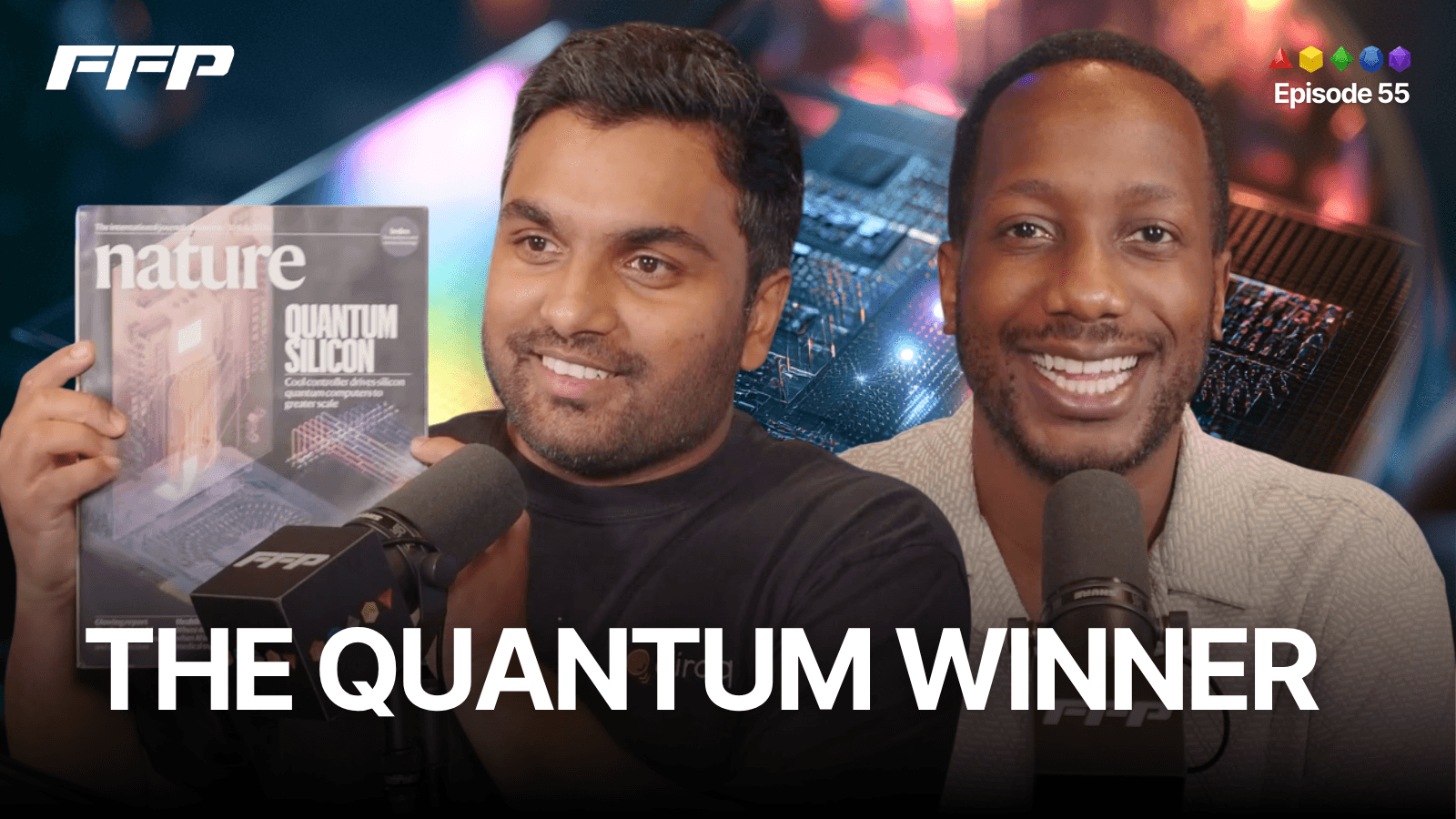
Krishna introduces an HRL research paper he co-authored on a digitally controlled silicon quantum processing unit. He uses the result to make a broader case for silicon spin qubits, emphasizing their potential connection to semiconductor manufacturing. That argument is his interpretation of the technology's prospects, rather than a settled verdict on competing approaches.
1,220 words · auto-generated from the episode video
2:25on the >> longtime listeners of this podcast might recognize that the intro music today is different from our usual music and that's because today is a very special episode. We're going to repeat the song at the very end of the episode in the credits and you can take a listen afterwards and hopefully you'll understand the lyrics. The reason why this is a special episode is because, you know, we've covered probably a hundred scientific papers on this podcast over the past year. And after a whole year of doing that, I finally get to talk about a scientific paper where I am co-author. I'm one of 250. It's a very large list of co-authors because it took a lot of human power, a lot of
3:08resources to do what we've done. But it's a special day. It's a special episode. I'm holding it right here. Nature's volume 655, issue 8,125, Quantum Silicon. >> All right. Look, look, look at look at [laughter] >> Shout out to John Carpenter for the visuals on the cover. Um, so this is a paper out of HRL Labs in Malibu, which was my former workplace, and it was recently announced that IBM has acquired the place. So hopefully By the time this episode ends, it'll give you a little bit of context about why that is a very interesting move. [clears throat]
3:48>> Okay. Now, this is not the first Nature cover story to have quantum computing or adjacent things. Okay. We've got several. Mighty Adams is a trapped ion story. Quantum supremacy. That's the Google one about quantum supremacy. There's the weird like holographic wormhole thing. I don't know if you remember, but like some people did some quantum experiment on a computer that suggested that they've they finally realized the Einstein Rosen Bridge and like wormholes exist. We tapped into that and it's like no, you know, that's not what happened. But in any case, the the current cover that I'm holding here is in a long line, but >> it's kind of the debut of a type of MVP.
4:31You know that they they say in VC circles, >> minimum viable product. >> That's right. This is an MVP for a type of quantum computer that I think will be the future quantum computer. Okay. Um why? Well, because it's in the name right here, quantum silicon. It's made out of silicon, which means that it can be made using the same machines and the same infrastructure that makes all of the classical computers that are in my phone, that are in this laptop, and in everything that we know and love. Whenever we have some new technology or some new paradigm, the question becomes, okay, you can prove it in the lab, but then how do you scale it uh in a production environment to actually make it viable for business use cases?
5:12>> Yeah, graphing [clears throat and laughter] >> and and to that point, you know, there's a there's a gap between uh the theoretical application and the production scale application. That's right. And so part of where I think you're saying we are is there are different approaches. >> Yeah. >> To how can we make this work at scale? >> Yes. >> And you're going to make the argument today that this debut is the way to make it work at scale because there's been promise around quantum computers for some time >> and we will have an fundamental understanding of why this is the way forward. >> Exactly. Yeah. And um to be clear I you
5:53know you've already given the disclaimer but I'll just say it again. This is not a normal episode and that we will be covering a lot of cool science. I mean it it is kind of a normal episode because we will be covering a lot of cool science and science history from first principles but it will be unlike other episodes >> um because it will not be unbiased science journalism. Now, I don't know if the other episodes were unbiased science journalism to to be preer perfectly honest, but um here I definitely have an agenda and the agenda will become pretty obvious as the episode goes on, but I want to make it explicitly clear here so there's no confusion and debate and people are in the comments being like, "You're biased. You're drinking the Kool-Aid." Yeah, it's my Kool-Aid. [laughter] >> I made it >> and I'm drinking it. Yeah. Purple,
6:33>> red. >> Exactly. So, th this will be an opinionated episode and the opinions are entirely our own. I do want to also just note for those who are audio listeners, as we were setting up the production for this episode, this episode has the most visual overlays of any episode we ever we've ever done. Yeah. >> Um it's quite there's a lot of complex ideas that are only best expressed by looking at it visually. And so to the extent that you can catch it on YouTube or on Spotify where we'll have the full video available, I do encourage folks after maybe a first listen via audio to do so because it is going to be very visually heavy.
7:13>> Yeah. Yeah. Yeah. And um it's going to be a lot of fun. I mean, I had a lot of fun planning out the notes for this episode. >> This is going to be fantastic. >> Um I mean, it's it's you know, it's a paper that I'm on. So [laughter] um and we're actually going to go into a deep dive not just about silicon quantum computers which is the um subject of the paper but quantum computing hardware in general and I want to answer the question how do you make a good quantum computer and what does that word good mean in this context right um there's going to be a shallow deep dive on other quantum technologies you know we've got superconducting circuits trapped ions neutral atoms and then I'm going to make the case for why this technology quantum is going to win >> there's is the agenda. >> Yes, that's that's the agenda.
7:54>> The agenda. >> Yeah. And um I used to work at HRL, which is where the paper comes from, but now I work at a company called DACA. Great name, by the way. Um and DAC also works on spin quantum computers in silicon. So, it's always been spins for me. >> That's fair. There's these other options, but you've been in the spin universe in terms of this is the way. >> Yeah. This is the way. This is the way. Um because it's still early in this race to make the first quantum computer. Okay. Um, other players might want you to not think that, right? Quantum supremacy on the cover of Nature. They did it. >> Well, okay. You simulated a probability distribution that is designed for a
8:34quantum computer to simulate because it was a quantum probability distribution. [laughter] Okay. All right. Cool. Um, there are different strategies. Um we've got superconducting circuits as I said trapped ions um neutral atoms and for a very long time actually the technologies um those those
Quantum HardwareQuantum InformationSemiconductor PhysicsCryogenic Electronics