
The hosts outline a comparison of qubit quality, control, and scaling before turning to the HRL processor. They also share listener-support updates and introduce the researcher transfer board at ffppod.com/transfers.
620 words · auto-generated from the episode video
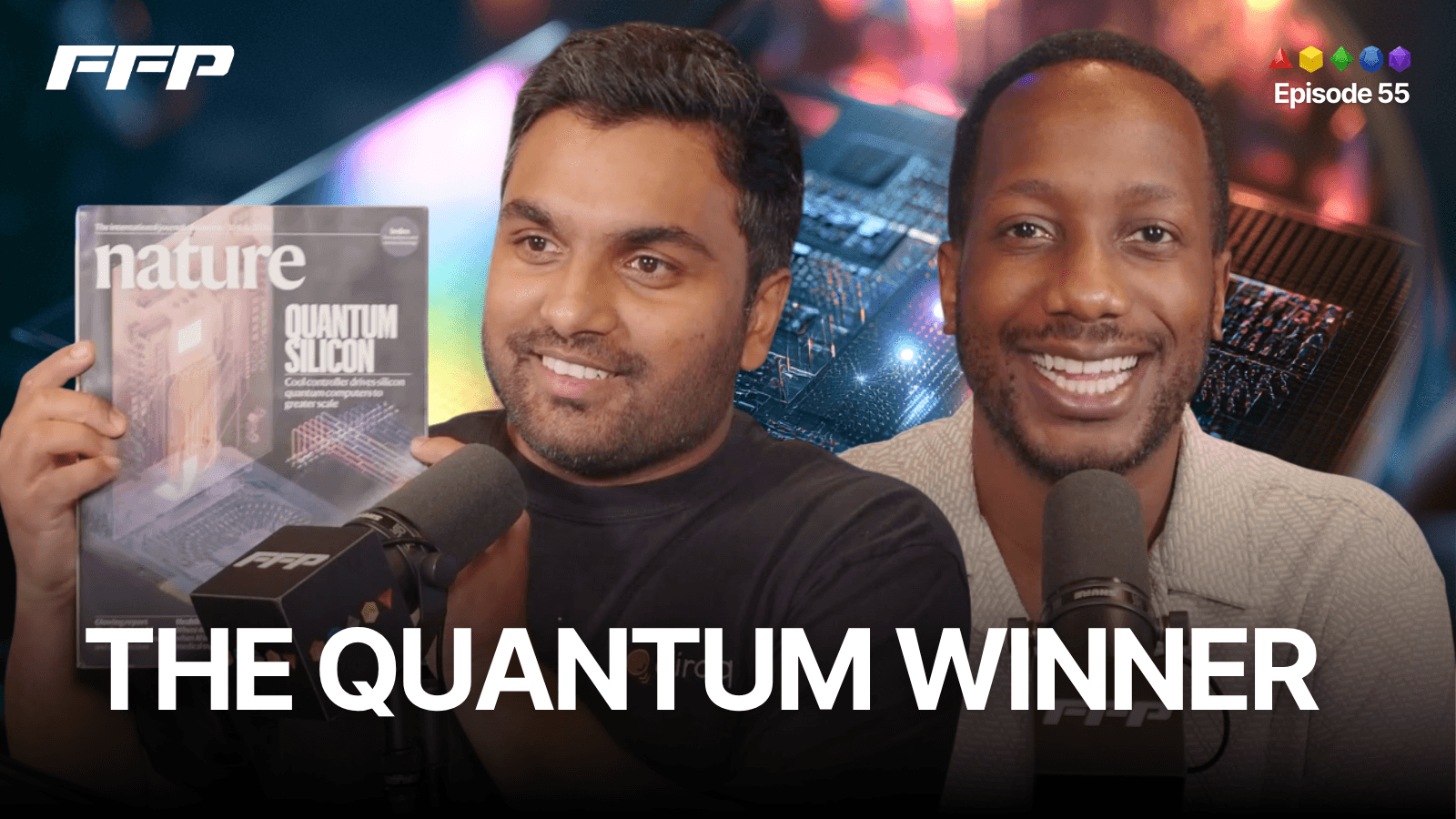
19:24I'm going to repeat the agenda for the rest of the episode. The agenda is the following. First, we're going to talk about what makes a good quantum computer. What are the criteria that a good quantum computer needs to satisfy? Next, we'll go over the other computing technologies, superconducting circuits, trapped ions, and of course, neutral atoms from our German boy. And then finally, we'll get into quantum silicon, this paper that's out in nature. We'll go over the history of the field briefly and where the recent paper fits in. And we're going to make sense of this cover photo because this cover photo has a lot of really cool tidbits that I think will be cool to understand like why certain parts are highlighted, things like that.
20:05>> It's quite nice. >> Yeah. Um there's if you if you notice there's three parts highlighted here. There's there's this square up here. Then there's this like um sort of >> half pipe a quarter pipe >> quarter pipe looking thing. It's like a ribbon. >> And then there's this tiny little square down here. So those are the three that are the big three that came out of this paper. and we're going to talk about all those um and what this paper means for the future of quantum computing in general. So that's going to be the episode. Um and before that, let's do some housekeeping. >> We'll do some brief housekeeping. For those joining us for the first time, welcome. This is the best science show on the planet. For those who really want to understand the fundamentals of the
20:46latest breaking frontier science research, as always, the best way that you can support the pod is a like, a share, a comment, put it in the group chat, uh, fivestar if you're listening on any of the podcast networks. Really helps us get this show to more people. We are available in video on Spotify and YouTube. As we mentioned again, we are waiting for Spotify creators to do video distribution to Apple podcast for those commenting on it. We have not forgotten. It is just in process by late 2026 and so we should see that hopefully before our Christmas time wishes get done. I'll try to keep this tight today. So, a
21:27couple of quick other points of order for our uh winners of our oneyear uh merch anniversary episode. We have just sent out those emails to you and so you should have a link to claim the merch from our shop. We appreciate again those of you who responded and have been here with us for some time and uh it was really incredible to hear a little bit of feedback again for what folks want to see from us in year two. We also have just put out our transfer portal. Again, it is uh the transfer season in science just like it is in sports. And after our
22:07last episode, many of you said you'd be interested in seeing this evolve. So, we've put out a first test at ffpod.com/transfers. You can see some of the latest highlevel transfers happening all across the world into the US, out of the US, uh and where are the best and brightest going to build the future of science. If you would like to donate, you can also donate at the website ffpod.com/donate. We are not going to do any other science stories in a brief rundown this week because we have so much to cover and so with that we are going to get back to the quantum no quantum mania bad Marvel movie but to uh this idea spin cubits.
Quantum HardwareQuantum InformationSemiconductor PhysicsCryogenic Electronics