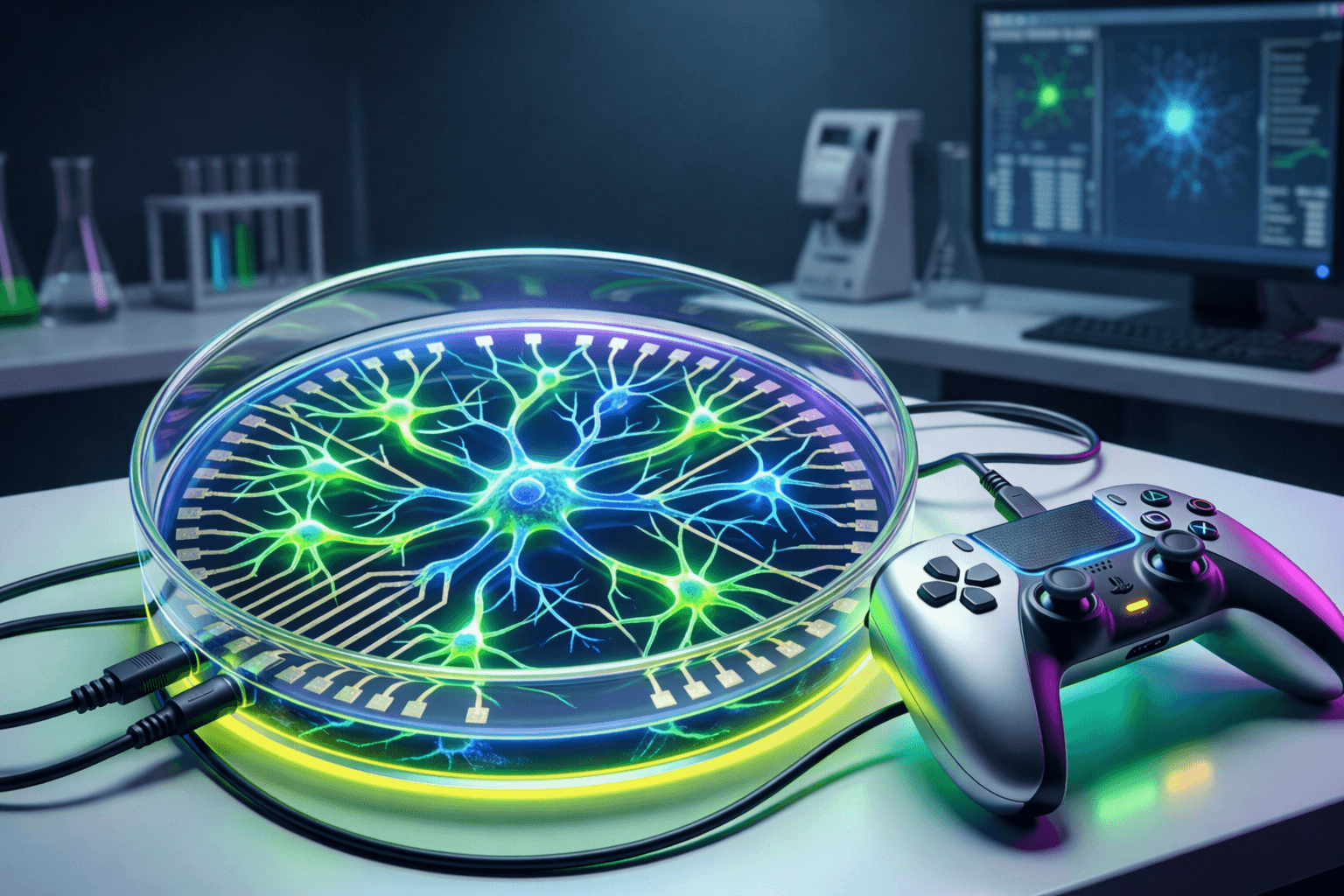
Artificial IntelligenceEvolutionGeneticsPaleontology
AI-designed dog cancer vaccines, weird fish evolution, ketamine for depression, and how life rebounded after the asteroid.
Hosted by Lester Nare and Krishna Choudhary, this episode is a fast-moving science rundown covering four remarkable stories from across AI, genetics, neuroscience, and paleontology. We dig into the story of a machine learning engineer who used AI tools to help design a personalized cancer vaccine for his dog, explore how an all-female fish species has survived far longer than evolutionary theory would predict, unpack new brain-scan evidence for how ketamine may rapidly relieve severe depression, and look at new research suggesting life rebounded shockingly fast after the asteroid that killed the dinosaurs. Summary AI and personalized medicine — a striking case study in how AI tools may help accelerate highly customized treatments, starting with a rescue dog named Rosie. Evolution gets weird — the Amazon molly fish appears to challenge the usual assumptions about why asexual reproduction should fail over long time scales. Why ketamine works so fast — new PET imaging research points to brain-region-specific changes in AMPA receptors in treatment-resistant depression. Life after catastrophe — microscopic plankton may have evolved into new species within just a few thousand years after the Chicxulub impact.
- Nature Astronomy
The dynamics of AMPA receptors underlies the efficacy of ketamine in treatment resistant patients with depression
Think of your brain as having billions of tiny locks and keys. One particular lock — called the AMPA receptor — sits on brain cells and helps them talk to each other using the chemical glutamate. In people with hard-to-treat depression, this study found that those locks are less plentiful than normal, especially in emotional brain regions. When doctors gave these patients ketamine, it actually changed how many of those locks were available on the cell surface — and the bigger that change was, the better the patient felt. So ketamine isn't just temporarily numbing pain; it appears to be physically restoring a broken communication system in the brain. The scientists confirmed this by using a special brain scan (PET scan) with a radioactive tracer that literally glows where those AMPA receptor locks are located, letting them count them in real time in living people.
- Geology
New species evolved within a few thousand years of the Chicxulub Impact
Imagine the worst day in Earth's history: 66 million years ago, a giant asteroid slammed into what is now Mexico's Yucatan Peninsula, wiping out the dinosaurs and about 75% of all species on Earth. The oceans were especially hard hit. Tiny shelled creatures called foraminifera — think microscopic snails that float in the ocean — were nearly completely wiped out. Scientists used to think it took around 30,000 years before new species of these creatures started showing up. But this new study used a clever trick: measuring a rare type of helium (helium-3) that rains down from space at a steady rate, like a cosmic clock, to figure out exactly how fast sediment was piling up on the ocean floor. By doing that, they could measure time far more precisely. What they found was shocking — brand new species were appearing in the fossil record less than 2,000 years after the asteroid hit. That's incredibly fast for evolution. In fact, up to 10 brand new species appeared within a window of just 3,500 to 11,000 years across six different ocean locations around the world.
- Nature
Gene conversion empowers natural selection in a clonal fish species
Transcript
Show →Hide7,590 words · auto-generated
Intro — four science stories and the quiz segment
0:00So, we're going to start today with our first story uh about a man who fixed his dog's cancer with Chat GPT. And no, this is not clickbait. It's fully female. Mhm. And it's incredible that it survived for so long because it uses cloning. Ketamine seems to work on them. Okay. And it's weird for two reasons. One, why does ketamine work when all these other antidepressants don't? And two, ketamine works at a really fast time scale. Life rebounding shockingly fast after the asteroid that killed the dinosaurs. Hello internet, this is your captain speaking. Lester Nare joined as always by my co-host and our resident PhD,
0:42Krishna Chaudhary. We are here for another casual rundown episode where we're going to touch on four stories that we did not do a deep dive on this week, but are also interesting and exciting breaking news stories. Categories we will cover today include AI, genetics, neuroscience, and we'll end with a paleontology and ancient life story. And squeezed in the middle there, we will do another lovely exciting round of are you smarter than a scientist where you can test whether your knowledge of the universe is greater than our resident PhD, Krishna.
1:24We are going to learn about the science from the ground up today, as always, because this is from first principles.
1:45So, we're going to start today with our first story uh about a man who fixed his dog's cancer with Chat GPT. And no, this is not clickbait. Uh there was a man's dog who
AI-designed dog cancer vaccine
1:59was riddled with tumors and dying. And he used ChatGPT to design a custom cancer vaccine, which is stunning researchers. This is a He's a Sydney tech entrepreneur, no background Mhm. uh in sort of this research area of oncology. >> Yeah. Uh used ChatGPT and some other AI tools to design a world's first personalized cancer vaccine for his dying rescue dog Rosie, who had advanced mast cell cancer. And then working with the University of New South Wales, they sequenced the dog's DNA, identified the cancer mutations using AI, and created the custom mRNA vaccine that shrank the
2:41tennis ball-sized tumor by 75% within months. This is fascinating. >> incredible story. And I mean, we've covered AI a lot on our podcast. And usually it's all been doom and gloom. But, you know, one of the things that gets me excited about AI is this I is this idea of the democratization of science and the democratization of technology and capability. And this is a spectacular example Right. of what it's capable of in the right hands. I think that's so cool. So, there was a Sydney tech entrepreneur, Paul Cunningham, and his rescue dog Rosie. The rescue dog
3:22Rosie had months to live. And he just did not accept that prognosis from the veterinarians. So, what he did was use ChatGPT to build a personalized cancer vaccine. It's pretty incredible. He had no, as you were saying, no background in biology, just 17 years as a machine learning engineer. So, reasonably tech savvy, Sure. reasonably has probably a first principles background of how stuff works at the DNA level. And here's what he did, okay? So, first always you go to chemotherapy. Chemotherapy slowed down the spread, but you know, it couldn't actually shrink the tumors of his dog. So, he spent
4:03$3,000 to have Rosie's healthy DNA sequenced, and then the tumor DNA sequenced as well. Okay. From the University of New South Wales. They've got, you know, biomedical labs, so they can do this. And then now that you have the DNA sequencing of what normal cells in his dog look like, and what the cancer cells in his dog look like, you can find mismatches Mhm. of where the cancer mutations are. Yep. Okay? And then he used the mRNA vaccine, which is the same vaccine that Moderna um sort of pioneered for COVID-19. The technology is the following. You insert a piece of mRNA
4:43that then gives your body a blueprint of what to look for in order to have that immune response. Mhm. Right? So, in the COVID-19 vaccine, the mRNA is for the spike protein on the COVID virus. The mRNA goes into our body, our body then translates that mRNA into protein, makes the spike protein. Our body then creates antibodies that
How mRNA trains the immune system
5:08recognize that spike protein, so that when the real thing comes in, we can recognize the spike protein, we can recognize the virus, we don't get full-fledged COVID. We actually have an immune response the first time. It's effectively training the body's defense forces for what the enemy is going to look like before the enemy is on your shore. Exactly. And over here, the enemy is already on our shore. Yes. But the problem is that cancer is very deceptive. Cancer has a lot of mechanisms to suppress the immune response. And then also, the cancer is our own DNA. So, our immune system isn't like as good at targeting cancer versus something that is fully foreign, right? Because when it's fully foreign, and obvious. Right. But with cancer, it's like your own
5:48cells are actually acting up. So, here's what he did. He pinpointed the mutations that were driving the cancer in that tumor, and then he made an mRNA that would train Rosie's immune system to target that specific tumor. Okay? He also actually had to um additionally put in things that would suppress that immune suppression. So, it's like a double negative. >> Yeah, yeah, yeah. Right? Cuz like the cancer is telling the immune system, "I'm don't don't come at me." So, there's a suppression there. He had to put in a bunch of drugs that actually like told the immune system to ramp back up. >> Right. Okay? So, this double double-edged sword kind of went in, and
6:29it's incredible. Less than two two months less than two months after the sequence was finalized, Rosie received her first injection in December, and by March, 75% of that tennis ball-sized tumor was gone. There's a great quote from this article from a Paul Cunningham who said, "At the start of December, her mobility was way down at the beginning. Uh she started to shut
Rosie’s results and why this matters beyond one dog
6:53down and was a bit sad. And towards the end of January, she was jumping over a fence to chase a rabbit." >> Yeah. So, not only the the the biological decrease by March, but even the behavioral change >> Yes. uh even sooner than that is just unbelievable. >> It's unbelievable, and it's like so incredible, such a cool story. As a former dog owner, um you know, like the the ends of the earth that this guy went to >> Yeah, yeah, yeah. to save his dog, I really identify with that. I thought this was so cool, and it's also the first time that there's a personalized cancer vaccine that's been designed for a dog. >> Yes. Ultimately, this is going to help in humans as well. I'm sure I'm sure the
7:34um New South Wales researchers at the university are like writing a paper right now, cuz this is a great paper. If you're not, you really shouldn't be. Like this is this is something that I can see coming out in a very top journal. Um, and the bigger picture is actually very cool. Moderna and Merck um, the two companies are actually leading the pack when it comes to personalized mRNA vaccines for this purpose. So, in humans, um, where they're going to, you know, again, sequence the DNA from the tumor, and then go back, create the mRNA vaccine. If you can make this cheaper, and if you can iterate on this faster, this is huge for, you know, cancer in human beings as well. I think the next step, um, what
8:15he's going to do is every single tumor on the body is actually different, right? Because every single tumor is a few mutations here and there. So, that's why only 75% of the tumor went away. Because the core of the tumor likely has other mutations that he didn't sequence. So, you can iterate on this. You can apply Now you can get to the smaller inner orbit. Sequence that, and then now get back to the >> the second order, third order, so on and so forth. Um, I just thought this was a very cool, hopeful story in the potential that AI has for just like average people, Yes. >> you know? Like uh, $3,000 sounds like a lot, but I don't know, I would have paid
8:56that for another year or two. Based on the cost of cancer uh, treatments now, I think that's probably bargain basement or close to it. It's It's on the It's not necessarily It's It's not It is It's not cheap, um, but healthcare, as many of us know in the United States, and especially in cases like this, is extraordinarily expensive. >> Yeah. So, anything you can do to chip away at the cost, uh, while still being safe and having efficacy and all the check boxes, is is huge. >> And if you were to compare it to, let's say, like you get a consultant who's a cancer researcher, and you get a whole team to actually do this, it's like pennies compared to like actually hiring a full-fledged team
9:37>> Right. to dedicate to your dog. Yeah. Yeah. >> Yeah. The time and the resources. So, I think I think it's really really cool. And a lot of these the Moderna and the Merck vaccines, they've jointly developed these for melanoma. It's already shown a 49% reduction in the risk of cancer recurrence and death over a 5-year range. So, should be coming out soon. Yes, this is good. >> The only way to have made this a more uh heartfelt lovely story of if if the Sydney dog owner's name was John Wick. Oh yeah. Yeah. Yeah. Yeah. That would That would have just rounded out the story perfectly. Um but great >> But Cunningham is a good enough name.
10:18>> It's >> Paul Cunningham. Paul. >> Props to you, man. >> Yeah. Awes- awesome stuff. Really really awesome stuff. Uh take life into your own hands. Great start with a that sort of interesting angle to an AI story. Our second story is uh a similar gene kind of story, but this one I'm very curious This one's weird. to to to talk to you about. So, the title on this one is gene gene conversion empowers natural selection in fish species. So, there's a tiny Amazon fish that has been uh a fascinating look for researchers for some time. And it get it should not have survived as a species.
10:59>> Yes.
The Amazon molly and the cloning problem
11:00And there's an interesting reason why it should not have survived as a species. And this is out of University of uh Missouri as well as the Ludwig Maximilian Universität in Munich, Germany. That's the umlaut. So, it's a Universi- Universität. Universität. Yeah. Uh so, you're a good You'll do the German and I'll do the French. >> Yeah, you do the French. Yeah. Um This is a really cool story because this particular fish, it's found in Southern Texas, Northern Mexico. It's called the Amazon molly. And it's named after the Amazonian tribe of legend, which were an all-female tribe, no men, and they had just figured out a way to procreate. This fish, all female,
11:43doesn't actually like have sexual reproduction Oh interesting. >> males. Interesting. >> Yeah. >> Okay. It's fully female. >> Mhm. And it's incredible that it survived for so long because it uses cloning effectively Oh, yeah. >> Yeah, yeah, yeah. And all evolutionary theory says that that is a really bad idea. Why? Because when you clone, you don't get genetic variability. And so if there's any kind of change in environment, evolutionary pressure, you're gone. Right. >> Cuz everyone is identical. >> Right. So, the big question has been, this thing is at least 100,000 years old How >> how did it happen? Yeah. So, it formed when there were two fish species, I
12:23believe it was the um Atlantic molly and the sailfin molly. They made it. They produced this hybrid. This hybrid now was a female, and every single Amazon molly today can can be traced back to that single parentage, that single person. Okay? That single fish, I should say. Mhm. Um what's weird about it is that, you know, as I said, they don't sexually reproduce. >> Right. So, they still actually have sex with males, but there's no sperm that is going to fertilize the egg. >> Okay. That sexual process, the act of having sex, starts triggers the special kind of meiosis >> Mhm. in the fish that causes this
13:03cloning to happen. So, you get egg cells
Gene conversion and how the fish survives
13:06that are identical to the mother. >> Yes. >> And then those egg cells become Yes. um Amazon fish. >> Baby fish. >> Okay. So, the question becomes, all right, how did it survive, right? How do you How do you actually um you know, if there's a deleterious mutation, if there's like something that goes wrong during the replication of DNA, Mhm. you might be completely >> Right. sidelined right? >> They use um a process where they're actually using gene conversion. This is the idea where you've got multiple sets of chromosomes, right? If there's ever a mistake, their genetic repair mechanism can use the other copy to make that fix. That repair mechanism also creates
13:48um genetic variation at exactly the right frequency to have a pretty healthy population that is that is not completely genetically identical, but it's got this mechanism such that it can stop mutations from going bad and also create tiny little mutations to create variation. So, the the genetic variability is deriving from the sort of uh the the internal cloning reproductive process as opposed to sharing the chromosomes from the mother and the father or, you know, one into male and female. >> Exactly. And that's kind of a dis- an important distinction in the difference
14:28with how it drives its own sur- ability to survive over long periods of time by uh while still not having uh a classic sexual reproduction between uh a male sperm and a female egg. Yes, exactly. And usually that's how we get genetic variability, right? Is like from the combination of two individuals' genes. That's most life actually, even trees, plants, like everything does this kind of mix and match. But these guys are doing a copy and paste, but that copy and paste has enough little tricks that like shows this is actually possible. It challenges this traditional assumption that, you know, asexual reproduction is going to
15:09cause sterile species. >> Yes. It's not actually true. So, maybe evolution has many more ways to actually maintain a healthy genome in that tree of life. And we've been sequestered into thinking that sexual reproduction is sort of an apex mechanism. It might not be. Uh don't tell that to the people who want to uh whatever you call it when you make people all the same. Oh, yeah. Yeah. That that's let's not let them know about that. Yeah. This this was in nature um again at the University of Missouri and the Ludwig Maximilian Universität in Munich, Germany. Tate. Tate. >> It's the it's the the double dot
15:49>> yeah. the umlaut >> The umlaut, yeah. We'll go we will be in Germany for Oktoberfest maybe this year. So, for all the fans out in Germany, let us know. We are going to need to be shown around. Now,
Are You Smarter Than a Scientist? — largest organs quiz
16:04last time around on the rundown, we introduced our new segment. Mhm. And we're going to bring it back for another trial test of Are you smarter than a scientist? >> Okay. The game show where you at home can find out if you are in fact smarter than our resident PhD. And the question this week is name the 10 largest organs in the human body by mass. And I will make uh one small caveat about the answers to this, which is that the organs are discrete. They're discrete. Okay.
16:46All right. Um let's see. Let's start with the liver. I'm pretty sure that's huge. So, we're going to see where is liver on the board? Is it on the board? Yes, it is at number two. Um And that's at 1.5 approximately 1.5 kg. Okay. 1.5 kg. What's bigger than the liver? Um all right. Let's start with some of the easy ones, right? Let's do um lungs. The lungs is on the board at spot number four at 1 kg. Um let's do the large intestine. I won't give you a strike for this. >> Uh-huh. Because technically it's a part of the
17:26digestive tract. Uh-huh. And would not be considered a discrete organ. >> Oh, interesting. >> So for that first one, I'll give you a pass. I'll give you that. All right. Um Well then, wait. Would digestive tract be on here? No. Okay, interesting. That I'll again, that's kind of all categorized together. So let's let's kind of put that to the side. >> put it to the side. So stomach is also not on this? I'm going to give you a strike for that one. Okay. Fine, fine. I'm asking too many questions. All right, let's do brain. Brain is on the board at number three. So we have number two liver, number three brain, number four lungs.
18:07Um Let's do heart. The heart is on the board at number five, approximately 315 g. Um, let's go for Is skin on here? Is skin on the list? Yes. >> Big spot at number one. >> skin is number one. >> I have the top five. Very good. All right. This one's hard. Last last last The last five. One strike. Skin, liver, brain, lungs, heart. Top five. Skin
18:48Um The heart is on there. Kidney. Is kidney on the list? At number six. >> we got to get smaller than kidneys now. Um Let's do pancreas. Is pancreas on the list? At number eight. >> Okay. So we are missing seven, nine, and 10. You are on a roll. Uh, give me These ones are a little tough. You'll you they're mhm Give me the bladder. The bladder? No, not on the list. That is our >> one strike left. >> You have one strike left. We have number
19:29seven, number nine, and number 10. Choose wisely those listening. We only have one strike left. Man, what am I thinking of now? Mhm. Now, again, it's it's discreet. Mhm. Um I'll give you one hint here, which is one of them is uh only present in males. Oh, it's only present in males. Um is it going to be prostate or testes? I'll do prostate. Prostate is on the board at number 10.
20:11So, we are missing number seven and number nine. >> there's there's something that's about that's in between size of kidneys and pancreas, and there's something in between size of pancreas and prostate. Okay. Gallbladder. Is it gallbladder? Unfortunately, that will end your trial on round two of are you smarter than a scientist? We had two missing items. Number seven was the spleen. >> Okay. Should have gotten that one, yeah. And our last one, get your guesses in now for those at home, was the thyroid. >> Thyroid, yeah, I didn't even think of that, you know. So, our list: skin,
20:53liver brain lungs heart kidneys spleen, pancreas, thyroid, prostate. And I will just note that this was for the male body because you could arguably put the uterus on the list a little bit higher than some of these items. So, not a bad round. We were missing some of those answers. We're still going to give you a a nice little five there for our second round of are you smarter than a scientist. If you are interested in the game show or you would like to see us bring on guest contestants for a head-to-head competition, please let us know in the comments. We are going to
21:35continue on to our third story, which is about brain scans revealing how ketamine can quickly lift severe depression. If you're in the UK, you might be familiar of uh with this as being called ketamine. Mhm. Here in the US, it's called ketamine. Uh this is out of the YCU Advanced Medical Research Center and it was in Molecular Psychiatry. Yeah, this one's a very interesting
How ketamine may rapidly lift severe depression
22:04um paper because I've always wondered why ketamine or ketamine is so effective against depression. So, major depressive disorder, that's MDD, it's a major global health problem. Um 30% who are diagnosed are given treatment-resistant depression. That's the tag that they're given because even normal antidepressants don't work on them. Ketamine seems to work on them. Okay. And it's weird for two reasons. One, why does ketamine work when all these other antidepressants don't? And two, ketamine works at a really fast time scale. Okay. Okay? Most of the time when you take
22:44antidepressants like in pill form, the the effects are going to come in like a week to a month. That's the time scale that you're looking at. >> Yes. With ketamine, it's like minutes. Really? >> Okay, yeah. Yeah. That's >> it's like you're there at getting the therapy, you know, getting it injected and then like it's like within the hour to like that day is like when you start feeling not depressed. >> Mhm. Okay? So, there's clearly a very different mechanism about what's going on. Right. And for the longest time it's been really quite nebulous how it's actually working. And a lot of times with the brain a lot of things are nebulous because we don't know enough. There's so many things that are working around and at some point, you know, you just you
23:24just sort of say, "Hey, it's working." But as scientists we always want to figure out what's actually happening because then we can model things very well. We can start thinking, "Okay, how is ketamine actually going to affect? What is the dosage that we want to give? What is the frequency with we will with which we want to give?" If we have a fundamental understanding, then we can actually start doing clinical trials for like different types of therapies, different schedules, and things like that. So, it's very important to actually figure out what is going on. Now, there were early um studies that showed it had something to do with the AMPA R receptor. So, a brief overview of neuroscience.
Neurons, synapses, glutamate, and AMPA receptors
24:00Our nervous system is built out of neurons. Neurons are the single unit of the unit nervous system. They're cells and they talk to each other using synapses. So, when one cell fires or turns on, what it's going to do is talk to its post-synaptic cells, the cells that it is synapsing onto, the cells that it can talk to using these structures called synapses where one cell comes in kind of like a hand and the other cell that is downstream comes over it like a uh like a like a open palm around it, okay? But there's a gap in between. They're not actually tied together. They're separate cells and they have a tiny gap called a synaptic junction. Now, through that
24:41synaptic junction, the way you talk is you ex- you release the the pre-synaptic cell releases chemicals into that synaptic cleft, that gap, and then the post-synaptic cell senses those chemicals and then turns on. Okay? That's effectively most like 99% of neuroscience is just a cell talking to another cell using these chemicals. Most of the time that chemical is glutamate. It's not, you know, serotonin, dopamine, all this other stuff. We talked about this on the Dave Chang podcast. Yeah, MSG is effectively just glutamate with a little bit of sodium. Um so
25:22glutamate is the bread and butter. It is how It is like the cash money of how neurons talk to one another and transact information. And the receptors that sense the glutamate to trigger a response in the postsynaptic cell, in the downstream cell, those receptors, one of them is the AMPA R receptor. Okay? And what we've what we've seen in previous studies is that ketamine has something to do with these AMPA R receptors. Okay? We just don't know
The PET brain-scan breakthrough
25:53what. Okay. The receiving end of the chemical signal to turn on. Yes. It's It's receiving the glutamate and somehow that receiver has something to do with ketamine. Okay? So what these guys did was they used positron emission tomography. This is an imaging method where you basically like you have the patient inject some radioactive chemical. It's not that harmful, but it's what it does is that chemical becomes a tracer. It releases positrons as it makes its way through. Positrons are the antimatter version of the electron. And if you have a positron detector, then you can detect these positrons and you can see where the chemical is going. So it's it's a way
26:34it's a way to basically look at what's happening inside the body or track what's happening inside the body from outside the body. Yes, exactly. And so what what these guys at the City University of Yokohama they developed a PET tracer, a positive a positron tracer that had been developed earlier. This tracer allows them to visualize that AMPA R directly because it somehow either connects to the AMPA R or like interacts with it in some way. So, we can actually map where the AMPA R receptors are in the brain. Got it. Okay? That's step one. We figured out a way to trace and map out where the AMPA R receptors are.
27:14Now, you give your patients ketamine. Cuz we first identifying the location >> Yes. That's what we want to do. >> the thing we care about is happening. But, we didn't actually know where the like we needed to know where the locations were first. >> Yeah, we knew that it was this thing, yes. But, we don't know we have no way of figuring out where it is. And like what are the dynamics when somebody gets ketamine? How does that change? Now, we do. Now, we've got this tracer that goes in, it's going to shoot out positrons, and we've got a big positron detector. So, wherever the positrons are coming from, we know that's where the AMPA R receptors are. Mhm. Okay? Then, we give them ketamine. Yes. And we look at how these antidepressant effects evolve that AMPA R activity, that receptor activity. And that's what they've done, okay? >> They they used 34 patients that were
27:55diagnosed with this um treatment-resistant depression and 49 healthy patients that were in control. They gave half ketamine, half like just, you know, placebo cuz you got to have the that control. >> Mhm. And then what it shows is the the people who have this treatment-resistant depression, first of all, they had widespread abnormalities in their AMPA R density just without even the treatment and everything. Those who have depression have a very different AMPA R density in their brain compared to healthy patients. Can I do a quick pause here on that point because well, just to double click on it, there is a structural a physical structural difference
28:36>> Mhm. uh at the neuron level >> Yeah. for people who have this treatment-resistant depression than the control than than others. Yeah. So, for
Depression has measurable physical differences in the brain
28:45all the boomers who say depression is a made-up thing in people's head, it's actually it has a it has a physical manifestation. Yes, it is in their head and it is like a very much physical manifestation of like literal receptors and chemicals. >> Are structured differently. >> a difference, right? And so now we we we get into, okay, what is the ketamine actually doing, right? Um,
Where ketamine seems to change AMPA receptor activity
29:08and surprisingly, it was not uniform. There was like what what they would do is figure out what is the AMPA receptor density before the treatment and then you give them ketamine and then you figure out what is the after, right? Not everywhere in the brain changed. Okay. >> Very specific regions of the brain actually changed. There's this place where there's reward processing, it's called the habenula. Okay. >> Okay. A lot of AMPA receptor shifts were happening there. And this region-specific shift is strongly connected to the improvement >> I see. in the depressive symptoms, okay? So, we can also see that. Not only is there change, we can also see that how much change is related to how much the depression gets better. So, clearly we have some mechanism here, right? Mhm.
29:50And this is very early. This is very early, but I think it's very very cool because now we're seeing these dynamic changes in something as fundamental as the AMPA receptor. This is not like serotonin, again, this is not serotonin or dopamine or things like that, which are very specific to certain circuits that have to do with reward, that have to do with pleasure and things like that. AMPA is like how like it's like the again, cash. It's not a weird commodity like gold or something. This is how all neurons talk to one another, right? And so, this is a very fundamental substrate. Can I try to make a a different analogy maybe here? Um, would it be like saying these AMPA receptors are like the
30:31the the under the underwater internet pipes. Mhm. Whereas the serotonin are like a webpage or a specific domain that is accessible on the internet, but it's not the actual system that information is sent through. Like I'm trying to I don't know that I quite understand the cash analogy. It doesn't track in my head as well. Um so, I'm trying to understand the how to differentiate thinking about serotonin and dopamine as different from these receptors. Yeah. Okay. So, let's let's go with the internet analogy, right? Um if if you say that the um the amp the
Glutamate vs serotonin — the currency analogy
31:06glutamate Yes. >> What I'm saying is like glutamate and another one which is GABA, that's the inhibition. Glutamate and GABA are like your cash. What I mean by that is like it's like I shouldn't say cash. I should really say they're the dollars. Okay. You know what I mean? Like if you want to if you want to transact value between one person to another, what do we normally use? We use dollars. Or if you're in another country, you use whatever denomination is the fiat currency. >> Yeah. Okay. So, it's okay. Got it. >> But there are other ways to transfer value. I can give you a house. I can give you land. I can give you Bitcoin. Those are your serotonin, your dopamine, your acetylcholine, things like that. Right? But you can't build an economy
31:47off of those assets. I I I would say yes. >> need a fiat currency that is super liquid. And I mean, there's people who are going to say Bitcoin is But look. We are where we are today. It wasn't invented in the whatever centuries ago. >> make sense? It's like glutamate and GABA are your dollars. >> Yes. Yep. Yep. Yes. >> so, the fact that ketamine is tied to AMPA receptors Yes. which are receptive to glutamate Yes. shows just how like nitty-gritty it's getting into. And perhaps that is a clue as to why it's so fast. Right? >> Because it's it's not waiting for the Bitcoin network to settle. >> Yeah. Yeah. You don't You don't need to produce dopamine. Right. It's just Yeah.
32:28>> Yeah. Yeah. Yeah. Okay. That That's That's very And So, this is very early, but I think it's very very cool. And it's only going to get cooler and cooler. And I think another piece of this that is that is interesting is being able to, you know, have I mean obviously a there are a variety of these new studies now that are trying to look at you know, substances that have historically been viewed as just purely detrimental to the human condition and having no positive Mhm. upside uh primarily cuz they were viewed for as recreational purely. Mhm. Uh but there is a clinical Uh a potentially clinical application >> Yeah. here that again when you actually understand the structures and
33:09fundamentals of what is happening we're kind of now starting to see why is it that ketamine can possibly has this positive effect on treatment-resistant depression. Yeah. Because the way in which it interacts with our brain is fundamentally different >> Mhm. than I can't remember what the terminology is for the kind of existing set of >> antidepressants. There's another like um there's another technical name for it. It's escaping me right now. >> I don't know. But, you know, all the Klonopin and all the stuff that people talk about in TV shows and things like that which there's been a lot of both there's been a lot of kind of pushback on what are the while it might treat the dopamine or the serotonin piece, it has
33:49a lot of these other potentially negative consequences for people. So, maybe there's a new path here. Super super fascinating story. Um And we'll see where it goes. Early like you said. >> but very cool. >> we need to be able to research a variety of different areas and explore all opportunities in a controlled and safe environments. So, we love to see that. Our last story of the day is our paleontology and ancient life story about life rebounding shockingly fast
Life rebounded fast after the dinosaur-killing asteroid
34:17after the asteroid that killed the dinosaurs. This is out of University of Texas at Austin. It was published in geology. And basically what they're saying is new research reveals that microscopic plankton right? >> Mhm. Uh began evolving into new species within just a few thousand years, possibly under 2,000, uh after the asteroid impact that killed the dinosaurs that we all remember from high school was 66 million years ago. Um and we all remember the amber from Dr. Hammond's staff in Jurassic Park where they extracted amphibian DNA dino DNA and merged it with amphibian DNA. But the idea here is that there was not the expectation that life after such
34:59a catastrophic impact uh would re-arise so quickly. It's an interesting way in which scientists have actually uh found this to be true. Yes, this is actually really cool. So, you know, 66 million years ago an asteroid hit Mexico effectively and created the Chicxulub crater. All the dinosaurs died. There was massive extinction all over the planet. There was a bunch of climate change. Um it was pretty bad. And what this paper is suggesting is that within 2,000 years there was a new species of plankton that had evolved. And 2,000 years is a blink when it comes
Why this recovery surprised researchers
35:34to 66 million years ago, right? This is pretty insane. It's ridiculously flat fast, okay? I mean ridiculously fast. >> It is. And that's literally what um the Chris Lowry, who's the study's lead author from the University of Texas, he said, "It's ridiculously fast." Is what he said. Um so earlier they had done work where they had gotten samples from the Chicxulub crater around the Chicxulub crater. And you can figure out where the fossils are in the fossil record. And then you've got some kind of model for how fast sediment gets deposited. >> Right. And so from that you can figure out how old stuff is, right? Because the deeper you go, the older it is. And if you have some rate of how much sediment
36:16goes through, you can calculate you can back calculate from where the boundary is you can there's a there's a layer of sediment from the meteorite all over the Earth. Mhm. When the meteorite splashed and like created that sediment in the atmosphere, so if that's our, you know, zero, 66 million years ago, from there we can then figure out how fast fossils were coming up. That's actually a good point in that because that impact surrounded the atmosphere in the planet with the ejecta from that impact, it's a it's a bookmark >> Yeah. in the sedimentary layers of of it's a time bookmark. >> Yes. Um which that's actually interesting.
The impact layer as a geological time bookmark
36:54>> cool, right? >> Yeah, yeah. It actually took um Luis Alvarez, who um he's mentioned in the Oppenheimer movie. We're going to do a special on all the scientists of the Oppenheimer movie and we're going to rank them. You're going to see where he falls, but Luis Alvarez, um he's one of Lawrence's PhD students. Mhm. And he actually later on in his life, he started doing lots of random stuff. Like he did this Chicxulub crater thing. He also mapped the pyramids. Like once he won his Nobel Prize in physics, he was just doing side quests. And each side quest was like, "Wow." You know? That's awesome. So, anyways, um so so that's what we normally do, right? Now, that's built on an assumption. This this
37:36whole sediment thing, right? You take the zero and then you you like figure out where the fossil is and where the sediment how much sediment is. From that, it's it's built on the assumption that um the rate at which sediment is deposited is the same before and after. Okay. Now, that's not entirely true, right? Because if there's a giant mass extinction, >> Right. all your trees are dead, all your plants are dead, there's going to be more erosion, so there's going to be faster sediment being deposited. So, you might have an over or an underestimate on when actually these plankton got where they are. That makes sense. So, how do you resolve this discrepancy? Yes. What they did was they used the radioactive
Helium-3 and how scientists measured recovery speed
38:13isotope helium 3. This is an incredibly rare isotope. So, already, this piqued my interest because helium 3 is incredibly rare. It's the It's one of the most expensive substances on Earth because helium 3 is used for very specific industrial applications. For example, if you have a something called a dilution refrigerator, which is what you use to cool down things like quantum computers, you require a lot of helium 3 in order to do that. Helium 3 is two protons, one neutron, instead of normal helium 4, which is two protons, two neutrons. That's the more stable isotope. Here, you've got helium 3. That's an isotope, right? And if you look at the dynamics of helium 3, helium
38:543 actually accumulates in the ocean sediments at a steady rate. Uh-huh. So, when the sediment builds up slowly, you're going to have higher concentrations. >> Mhm. But, if it's being deposited really fast, you're going to have lower concentrations in that layer of sediment that whatever core that you drilled, >> Mhm. right? So, by looking at the relative abundance of helium 3 versus helium 2 or like whatever not helium 2, obviously, but like, you know, other elements that it could decay into, we can figure out what was the rate at which the sediment was being depen- deposited. Because the helium 3's abundance level is correlated with the rate of sediment sediment accumulation.
39:34>> Exactly, yeah. The faster it gets accumulated, the lower the density, right? Because it doesn't have enough time to really pile up. And so, from that, they got the KP boundary location, you know, that layer of um meteorite like layer, >> Mhm. they got they got samples from that layer of sediment all the way from Europe, North Africa, and the Gulf of Mexico. >> Oh, interesting. So, all over the planet. >> Yep. And they looked at this helium 3 data Yes. to figure out what was the sedimentation rate. >> Yes. And from that, they actually figured out that the normal plankton species that we usually think about, it's called P.
40:15Ujubina. I hope I'm saying that right. I don't really know how plankton um is pronounced honestly. >> think it's pronounced Chum Bucket. I'm not Yeah, yeah, exactly. Yeah, but this normal plankton species that we normally look for um showed up about 3.5 to 11,000 years after the Chicxulub Chicxulub impact. >> Mhm. So, that's already pretty fast. >> Yes. There were certain species there were that there were certain species that appeared fewer than 2,000 years after the asteroid strike. Mhm. And that's pretty ridiculous. >> Yeah, no, that's very ridiculous. >> Right?
What a 2,000-year rebound means for life on Earth
40:53Like 2,000 years later these guys are already like, "Wow, no one is alive. I have all the sun to myself." Right. >> You know? Like so so the speedy recovery shows just how resilient life is. >> Yes. Right? To have This is not This is not like bacteria. This is plankton. So, this is pretty complex life. >> Mhm. Sure, it's still like, you know, single cell to fewer Yes. >> that many cells, but it's still it reestablished itself within a geological heartbeat. >> Yeah, which is which is un- I mean, it's unbelievable. And it's sort of, you know, there's all of the um you know, when people look at the history of this planet and there's all these epics that are kind of opaque to
41:34us. >> Mhm. Um and, you know, how many times have we seen these either regional or global ecosystem collapses and then, you know, rebirths. And there could be a number of them. And given how quickly now we're seeing the recovery from the asteroid from 66 million years ago introduced again, simple life, but so quickly. Um it does recalibrate, you know, how you think about a variety of sort of the catastrophe scenarios you see in movies. >> Yeah. Mother Earth will be okay. Yeah. >> Humanity may not. >> Yeah. But Mother Earth will be fine. And and and life will continue to find a way to live and prosper. I want to make a funny or not a like a quick side note
42:15about helium 3, which is for anyone who's a fan of For All Mankind, the Apple TV show, that does the revisionist history about uh who got to space first and the moon first. >> Yeah. Uh spoiler alert, uh one of the battles and one of the reasons for the moon permanent moon base location is that uh massive deposits of helium 3. Oh, okay. That makes sense. >> Which then allows them to power Yeah. all the stuff locally and then if you have and then there's all the movies where we run out of energy on Earth, we need to go to the moon to go get I think also um that's part of the plot point in uh uh Don't Look Up was that there was helium 3 on the moon and the tech guy wanted to go mine it or some crazy nonsense. Yeah. >> So, it's like it's one of those things people hear about in pop culture quite
42:56often, uh but not necessarily knowing real-world applications. So, this is a very interesting uh maybe non-traditional Mhm. uh use of of of the helium 3 isotope in terms of identifying Fantastic. We love a dinosaur story. We hit AI, genetics, neuroscience, paleontology. We had a great round two of Are You
Wrap-up and support the show
43:17Smarter Than a Scientist? In the comments below, let us know if you would like to see us continue the game show. If you have a guest that you would like to join as a contestant, tag them in the comments and say you got to be on this. And if you're still watching and you are a first-time listener or a long-time listener, this show is being able to be and produced multiple days a week just with the two of us and so your support is always super super helpful for us to be able to continue to get the latest and greatest breaking science in a way that's digestible and entertaining for all those who are curious. So, a like, share, a comment, bring it into the lunch, put it in your email listserv is
44:00super helpful as well as if you want to support us, you can go to our website at ffppod.com/donate and become a patron. Also, if you haven't checked out the website, all of the research papers we cover on every episode are right on that website. We have our episodes with chaptering and a whole bunch of features. So, if you want to really dig in, if we've piqued your interest with any individual story, there's plenty to dig in and jump in on the website. I am Lester Nare, joined as always by my co-host and our resident PhD, Krishna Chaudhary. Thank you all for joining us for another week, and we will see you next week.
- EP 63
Nobel Prize in Chemistry 2026 Explained: Mirror Molecules
Why does life favor one molecular mirror image? We explain Kagan and Soai's Chemistry Nobel, chirality, autocatalysis, medicines and mirror-life risks.

- EP 62
Nobel Prize in Physics 2026 Explained: IceCube & Neutrinos
How does a telescope buried in Antarctic ice detect ghost particles from space? We explain Francis Halzen's 2026 Physics Nobel, IceCube and neutrino astronomy.
- EP 61
Nobel Prize in Medicine 2026 Explained: Optogenetics
How did proteins from algae give scientists control over brain cells? We explain the 2026 Medicine Nobel, optogenetics, memory experiments and early medical applications.
- EP 60
2026 Nobel Prize Predictions: Medicine, Physics & Chemistry
Our 2026 Nobel predictions: the science behind GLP-1, light-controlled neurons, quantum interference, cellular droplets and more.