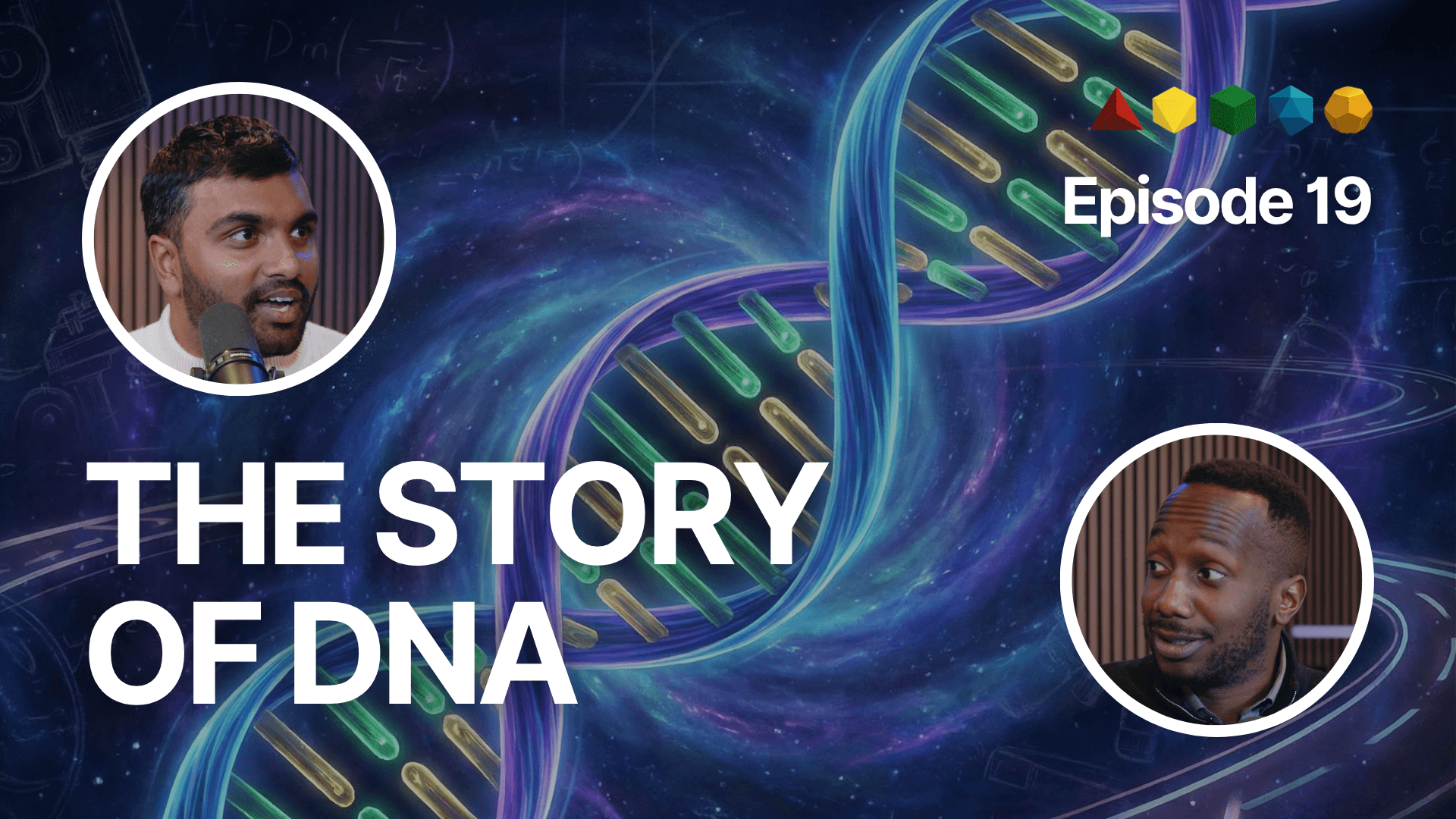
A single-story deep dive on DNA's discovery and its moral baggage.
Hosted by Lester Nare and Krishna Choudhary, this single-story deep dive tells the full story of how humanity uncovered the structure of DNA — and the human tensions that shaped it. From Mendel’s pea-plant mathematics to Rosalind Franklin’s groundbreaking x-ray crystallography, from Cavendish–King’s College rivalries to the famous Photo 51, this episode follows the scientific and ethical arc behind one of history’s most important discoveries. Summary Before DNA — Mendel’s inheritance laws, Miescher’s nuclein, Levene’s early models, and why scientists initially thought proteins carried heredity. The turning point — Griffith’s transformation experiment and the Avery–MacLeod–McCarty proof that DNA is the genetic material. The physics connection — Schrödinger’s What Is Life? and the idea of an “aperiodic crystal” inspiring Watson, Crick, and many physicists to enter biology. Two labs, one race — Cavendish vs. King’s College, Wilkins vs. Franklin, and the clash of personalities, methods, and interpretations. Photo 51 — Franklin and Gosling’s critical diffraction image that revealed DNA’s helical structure. The model — base pairing, antiparallel strands, and why the double helix immediately explained replication. Recognition and legacy — the 1953 Nature papers, the 1962 Nobel, Franklin’s omission, and Watson’s later controversies reshaping his legacy.
- Journal of Experimental Medicine
STUDIES ON THE CHEMICAL NATURE OF THE SUBSTANCE INDUCING TRANSFORMATION OF PNEUMOCOCCAL TYPES
Imagine you have two types of bacteria - one harmless and one deadly. Scientists found they could take a mysterious substance from the deadly bacteria and use it to transform the harmless bacteria into the deadly type. It was like giving the harmless bacteria a "recipe" that completely changed what they were. The big question was: what was this transforming substance? Most scientists thought it had to be protein (the body's workhorses), but Avery and his team proved it was actually DNA - the molecule we now know carries all genetic instructions for life. Think of it like discovering that the "instruction manual" for life was written in a completely different language than everyone expected.
- Nature
Molecular Structure of Nucleic Acids: A Structure for Deoxyribose Nucleic Acid
Imagine DNA as a twisted ladder (the famous "double helix"). The sides of the ladder are made of sugar and phosphate molecules, while the rungs are pairs of chemical letters (A, T, G, C) that always pair up in the same way - A with T, and G with C. This pairing rule is like having a perfect template: if you know one side of the ladder, you can figure out exactly what the other side looks like. This is how cells copy DNA when they divide, ensuring that genetic information gets passed along accurately from cell to cell and parent to child.
- Nature
Molecular Structure of Nucleic Acids: Molecular Structure of Deoxypentose Nucleic Acids
Imagine DNA as a twisted ladder, where the sides are made of sugar and phosphate molecules, and the rungs are pairs of nitrogenous bases. This paper helps us understand how these components fit together to form the structure of DNA, which is like the instruction manual for building and maintaining living organisms.
- Nature
Molecular Configuration in Sodium Thymonucleate
Imagine DNA as a twisted ladder or spiral staircase - that's what we call a "helix." Before this research, scientists knew DNA was important for heredity but didn't know what it looked like. Franklin and Gosling used a technique called X-ray crystallography, which is like taking a shadow picture of molecules using X-rays instead of regular light. When they aimed X-rays at DNA crystals, the shadows they captured showed a distinctive pattern that revealed DNA's twisted shape. They also discovered that DNA can change its form depending on how much moisture is around it, and that the "backbone" of the DNA molecule (the phosphate groups) sits on the outside of the structure. This was like finally seeing the blueprint of life itself.
Transcript
Show →Hide17,414 words · auto-generated
Intro
0:00Nihow internet. This is your captain speaking Lester Nar joined as always by my co-host, our resident PhD and number one Chimamath Polyapatillaa cosplayer Christian Chowdery, my friend. >> That's right. I can't afford um the the sweaters that he wears. >> The alpaca shipped from god knows where. >> Yeah. Yeah. Yeah. Yeah. Yeah. This is this is nylon shipped from Tik Tok shop. >> You you don't have the spack money. >> No. Maybe one day. >> One day. Maybe not via spa but via science communication. >> U it is now we are in the holiday season so we are winding down for the year. >> Uh big shout out to everyone who's
0:41joined the show. We started less than 6 months ago. >> Yeah, >> the response has been incredible. Uh we're going to be wrapping up season 1 basically at the end of the year. I think we've made the random executive decision to decide our seasons are just going to be every year. >> Yeah. And so we started only in halfway through this year. So season one little truncated. >> Yeah. No season. >> No, the Gregorian calendar is a great calendar. >> It's a great calendar. >> So that's how we're going to do our seasons. >> Yeah. >> So this is the first of kind of our wrap-up of the year episodes. >> Yes. >> With holidays, with travel, all these things with Mariah Carey being on the radio non-stop. >> Yeah.
1:21>> Uh she's creeping up. >> It's the holiday season. So what we're going to do this episode is similar to what we've done when we did the Nobel prizes. >> Yes. >> Which is we're going to do a single story deep dive. And what we're going to talk about in this episode is the discovery of DNA. >> Yes. >> And the reason why we're going to talk about the discovery of DNA is the the unfortunate recent passing of one of the pioneers of the discovery of the double helix which was James Watson who recently passed away. >> Yes. And there's a lot of drama in this story. This will be a complex episode.
2:01We are really focused on science, experimental design, the concepts, thinking about things from from first principles. But this is one of the things I think we both do is it's a
Why the DNA story matters
2:14human story. >> Yes. >> And it's a fascinating human story. And there's a lot of controversy uh associated with Mr. Watson. And so we're not going to shy away from >> No, not at all. >> You know, talking about that in the context of what was one of the greatest >> discoveries discoveries >> of the 20th century. >> Yeah. Yeah. Easy. >> And as always, you guys know we're going to go deep. It's going to be fun. It's going to be light-hearted, but serious. You're going to learn something today. This is from first principles.
3:00[music] >> So, James Watson, >> yes. He recently passed away and colleagues and people in the field are wrestling with his legacy because he is a very controversial character. Okay. He is clearly one of the greatest um scientists of the 20th century, right? Um discovering the structure of DNA is an incredible [snorts] achievement. It is quite possibly I would say in in the world of biomolecular chemistry. It is the crown jewel of human achievement up till now
3:44is the discovery that DNA is this periodic you know double helix twisted ladder beautiful looking molecule that is ubiquitous in all of life from bacteria archa fungi plants animals all the way to us. It's it's something that tells us that we're all connected, right? Me and the plant and the bacteria, we all have the same lineage. One of the one of the definitive proofs of that is the fact that all of us use DNA as our information molecule, right? >> Um >> it's it's the idea of this universal storage system. >> Yeah. >> Like everything that we classify as life
4:25uses the same Samsung hard drive. >> Yeah. Yeah. Yeah, [laughter] everyone uses like the same Yeah, it's it's like a transistor in some sense. Like it's >> it's everywhere. >> It's everywhere >> and it's so good at what it does. >> And one of the reasons why it's so good at what it does has to do with its structure. At the end of the day, biology, I've told you, is just lock and key, right? And and the the shape of these molecules has everything to do with what the thing is. And DNA is one of these things that's just in incredibly beautiful to look at, incredibly beautiful to think about, beautiful to innovate on as a
5:08technology. At the same time, James Watson is a very controversial figure. He helped strengthen US research. Like he he single-handedly did a lot for US biomedical research, but at the same time, um he was very controversial. He said some really out out of pocket things towards the later years of his life. >> Sorry, I'm looking for my pocket, but it's kind of out right now. >> Yeah. [laughter] Yeah. He was he Dude, I later on in the story, we're going to get into some of the stuff he said and they're like comical how bad they are as takes, >> right? >> Look, as as a member of the black community, it's exactly like the story
5:49of R. Kelly. >> Yeah. Great music, >> but man, >> you really >> you can't It's tough. >> Yeah, it's tough. It's tough. But you got to celebrate the good with the bad, right? And you got to know all of the nuances of the story to really appreciate it. >> It's the human it's the human experience right? >> Yes, it is. Yeah. Um, and I want to start by just talking about >> the historical landscape that sets up DNA >> as this molecule that everybody is going after. Mhm. >> why it was such a big deal that we got this structure and then and then we'll go into some of the future of, you know, after the 1950s when this was discovered, what happened to the
6:30players. Okay.
Mendel & quantitative heredity
6:32>> Okay. >> So, we're going to start actually all the way back in the 1800s with a man named Gregor Mendel. >> Back then, you know, everyone knows about like inheritance, right? Like you get stuff from your parents, but nobody really knew how. Gregor Mendel is this guy. He's an Austrian monk and he does experiments on pea plants and he starts noticing that actually when you do these quantitative experiments you can really mathematically say how much of the next generation is going to get a certain trait from their parents. He was doing very selective breeding where for example let's say a pea pod had green
7:13and then there was another pea plant that had yellow pods right if you selectively breed them together how many of the next generation are going to inherit the yellow versus the green how many are they of the next generation are going to inherit tall versus short how many are going to do this or that right and there was a mathematics to it >> there was an understanding that you could glean Mhm. >> Which means that there's it wasn't random. >> It wasn't it wasn't completely random. There's some mechanism that's happening. And this is before the whole mechanistic view about biology. Got it? >> Right. This is biology was still kind of a dark science of like things are just
7:54happening and we're trying to figure it out. But here, this is one of these first clues that something as fundamental as inheritance could be put into a mathematical language. And if it's being put into a mathematical language that means there must be some like physical thingy >> that is that is that is going on >> that is facilitating the structure that allows you to make those effectively predictions. >> Yes. Exactly. >> About about what will happen based on initial conditions. >> Exactly. Yeah. So it started out as a statistical abstraction that represented inheritance and pretty soon people started asking well what is the thing what is the material >> that is conferring this inheritance
Early search for the “hereditary molecule”
8:35>> right right >> so the prevailing view was that it's proteins >> okay everyone and and it kind of makes sense if you look back in the 1920s 1930s proteins have a really complicated structure there's 20 different amino acids that we had already kind of figured out from biochemical pathways and the fact that there's 20 different amino acids. Proteins already we know have so many different functions, right? So it's like it's kind of an obvious thing to say that yeah proteins are the thing that are conferring >> inheritance. The idea is you know proteins are where a lot of it's the workhorse. Yes. It's it's where a lot of stuff can happen
9:15>> happen. Yeah. It happens not can literally happens. >> Yes. Literally proteins are doing all these things. They're incredibly diverse. And given the diversity of life, >> it's just like, oh, it's another thing in the toolbox.
Miescher’s nuclein
9:27>> Yes. Exactly. >> Which is a fair >> totally fair. >> Totally fair. >> Totally fair. Right. In in the in 1869, actually, there was this guy um Friedrich Misher who identified something called nuclean, which is what we now call DNA. He identified that inside the nucleus of cells there were two different types of compounds. There were proteins and then there was this other thing that he he said was nuclean, but he was like it's probably just like some structural thing. >> He was like you nuclean. >> Yeah. [laughter] Yeah. Because it's in the nucleus. So So I'm going to call it nuclean. And he and it was seen as a monotonous structural scaffold, right? It's it's just like conferring structure
10:08into whatever is really important inside of inside of the nucleus, right? Mhm. >> And um then came uh Feebis Lavine in from 1905 to 1930 he was actually at the Rockefeller Institute which is now called the Rockefeller University. It's on the upper east side of Manhattan. >> Yes. >> Um endowed by the Rockefeller Foundation. >> Yes. [snorts] >> He discovered nucleotides. Okay. So he he was he was going into this nuclean stuff and he discovered that there's these things called nucleotides that really make up >> that that's the structure >> the the structure of nuclean and there's three different parts to a nucleotide. There's some kind of sugar which he
10:51identified as deoxyibbos. It's just a type of sugar. It's like a carbohydrate. He also identified that there's there's a part of the molecule that's the phosphate, >> right? And then if you if if you actually look it up, there's there's another thing called the nitrogenous base. There's something with nitrogen. So there's three different parts to a nucleotide. >> You have a base, you have a sugar, you
Levene’s nucleotide model
11:14have a phosphate. >> Exactly. And these are the things that make up my nuclean. >> Okay. >> Okay. That's that was sort of the prevailing thing. There's four different types of nucleotides. What he did notice was that there's four different types of bases in DNA. Here we're actually showing five because RNA which is another type of nucleon has another type of nucleotide. But notice the following and this is going to be important later with those nitrogenous bases which is part of the building block of this nucleon. >> Mhm. >> Some of them have a single carbon ring. >> Mhm. >> Those are called the paramedines.
11:54>> Yes. >> And then some of them have a double carbon ring. They're a little bit bigger. Right. They've got a pentagon on a hexagon. Whereas the other guys are just a bunch of hexagons, single hexagons. >> Yes. Yes. Yes. >> Right. Yes. >> And and he noticed that there's these four different types. >> And he had this thing called the tetra nucleotide hypothesis, which is basically that all of DNA is just basically made up of these four types of nucleic acids that are all come in four. And this what you're seeing here is the first ever proposed structure for DNA. >> Okay. >> Okay. He's like these four different things. There's the A, there's the C, there's the T and the G. That's adinine,
12:36guanine, cytosine, and thymine. Those things [clears throat] come together and they create a structure called DNA or nuclean at that point. >> And this is what confers that structural scaffold >> into the nucleus. So this is the very very first proposed structure of DNA. >> Okay. >> Okay. Is just like this box-like structure. >> Yes. with with the four just in a little rectangle. Yes. >> Okay. And he's like, "This is what it is. >> It clearly is not what it is. >> It clearly is not what it is. We know that it's >> We know that now. >> We know that now. But back then, back then, you can imagine like the tools that they have is not at all what the tools that we have, right? There's no X-ray crystalallography. There's no um
13:18genetic sequencing. There's you're dealing with really crude tools compared to what we have today. It's incredible that they were able to make to to get to this intuition and this directionality of what was correct. [snorts] >> Details were a little fuzzy, but it was directionally accurate and tactically wrong. >> Yeah. Yeah. Yeah. Tactically wrong. But but he had already figured out that there's four different types. But because he had this hypothesis that well they're all just like >> conglomerated in this square shape, there's no there's no real way for them to >> be complex. They're just simple. Yeah. >> And life is very complex. >> So, how do you how do you go from the simplicity of that structure into all of
13:58the >> complications? And that's kind of a little >> and so they're like, "Okay, okay. So, this is not this is not what it is, right?" >> Okay, that makes sense. That makes sense. >> Then we get to a Fiser. So, this is in Liverpool University.
Griffith’s 1928 experiment
14:08>> Liverpool. >> Yeah. >> Shout out to all the Scousers out there. You never walk alone. [laughter] >> Frederick Griffith. Okay. He's he's at the Liverpool University and at the Liverpool Medical Institution. >> Okay. and he does a few experiments with bacteria and mice. >> And this is what he's doing. >> Back then we we knew that there were two types of bacteria of this particular strain called S nummon. I think it's basically pneumonia. >> Okay, it's pneumonia that affects mice. >> Okay, there's two types of these bacteria. There's a smooth strain which is the S and then there's a rough strain
14:48which is the R. Okay. >> And we know that the smooth strain kills mice. >> Okay. >> But the rough strain does not. >> Okay. You can inject the rough strain into mice, they'll live. The smooth strain into mice, they won't live. >> Okay? >> But here's the kicker. Here's the the genius of his experiment. What Griffiths did was he said, "Okay, can I turn the rough strain into the smooth strain?" >> Can you turn water into wine? >> Yes. In some sense, in some sense, here here's what he's doing. Like >> what what he can do is so if he puts the rough and the smooth strain together and then he puts it in a mice, they die. But
15:29that makes sense because you just put the smooth strain, the viralent form in the mice and they died, >> right? >> What he does was he he kills the smooth >> heat kills. >> Yeah. So he he he gets a bunch of bacteria that are really bad that are going to kill the mice and he kills them. >> I don't know what that means. Um, just heat it up. He lit. So, so he he literally turned turned the volume to 11. >> Yeah. >> On the heat. >> Yeah. He boiled them up. >> Literally literally just heat. >> Yeah. Just literally heated them up and it inoculated kind of the the fatal aspects of it. >> Yes. And now when he puts that into the mice, they still live. >> They still live, right? Because you've killed a bacteria. I see >> that makes sense.
16:09>> That makes sense. >> But here's the thing. This is the kicker. He takes that heat killed strain, that little sample that he has. Uh it's a you know, let's say it's in a test tube. He's he's put it into a really hot water bath. It's killed all the bacteria and he mixes that with the nonviolent type. >> Mhm. >> And then he puts that mixture >> into the mice. >> So he's taken the thing that's bad. >> He's boiled it. >> He's boiled it. >> And now he's done a little mix >> mixing with the stuff that was fine. >> That was fine. >> And then he puts that mixture in the mice and the mice die. Uh, so even when you boil, even when you heat, >> you heat it up, boil it all up, and still mix, there's something there's
16:50something there. >> There's something there. That's the thing. That's the thing. >> That's the thing. There's something physically there >> the that that has transformed, >> right, >> the nonviralent form into the one that kills mice. And it has nothing and it has nothing to do like it it's still present even after trying to have heated. Yes. Which the theory was that will kill any problematic. >> Yeah. That that's why that control was very important. Right. The control of let's heat up my um viralin form and then put that in the mice. >> Right. >> They don't die. >> They don't die. So, so I've killed a bacteria, but I've preserved something in that bacteria
17:31>> that is continuing to propagate >> that is continuing to propagate this ability to kill mice. >> Yep. >> Right. That this ability to be violent and that has gone and transformed the nice bacteria into the bad bacteria >> and gone and done the experiment. >> The point being there is something more fundamental than what we thought to be what is driving this process. >> Yeah. It's not just the bacteria. There's something inside the bacteria that is staying put that is going inside the the the non bad bacteria, the good ones, >> and replicating making them bad. [clears throat] >> And it that's okay, >> right? This is a very fundamental experiment. It's very simple. It's very
18:12simple, but it shows you that there's a physical element to this idea of ability. I want to just take a quick pause to point out like how sometimes simple or straightforward some of this early stage science sounds like.
Avery–MacLeod–McCarty identify DNA
18:29>> Yeah. >> But you actually need to be able to simplify before you can complexify for lack of a better way to put it. >> No, no, totally. And with the with the tools that they had, this is already a huge leap, right? This is showing that there is something there. There's something physically there that is transforming the bacteria to become something else. Right? The the bacteria is going from a nonviralent form to a viralent form >> and it's now has the ability to kill mice. >> Right. Even even Yes. Yes. Yes. >> Right. This is this is this is pretty crazy. And already and it it is >> and this is in 1928, >> right? So this is during like in in the
19:10middle of the two wars >> in Liverpool that that he's figured this out. >> Liverpool, >> right? >> People are trying to figure out what is that thing? >> Which makes sense. Now that we now we've pointed out like there's a mystery that is clearly identifiable and replicatable. >> Yeah. >> What is it? >> What is it? And now we get to the resolution of that with an experiment by Avery McClode and Mccardi in 1944. Okay. What they do is they systematically purify whatever the thing is that is doing this transformation. And here's what they do. They say, "Okay, there's there's possibilities, right? It could be protein. It could be RNA, or it could be DNA. What I'm going to do is I'm
19:52going to take that soup of heated up bad bacteria, >> right? and I'm going to treat it with something called trison which basically cuts a bunch of protein >> and inoculates all the proteins. It degrades all the proteins. >> So the point is if it's if protein is the source we're injecting a kill switch that kills the protein >> and so if the protein was the source uh it would not have the the bacteria would not carry >> Yeah. Yeah. And then and then mice would live. >> Mice would live, right? >> Yes. >> Um they still die. kill switch was maybe a bad terminology to use when we double kill going on. However, the point is
20:33trison killed the proteins. Proteins no longer being problematic. We put into the new mice. The new mice still die. >> The new mice still die. >> So, it's not proteins. It's not protein. >> Okay. Then we do something called RNAs, which we know is something that >> kills RNA. It cuts RNA out. >> Yeah. Okay. >> Same thing. >> Nothing. Then we do something called DNAs which is something that cuts up DNA. We know that >> that's when the mice live. Not to be confused with crisper which also cuts up DNA. >> Yes. I mean this this was a this was a very big precursor of this is this is like you know 100 years ago it's a very [laughter] specific crisper. >> Understood. >> Right. But it is it's it's a scissor and
21:14what it's doing is it's cutting up DNA. when well when you cut up the DNA that give the instructions to the bacteria to actually tell the bacteria how to infect the mice >> that's when it >> that's when that's that's when we killed that ability >> now we found the building block >> yes now we found the building block for the gene the idea of inheritance is something that is coming from DNA I actually want to take a quick step back and talk about this because at this time we did not understand how traits were passed. >> No, >> generationally >> we knew that they were from Mandel and from all these I mean obviously like I look like my parents, you look like your
21:55parents. So obviously there's something >> and then experimentally we also proved it in a controlled context to know that there there is this inheritance the concept >> of inheritance exists. >> Yes. But what it is, >> what is like what actually makes up the fabric of that? It it's actually a really important point to know like we actually didn't know that >> barely 100 years ago. >> It is it is quite incredible years ago. >> It is quite incredible. >> We didn't really know how my dad I look like my dad. >> Yeah. Yeah. This is 1944. >> That's crazy. 1944. We didn't know if it was DNA or proteins or something else. >> We We figured out how to split the atom and create nukes. Yeah, but we still
22:36didn't know why I look like my dad. >> Yeah. I mean, that just goes to show you how complicated biology is, right? And how hard it is to do experiments and really figure out what the hell is going on. >> We talk about this often where you talk about like, oh, physics. H >> Yeah, we've got that. But biology biology is tough, man. >> The variables are a little
Schrödinger’s What Is Life?
22:55>> Yeah. Yeah. [laughter] Cuz every every molecule is different. Every every individual is different. You know, in physics, we have the we have the nice pleasure of being like that electron is the same as every other >> electron in the universe. >> In the universe, we've never found one that's different, right? So, um it it is an incredible experiment that they did back in 1944. Right. Got it. >> At the same time in 1944, you've got >> Irwin Schroinger's book called What is Life? >> This is one of my favorite books of all time. >> Okay. Okay. It's on the FFP readers uh uh uh bestsellers >> 100%. It's it's a very short book. You you can read it in about you can read it
23:36in about 2 hours. Honestly, it's very short. It's just a bunch of lectures that he gave at the Dublin College in Ireland. But it is one of my favorite books of all time because it really shows how a physicist would approach this problem. >> Okay. He was he was influenced by someone but by a bunch of physicists at the time like Max Delbrook who was a physicist that had gone to University of Gingan which we've talked about he was mentored by Lisa Mitner and um then he finally gets to Caltech and he shows that he really starts thinking about how hereditary material must be something that is solid. It must be something that
24:17can resist temperature fluctuations >> and >> because of what we just talked about. >> Yes. And it must also be non-repetitive. >> What does that mean? >> If it's repetitive, >> if it's just a bunch of repetition, you can't store a lot of information there. >> Uh I >> it's got to store a bunch of information, right? It's got to be like this is how you do this and this is how you do that. A recipe book is not repetitive. >> Yeah. Right. Right. every every page or every couple pages is a different >> is different is a different recipe for all of the different things that I need in life. >> Right? This is a it's it's it's quite nice, but it's it's it's a fundamental thing that you can even think about for
24:58a bit and be like, "Yeah, of course." Okay, that makes sense. Whatever the thing that is giving you the information for inheritance has to be something that is not repetitive. It's something that encodes a bunch of information like a recipe book, [clears throat] >> right? Mhm. >> So you could say the you can have multiple books. Books are repetition but within the context of a book. >> Yeah. >> There's complexity within that that like object type. >> Exactly. Yeah. Yeah. Yeah. And one of the key things that he says it's a postulate that he that he puts Irving Schroinger. He says the gene is an aeriodic crystal. What does he mean by that? What he means is there's periodic crystals, right? Diamond is a periodic crystal. It's a bunch of carbon, carbon,
25:40carbon, carbon, carbon. Right? You can have salt, which is sodium chloride, sodium chloride, sodium chloride. Not a lot of information there. There's like two bits of information, which is you put the sodium here and the chlorine here, and then you repeat. And a periodic crystal is somewhere where the atomic arrangements are different. >> Mhm. >> Right. And that difference tells you how to do whatever inheritance thing that you're doing. Right. >> Right. So he was the first person to postulate that there's some kind of hereditary code script. There's some aperiodic crystal inside of biology. >> Mhm. >> That is conferring information to the next generation. >> And this is really important because
26:21this is cited by both Watson and Crick >> who are the who are the discoverers of the double helix. >> They said this was a primary motivation for seeking the genetic structure. what they wanted to do with their life was find this per a periodic crystal. >> So, so just the idea here is that
Chargaff’s Rules
26:40someone basically said there's it's a treasure map. >> Yeah, there's a treasure map and this is what it looks like and >> right and this is this a periodic crystal concept >> with a hereditary codec script which makes you can intuit it that logic. Yeah, you can you can you from first principles you can build it up and be like okay something that requires information capacity needs to be aperiodic. It needs to not be the same everywhere. Right. >> Right. Because your your level of fidelity if you just have two >> bits is very low as compared to 16 or 32 or 64. >> Yeah. And the and the order of those bits is what matters, right? You can't just be 0 1 0 1 0 1 01. It's got to be a
27:22different and that sequence is what tells you what the information is >> because DNA ultimately runs a variety of biological processes. And so like what are the how are the how are the instructions >> stored >> stored and you need a you need basically a system of enough different component parts or variables to store that complexity. >> Yeah. And so we have the treasure map and then with Watson and Crick, we have the treasure hunters. >> Yes, that's a very good way of putting it. Yeah. They they read this book and they're like, "This is a treasure that I want to find. >> Let's go find the gold of whatever. What's the What's that uh famous um
28:03place where they had all the gold, the ancient place that back in the day?" >> Yeah, I know what you're saying. I I saw I saw National Treasure, too. One of my favorite movies. It's >> the city of gold, right? >> It's the city of gold. Yeah. Yeah. Yeah. Yeah. Yeah. Yeah. Yeah. The city of gold. >> They were looking cuz frankly >> the things we live we'll get there. Sea of gold. >> It's it's so so they're trying to find this thing. They they read this book. It's an incredibly influential book for them. >> Yes. >> And they're like we want to go find what this a periodic crystal is and what does this crystal look like? >> Right. >> Okay. This is around 1944. So at this point people are are already trying to justify
28:45that DNA is really the thing that carries this genetic information. Okay. >> Winwin Churaf Chargaffin Chargaff at the University of Colombia in Manhattan I should say Colombia University um >> he uses this technique of partition chromatography to look at what is the base composition of this DNA across species. Okay. >> Okay. Because, you know, back then when um when Lavine was trying to look at the base composition, he just said everything's the same, right? There's an A, a C, a T, and a G, and they all just come together, and it's all equal parts. He didn't have the resolution >> to to to figure out if there was more A
29:27or more T and so on and so forth, right? Charge uses this new method called partition chromatography >> to quantify how much A is there in a species, >> how much T is there, how much G and how much C. As an analogy, it's like you can say, oh, it's all soda, but it's like, is it Coke? Is it Sprite? Yeah. >> Is it Fanta? >> Yeah. And are they all in equal proportions? >> Proportions, right? Like is there what is the is it Coke Zero? >> Yeah. Right. Or Diet Coke. What's the sugar volume? I'm trying to identif like create a an >> Well, there's only four different types of sodas, >> right? >> Four. So, so Coke, Sprite, Fanta, grape soda. Yeah, we'll say those four. >> And and and those are the those are the four, but Lavine has said that they're
30:08all equal and they're just creating the scaffold, right? And Char went out to say, okay, is this actually true? And he actually dismantled that hypothesis by showing that there's species specific variation. Meaning like the amount of A's and T's that I have is different from the amount that the cow has is different the from the amount that um a pig has from a bird and so on and so forth. And um he came up with a rule that said there's actually a pairing ratio. >> Okay. >> The A and the T are always the same amount. >> Interesting. and the G and the C are always the same amount. And if you look at that, um, this is this is an expert
30:51from his paper, >> the source is actually this is for humans. It it actually comes from human semen. >> Ah, we love it. >> Yeah. I mean, the these guys when you're doing science at the cutting edge, >> you got to get down into the weeds. >> You got to go to the source. >> Yeah. And and the the [laughter] advantage of human semen is like most of the stuff is DNA. I get it. It's a it's a good source >> like like with cell with normal cells there's so many proteins >> that like it's going to cloud whatever chromatography that you're doing with with human semen the sperm cell is like mostly just packaged DNA >> and a tail. >> So it's pure it's it's pure sigma pure
31:32alpha pure >> alpha. Yeah. Yeah. Exactly. Exactly. Like the most of the stuff that's in there is like your DNA. >> It's what you're looking for. >> It's what you're looking for. So, so he used that and he showed that, you know, with humans the >> the A and T's were about 35%. Yeah. >> And the C and G's were the rest. And then when he looked at, let's say, cows, he found a different ratio. >> And with pigs, he found a different ratio. But the ratios always came in these pairs. >> So the point is A and C a and C's A and T's like to hang out and C's and like to hang out. And that's true across species. across piece the the numbers could >> the portion of it is a little different but in everything the ENTs
32:15>> are are are hanging out >> and the seasons are hanging okay that's which is like another level of uh of of
Cambridge vs. King’s College
32:24fidelity that we're going down >> yes so we're getting clues into what DNA is right we're getting slowly we're we're honing down into this these are called charg rules which is the A equals the T the C equals the G and they all add up to 100%. >> Everything we have today is building off of the shoulders of the people who came before who asked maybe simpler questions. >> Yeah. >> Figured out the simpler question that allowed us to ask now more complex questions. >> Yes. Yes. Exactly. >> And we're kind of going through an example of that journey. >> Yeah. And I I that's why I love the story is like it's really building up this, you know, crown jewel, >> right? >> It's not it's not just randomly these
33:04guys came up with it. They didn't walk into a cave and find it. They had to be crafted. >> There were there were there were a bunch of people. There was an entire community trying to figure this out, right? And maybe these guys just got lucky, >> right? You know, >> right? Look, it happens. >> It happens. And now after all that, we get to the setting of the story. After all that, >> 1951, England. >> Oh. So, what's great is we were in Liverpool. >> Mhm. >> Speaking Scout, >> we were in Liverpool. We were in Colombia. Columbia. >> We were in um Rockefeller Institute in Manhattan. And now we're finally getting to where the room where it happens. >> The room where it happens.
33:45>> There's [clears throat] two rooms where it happens. It turns out >> in the Caendish lab. Okay. >> Which is the physics department of Cambridge University. >> Yeah. Yeah. >> And King's College London. >> I'm feeling a little Cavendish right now. >> I don't know. [laughter] >> Yeah. But those are the two rooms where it happens. Okay. the Cavendish lab which is a storied lab. Y >> it's the it's where you know all sorts of stuff have happened right [laughter] JJ Thompson discovered the electron this is the you know crucible of experimental physics before America took over post war okay and this is actually one of the last big things that they did tough but
34:27it's it's good it's they had a good run while they were at it >> and look we and we appreciate
Rosalind Franklin arrives
34:33>> Oh Yeah, incredible, incredible work. And one day, one day when this podcast is big, I want to go there and and record. >> We'll do a live show in the room. >> Show the room where it happens because they they still have the old Caendish Lab there. They they have a new building now in Cambridge that is off campus that has all of the big facilities obviously. And Cavendish Lab in Cambridge, don't get me wrong, okay? Cavendish Lab in Cambridge is still one of the foremost institutions for experimental physics research, right? But the old building which is in the center of town um in the in like the old Gothic architecture, I mean, you can't beat that. It's kind of like the uh Fris Campus Center at Princeton, right? First Camping Center
35:15there. It it says Palmer Physics Lab and you've got uh >> you've got >> these statues of Benjamin Franklin and Joseph Henry, which are some of the founders of American physics. You can't beat the building where Einstein had >> an office, [laughter] right? You know, now now we've got Jadwin Hall, which is, might I just say, the most depressing piece of architecture on Princeton campus, built in the 1960s. Brutalist architecture. I saw The Brutalist. It's a fine movie. The [laughter] architecture is absolute trash. Can I just say I it is it when you look at it cuz there's a lot of beautiful amazing things to look at on Princeton's campus. >> Yeah. No. And Juan Hall is not one of
35:56them. >> It's pretty depressing. >> No, it's it's awful. [laughter] Yeah. But it does its job. It does its job and it's still pumping out amazing research. >> Look, and and Nobel Prize winners. >> Yeah. Yeah. All the time. So So anyways, let's get back to Cavendish Lab and King's College. These are the two rooms where it happens. Okay. >> We're first actually going to run into Rosalyn Franklin. >> Okay. >> Rosalyn Franklin is this young u PhD right out of Paris. She joins John Randall's group at the MRC, which is the medical research council, the biohysics unit at King's College. Okay? And Randall writes to her and assigns her responsibility for the DNA project.
36:39>> But he does not clearly inform the guy who he already has on staff, Maurice Wilkins, that he's doing this. >> Oh. So Maurice Wilkins thinks that Rosalyn Franklin is joining as kind of a lab assistant. Here we go. But Randall has explicitly wrote in a letter to Rosalyn Franklin that no, you're going to have your own lab. She's been doing a lot of X-ray crystalallography, which we're going to get into um in Paris. She's been actually investigating the structure of coal using X-rays and trying to figure out the crystalline properties of coal. Um, there's a miscommunication there happening from the head of the lab, John
37:20Randall, and that seeds years of personal tension between Maurice Wilkins and Rosalyn Franklin. These are two players at King's College in London. >> Maurice is like, I'm here. Oh, you're bringing someone new. They're my executive assistant. They're going to help me take out the trash. >> Yeah. Give me >> Yeah. Yeah. If I'm going to be like, I need this particular scan done, they're going to do it. They're not really going to have the intellectual autonomy that is required for a true scientist. >> Right. Right. They're not going to be smart enough and they're not going to have agency was Maurice's viewpoint. >> Yeah. >> But Randall was like, "No, no, no, no, no." Like, you're going to you're you're at you're >> you're at equal level. >> Yeah. Right.
38:00>> But he didn't tell Maurice, [sighs] >> you know, and obviously that's going to cause issues. >> 100%. >> Right. Especially cuz like Rosalyn Franklin is a woman. So like >> it's like she's coming in at the time she's coming in. It's like oh this is my secretary, >> right? This this this this is actually in the same era maybe a little bit earlier as Mad Men the TV show. >> No, no, no. Exactly. >> Just in terms for context. >> Yeah. It's it's the same dynamic, right? There's a new person that comes in. She's really good at what she does, but no one's taking her seriously. least of all Maurice Wilkins because he didn't he didn't get the memo that this is someone that you need to take seriously as an equal. >> Right. >> Right. Right.
38:41>> Um >> Right. >> So at the time they they both get into King's College. Maurice Wilkins is already there. He's he's established there. Rosyn Franklin is a new researcher and they start researching DNA. They get these samples from Rudolph Signner um in Austria. And this guy, Rudolph Signner, is an incredible DNA experimentalist. And what he's really good at is getting pure samples of DNA. >> Okay. Okay. And we've got pure samples of DNA that are coming in from this guy all the way from Austria. >> Okay. Right.
39:23They're originally obtained by Wilkins, but now because Rosen and Franklin is kind of this equal player, she's getting samples too. >> And these are very precious >> because it's really hard to extract DNA. Signar's found some secret formula >> to do it. >> He found the Krabby Patty secret
Humidity-controlled x-ray diffraction
39:39formula. >> Yeah. Yeah. Yeah. And he's not telling anyone how he does it, but he's like, I'll give you my samples just like, you know, cite me in your paper. >> Right. Right. Right. Right. Right. >> Little quid proquo. >> Yeah. Yeah. And then and and then we'll do it. So Rosen Franklin, she's incredible at X-ray crystalallography, which is taking pictures with X-rays. >> Yes. >> She builds her own camera apparatus and she starts doing humidity controlled photographs of DNA. >> Okay. >> And she actually starts creating the best pictures there are ever of DNA. >> Morris, eat your heart out. >> Mhm. [laughter] Yeah. Rosen Franklin is just incredible. Her and her PhD student, Raymond Gosling, >> Yeah. are just incredible at taking
40:19pictures of DNA. >> Ryan Gosling, no relation. >> No, no relation. Oh, maybe. I don't know. But in this case, Raymond Gosling is is learning from Rosalyn Franklin. >> So So she has an underling. >> Mhm. >> Right. And they're coming and they're just crushing. >> They're just crushing >> crushing the high quality capture. >> Yeah. >> Using X-ray crystalallography of DNA. And it's just like you It's like >> Yeah. And the personalities are crashing because Rosen Franklin is very, >> you know, she's a woman in science and at the time you got to be confrontational. >> Yeah. You got to be tough. >> You got to be tough. Maurice Wilkins is this really shy guy, >> you know, and so even personalities are crashing. >> He always got what he wanted in his life and all of a sudden this tough, you
41:00know, charismatic, you know, attitude. He doesn't know what to do. >> Exactly. Yeah. >> Okay. So that's that's the situation at King's College in London. >> Understood. >> Now let's go to Cambridge. in the Cavendish lab. >> Again, we're in 1951. >> Mhm. >> These are happening simultaneously. >> Simultaneously, simultaneously, James Watson moves there to Cavendish Lab. Okay. He had just come out of a PhD in Chicago. He had done a posttock at Copenhagen. >> Yes. >> And there in Caendish Lab, he meets Francis Crick. At the time, the Caendish Lab, the director was Lawrence Bragg. Mhm. >> Lawrence Bragg is very famous for being the youngest Nobel Prize winner of all time >> in the sciences.
41:40>> In the sciences. >> In the sciences. Right. He won in 1915 at the age of 25. That's unreal. >> Unreal physics. >> That's Yeah. >> Right. >> Physics. >> Yeah. This is a really really interesting story. Okay. So, he won it with his dad, William Bragg. William Bragg and Lawrence Bragg won it together. >> That's crazy. Okay. >> They're also the only They're only They're the only LeBron, Bronny, James. >> Yeah. To win at the same time. Neils Boore and Neils Boore's son also won,
Watson & Crick team up
42:11but at separate >> at separate times. >> At separate times. This is the same prize going to father and son. >> NBA players who have sons that play. No one cares about that. >> Yeah. Yeah. On the same team at the same time. >> Yeah. So, this is this is William and Lawrence Bragg, right? They they won for developing X-ray crystalallography. Basically the idea of X-ray crystalallography is you've got some crystal let's say which is a bunch of electron density maps right you've got electron densities here and here and here where the atoms are and X-ray comes in remember the X-ray has a wavelength that is about the size of the atomic spacing about one angstrom so what you can do is when the X-ray interacts with
42:53that crystal it's going to constructively interfere and destructively interfere meaning it's going to add up >> and it's going to cancel out. So, at certain angles, it's going to add up and you're going to get a bright spot. At other angles, it's going to cancel out and you're going to get nothing. Right? >> By looking at the angles of where stuff adds up and where stuff cancels out, you can, you know, by looking at the angle, what I mean is you can rotate this crystal and keep shooting X-rays. >> Right. Right. So, I'm shooting a beam, some some a beam of Xrays of X-rays at a crystal. >> Mhm. And then it's going to go through that crystal. And on the other side, I have a photographic plate. I have
43:34something that I'm going to track and I can move the crystal around and I'm going to get different a different map >> based on how and that map allows me to actually then reconstruct >> what the crystal is. >> What the crystal is even though the map is like a 2D Yeah. >> structure, but because I rotate and then I can reverse engineer. >> Yeah. Yeah. Yeah. you're you're in technical terms you're getting a kind of forier transform okay >> in frequency space of like what frequencies at what angles are doing what and then from that I can then back calculate right and um the funny thing about this right you think Lawrence Bragg and William Bragg father-son duo
44:15sounds like Nepo baby >> sounds like a nepo baby right >> Lawrence Bragg who's the son is actually the guy who came up with this technique No way. >> His dad, William Bragg, was in charge of the lab at the time and he set up the experimental apparatus. But Lawrence Bragg is the guy who came up with the mathematics and the equations for it. >> That's incredible. And when his dad William Bragg reported their results at the meetings and in a paper, he gives he gives credit to his unnamed son saying that my this person my son came up with the equation, but the son is not a co-author on the paper
44:57and this is something that like Lawrence Bragg had to deal with for the rest of his life. It was kind of like a trauma that he got from his dad. >> No way, bro. You're telling me, >> dude. He wasn't. Yeah, dude. This is He's not a Nepo baby. The dad is a Nepo dad. >> You know who this This is There's a viral story right now about Simon Cowell, >> the like judge from American Idol. >> He's come out in public in the last like two weeks and said, "My son is going to get none of my whatever $500 million empire. Zero. All my money is going to go to charity and he's gonna have to figure it out." Yeah. And it's not quite the perfect analogy, but it's like the dad basically took the son's work and
45:39was like, "Oh, I guess I'm the only named person." >> Yeah. Oh, that's nice. >> That's convenient. Yeah. This I mean I I wouldn't say because with the Simon with the Simon thing, at least Simon's the guy who like did the >> the thing the thing. >> He did the thing. >> This is Lawrence Bragg actually came up with X-ray crystalography. >> This kid's work he put in the paper and said, "Ah, my name's on it." >> Yeah. Yeah. He wasn't even a co-author. They both got the Nobel Prize, but to be honest, only the son should have gotten the Nobel Prize. [laughter] The dad just had his name on the building. >> Yeah, he just had the facilities. >> Yeah. So, he was a Nepo dad. I don't think you have the facilities for that, >> bro. But at this point, like Lawrence Bragg is clearly extremely talented and
46:21at this point, he is the director of the Caendish Lab for good reason. 25, he wins a Nobel Prize. He's astute and he wants he he he's been he's been using the Cavendish lab to create X-ray crystalallography of a bunch of crystals. They're just getting into biological compounds, creating protein crystals and finding the structure of those. He really wants this. He really wants the DNA >> Yeah. >> structure >> to be to be in England. Okay. >> In Caendish. >> Okay. >> Okay. >> Okay. I see what you're doing. >> Right. I see what you're doing. Now, [laughter] now so he hires uh Francis Crick. Francis Crick is a physicist and at the time Francis Crick um he starts
47:04studying with a bunch of other colleagues at the time. He starts studying just X-ray crystalallography in general. And he's asking what would X-ray crystalallography look like for different types of molecules. >> Specifically, he's trying to ask what would a helical molecule >> look like in X-ray photograph. >> Helical meaning helix.
Helical diffraction theory
47:24>> Helix meaning a spiral. Okay, >> a spiral molecule I subjected to X-rays. What is it going to look like? He comes up with the Cochran Cric van theory with his two um colleagues in 1952 and he publishes this paper and what it shows is that the the scattering amplitude like the where the the the dark spots and the light spots should be they should come up in X. >> Mhm. [clears throat] >> They should have these spots. >> Mhm. >> And they should have um the cross shape is a signature of a helix. The angle of the cross tells you what the pitch of the angle is of that helix, right? And things like that. >> So, they came up with a formula for if you're looking at a a a helix object.
48:05>> Yeah. And I and I have the photograph from the X-ray. >> What would that tell me about the structure of the helical object? >> Got it. Got it. It's kind of like a a dictionary or like a translation between a results list and what is the like interpretable meaning of like the raw results. >> Exactly. Okay. So Watson at this time moves there after a PhD in uh in Chicago posttock in Copenhagen and he strikes up an immediate friendship with Francis Crick. They think very alike in terms of these >> scientific problems. They're very much alike. Okay. So they start working on the DNA structure with whatever information that they have. >> We're going to need a photo like that on Princeton's campus in black and white in
48:46the in the whole in the whole. We're going to need one of those. >> Yeah, we're definitely going to need one. [laughter] Yeah. Um, so this is sort of setting up >> Yes. >> that situation, right? Cavendish >> versus >> Cavendish, you've got these theorists and these X-ray crystalographers that are trying to figure out >> what an X-ray cris picture would look like. And then in King's College London, they're the guys that are actually taking the photos, >> right? >> Okay. So, you have the people taking the pictures >> and you have the people creating the >> framework for the interpretation of the pictures. >> Yes. And they're both kind of cooking. >> They're both kind of cooking, right? At the same time. >> Yes. And they're cooking at the same time. And they're kind of competing against each other
49:26>> cuz they want to be each one of them. >> Each one wants to be first >> for the whole thing. >> They realize They realize what this is, >> right? Yeah. Yeah. >> Everyone knows what this is. >> The treasure map was already created. >> Yes. >> They know that there's a city of gold.
Watson’s failed triple-helix model
49:38>> Yes. Yes. And they're trying to find it, right? >> Franklin and Gosling. Now we're back in King's College, London. What they figure out is there's actually two different types of DNA in the sample that they got. Okay. Okay. There's A DNA and BD DNA. And it has to do with two different types of humidity. Okay. Something that has something that's super dehydrated is called ADNA. And that's what Rosalyn Franklin was really after. And then there's something that has a bunch of humidity, a bunch of water molecules there, and that's the BDNA. The way they're doing this is actually incredible. They take single bits of DNA like strings, okay? And they they they
50:21pull these wires like spiderw webs and they put it in front of their X-ray machine and they take photographs with the X-ray machine and the exposures are something like 60 hours. >> They're exposing this thing because it's a tiny little thing, right? So, you need a really long time exposure to capture all of that information. >> That makes sense, >> right? So there's two different types of DNA that they're looking at. Franklin is looking at both. She gives an internal talk at Kings, okay? Explaining that there's these two different types. Um the phosphates, the phosphate groups that I was talking about in those building blocks, those phosphates lie on the outside. >> Um and there's some kind of helical
51:02structure that they've already found because >> they see these X's, right? The the stuff that Francis Crick was talking about. They've already seen these X's. So They're seeing a helical form. >> Okay. >> Um Rosalyn Franklin gives a seminar. >> Okay. >> In King's College. >> Yes. >> Where she's talking about her work. >> Yes. >> James Watson is in attendance. >> Okay. >> In that seminar. >> Okay. So the op So the point is we have we have we have someone from this block and someone from that block. They're both trying to be the best. >> Yeah. >> And then so Franklin on her block is like I'm gonna preach the gospel. >> Yeah. I'm I'm gonna do the actual experimental work. And then and then Watson rolls up. >> Watson rolls up. He he's in the back of
51:44the seminar. >> He's kind of peeping game. He's like like what's going on over here? >> Yeah. [laughter] And and he's and he and he goes to the seminar. Okay. >> He's extremely excited. He comes back to to Cavendish. He goes to Crick >> and he's like this is this is all the stuff that they were talking about in the seminar. He misreme >> what happened in the seminar. >> He didn't have a voice memo. >> No, he and he didn't have the chemistry background really to really understand what was going on. and internalize. So he tells Francis Crick about all these things. They get to working. >> Yeah. >> They create a model and at that time um Watson and Crick were really >> into making Lego models. These are like
52:24little stick figurine models of the they're like okay this is what the purine looks like. It's a hexagon with these little sticks and the and the stick represents a hydrogen and the the hexagon represents carbon ring and so on and so forth. So they start creating this model and they think they have a model. Okay, it's it's a triple helix. There's three strands that are going out. >> The phosphates are on the inside >> because he misreme but he's like really excited. [laughter] >> He's like, "Oh, this might work." >> Um, >> so the Cavendish group called the Kings London, the Kings College group to to come on down, get your car, come on down, check it out. >> So Rosen Franklin rolls up, >> okay? demolishes them.
53:07Okay. In the presence of Lawrence Bragg, who's the director of Caendish, she's like, "This is wrong. This is wrong. This is wrong. This is just stupid." [laughter] Right? [snorts] And um in in Watson's garbled account, they've they've built this three-stranded helix and the the data contradicts what the model they've built. Cavendish is embarrassed. >> Embarrassed. >> Embarrassed. Okay. Lawrence Bragg is like, "You need to stop. [laughter] >> This is in 1951. >> You're making us look bad." >> Yeah. Yeah. >> Stop it. >> Stop it. So Lawrence Bragg is like, "This this is no. This is not what we do
53:49in Cavendish, >> right? The most one of the most like again one of the most legendary." >> Yeah. This he this guy's a legend. He won the Nobel Prize at 25. He's telling you to stop. He's in charge. Stop. >> They stop. Okay. They stop. In 1951, they stopped. >> This is incredible. >> It's it's it's it's actually incredible. Then, >> okay, >> um the King's College group still keeps going on. They still keep collecting data. In 1953, early 1953, they get wind of a guy named Lionus Powing. >> When you say they, who? >> This is both King's College >> and Caendish. >> And Cavendish. The Brits. >> Okay. The Brits. The Brits get wind of
54:30the Americans. >> The Americans. >> Okay. [laughter] Because Lionus Powing at Caltech, >> yeah, >> has just discovered the structure of the alpha helix. The alpha helix is a fundamental building block of proteins. Okay. there's a helical structure that um almost a lot of proteins have this helical structure that is sort of it's called a secondary structure that is used to build the tertiary big 3D structure. Okay. You build a bunch of these alpha helixes together and you make like whatever protein you want. But this is a >> it's a single Lego block that makes the thingy you want to make of your
55:11>> Lego. Exactly. Exactly. Right. and and Lionus Powing comes out with this manuscript of the alpha helix. He's incredibly good at chemistry, trained under Neil's Boore. >> Yeah. Dangerous. >> Dangerous. [laughter] Okay. >> Everyone's sweating over it. >> And and and and he's he comes out with this. The Caendish guys are like, "Wow, he just scooped us because they were working on the same thing." >> Okay. >> Okay. >> Okay. And at the same time in 1953, Lionus Powing comes out with his version of the DNA helix. >> Okay. >> It is the same triple helix. Very similar this three stranded helical
55:52structure that Watson and Cric had done that was wrong. >> Correct. >> Right. Because he has limited data. He doesn't actually know the data >> cuz cuz he doesn't have the source. >> Yeah. He's he hasn't been to King's College. If he was at that seminar, he's a chemist. Yeah, he would have figured it out. >> So the point is that that at Kings they were getting source data because of their expertise in being able to do the X-ray crystalallography. >> Exactly. >> And so they like had basically the best map >> for where the treasure is. >> Yes. >> And and the uh Watson and Craig only got were able to get to it cuz they were local. >> They were local down the road whatever and we're able to see it. Now at Caltech, Powelling, he he is intuiting
56:33this without having a really good map.
Pauling’s incorrect triple helix
56:36>> No, no, he's he's intuiting it from published data. >> Right. Right. >> From stuff that's already out, >> right? Right. >> But this is a huge red flag for everyone in Great Britain. >> Yeah. They're like, >> it's like, oh, no, no, no. Lionus Ping is on it. >> Yeah. The the Americans are coming. >> We got we got like we got like a few months tops, >> right? >> We're in the final lap of this race. >> Mhm. >> Okay. No more pit stops. This is it. >> Whatever tires we have now, >> we need to get to the finish because >> otherwise this Linus Ping is like Max Versappen, dude. He's coming and he if he if he figures it out, he's going to figure it out very soon. This guy's This guy has the credentials, trained under
57:17Neil's Boore, knows quantum mechanics, like discovered the pie bond, which is like the way in which the quantum mechanics of how atoms bond to each other. Like, he's done incredible work. Okay. This guy is dangerous. >> Yeah. Yeah. Yeah. >> If he if he has a little bit more information, he's going to >> he's going to do it. He's going to do it. Okay. So, so Watson actually gets wind of this manuscript because Lionus Powing's son brought an early version of the manuscript to Cambridge. [laughter] >> I love 19 or mid 20th century >> uh because there's no online, right? It's not it's not like just it goes on nature website and then like so so
57:57physically Lionus Powing's son brought the manuscript >> to the Cavendish folks because he knew that they were working on it too and they they might want to see it, >> right? >> Watson looks at the manuscript and he's like, "Okay, this guy's clearly wrong because he's doing the same mistakes that I did, but this guy's line is piling. >> Okay, I am concerned." >> Yeah. >> So he he he goes to King's College. >> Okay. and he tries to show the manuscript to Rosalyn Franklin and Moraurice Wilkins. He's like, "Guys, we need to set our differences aside.
The race intensifies
58:29>> This is like local G. This is like in LA. It would be like two gangs in LA in different parts, right? The blood being like, look, we have a bigger enemy right now. Can we just for like have moratorum for a moment?" >> Yeah. Like New York is coming up. >> New York is coming. >> Yeah. >> Yeah. Uh we 50 just dropped Get Rich or die trying. [laughter] >> Yeah. It's gonna be a problem. It's gonna be Yeah. He's hooked up with Jimmy I [laughter] Eminem and Dr. Dre. >> Yeah. Exactly. So So this is when Watson goes to King's College. >> Okay. >> And he's like, "Look, we got a problem here." >> Yeah. >> He goes to Rosalyn Franklin. Um this is where things get sketchy. >> Okay.
59:09>> He goes to Rosalyn Franklin's office. She's not in there. >> Okay. >> I guess the door is open. This is where, you know, I don't know if the door is open or not. >> Okay. >> Okay. He just goes in. Rosen Franklin walks up on him in her office looking through her stuff. >> Yeah. No, no, no. >> Never a good look. >> Okay. Never a good look. At this point, this is 1953. Rosen Franklin has already had it with Maurice Wilkins. >> Yeah. because of the dynamic where like they're just not getting along. So, Rosen Franklin is about to leave in about six months to go to another
59:49university. Right. >> Okay. >> Right. >> And um the head of the group >> has told Rosalyn Franklin to give up all of the resources and all of the research that she's been doing on DNA to Maurice Wilkins. Hand it over, right? Because you're no longer going to be part of this group. All of that is going to go to you. Um, Gosling, who is the PhD student, is also now going to go under Maurice Wilkins because he needs to finish his PhD. >> He got to do what he got to do. >> And um, in this whole time, Watson is in her lab just like looking through her stuff, >> rifling through papers, >> right? I mean, the guy is desperate. I get it. But my guy >> Yeah. No. No. That's
1:00:29>> like, what are you doing? Okay. Rosalyn Franklin catches him. It's like, what are you what are you doing? They have they have a little They have a little, you know, tiny argument. Watson's like, "Well, I wanted to show you this paper from Lionus Powing. You know, we're on the same team." >> Well, Franklin is not having any of this. You were just in my [laughter] office. >> And now all of a sudden, like, we're on the same No. Okay. Get the hell out of my office.
Wilkins shows Watson Photo 51
1:00:55>> Okay. >> He's like, "Fine, I'll go." [laughter] >> He down the hall, he goes to Maurice Wilkins office. Maurice Wilkins is in his office. He goes to Maurice Wilkins. He's like, "Maybe I can talk to this guy." He's like, "Look, this is the manuscript. Lionus Powing, he's coming at it. Um Wilkins has all of the data from Rosalyn Franklin. Right. >> Right. Because the transfer is happening, >> right? >> And Wilkins shows him the famous photo. >> Okay. >> Okay. >> Okay. >> This is the famous photo of BDNA. This is a extremely famous photo of the X, the characteristic X that gets you the helix. >> Yes. >> It's so well done. This is the photo
1:01:36that Ryan Gosling took at >> Not Ryan. >> No, not Ryan. What was his name? Raymond. Sorry. Raymond. I just screwed up on that. >> Yeah. This is the photo. This is the photo that Raymond Gosling took. Incredible detail. Right. The spots. >> The the You can tell the angle. So, you can tell the pitch of the helix. You can tell that it's a helix because of the X. The distance between the spots tells you how far apart each nucleotide is. I want to for for people who are listening and not watching, I want to describe what we're seeing here. So, there's two there's two photos next to each other. There's sort of a black and white uh if you've ever looked at photos of like people taking a picture of a petri dish >> like in any science context. That's what
1:02:18it looks like on the left and then on the right is a 3D recreation of the structure >> of what it would look like. >> And so, what I want to The point is there's a 2D there's a 2D black and white image. >> Yes. And it's rich in information. And you can derive the the threedimensional like double helix from a variety of the angle and the angle the spacing of the dots. All of these things in this black and white. >> The fact that there's nothing in the middle means that [clears throat] one strand goes one way and the other strand goes the other way. So it's antiparallel. >> Right? There's so much information in this. And Wilkins shows Watson this photograph. Watson is immediately enamored.
1:02:59>> He tries to memorize this photograph. >> There they were ops kind of because they were kind of competing with each other and then it came to a situation where the enemy of my enemy is my friend. >> Yes. >> Right. Because Powelling showed up. >> Yeah. >> And we're like at the end of the day we're not going to let New York win. The Americans like we're not going to let Keltech win. Right. Right. So in the in the rapology they already won with Alpha. >> Right. So, like we have we And so now Maurice is like, "Okay, let me Yeah. Let me let me show you what we got. >> Here's what we got." She's leaving anyway. >> Yeah. >> Yeah. Exactly. >> Exactly. Let me show you what we got. Okay. >> Um Watson immediately heads back to
Franklin’s report & Crick’s insight
1:03:37Cambridge to tell Crick about the photo that he >> saw. Right. At the same time, um, Franklin publishes an internal report, which is something that institutions do where they talk about the research that they've done over the past year, and it's an internal, um, medical research council report and King's College report that >> shows all of the that shows this photograph along with a lot of the determination that Franklin has done on the photograph cuz she has the original, right? She has that original print. So she can measure the distance between those those black spots and say that okay these things are 3.4 angstroms apart. >> Each turn of the helix is 10 nucleotides
1:04:1934 angstroms. >> Um and all of these little details. >> This is a medical research council report. Crick gets wind of this and gets a copy of it. >> Of course he does. >> Okay. All of this stuff is happening without Franklin knowing. That's the key. >> Yeah. It's not with consent, right? >> Informed consent. >> Right. Right. Okay. And especially in this world at when the stakes are as high as they are, >> it is a very >> they're working on DNA. >> They're working on the physical substrate of genetics. >> I mean, obviously they're working on a Nobel Prize level. >> Everyone knows >> everyone knows >> that this is what's happening.
1:04:59>> The treasure map. We know. >> Yeah. >> Right. And so Watson and Crick get to work. They have all of this information, >> right? They go up to Bragg and they're like "Look Bragg Lionus Powing is working on it. We have all this information. We need you to let us work on this again." >> Because in 1951, he's like, "Stop embarrassing us. >> Stop embarrassing us." Bragg does not like Powelling. >> Ah, [laughter] okay. >> I love it. It's such a human story. >> Yeah, it's such a human [laughter] story. Bragg does not like Pow. >> All right. So, he's on board. >> Okay. So, he's like, "Do what you got to
1:05:39do." >> Right. Right. >> Don't screw it up. >> This time, do not embarrass me again. I want this for Cavendish. >> Mhm. >> Okay. >> Yeah. >> This is This is ours. >> Yeah. >> You need to do it. >> So, um Watson and Crick go down to the machine shop. They're like, "Boys, we're back in business. I need you to make me little models of it so that we can
Donahue corrects base-pair structures
1:06:00tinker around." >> Mhm. They get these models of um nucleotides, those base pairs that I was showing you earlier, and they start trying to put them together in the way that they know now, right? Things have to be antiparallel. The phosphates have to be on the outside. The nitrogenous bases have to be on the inside. It's still not quite working until their office mate Jerry Donahghue looks at the bases that they're the the Lego blocks that they're using to like do this and he's like actually um you're doing it wrong. The given the pH of the cell and the temperature of of living organisms, the the hydrogen there isn't actually
1:06:41going to be there. It's going to be over here. >> Mhm. >> And Mhm. >> Watson's like, "Oh, okay." [laughter] And then he goes back to the machine shop. He's like, "Make me new ones." And the new ones work out splendidly. >> Oh my god. >> They fit like puzzle blocks. >> Oh my god. Like that like single singular subtle insight. >> That subtle insight from his lab mate Jerry Donahghue to to turn from keto. >> Um they exist in keto and amino forms and not in the enol form. Meaning that the hydrogen was in the wrong place. But now when the hydrogen is in the right place, the hydrogen of one is going to hydrogen bond with the nitrogen of the other or the oxygen of the other. And they're going to create these weak bonds
1:07:21in the middle. The other thing that was crazy was that when they had the A and the T >> Mhm. >> and the G and the C >> Mhm. There was structural consistency because the A and the T is pairing two carbon rings with one carbon ring and two carbon rings with one carbon ring. Meaning the distance between the backbones was going to be the same, right? And we and there's a you see you've got >> you've got the the C and the G. >> Yes. >> Those have three hydrogen bonds between them. >> The A and the T have two. In that case, that's a U, but same thing, right?
1:08:02>> Yeah. Yeah. >> But notice that the distance between the phosphate backbone on the top and the bottom are the same. >> So, so we're looking at an image where in the middle we have on the left the G and the C with three hydrogen bonds in the middle and on the right the the A and the I guess it's supposed to be a T. >> Yeah, that's a U for the RNA, but it's it's the same structure. >> Sorry, T with two hydrogen bonds. And the point is when you look at it at like top to bottom even though there's a difference in pair number >> the the the distance is is identical. >> Yes. >> Which means it can be a a structure. >> Which means it can be a structure. It can be a Lego block where I can swap out A's and T's and A's and T's. But the
1:08:44overall structure remains the same. >> Yes. >> So I've just created a code. >> Yes. >> Where? >> Yes. >> The the the the Lego blocks themselves are different. But when you extrapolate to the larger molecule, >> it fits. >> It fits. And they're all the same. Which means that whatever physics is happening here in this location, let's say there's more A's and less T's. In that location, there's the other way around. The physics is going to be the same. The rope is going to look the same. >> Same. Yes. >> Right. >> Yes. No. This that >> the rope might be colored differently. >> Right. Right. Right. Right. Right. >> But the physics of the rope is going to be the same. It's the a periodic crystal that Schroinger was talking about has fin
1:09:25they finally now found the missing piece for what is required to actually create the physical structure of this a periodic crystal which initially there was like oh it's a triple helix cuz again we [clears throat] have to remember there's no conception there's no concept of what the structure they're just trying to figure out what what what is going on they know that these are the building blocks but they're like does it go this way does it this way. >> Are there three? Are there five? >> God. And and that one flip of the the the the not enal form but the keto and amino form that of the hydrogen which
Replication mechanism becomes clear
1:10:01creates the three and two pairing which now is like that's how everything can now click together. >> Yes. And then this also explains char gas rules, right? Because now the A's and the T's are pairing and the C and the G is pairing >> because it's the two and the three hydrogen bonds uh as what creates that's the reason why they're paired in that way. >> Yes. There's a physical understanding there, right? And >> it's it's it's an incredible like story, right? All of this stuff coming together because they hate the Caltech guy. [laughter] >> Look, I just want everyone to know California is still the best. >> Yeah. Yeah. Yeah. But like they were scared. >> They were scared and they were scared for good reason cuz it had nothing's happened since [laughter]
1:10:42>> so that they were correct in their fear. >> Dude, Lance Ping was was was really scaring them. So [laughter] it's like so so now they finally figured this out. April 1953. >> Yes. Okay. >> Is when they decide, okay, we're going to publish this. >> Okay. >> They have a triple publication. Watson and Crick published their very famous molecular structure of nucleic acid. a structure for deoxxyribboucleic acid. It's just a two-page paper in nature. >> No way. >> It's a two-page paper in nature. There's no experimental findings because they didn't do any experiments. >> Yeah. They just put it out. >> They just put it out. They're like, "This is the >> we're first." >> Yeah. >> Cuz we have to beat them.
The 1953 Nature papers
1:11:21>> Uh Wilkins, Stokes, and Wilson, they provided supporting evidence of the helical structure. And then Franklin and Gosling Post had the third paper in the same issue. Same issue of nature back to back to back. >> No way. All three. >> All three. All three back to back toback had these papers. Um presented the empirical data with the with the famous photograph 51. >> I'm going to need to get a copy of this April version. >> Oh, I bet it's worth a lot of money. I would love to have that on the wall. >> So, we're going to we're Okay. So, if you audience, if you are currently in possession of the April 25, 1953 Nature triple publication of DNA,
1:12:01>> please DM us. >> Yeah. >> If you know somebody that's in possession of that copy, please DM us cuz it will make a great addition as one of our first pieces on the wall. We've now decided we're going to put the annals and history of science and great memorabilia on the walls behind us >> and this would be just absolutely incredible. It's a single issue of nature that has all three of these publications. >> So crazy. >> Yeah, >> that is they literally they they approached the editor of nature and they're like this is >> we got we got we got three things and they're these three. And the editor of nature was like yeah >> obviously like we got to put it together. >> Yeah, we got to put it together. and and
1:12:42they put it back to back. >> That's incredible. >> This order though, the fact that Watson and Crick were first, it sort of cemented that priority in the narrative, right? >> Because they're the guys who who came up with the structure. Rosen Franklin comes up with the empirical data that suggested that structure is true, right?
Franklin’s near-discovery
1:13:00>> But but she didn't come up with the structure technically. >> Yeah. Technically, she did not come up with a structure. She was incredibly close. If you look at the laboratory notes, she has notes in her labs about how this has to be two strands. They're antiparallel. All from her data because she took the data. >> Maurice didn't leak. If Maurice didn't leak, >> she could have had a little bit more time. >> She would have had time. And who knows? Who knows? But it, you know, >> she was she had the source. >> She had she was there. >> She was really the source. >> And if you look at her notes, she didn't have the pairing, which was crucial. >> That's that's D. Yeah. Yeah. and she didn't she didn't have that guy who was like no it's not that form it's this other form right and one of the other
1:13:42great things about Watson Crick's paper is um they say that it doesn't escape us that the replication mechanism is now obvious >> because you've got a double helix you unzip now there's a C here you attach a G if there's a T you attach an A right because of the hydrogen bonding which is unique a two goes with a two a three goes with a three and the length constrains the the the spacing of the ladder constrains that an A will not go with an A. Even though an A and an A have a two um two hydrogen bonds, it's going to be too wide for the ladder. >> That's a good point, right? So, it's obvious now given the structure how you
1:14:23would replicate this information, which was a huge deal like how how can you have a a molecule that does both that stores and also is able to replicate really quickly. >> Right. Right. >> Right. Um, it's an incredible story. So, now there's a shift in research. Franklin, as I was saying, she moves to Burkeback College and she focuses on the tobacco mosaic virus. She does incredible work on the tobacco mosaic virus with a colleague named Aaron Kug. Unfortunately, given that she was working with X-rays, it's um it's thought that the X-ray research actually contributed to ovarian cancer that she developed later on in life. Not that much later. She died actually in 1958 at
1:15:04the age of 37. This is a photo of her when she was visiting California um in Yusede and she had visited Berkeley to give some talks and UCLA to give some talks. Um it's really unfortunate that that she died so young at the age of 37. >> Yeah, that's and and was was incandescently bright. >> Yes. Incredibly bright. Incredibly bright. Um and she figured out the structure of the tobacco mosaic virus. her colleague Aaron Kug who was her subordinate at the time went on to win the Nobel Prize for the tobacco mosaic virus. So very very likely that had had she lived she would have won the Nobel Prize for that as well. Um 1958 is when
1:15:45she dies. Four years later the Nobel Prize is awarded to James Watson, Francis Crick and Maurice Wilkins. Um, obviously you can't give Nobel prizes and actually John Steinbeck won the the literature prize there. So he's he's in the in the group photo as well. Um,
1962 Nobel Prize
1:16:04>> obviously you can't give the Nobel Prize for >> postumously, right? And um, Rosalyn Franklin was already four years passed away. The problem is there is not a single mention of her in their Nobel lectures. That's crazy. >> That's crazy. >> That's crazy. >> Given given photograph 51, like that is just insane. >> Yeah. You guys wouldn't have been You would have been in in the dark. >> But for Maurice Leaky Leaky ass. >> Yeah. >> Leaky Wilkins. >> Leaky Wilkins uh giving you for his own beef that he his personal attention is probably a nonzero driver opening the
1:16:46books up >> 100% >> to a local competitor. >> Yeah. >> Right. And so you can't not >> Yeah, you cannot say anything. >> Nothing. >> That's insane. >> Nothing is crazy. >> Rosen Franklin would have would have sort of gone under the radar. But nowadays, whenever we think about DNA, I'll be honest, whenever people who know the story of DNA, if they know James Watson, they know Rosen Franklin. >> I mean, right? Because because of the resurgence of her persona. And all of that happened because she was so wronged. One, she was not given due credit in the Nobel lecture. >> Yeah. >> And then second, in 1968, James Watson
1:17:27publishes the double helix, >> which is this book. My dad bought this book. Um, it's in terrible condition because he bought this in uh the late '9s when he first came to America. This is one of the first books that he bought and he brought it all the way back to India and we've brought it back when we moved back. Um, the double helix was published in 1968. It's a firsthand
Watson’s career & controversies
1:17:52um, memoir, first-p person memoir about the scientific discovery. It's unusual for its time because a lot of scientists didn't really talk about the human story, but James Watson put puts this out in print. Um, he wanted to get it published in the Harvard press. >> Yeah. Yeah. >> But Francis Crick and Wilkins were like, "No, >> we don't want that." because they read copies of it and it was a lot of >> self arandizing. >> The other thing is he calls Rosie by her nickname he he calls Rosalyn Franklin by her nickname Rosie which at the time was actually uh >> no one no one said that to her face
1:18:32>> because she [clears throat] wasn't really a rosy personality. Right. As I was saying, she's a tough woman. She's a woman in science and a man's field. She's a tough woman. So he's calling her Rosie. He's basically saying that like Rosyn Franklin did not have the scientific expertise and the brain to figure it out on her own and and yeah and the men had to do it. >> Um this creates a lot of tension among all of her colleagues and they're like what are you talking about? And then that's what starts this movement to be like no you're not going to get away with this. We're going to start talking about Rosen Franklin and her >> contributions. Right. That's the That's so crazy given
1:19:16the context because like y'all were putting Legos together in the lab. >> Yeah. >> She was doing X-ray crystalallography. >> Yeah. >> And actually got the key image that created the entire unlock. >> Yes. >> For everything downstream. >> Exactly. >> And to not even like just be able to >> acknowledge >> acknowledge that is weird, bro. >> It's weird. >> That's like weird. really weird. It's really really weird. >> It doesn't make your insight any less important. >> No, >> like it didn't have to be anyway. >> No. Yeah. >> That's crazy. >> It's weird. It's really weird. Um, James Watson goes on to be appointed the director of the Cold Spring Harbor
1:19:57National Lab. This is a private nonprofit research institution. It's kind of like the >> Institute for Advanced Study, but for biology and chemistry and biochemistry. At the time, it was very small. James Watson really transforms this into a research environment that is unparalleled and I will have to give him credit for that. Cold Spring Harbor um lab today is one of the foremost great world institutions when it comes to cancer research when it comes to genetic research. Um they have eight Nobel prizes to their name >> for a single institution that is not a university that's it's just like an institution. It's pretty good. bioarchchive which is the bio biology
1:20:39archive is hosted by them. Okay. They discovered telomeirs, jumping genes, a bunch of other things. So, >> we just talked about telomeirs. Yes. Uh in one of the two episodes ago. >> Yeah. Yeah. So, so they've done a bunch of research and and James Watson was really one of the pioneer drivers of creating that institution. So, I have to give him credit for that. Um in 1990, he actually became head of the human genome project before it was taken over by Francis Collins. He left two years later because the NIH director at the time, Bernardine Healey, um was proposing acquiring patents on gene sequences and he opposed any ownership of laws of nature. So I have
1:21:20to give him credit for that too because he said that genes are something that belong to humanity. You can't like patent something that is within me. That sounds completely absurd. >> So that's also really great. Yes. >> Um, in 1994, he goes back to Cold Spring Harbor, and that's where things get unhinged. Okay. >> Okay. Starts getting old. Maybe he starts thinking he's invincible. >> Um, >> we've seen that story before. >> Yeah. So, in 2000 in Berkeley, Watson gives a lecture where he suggests there's a link between skin color and sex drive. >> No, at Berkeley, >> bro. >> Like, of all institutions at Berkeley, you're going to say this I mean I
Pseudoscience and the downfall
1:22:01mean for for context Berkeley is like in the Oakland area of California which is very diverse very black >> and Berkeley is extremely liberal. Yeah. Like it's like it's cuz they have people around anyway. >> Yeah. Yeah. And he hypothesizes [laughter] that dark-kinned people have stronger libidos. >> And the the the lecture argues that like melanin which is the the thing that's giving us the brown and black color. Yes. that's somehow um a derivative of a compound that boosts sex drive. And then quote, he says, "That's why you have Latin lovers. You've never heard of an English lover, only an English patient."
1:22:42>> Oh, [laughter] yo, like, bro, what are you doing? >> I cannot cringe any harder. That's actually pretty That's pretty wild. >> That's pretty wild. And that's not even the start, dude. Okay, and these are some other quotes from him. Whenever you interview fat people, you feel bad because you know you're not going to hire them. And then and then he goes, he doubles down later and he says that like like thin people are smarter. >> Why? >> What are you talking about? >> Why is this the consistent Anyway? >> Yeah. You know, in earlier in the episode when I when I said like, you know, this guy's controversial. >> Yeah. Yeah. It's >> it's more than controversial, right? Yeah. Like cuz the behavior was not only problematic during the discovery.
1:23:24>> Yeah. >> Yeah. During the discovery he's already like sketch >> then afterwards trying to like rewrite history at also sketch. Also sketch >> and now you're just like just pointing fingers at everyone. >> Now you're just saying nonsense, right? And I just want to read you some of the other crazy stuff you said. U people say it would be terrible if we made all girls pretty. I think it would be great. Bro, I just >> just stop talking. I just So, at this point, at this point, Cole Spring Harbor suspends any affiliation to him. >> Wait, >> there's Oh, yeah. He doesn't he he he doesn't even leave the Indians alone. So, this is what he said about one more.
1:24:04>> Yeah, there's one more. I I got to keep going. So, so he doesn't leave the Indians alone. He's like, uh, Indians are survile because of selection under cast and dogamy. Castendogamy meaning casts um you know marry within casts in the in the Hindu tradition and because of that we're survile nothing to do with uh maybe the 200 years of colonialism that was subject to us by the British >> man never love we love to never touch on that >> yeah yeah yeah and the other thing is he >> look with the cast system it's like >> he's only basically interacted with the top tier of cast probably because the way the cast system works is the lower cast haven't had the kinds of
1:24:44opportunities that the higher casts have because of the messed up nature of the cast system. So the stereotype doesn't the argument doesn't even make sense 100% >> because he's interacting with the higher you know it's like at least be scientific in your bigotry. Africans are less intelligent than westerners. Watson said his intention was to promote science, not racism, but some UK venues canled his appearances. >> Yeah. He was going on a book tour and the UK canceled his appearances. Um the in 2007 the Cold Spring Harbor Laboratory suspended any affiliation >> even though that it was it was he he was >> he basically created but I mean he's
1:25:26doubling down on this stuff. He's not even apologizing. >> He's just saying that no this is this is how it is. And um there's this YouTube there's this YouTube page called Web of Stories. It's one of my favorite YouTube >> channels. Big plug for Web of Stories. >> Yeah, it really is because what they do is they they have these long- winded interviews with the titans of science. So, they have James Watson, but they also have Freeman Dyson, for example, Hans Beta. Um they also have uh Edward Teller and they're just it's just stream of consciousness about their life. Okay, the ones from Hans Beta and Edward Teller I really enjoy. They talk about their time in Manhattan Project and all of the physics that they did. They talk
1:26:07about their experience with Neils Boore and things like that. Um, >> right. So, so, so they also did James Watson because he is a titan of science, let's be honest. The 20th century, he discovered DNA, the structure of DNA. He he got there in weird ways, but at the end of the day, he's the one who got there. He won. [clears throat] He won. He Yeah, he won that race. >> Max Stappen, he might be a little bit of a dirty race, but he >> he wins. >> Yeah, he wins. And um, so there was this one there was this one clip where he's asked about Rosyn Franklin. The first thing he says was, "I can't give I can't give a lecture anywhere without a few questions about Rosie." It's like, "Yeah, no, because you stole her data." [laughter] >> Like, okay. So, he's clearly already not
1:26:47in a good mood because the interviewer is asking him about Rosalyn Franklin and he thinks that Rosan Franklin doesn't deserve all this attention. Um and then and then the most unhinged thing was like you know Rosalyn she was a woman and um she was also Jewish and they say that the the the the woman brain does not think in 3D and ne neither does the Jewish brain. The Jewish brain does not think in 3D. >> Crazy, bro. He's literally saying this. >> He's saying this, right? And then the interviewer's like, "Oh, what about like Einstein, >> right?" Like I Einstein literally did like 40 mathematics and [laughter] and he's just like, "Yeah well
1:27:28he was a man. He had a penis." >> It's so It's so insane the stuff that this guy is saying. So really, I didn't really have a good appreciation for how unhinged and problematic this guy was, but but I I saw that video and I was like, "Oh my god." >> Yeah. Yeah. Yeah. Yeah. >> Like he's just saying this like it's everyone. It's It's fair game on everybody. If you're a woman, if you're a person of color, Jewish, like it doesn't matter. Like unless you're >> Watson. Yeah. >> You ain't >> Dude, it was it was insane. I was watching these I was I was watching these videos just going like this is the guy who discovered the double helix and like that we celebrate and you know it
1:28:09really it I don't even know what to think right because clearly he he's he's a he's a great scientist and he's a great uh thinker and he's a great manager of science but man oh man >> terrible human being >> terrible human being I got to say like
Achievement vs. character
1:28:28one of the worst That's I mean it it there was such a great opportunity to actually uplift Rosalind in that context >> like and and have this like the UK is better than you like you could have had a whole >> like narrative and story around >> there could have been so many other ways to go about >> right and not and handling that situation >> and what's interesting when we were growing up and we heard the story about Watson and Crick none of this stuff was really kind of like >> no dude I read I read the double helix Like I read this this version, right? And it's it just shows that he's like this brilliant guy. Everyone else around him is dumb. >> Yeah. Yeah. Yeah. And like you take it at face value. >> Yeah. >> Which is why if you're going to uh do
1:29:11anything, make sure you write your own biography. Autobiography. Because the world will make the story up of your life. You either die a hero or you live long enough to see yourself become the villain. >> Yeah. Watson lived long enough to see himself become the villain because >> but it's out of his own making, >> right? >> He didn't have to say any of these things. He could have just been a quiet old man. The thing is he didn't have to say anything. >> No, none of this. [laughter] >> This this was so cool though because like again this I know we kind of talk about it. If you've reached this part of the episode in in the comments, I want you to put
1:29:53Watson is not the guy. >> Yeah. Yeah, that's a good one. >> Watson is not the guy. If that's how we'll know that people like really enjoyed this journey. I really enjoyed this journey. Yeah. >> It's it's it's cuz DNA is one of these things that again we learn about in school. We talk about it's Watson and Crick and it's like that's the only part of it. understanding this like Caendish versus Kings >> versus Caltech >> versus Caltech sort of like energy uh the the starts and stops the actual fundamental science that led to the like how do we know >> Yeah. >> How do we inter like how did we get there? It was a triple helix at first. Crazy. Obviously dumb.
1:30:34>> Yeah. Now now we're thinking about it's like [laughter] triple helix idiot. Like oh But like but like at but like really and why like from an image from a 2D image of of X-ray crystalallography of like what the double X-ray being able to then extrapolate to the structure. >> Yeah. >> And shout out to Donahghue who no one never talks about. >> No. >> But is kind of like the last >> the last little peg. Yeah. Peg in the in the in the structure to like get to the point of of insight. Um, I think one of the most important things that I know as someone who works in tech startups and has been building teams for a long time
1:31:15is it's never about any individual. It it is always a team effort. Whether that's one person gives 98% and another person gives 2% or 50/50 or there's a 100 people or there's a thousand people you we are not sufficiently all knowing as an individuals. >> Yeah. >> And it requires collaboration. >> Yeah. >> It requires teamwork >> and and just dogged uh commitment and unwillingness to give up. >> Yeah. to get to like these places like this is such a cool >> it's such a cool story. It's such a cool story and because of the and again
1:31:56science >> and these characters are so it's like Game of Thronesy >> you know >> it is all science is a human story >> and we've talked about this before in a pod where it's like even when you do a research paper >> you're creating a narrative because raw data does not have a through line no >> that is is digestible >> uh without >> framing and reference and context. Um, an unbelievable story. Unfortunately, James Watson, again, as we mentioned at the beginning of the story, has recently passed away at age 97. >> Clearly, karma does not exist. Um, >> yeah, >> because, you know, that's a whole thing. >> Yeah, he lived till 97. Rosen Franklin
1:32:36only lived till 38. >> 38. It's like, how do you how does that how does that work? However, um, one of one of our best deep dives. Yeah, I I really enjoyed >> doing the research for this. >> This was this was a good one. Um, we're in December now. It's the holidays. >> As we get to the last episodes of season 1, which will round us out for 2025, we are likely to do some probably best of episodes, maybe we'll do a little bit of a twist. Had this idea of analyzing and breaking down the science of movies and TV famous scenes. We all know >> when Dr. Ian Malcolm talks about chaos
1:33:18theory. >> Yeah. >> And the amphibian DNA and you can just take some frog and mix it with some so the amber or we're not going to do interstellar. Everyone's already done that. But we're going to try to do some concepts as we get into the holidays and gets a little bit difficult for us to
Franklin vs. Watson — moral of the story
1:33:33shoot >> to keep you guys tied it over with the best content. You guys are the best audience. We're so grateful. My name is Lester Nar as always joined by our co-host and resident PhD and the better brown person than Chimoth Christian. [laughter] This is from first principles. We'll see you guys next week. [music] Peace.
1:34:04>> [music]
1:34:10[music] [bell]
- EP 63
Nobel Prize in Chemistry 2026 Explained: Mirror Molecules
Why does life favor one molecular mirror image? We explain Kagan and Soai's Chemistry Nobel, chirality, autocatalysis, medicines and mirror-life risks.
- EP 62
Nobel Prize in Physics 2026 Explained: IceCube & Neutrinos
How does a telescope buried in Antarctic ice detect ghost particles from space? We explain Francis Halzen's 2026 Physics Nobel, IceCube and neutrino astronomy.
- EP 61
Nobel Prize in Medicine 2026 Explained: Optogenetics
How did proteins from algae give scientists control over brain cells? We explain the 2026 Medicine Nobel, optogenetics, memory experiments and early medical applications.
- EP 60
2026 Nobel Prize Predictions: Medicine, Physics & Chemistry
Our 2026 Nobel predictions: the science behind GLP-1, light-controlled neurons, quantum interference, cellular droplets and more.