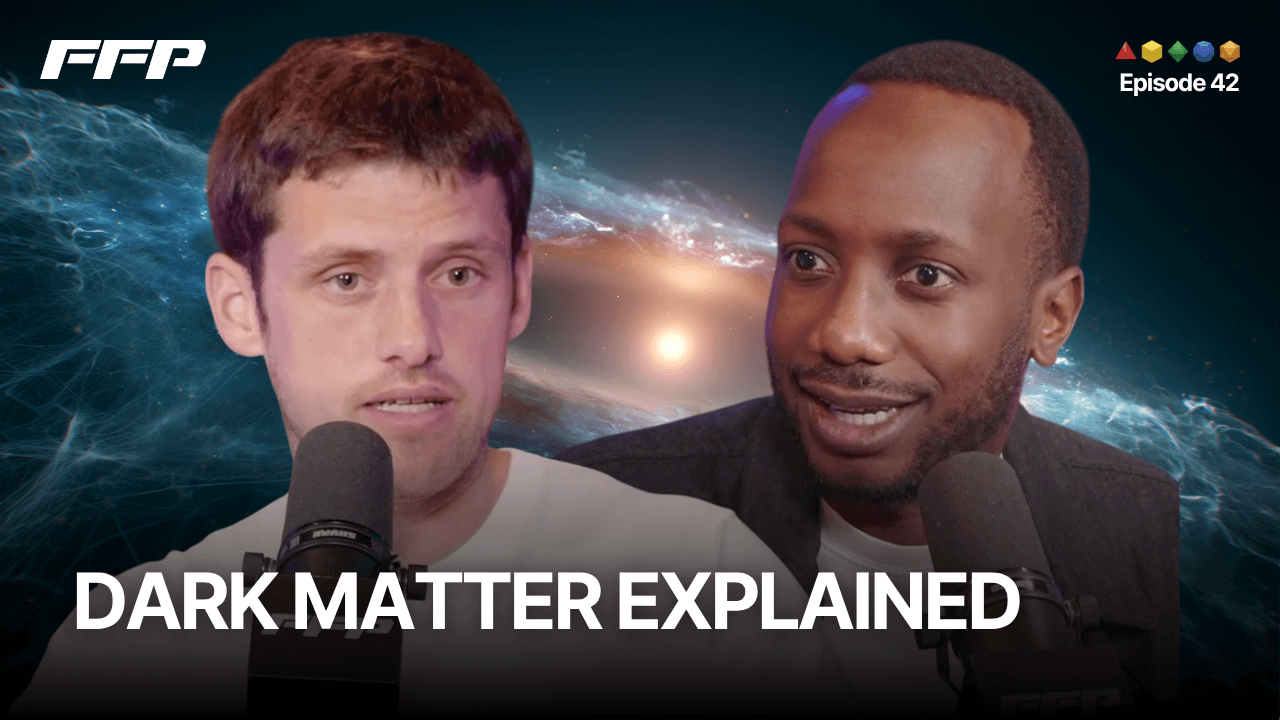
AstronomyCosmologyDark MatterAstrophysics
A first principles interview with astrophysicist Dan Gilman on what dark matter is, why strong gravitational lensing matters, and how the next generation of surveys could reveal the universe’s hidden structure.
Hosted by Lester Nare, this episode features astrophysicist Dan Gilman for a deep conversation on one of the biggest open questions in modern physics: what dark matter actually is. Starting from first principles, Lester and Dan walk through why the evidence for dark matter is now so strong, how strong gravitational lensing works, why tiny distortions in lensed light can reveal invisible clumps of matter, and how the next generation of surveys may transform the field. Krishna is out on family leave for this one, but the conversation stays fully in the From First Principles lane: grounded, visual, and science-first. Summary What dark matter is — Dan explains the basic case for dark matter, why it appears to interact only through gravity, and why multiple independent observations now point to the same conclusion. How strong gravitational lensing helps — the episode uses intuitive analogies like tides, fish tanks, and flashlights to explain how astronomers can infer the presence and structure of dark matter without seeing it directly. What Dan actually studies — the core of Dan’s work is building and testing simulations of lensed systems to see which dark matter theories best match reality. Why the next few years matter — Vera Rubin, Roman, Euclid, and AI-assisted lens finding could dramatically increase the number of usable lens systems and sharpen the search for dark matter’s fundamental nature. Show Notes ESA’s Euclid overview for the mission context discussed in the episode. https://www.esa.int/Science_Exploration/Space_Science/Euclid_overview Official Rubin Observatory site. https://rubinobservatory.org/ Roman Space Telescope mission context. https://www.space.com/space-exploration/the-nancy-grace-roman-space-telescope-nasas-next-great-observatory-is-finally-complete
Transcript
Show →Hide11,703 words · auto-generated
Intro
0:00So, it's something that is out there, it's passing through the Earth, probably through us right now, but because it doesn't have any interactions except gravity, we can't really tell. This fundamental prediction of cold dark matter, which is our best current theory for what it is, which is mind-blowing when you think of it, which is that every galaxy should be surrounded by an innumerable number of completely dark concentrations of matter.
Dan Gilman intro
0:45>> Hello internet, this is your captain speaking, Lester Nare, and today I am joined in studio by a very special guest, friend of the pod, and astrophysicist, Dan Gilman, as we await the return of Krishna, who's on family leave. I'm super excited to have a chat with you today. We are going to be covering and talking about uh an area that you do research around, which is dark matter, and I think we're going to have a an exciting conversation. I think the last time I saw you in person was almost 3 years ago? >> Something like that. Yeah, maybe 2 years ago or something, three maybe.
1:25>> It was uh for Krishna's wedding and just prior bachelor party. And before we jump into the weeds, uh I was requested to have you provide an explanation for these two photos of of you and Krishna. >> Yeah, so the first one, the one on the right, uh that was in Thailand. I think it was like 2017, 2018. >> Okay. >> I believe it was Koh Phi Phi, Koh Phi Phi. I don't know. I always forget how to pronounce it. >> And I think Krishna has a broken arm in this photo. Do we have any >> He broke his arm. I don't know. Probably something dumb. I don't remember what he did.
2:07>> And then here on the left, you guys are pointing to a couple of plaques it looks like. >> Uh yeah, that the one on the left. The other one was in Vienna. And we were outside of a famous scientist's house. I don't remember who it was. Krishna definitely remembers. He remembers that kind of stuff. >> So, Krishna when you're when you're back we'll ask you whose house you were at for that photo. And so, before another thing before we do is like how do you guys actually like know each other? What's the story behind how you two initially met? >> So, we were the same year in grad school >> at at UCLA. >> at UCLA. >> Yeah, so we entered the same year. >> The first year of grad school you have
2:47to take a bunch of classes. >> Okay. >> So, we were taking the same classes together. We studied together. Uh before your first your second year you have to pass a big written test. And so, we studied for the test together. Uh and then we started we eventually became roommates. I think after the after the second year we became roommates. >> I I remember when you guys were roommates cuz I would come over and I would badger you in the kitchen uh asking you to explain to me what you're researching and you would always be like, "What I I don't I don't know, man. It's kind of it's kind of in the weeds." And uh >> Dude, you guys have been talking you guys have been doing this podcast for 10 years. I've been listening to you guys do this in our in our living room for 10 years.
3:28Now you're recording. It's the only difference. >> Uh which which is is is is so true. Um and it's something we talk about in terms of like where the inspiration for the show came from. But since UCLA you went moved out to Chicago.
UCLA, Toronto, and Chicago
3:43>> Yeah, so I bounced around a little bit. I was in Toronto first as a post-doc. So, after grad school you do some uh research contracts. So, I did one at the University of Toronto, and now I'm at the University of Chicago doing another one. >> Beautiful. And for those who are joining us who are long-time listeners, we've talked about dark matter before on the pod. Uh, it's usually been around the classic galaxy rotation curve argument, uh, and we covered the dark matter halo story uh, that came out earlier this year, which is, you know, one line of or way to think about the question of dark matter. And I think part of what's
4:24going to be so interesting about our conversation today is, you know, in the research that you do, you're coming at it from a different angle that kind of looks at large-scale structure, and we'll get into that. But just to kind of start because it's always still a little bit murky to me, you know, what Let's start with just the
What is dark matter?
4:42basic question from first principles like, what what is dark matter? And sort of understanding why the case why we think the case for the existence of dark matter is so strong. >> Yeah, so dark matter is something that only appears to interact through gravity with, uh, baryonic matter, which is essentially normal matter. >> The stuff you and I are made of. >> Yeah, the stuff that you and I are made of. So, that we know of some forces that mediate interactions between normal matter. So, things like gravity, electromagnetism, uh, the strong force, and the and the weak force. So, dark matter is something that only appears to interact through gravity.
5:23>> Okay. >> So, it doesn't interact, uh, through electromagnetism, which means it doesn't interact with light because light is described by electromagnetism. So, it's something that is out there, it's passing through the Earth, probably through us right now, but because it doesn't have any interactions except gravity, we can't really tell. It only becomes apparent when you start looking through telescopes at the universe that there's more stuff out there than we can see. >> This is interesting. So, the the idea is the the and I I think I remember seeing these statistics of like the actual what we believe to be the uh breakdown between, you know,
6:03uh let's call it normal matter and dark matter. It's It's actually the majority of the universe based on how we see, you know, things interacting with gravity, there has to be what is it like 60, 70, 80% has to be dark matter to account for what we see in the visible light spectrum. >> Yeah, it's about Dark Matter is about five times as abundant as regular matter. Uh but we don't know what it is. So, we're trying to figure it out. >> So, when when we say what's interesting about Dark Matter is it's invisible to us because it doesn't interact with light itself,
6:44but it is not non-interacting because it does interact with gravity, which can subsequently have an effect on objects that do interact with light that we can actually see and measure.
Why the evidence is now so strong
6:59>> Yeah, exactly. And so, I think that's when people started becoming really convinced that something like Dark Matter exists, it was because of things like galaxy rotation curves, the you know, the observation that stuff appeared to be being pulled by by more gravity than you could account for based only on what you could see, based only on starlight. >> That That makes sense. And so, this is This is why sometimes, and this kind of begins to dovetail with your area of research, you know, I've heard it described that, you know, Dark Matter as the the invisible structure of the universe. And And the reason we
7:40say that is, you know, when we look at the the the spin of these galaxies, um it the the speed at which the rotation is happening we're based on what we can see, it should not be possible is the point. Based on purely what we can look at through these telescopes and these instruments, the some of the speed or acceleration or the way in which it operates doesn't make sense unless there is something else there. >> That's right. Yeah, and that was the early evidence. >> Okay. >> Now, today we have, you know, we've made that kind of observation, but on, you
8:23know, vastly different scales and in different environments. So, from the large-scale structure of the universe, the cosmic microwave background, all of these things that are independent of each other, they all point to the existence of some form of matter that only interacts gravitationally. >> interesting. So, it's not simply that we've looked at either like one type of object, a celestial object, or one subset of celestial objects. We've now looked at an array of these different things, and all of them point to there there being a missing variable in the equation. >> Yeah, that's right. So, it's it's the fact that you have lots of independent lines of evidence, right? You just have
9:04one experiment, maybe, you know, okay, maybe you don't understand galaxies that well, and that's why you you don't understand the rotation curve, right? But once you start having lots of different phenomena that are all you know, reasonably well explained by the existence of dark matter, that's when it becomes really compelling. And that's why we're trying to figure out what it is, and we're not so much anymore focused on determining whether it exists. >> This is actually a a great transition point. So, we're now at the point, and this is where your research comes in, where we've identified that there is a there there. And now we are trying to better
9:46characterize what it actually is, the structure, its component parts. Are there Are there dark matter particles? Um, you know, and and and so
Studying the particle nature of dark matter
9:59as we now turn I So, we now kind of have an idea of what is dark matter in the sense that it it is this thing that interacts with gravity, that impacts things we can see all across the universe from multiple instruments and multiple observations. And now we want to sort of take it a step further. So, in terms of the life of you as a researcher right now looking at this issue, you know, where do you even start, right? Like like what is you know, how do you even define the problem, think about where to begin? >> Yeah, so let me let me give you the kind of quick explanation, and then we'll get into the details. >> Okay. >> So, we're you know,
10:41we want to study dark matter in a way that's sensitive to its particle properties. >> Okay. >> Right. So, the galaxy rotation curve uh types of of arguments are not so sensitive to the actual particle nature of dark matter. They are a little bit, but if you want to understand the particle nature of dark matter, and you want to do particle physics with astronomy in the context of dark matter, we have to start looking at how dark matter clusters uh around galaxies. That turns out to be one of the uh most constraining types of measurements you can make is by studying
11:22not the large-scale structure of the universe, which by the way is almost impossible to explain without dark matter. Uh it's actually how dark matter behaves on smaller scales. You know, on on scales like galaxies. So, I think we actually have a good picture that we can show. It's number six. >> Number six, okay. >> Right. So, this this figure it was came
What are dark matter halos and subhalos?
11:45out of a review article about dark matter that's now, I think, eight or nine years old. On the left, that is a computer simulation uh of what we think a dark matter halo looks like. So, a dark matter halo is a gigantic uh blob of dark matter. That's the technical term for a giant blob of dark matter is a dark matter halo. >> This has nothing to do with Master Chief, I'm assuming, and Cortana. >> Uh I'm I'm No, it does not. I don't know I don't know what that is, but it definitely doesn't have to do with it. >> It's Halo is a best-selling Xbox game where there's a planet >> Oh, Halo. >> that's the ring.
12:25>> Oh, Master Chief. All right, sorry. It took me a second here. I was I was too focused on the on the picture. >> I I think I threw you off there. So, so on the on the on the left here, um this is our at the time this was our best guess at the this these clumps of dark matter uh in relation to where? >> Right. So, this is a again, it's a simulation on a on a supercomputer. Our galaxy in that picture would be at the center of the bright blob in the middle. And it would be much smaller than the size of this image. >> Okay. >> Got it. So, these what you're seeing is this dark matter halo that hosts our our galaxy. We think
13:06galaxies, for the most part, are inside of dark matter halos. And this is, in some sense, a prediction of our best theory of dark matter, which is that every galaxy, including our own, should be surrounded by an almost innumerable number of these small clumps of dark matter. >> It's almost like our galaxy is being insulated by these this dark matter as a way to incubate the like the the the existence and sustainability of the galaxies. >> Sure, you can think of it that way if you want. >> So, on the left, that's our simulation. And then on the right, we're looking at what looks almost like a like a a
13:48sphere imposed on a 2D like image. And And what are we looking at on the right? >> Right. So, on the right uh and that's what I That's why I like this figure so much. So, on the right, that is an a map of at the time all of the satellite galaxies of our galaxy that we knew of. >> Okay. >> So, you know, as as I said, we think galaxies reside inside of dark matter halos. And so, little galaxies that are orbiting around ours are inside of smaller dark matter halos. And that on the right is a map of the little galaxies that we knew of at the time. And what you see just looking from left to right is that there's a lot more
14:29clumps on the left that we don't see based on starlight, right? Those clumps, they don't have enough stars and gas in them for us to tell that they're there just by looking up and >> Mhm. >> assigning them a galaxy, right? So, they're completely dark, gigantic, so these are, you know, a million times to a billion times the mass of our sun, these enormous concentrations of dark matter, uh which we don't see. Because they have they they don't have enough stars or enough gas to be detected. >> This is so bizarre. Um and and okay, so just to just to make sure I'm tracking here, kind of what what's interesting is you sort of see on the left the the the bright spots are the clumps of dark
15:12matter. And it it it's almost there's almost a like a perfect one-to-one correlation with the galaxies in our right image, which would track with the thesis or idea that you mentioned, which is that we think galaxies are concentrated around these large clumps of dark matter. Am I getting that correct? >> Yeah, so the the idea is that, you know, galaxies, which are made of regular matter, they form inside of dark matter halos. So, the dark matter halo is there, it forms earlier than the galaxies because the regular matter is hot at the at early times. And so, the the dark matter is there, and then the the gas falls into it, and you form stars, and you
15:53form galaxies. >> Oh, it's like a pressure cooker for building galaxies. >> That's right, and life. >> And and life itself. Inter- So, so, in to some extent, one implication here is that the existence and the concentration of these these dark matter halos or clusters is a prerequisite for the formulation of stars and galaxy. >> I wouldn't say that it's a pre- pre-requisite for the formation of stars. What what what I would say is that our current theory, our best theory for what dark matter is, it explains galaxy formation partially by putting galaxies inside of dark
16:35matter halos. And it also predicts that there should be way more dark matter halos than we can see from their stars. >> It justifies its own existence almost. Um >> Well, you know, it's a it's a concrete prediction of the theory, and it turns out that if you change the particle physics of dark matter, you can completely change the properties of these clumps. >> And so, this is why as you talk about why it's an interesting area of research it by having a better model around you know, these dark matter clumps, etc., we can actually start to poke at
17:17its fun like it's fundamental component
Inferring invisible things through gravity
17:19parts in a way that we might not be able to in other lines of inquiry in this area. >> Yeah, that's right. So, what we want to do is essentially count how many of these clumps there are and measure how dense they are. Those are sort of the two uh you know, two of the most interesting types of measurements you can make. But, it's hard, right? Because they don't interact with light. >> Mhm. >> We can't like detect them directly. We have to rely only on gravity. But, it's not impossible. So, so let me give you a you know, think about this situation for a second. >> Okay. Okay. >> Suppose that we couldn't see the moon for whatever reason. Maybe it was We're
17:59on a planet where it's always cloudy, but there's a moon and there's an ocean. >> Okay. >> So, you would be able to infer that something like the moon exists based on the tides. Because the the moon's gravity is partially responsible for the tides. >> It's the the idea, you know, it's the graphics you see where Earth is here and the moon as it goes around, you see the water on the surface of the Earth track with the the orbiting of the moon, which is what actually generates the tides itself. >> That's right, yeah. So, even even if you were in a situation where you couldn't see the moon >> Ah, yeah, yeah, yeah, yeah. >> be able to infer that it exists, which I guess in this analogy is like the rotation curve argument, right? So, we're pretty sure
18:40that there's stuff there, but we could take it one step further, right? And you could you could also estimate properties of the moon based on the tides, right? >> This this is the point is through indirect obser- even though we can't directly observe dark matter, in your analogy, if we couldn't if the moon was dark matter and we couldn't directly observe it because we were in a cloud of whatever nuclear dust everywhere, um we would still be able to infer that it's there because it has direct impacts on some derivative observation, which in this case is the tides. >> That's right. Yeah, and so it turns out that you know, we don't use tides in astrophysics. What we can actually use
19:21is light because it turns out that light is actually bent by gravity. So, a gravitational field will deflect the path of light. We can see light. And so we can use the fact that that images of astronomical objects will be slightly distorted by the gravity from dark matter to study the dark matter even though we can't detect the dark matter directly. >> It's okay, very interesting. So, in this case in the just keeping with this analogy, if dark matter is the moon, um and then the water of the ocean that causes the tides is light. The water gets disturbed by the moon, which creates high low tide and you
20:02know, all that flow. Similarly, dark matter impacts light as it's traveling into our instruments. And it's going to distort it a little bit in the same way the moon would distort the tide, and we can measure that distortion to then derive some understanding of the size and what was this the two measurements was size and >> And the internal structure of these clumps. >> clumps. Am I am I getting that right? >> That's exactly right. >> Very interesting. Okay, okay. And so this is where where your area of research focuses. >> Right. So, that was the longest intro of all time, right? That's the problem. >> But that's that's the that's the best
20:42part is really understanding deeply what are we trying to what are we looking for trying to measure? >> Yeah, that's right. So, we are trying to measure the properties of these small I say small, keep in mind that they're enormous, right? But from a cosmological standpoint, they're very small. >> Yeah. >> These small clumps of dark matter using light and the deflection of light by the gravity of those clumps. Imagine if I asked you to describe the room that we're in now using gravity. Okay? This maybe that's gives you another way of thinking about this, right? It's It's a very challenging thing to do is to understand the structure of some uh material using only gravity. >> I I I I literally was like I don't even
21:24I literally was like I don't even know where to start. But this is this is fascinating. And I I I So now that sets the table really nicely because I think I understand the problem set. Um and and there's so many implications to being able to better understand this area because it'll totally impact our ability to map the early models of the universe and you know, different types of existing um um space-based telescope and ground-based telescope missions. But when when we now talk about you as a researcher having clearly defined the problem now that we're trying to look at
22:05you know what is Now what is your day-to-day kind of look like in trying to solve for that now well-defined problem?
How gravitational lensing tests dark matter models
22:15>> Yeah, so what I do uh to study these dark matter clumps and you know, by I mean you know, my collaboration and myself. So we use an effect called gravitational lensing. So this is the the bending of light by gravity. Uh and we we use that effect to try to study uh the properties of these dark matter clumps. And I can come back uh you know, a a little bit later to give some more ideas, but the but you know, the the main picture is that we will take our best theories for what dark matter can be. We will predict from those theories what the properties of these clumps are and then we'll try to simulate how that would change the deflection of light
22:57uh you know, around astronomical objects in a way that we can measure and detect statistically. >> Okay, so that's the kind of structure of like, you know, how it is we're going to go about this process. Um, where do you think is the best place to start in trying to understand this? Again, I'm really curious about how like what is it that you do? >> Yeah, yeah. So, let me uh Let me uh let me let me try to explain lensing a little bit more and then once uh once uh we have a clear understanding of what gravitational lensing is, then I'll I'll give you some more details about the day-to-day. >> Makes sense. >> So, why don't we start with uh number two? >> Number two, let's pull that up.
23:39>> So, this was uh one of the first images released by the uh by NASA after the James Webb Space Telescope went into space. Uh and this is a cluster of galaxies. >> Mhm.
JWST lensing and “gravity bifocals”
23:51>> And behind this cluster of galaxies are a bunch of other galaxies whose light is being distorted by the gravitational field of this foreground uh galaxy cluster. >> Okay. >> So, this galaxy cluster is billions of light years away and the sources behind it are another few billion light I mean, so these are, you know, we're looking across most of the observable universe. >> So, the idea is like if we're if we're here at this point right in front of my face, a billion light years away is one dot on this image. And then right behind it in our line of sight, another billion light years away is another dot of a light source. Again, from a line of sight perspective
24:31that comes directly into our instrument. >> That's right. But because you have this gigantic concentration of material in between us and the light source, >> Mhm. >> we see those distant sources magnified and distorted. So, if we if we zoom in now, >> Yes. >> uh right. So, this is a zoomed-in uh part of that wider image. >> Yes. >> And you see in the top center there is this bright uh yellow object. >> Yes. >> That's a regular galaxy >> Okay. >> in the cluster. >> Mhm. >> And the yellow the other yellow banana that you see kind of draped on top, >> Yes. >> that is a background galaxy that is being warped and distorted. It's not Sorry. It's not actually being warped
25:12and distorted, but our image of it, what we see, is a warped and distorted image of that source. >> So, what we're saying is for those who are listening on audio, we always encourage uh because we do so many visuals on the show. Um but many of you have probably seen these JWST images. We sort of see a diffuse circular object, which is our galaxy that's closer to us in this 1 2 3 line of sight point explanation we did earlier. And then the kind of the yellow orangeish banana, are we saying that it is for the most part a similar diffuse circular galaxy cluster, but on its way to us, the light on its way to us is
25:54being is is being manipulated by all the gravitational and other things going on, so it comes a little It looks funky to us in the image, but that's not literally what it looks like in real life. >> Yeah, it's probably a boring-looking, you know, regular galaxy. Maybe it's interesting. Maybe you Maybe it's a spiral galaxy or something pretty, right? >> Sure. >> we see is this, you know, warped banana-type structure. >> Yes. >> And that's a purely optical effect caused by the deflection of light by gravity, in this case by this bright cluster member that has enough stars in it that we can see. >> Makes sense. >> So, that's This is gravitational lensing. And by the way, you see lots of other cool bananas in this image. That's
26:36not the only one. >> So, so when we when you say gravitational lensing, right? What you mean is the um the optical distortion that arises when we use our telescopes to look deep into the universe and there is the foreground the foreground point light source is impacting our ability to observe the background point light source on its journey to our devices. >> Yeah, so there is some lens, in this case it's gravity, that is
27:17distorting the image of some background source. >> Oh, so you like you're literally using lens in the way like it's almost like like glasses. Like we're putting on bifocals and it's distorting the light on its way in. >> Right, gravity bifocals. >> Gravity bifocals. >> So that's the idea. And so we can use that effect to study all forms of matter, regular matter and dark matter because they both have gravity. >> Oh, that's a good point. >> We'll come back later, you know, one of the challenge we'll come back to that point later. One of the challenges is disentangling the contribution of dark matter to this lensing effect from the contribution of regular matter to this lensing effect. >> Cuz they all interact with gravity and got it. Okay. >> So I I propose we we circle back to
27:59that. Let me tell you more exactly about what we what we actually do with these lenses cuz it turns out that some lenses are better than others for some gravitational lenses are better than others for this. And the particular kind of lensing system that we study are called strong gravitational lenses. >> Okay. >> As opposed to weak gravitational. >> So this is the strong ones. >> So if in my silly glasses or contacts analogy, if you if you're a negative 0.5 or negative 1, that's weak lensing. If you're a negative 4 or negative 5 like I am, strong lensing. >> Yeah, yeah. If you can't see your hand, then you need strong lensing. So let's to introduce let's let's introduce
28:40strong lensing. So let's look at the fish, number five. All right, so this was a a movie. Uh I believe Yashar Hetzave is was the
The fish tank analogy
28:48first one to use this movie to discuss strong lensing. >> Okay. >> This is just a a movie made on Earth of a fish tank. Uh there's a goldfish in the fish tank and you'll see that as it approaches the corner of the tank the fish becomes doubly imaged. So, we see two images of the fish. >> But there are not two fish. >> But there's only one fish, right? So, what's happening is the light is being deflected by the glass. >> Mhm. >> In this case, the corner of of the fish tank in such a way that there are two paths through space that connect our eyes with the fish. So, you know, light takes two different paths. It gets bent by the by the glass in the fish tank and
29:29then it comes to us. >> Right. So, it's like light is bending. So, we're looking at the corner of a fish tank. This sort of left side as the fish comes across, the light's coming into my left eye from the left side. And but as it's coming, as it gets closer to that corner light is now traveling down the glass from the right side and coming to my right eye. And so, it's not It is the way in which the the line of sight we have currently is what is driving this because it just happens to be at the the right angle to see it coming from both points. >> Yeah. So, those are two images of the same fish. Both images are just as
30:11valid, right? I mean, it's not like one of them's a fake image, right? It's just you know, we see two images of this background source, which in this case is a fish. >> Mhm. >> Uh because the foreground deflector, which in this case is a fish tank, is is bending the light in different directions. >> I see. >> So >> I see. >> In cosmology, you you replace the fish with the galaxy and the fish tank with another galaxy and then and then you understand strong lensing. >> I see it. So, the fish is the background galaxy. >> That's right. >> And then the glass of the fish tank is the foreground galaxy and we are and so the we can look at the image of the background galaxy being warped to be able to define like the glass of
30:53the fish tank for like to be able to better understand like the structure of the glass of the fish tank. >> Yeah, totally. So you could imagine that you know even if you couldn't see the fish tank for some reason you could infer that there's something there >> I see where you're going with the two images of the fish. So in this analogy if the glass of the fish tank was dark matter which we couldn't see we would be able to infer that there was a piece of glass that was at a right angle right here because we're seeing two fish like that. >> Yes, unless we can even take it a step further, right? If this fish tank had a bunch of defects in it like dents and stuff those would be the clumps and they would affect the small scale structure of the fish, right? So if we
31:33saw a fish that had a bunch of small deformations in a in addition to being >> Yep. >> doubly imaged >> Yep. >> we might conclude that whatever lens is there is clumpy on some scale and we can >> That is great. Okay. >> That was that's very helpful and so you know the the concept here is gravitational lensing >> Yeah. >> and it is a methodology by which um it's something that happens because of the way optics works and the way light and gravity interact. It it it is we can see these lenses throughout all of our different sky surveys and etc. etc. And we can use the structure of the
32:15lens to do a whole bunch of science around it. >> Yeah, that's right. So you can do lots of different cool science with lensing not just dark matter. >> Okay. >> You can also use them to measure distances which are sensitive to the expansion rate of the universe. >> Mhm. >> For example, you can use lensing to study the stars >> Mhm. >> uh because you know, regular matter also contributes to this effect, so you can use it to study uh stars around different galaxies. For us, we're interested in using it to study the dark matter, and in particular to study these clumps. And I think we actually have another picture that would be helpful here. It's the uh Let's see. It is number eight.
32:56>> Number eight. >> No, I'm sorry. No, no. Number nine. Number nine. >> Number nine. Let's go to number nine. Yes. >> So, yeah, this is another uh cluster of galaxies
A proof of concept for hidden mass
33:06uh that's producing a a strong gravitational lensing effect. >> Mhm. >> So, here uh there's G1 through G4. You see them labeled there. And then there's this giant blue arc. >> Yes. >> So, that blue arc is a galaxy that's behind this this cluster. >> Mhm. >> So, that background galaxy is being lensed around, you know, and it forms this distorted arc. And you see there in the bottom right that galaxy G4, which is associated with this other group of galaxies >> Yes. >> It happens to be right on top of the arc. >> Yes. >> And you can see that the arc does this
33:47little, you know, jog around G4, right? So, the G4 is here splits this arc in two. Uh and you can imagine that even if you didn't see uh G4 at all, here we can see it because it has enough stars to be detected directly. But, even if we couldn't see G4 there, we could infer that there's some massive object at that position because the arc is split around it. >> would be split split around it. And And this And the the arc is massive. I mean, it's so And so, would would this be an example of strong gravitational lensing? >> Yeah, that's right. So, the here G1 through G3 and uh yeah, G1, G2, and G3,
34:29they are massive enough to produce two images uh of this background galaxy. You see that there's another little counter arc there on the left. >> On the left, yep. >> Uh so, here those guys are producing the the lensing effect and then we're we can detect this the presence of this other clump because it's impinging on the lensed image of this background source. >> Yes. Makes sense. Makes sense. This is so fascinating. It's like kind of a hard thing to visualize or to mentally uh track. I think the fish tank analogy was very helpful in trying to create some grounding. Um you know, because I think what you're
35:10part of what your point is in if we look at this image and I think where we're going with this is let's imagine G4, which is right on the arc, which is the lens from the background galaxy that G1 through G3 are creating. If G4 was not had no light, there was no point light source, because it's so massive, it's having its own almost mini lens on the other lens, we could subsequently make some characterizations about G4 being there because it is impacting the larger lens from G1 through G3. Is that Is that correct? >> Yeah, exactly. So, here, you know, it Here G4 is so big that it has a galaxy
35:52in it and we can see the galaxy, right? So, this is just a proof of concept. What we're really interested in is these dark matter clumps that don't have galaxies. Conceptually, it's it's very similar, right? They would introduce some perturbation or some small deformation of the lensed image, right? It wouldn't be as obvious as as this case, but the idea is is the same. >> I I I get it now. I get it the the the canvas on which you're trying to paint is the lens itself. You can look at the light arcs, you know, that are happening and see do we see anything any perturbations in the light arcs or the lens where there are not necessarily point light sources like
36:33a large galaxy? Because if you do see that, that is a potentially good candidate or indicator of underlying dark matter clumps uh on the lens. >> Yeah, exactly. Very interesting. >> you know, >> Very interesting. >> And what helps what helps look at smaller clumps is actually having a more compact source. >> Okay. How do you How do you mean?
Why compact sources are better
36:57>> So imagine that you were at a football field >> Okay. >> and there's a gigantic floodlight that's shining down onto the onto the field. >> Yes. >> It's this huge lamp, basically, right? >> And someone held up a magnifying glass in front of that lamp. >> Mhm. >> Or in in front of that light. >> Okay. >> You probably wouldn't be able to tell that the magnifying glass is there >> Mhm. >> because the the this lamp is so enormous, right? So like you have this huge source and you put some little you know, lens in front of it, but it doesn't really change what you see when you look up at this giant floodlight, right? >> Right. >> So But if you do that same thing with a flashlight
37:38So if someone is shining a flashlight and you put the same little magnifying glass in front of the flashlight >> Yeah, yeah, yeah. >> Okay, then, you know, you're going to tell there's something there, right? >> Yes. >> Because all of a sudden this flashlight gets a thousand times brighter, right? >> And so it's actually really helpful to look at lenses where you have a really compact source that's being lensed and not like a whole galaxy that becomes lensed into an arc. >> Oh, okay. >> want to find lenses that have a really tiny source because then they're really sensitive to really tiny, you know, lensing perturbations >> from these smaller dark matter clumps. So actually, this is an interesting note. So when we say strong gravitational lensing, it doesn't necessarily mean visually when we look
38:19at these images, big arc. It just means the effect is strong, but we actually want tighter um from the against from the talking about it visually, we want a a tighter, more concentrated lens because we we are going to be more able to detect these sort of smaller perturbations from dark matter than we would if it was this giant and it's the it's the perfectly like the analogy you just said, you wouldn't be able to see the magnifying glass if it was a floodlight, but you would if it was a flashlight. And so we're looking for flashlights. >> Yeah, we're looking for flashlights. That's right. And there's actually, you know, nature provides flashlights for us. And sometimes they get strongly
38:59lens, which by the way, maybe we should have said this earlier. So it distinguishes strong lensing from weak lensing or some other type of lensing is the appearance of multiple images. >> Okay. >> You like you had multiple, you know, two fish, right? So that was a strong lensing by a fish tank. So >> That's a good Okay. >> We want We want to find strong lenses. This is the This is the the dream scenario for dark matter, right? You have a bunch of strong lenses where you have multiple images of a point-like background source. >> And so the in the in the fish tank example, when you say multiple images, we're talking about how when we're looking at the corner of the fish tank, we saw the fish twice. Is what part of what you're saying that
39:39the multiple images can also be more than two? >> Sometimes, yeah, they can be four. And
How four images of one quasar help scientists study dark matter
39:44those are actually the ones we like. That's why there's four. >> Very interesting. Okay. >> Let's look at Let's look at one. So number seven. >> Yes. >> Uh so this is a quadruply imaged quasar. >> Wow. >> So nature provides point-like background sources in the form of uh quasars. So a quasar is a black hole that is uh eating matter. Uh and so all of the matter around it gets really, really hot and it shines extremely brightly. And they are extremely compact, so they're essentially like like point sources. >> Mhm. >> And in this case, you have this yellow blob in the middle. >> Yes. >> So, that's a regular galaxy. >> Yes.
40:24>> Uh and that regular galaxy is situated directly in front of another galaxy that has a quasar in it. >> Mhm. >> And so, in addition to this ring, which is uh lensed light from the background galaxy coming around, and so we see it, you know, around the the deflector in front, we actually see four images of the central quasar. Uh so >> one of the coolest things. >> So, those are four duplicate images of the bright point-like center of that background galaxy. >> This is unbelievable. And so, you And we're saying one of them is kind of that uh solitary one slightly to the right of the center like galaxy cluster, and then we sort of have three on the edge of
41:07what this like outer ring of the lens looks like. Um and so, I just want to make sure and clarify that I'm understanding these correctly. There's two things happening here. It is both the lens of the background galaxy itself, which is kind of the orange ring, and then in addition to that, because the quasar inside that background galaxy, based on the way you describe it, is such a high It has a um It's such a key source of light because it's eating so much and creating a lot of heat, and subsequently giving off a ton of light in and of itself as an individual That's
41:47the purple that we're seeing in addition to the lens of the whole galaxy that the quasar's inside itself. >> Yeah, so if if you saw an image of that background source, which here it's being lensed, so it looks really weird, right? But if you saw an image of that galaxy without lensing happening, it would probably be a spiral galaxy with a really bright spot right in the middle. >> Right. Right. >> Now, if you put a giant galaxy in front of it, instead of seeing a spiral galaxy with a bright spot right in the middle, we're seeing four images of that bright spot, and then the galaxy around that bright spot being lens around into this really really cool looking thing.
42:27>> so fascinating. My goodness. Oh my god, that's so interesting. >> Yeah, so these things are I mean, it's one of the most in your face examples of Einstein's general relativity, right? I mean, you point a really good telescope into space and you find these things. >> This is the whole the space-time curvature piece, like like the that it that um greatly like gravity creates these wells that light travels around and is so concentrated gravity and all like it's such a it's so not intuitive to me, like just it like it makes sense. Everything you're saying makes sense. But thinking about it makes my brain hurt a little bit.
43:10Because it's like, well, why does it do that? But like I know there's a reason why it does that, but it still is not naturally intuitive for me. >> Yeah, I mean, it's it takes a while to wrap your head around. >> But that's fascinating. And and so now I think it makes a lot of sense why with that explanation of strong lensing, strong gravitational lensing, and an understanding of dark matter and the base research question around wanting to find and be able to measure these small clumps of dark matter, I I I can sort of now get why these concentrated point light back source background galaxies
43:51that create like the tight ring that then have these multiple images, because what I would sort of guess from the way we set this up is that each of those you now have four in that case four images of the same thing that you can then analyze in a variety of different ways as opposed to just having one image of the same thing with a well-characterized understanding of the gravitational impacts and things like that. >> Yeah, so it's actually it's really important to have and this is why strong lensing is so important. It's important to have the multiple images because if you just have one image, it's not possible to disentangle what the source actually intrinsically looks
44:32like and what kind of, you know, lensing deformation might be happening in between you and the source, right? >> Right. Right. >> But if you have multiple images of the same source, it's much easier to disentangle what the source actually looks like from what kind of distortions might be there. >> What's so funny is I mean, if you if as many know, I'm the resident UAP guy on the podcast unidentified anomalous phenomenon and one of the challenges with um detection characterization and evaluation is you need a multi-sensor systems because if you just have one source, an infrared detector, or a you know, electro-optical or you know, full motion video, it's it's hard to understand
45:13distance and speed and and all these things with only one reference point. So, a similar like it tracks conceptually that you want to be able to have multiple points to be able to triangulate to disentangle in the way that you described. Does it also help with disentangling the impacts of the regular gravity versus the gravity driven by dark matter? >> Uh yeah, so that's a it's a good
Separating dark matter from regular matter
45:38question and it's one of the main challenges in my research is finding ways to model these gravitational lens systems in a way that allows you to disentangle uh the two uh the two signals, right? One of them is dark matter, the other one is regular matter. They're both producing a gravitational lensing effect and we want to isolate the one from these clumps. What helps is that these clumps, they look very different or they're predicted to look very different from a galaxy, right? So, they are these concentrated blobs of mass uh whereas uh the galaxy that you know the the one that we were just looking at, maybe we can pull it up here again number seven. Yep.
46:19Right? It looks uh you know that the scales here are are a little bit uh difficult to to comprehend, I think, but you know this galaxy is much uh it does not look like the clumps that we're looking for. So, we we can use the fact that the predicted property of these dark matter halos produces a a very different kind of lensing effect from the galaxy itself and from the regular matter and that allows us to to disentangle them. And again, that's a prediction of the theory, right? That we're testing. Uh if you had no information, if you had no idea what you were looking for that then the task would be a lot harder.
47:00>> Right, right. And so, and this comes back to kind of I think understanding what you're you know, I think now we have a good structure and setup for myself and the listeners on, okay, what is dark matter? Why do we think it exists? Uh how have what are the ways in which we've tried to um prove its existence. We talked about galaxy rotation curves versus now gravitational lensing. What is lensing? Why does it happen? Um and as we look to better characterize dark matter, um measuring uh looking at and measuring
47:43uh
Simulations vs reality
47:44strong gravitational lensing is an indirect way for us to start to better understand the structure of these small dark matter clumps. And so, that's kind of now the intellectual thought process that brings us back to my question that I'm not going to let you leave the studio without answering, which is so what is it that you do every day? >> Yeah, yeah. Now that we have all the groundwork laid, I can tell you. So, you know I uh I'm interested in finding ways to use these lenses, gravitational lenses, to tell to to distinguish between dark matter theories that make different
48:25predictions for these clumps of dark matter. So, that's what that's what me and my colleagues think about on a daily basis is how we can make this measurement statistically. And so there's a few different There's a few different angles, right? So, one is the data. So, we try to observe uh as many of these uh gravitational lenses as we can. Uh the other one is from the the theory and the modeling side. So, you know, you you maybe you have some theory of dark matter that predicts that these clumps are less numerous than our than some other theory. We'll think about how to simulate lenses with those predictions built into the simulations.
49:05And we'll compare those simulations with reality in a statistical sense and try to determine whether the physics that we put into our simulations of these lenses looks if it produces data that looks like the real thing. And if we succeed in doing that, then we think that maybe the physics that we put into our simulations for the dark matter is correct. >> That's so the the Okay, I I think I'm tracking. So, there's there's like uh there's two There's two inputs almost. One input on one end is existing theories on uh the formation of dark matter. Uh theoretical frameworks
49:47uh that provide an argument as to why this is the way it works. There's, you know, n number of these that you could potentially be using. That becomes an input into the models you create uh the simulations that would then generate examples of gravitational lensing. Right? Um because we have like and so that's one input and then the other input on the other side is we have all this data from that's been taken from our real world with real gravitational lensing and we know where all those objects are. Uh and so we take sort of a model of the physics of the world. We add the extra ingredient of the dark
50:29matter physics. And we see can we generate a lens in the simulation that maps to this a lens that we've already captured and we have well characterized. >> Yeah, exactly. So, you know, that this picture that that the lens that we were looking at the the the yes, this guy. Uh so, you know, we can simulate on a on supercomputers uh lenses that look very very similar to this. You know, almost exactly like this, but they have different clumps of dark matter around. And uh they you know, some theories of dark matter with different properties for the from these clumps will do a little bit better than
51:09others at explaining this this particular lens. So, each one gives you a little bit of information. So, you know, maybe dark matter theory A is like twice as as likely if we only had this example of of a of a gravitational lens, we would maybe think, "Okay, the clumps, you know, maybe they have these properties, so dark matter theory A is a little bit better." What makes it powerful is when you do it with 30 lenses or 100 lenses or in the future maybe a thousand lenses. Like that's when we can start to make really really uh you know, we're already making interesting statements about dark matter, but we're about to be in a new era where we'll be able to do these
51:51experiments with thousands or tens of thousands of lenses. >> This is actually a good note because um I I think one of the things so the reason I kind of talked about it as inputs earlier um is one of those the input on the real world side is dependent on our space-based and ground-based telescopes and ideally space-based because we get rid of the atmosphere and the distortion and dealing with that is no fun. Um but it's sort of a currently inherently a limited data set, but that seems to be on the path to changing uh not only with Vera Rubin, which is already online and producing an
52:32unbelievable amount of data that's available like they're doing dumps every day or every 3 days right now, as well as the I believe it's the called the Roman Space Telescope, which is slated to launch later in 2026. Both of which as I guess quote sky surveys are going to just have an unbelievable amount of data, which with that would data from either of those two now become an another an input into that real world confirmation data set.
Rubin, Roman, and Euclid
53:04>> Yeah, definitely. So you So you mentioned the the Vera Rubin Observatory and the the Roman Space Telescope. There's also another European mission called the Euclid >> Okay. >> mission. >> Okay. >> So these are our uh surveys that are going to look at huge uh swaths of the sky in unprecedented detail. So the Roman uh telescope for example is like the Hubble Space Telescope has a similar diameter mirror uh and the images that it will produce will be of similar quality to the Hubble Space Telescope, but it it the field of view is a hundred times larger. >> Oh my >> god, that's incredible. >> And it's >> going to look at, you know, a huge part
53:44of the sky and it's going to find, we think, hundreds or thousands of lenses. And by the way, I mean, these lenses they they're, you know, they look bright and spectacular, but they're actually really difficult to find because they are so small. So, the you know, the examples that we were looking at this quadruple image quasar, for example, that is about 1/1000 of a degree on the sky. >> Okay. Say more. >> So, you know, this is not something that you can just look at a at a image from a telescope and find, right? I mean, it's so tiny. You I mean, it's it's really challenging to find these things. Uh >> Is this an area where and I think um
54:26you were you were explaining to me just cuz I want people to understand that scale a little bit better. Like, the moon is what as compared to like we like people can have a reference point for the moon. So, the moon is like something and then we're thing we're looking for is a fraction of that. >> Yeah, yeah. So, the moon I think it's about a quarter of a degree or so. So, about 1/1000 of the size of the moon, give or take. So, you know, they and they're really tiny, but I mean, bear in mind, these are enormous galaxies producing the lensing effect. The reason they're so tiny is because they're so far away. >> They're just millions of light-years uh in the past. Um that's so that's so So, what one of the things that's that has
55:09become a conversation and this was actually something that Krishna in his interview with John Mulchaey at Carnegie Observatories asked him about, which is uh because they had a brief discussion
AI and the future of lens finding
55:22on Vera Rubin as well. And the impact that AI is going to have in the detection and characterization and data processing pipelines, again, with still a human in the loop, but if you're taking 800 terabytes of a data set and you can narrow it down to candidate targets that then can go to human review, that seems like it's going to have huge impact in terms of trying to more aggressively and quickly kind of get from the 30 lens candidates to the thousands number. I mean, what do you How do you feel about the role that AI will have in your research particularly? >> So, it's definitely going to have a huge
56:04impact on astronomy. I think it's too early to say exactly what it's going to look like. But I think it's safe to say that it's, you know, it's definitely going to be around and it's going to fundamentally change the way science is done. Uh you know, AI is already excelling at finding lenses because they really don't look like that much other stuff in the universe, right? A ring with four really bright point sources. >> Mhm. >> Uh you know, it could be maybe four stars or something, but you know, AI's are really good at finding lenses and and telling the difference between four stars and four images of a quasar, for example, and they can do it much faster
56:45than like a poor grad student. >> going to say a poor grad student. >> has to look through like terabytes of data to find these little things, right? Uh people also use uh machine learning to model lenses. You know, some people have have tried generating lots of examples with clumps of dark matter in these simulated uh lenses, showing them to neural networks, and then essentially showing that neural network a real lens and saying, "What is dark matter? You know, tell us the properties of these clumps." >> Yeah. >> So, people are are trying all of this kind of stuff. I don't know yet uh to what degree it's it's going to be successful. Uh but it's I mean, extremely
57:26interesting. I mean, in general, astronomy has been a great uh test bed for AI because there's so much data right >> Uh and the parameter space is so enormous. Uh, yeah, I think that the challenge for AI, in my opinion, is doing it in a way that humans are going to believe. >> Yeah. >> So, if the AI tells you something, it did some really complicated analysis that maybe you don't really understand how it it drew the conclusion that it did. Uh, and so making it a believable tool for scientists, I think, is the challenge. But, people are working on that. So, they're they're trying to understand how the AI is drawing, you know, if it if it makes some interesting
58:06statement about the properties of clumps in a lens, for example, how did it get to that conclusion just from looking at the lens? >> It makes total sense. I mean, it's obviously going to be continuing to impact a variety of areas of science and I I I just this is so fascinating and I have so many questions, but I'm going to try to have us land the plane here with a couple of just uh, clarifications. I'm going to come back to this. And so, when you wake up in the morning and you grab a cup of coffee and you head to the lab, you know, a large part of your day is like, you know, working and designing with the theoreticians around what like understanding you have to understand the dark uh, matter theory quite well.
What research actually looks like day to day
58:51Um, and so part of it is like continuing to stay, you know, abreast on that component part. But, it seems like a lot of the the current work is around building, running, and testing the simulation process. >> Yeah, I'd say that's the core of what we want to do. We want to take the predictions of dark matter theories and simulate them. >> Yeah. >> There's a lot of work in actually going from the dark matter theory to understanding how the clumps are going to look. >> Right. >> Uh, and so there's a lot of kind of stuff around the simulations, a lot of physics that you have to understand in order to know what the theories are predicting actually for the the properties of these clouds. >> And you know, the other thing about
59:31research is that it's very rarely a straight line from idea to paper or conclusion, right? Sometimes you go on these you know, you you end up somewhere completely different from where you anticipated or if or from where you planned you would be. Uh there's this quote, it's a Dwight D. Eisenhower quote that says plans are useless, but planning is essential. >> Yes. Yes. >> So the idea is that you know, if you've thought through a problem really well and you and you've mapped the road to a solution, the act of doing that is more more relevant than whatever you thought the the conclusion or the end goal would be. And so there's a lot of times in research where
1:00:11you know, you you start with some idea and it leads to some completely different investigation. Uh and that's what makes it exciting for me uh at least. >> 100% if if you're still listening here and that ethos resonates with you, I encourage you to watch our Carnegie interviews because you know, Mukaihi said exactly the same thing. I mean, he had the story about his um he was studying black holes for his thesis, but he was part of a project that made a breakthrough discovery and it was almost by accident. You know, it was not necessarily what their initial assumption was and one of his his things he always tells the lead researchers at the Carnegie Observatories is we need to
1:00:52leave space to explore, to be creative, uh to do things that we might not that might not be exactly what we think it'll be because that's where uh discovery happens. Um and so I'm going to leave you here with one last question. And because we might have to come and have you come back for a part two because I I could talk to you all day about this. Um as you look now at you know, where your
What a landmark result would look like
1:01:17your current work uh and where you you are in terms of your process and you look forward at the different things, all the new telescopes coming online, you know, the compute getting better, getting cheaper, well, maybe not cheaper anymore, but uh what you know, what does in your view like what would be a uh landmark result for you? Or you know, how how would you define success and and relatedly, you know, how would you characterize the implications of that? >> Oof. >> That's a big one I know. That's a that's a big one. Yeah, so I think you asked about what
1:01:57would be a landmark result and then how would I define success? >> Which are different things. >> Yeah, so I you know being a successful you can be a successful scientist without ever having like some massive impact. Obviously, it'd be nice to like, you know, be the one that discovered so-and-so dark matter particle or something like that, but you know I think it'd be nice if if uh you know, what what what would make me happy in my career is if I can advance the state of the field and help uh train younger scientists like the next generation, you know, working with uh grad students and and undergrads and teaching. I mean, that's something that I'm personally interested
1:02:38in alongside my research. >> Okay, I mean >> Obviously, I'm also interested in doing research and it would be great to if we could figure out what dark matter is. That would also be awesome. Uh and then you know, on that line of interest I'm really interested now and uh there's some theories that have very particular predictions that look very different from what our best current understanding of dark matter is. >> Mhm. >> Uh and they have some kind of smoking gun signals that if you could detect them, that would be very strong evidence in favor of this other kind of dark matter. >> Okay.
1:03:19>> So, I'm very interested in in in those kinds of theories and also just testing this fundamental prediction of cold dark matter, which is our best current theory for what it is, which is mind-blowing when you think of it, which is that every galaxy should be surrounded by an innumerable number of completely dark concentrations of matter that only interact through gravity. You know, if that's if we can demonstrate evidence of the existence of these clumps of dark matter, that would be extremely interesting and really profound uh and yeah, it would be mind-blowing, I think, right? >> I I I I am
1:03:59I cannot wait, but I I do take your your point to heart, though, which is as with many people in the sciences, uh it is a it is the journey, not the destination, and it is a community and a collective effort to better our understanding of the world around us, and just being able to participate in that process, and also pass that the the the bug of curiosity and exploration onto the next generation is exactly why we have this show, and we are able to bring on really incredible uh researchers who also happen to be friends we've been talking to for years. Uh I I Dan, I really appreciate you coming in today. We're going to have you back for part two because you just dropped a bomb there at the end that I
1:04:40want to dig into to more, and I know Chris is going to want to poke fun at you and and banter. >> Probably. >> And and banter. Um again, we had Dan Gilman in studio today, astrophysicist looking at gravitational strong gravitational lensing as a means by which to study dark matter. Um thank you for sharing your your both your intellect and as well as a little bit into a window into what is it really like for a research and how you think about this problem set. Um
Krishna update and outro
1:05:13for those who are still listening, as you know, Krishna is a new dad and will be returning to the pod here in a couple of weeks. We have some great interviews like this one lined up in the meantime, and he will be back and fired up and ready to go. I can't tell you how antsy he is to get back in the catbird seat, uh but I let him know that FFP Nation will be here waiting for the return of our resident PhD. Uh a big round of applause again for Dan Gilman for joining us on the pod today. Thank you, good sir, for sharing all of your wonderful expertise. We look forward to having you back. >> Oh, thanks. Thanks to you guys. Uh I
1:05:55appreciate it. And you guys are doing a great thing for science. >> This is a debut. Uh we're going to start seeing him everywhere. He's going to start bragging to all of it journal club. Hey guys, you see my see my pod? You see how beautiful I look? Um as always, I am your captain speaking here, Lester Naray. This is from First Principles. We will see you all next week.
- EP 63
Nobel Prize in Chemistry 2026 Explained: Mirror Molecules
Why does life favor one molecular mirror image? We explain Kagan and Soai's Chemistry Nobel, chirality, autocatalysis, medicines and mirror-life risks.

- EP 62
Nobel Prize in Physics 2026 Explained: IceCube & Neutrinos
How does a telescope buried in Antarctic ice detect ghost particles from space? We explain Francis Halzen's 2026 Physics Nobel, IceCube and neutrino astronomy.
- EP 61
Nobel Prize in Medicine 2026 Explained: Optogenetics
How did proteins from algae give scientists control over brain cells? We explain the 2026 Medicine Nobel, optogenetics, memory experiments and early medical applications.
- EP 60
2026 Nobel Prize Predictions: Medicine, Physics & Chemistry
Our 2026 Nobel predictions: the science behind GLP-1, light-controlled neurons, quantum interference, cellular droplets and more.