AstronomyCosmologyExoplanetsScience PolicyTelescopes
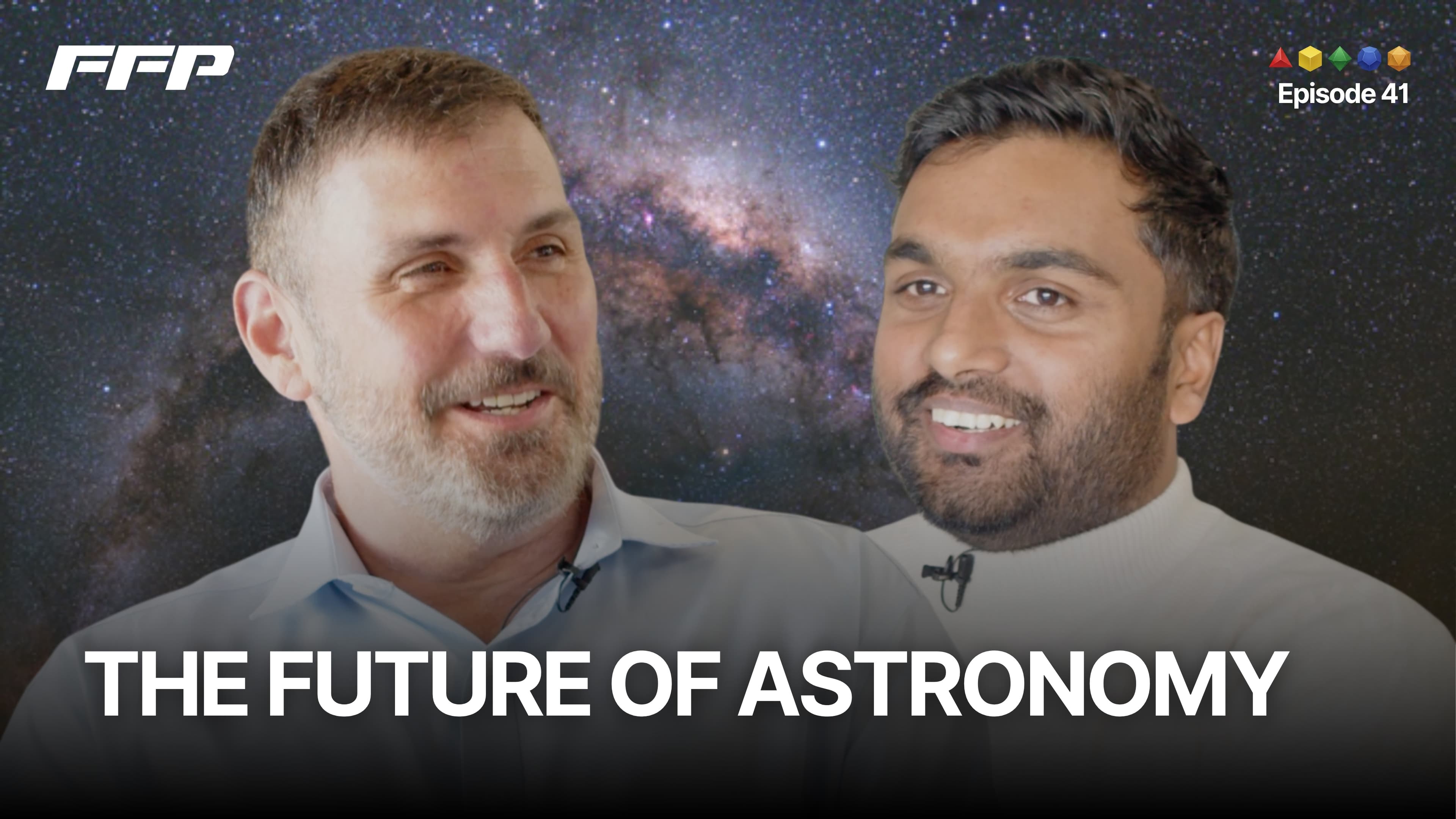
A wide-ranging interview with Carnegie Science President John Mulchaey on dark matter, giant telescopes, exoplanets, science funding, and why eclipses still matter.
Hosted by Lester Nare and Krishna Choudhary, this interview features John Mulchaey, the 12th President of Carnegie Science and former Director of the Carnegie Observatories. The conversation starts with his early work on galaxy groups and dark matter, then expands into how Carnegie works as a scientific institution, what the Giant Magellan Telescope could unlock for exoplanets and astronomy, how science funding actually works, and why eclipse chasing is still one of the most magical experiences in science. Summary Galaxy groups and dark matter — Mulchaey explains why small galaxy groups matter more than most people realize, and how X-ray observations of hot gas helped make their masses and dark matter content measurable. Carnegie’s scientific model — the interview gets into what makes Carnegie unusual: long time horizons, scientific freedom, and the ability to pivot toward new questions without the same constraints most university researchers face. The Giant Magellan Telescope — Mulchaey breaks down why bigger telescopes matter, why GMT is such a leap beyond current facilities, and why exoplanet atmospheres are one of the biggest prizes ahead. Science funding and eclipse outreach — the second half moves into federal science funding, philanthropy, how astronomy has changed as a field, and Carnegie’s major eclipse outreach partnership with the Perot Museum. Show Notes John Mulchaey leadership bio — Carnegie Science https://carnegiescience.edu/about/leadership Carnegie Science appoints John Mulchaey as its 12th President https://carnegiescience.edu/news/carnegie-science-appoints-john-mulchaey-its-12th-president Giant Magellan Telescope — official overview https://giantmagellan.org/about-us/ 1993 NASA write-up on Mulchaey’s dark matter result in galaxy groups https://science.nasa.gov/missions/hubble/dark-matter-found-in-a-typical-cluster-of-galaxies/ Carnegie Science Great North American Eclipse outreach recap https://carnegiescience.edu/yearbook/2024/science/great-north-american-eclipse Perot Museum eclipse partnership recap https://www.perotmuseum.org/events/solar-eclipses/
Dr. Mulchaey discusses how observatories actually get funded. Here's where U.S. research money comes from and where it goes.
In 2023, industry paid for 75.5% of US research and development.
Where US research money comes from, and how the federal slice divides among agencies.
Transcript
Show →Hide8,244 words · auto-generated
Intro
0:00It's very important that we try things that we don't expect to work >> Right. >> for just this reason because this is how big discoveries happen. But James Webb is smaller than one of the mirrors of this one of the seven mirrors of this telescope. And we hit a limit with James Webb. I mean, you know, they're doing exoplanet work. It's super exciting. We have many Carnegie scientists trying to do atmospheres with James Webb. It's just not a very big telescope. >> Well. >> And so this telescope will allow you to really get the high quality spectra we need. I tell people and I'm sure you
Carnegie collaboration series intro
0:28feel this way now like if you haven't lived through one you have to see one. >> Hello internet. This is your captain speaking Lester Nare and this week we are very excited to share our first guest interview as a part of our collaboration series with Carnegie Observatories, one of the most historically important astronomy institutions in the world that just so happens to be based right here in our backyard in Pasadena, California. Founded by Andrew Carnegie more than a century ago, Carnegie has helped to shape modern science through a culture of independent curiosity-driven research across astronomy, Earth and planetary
1:08sciences, biology, and more. For this
John Mulchaey interview setup
1:11first conversation in the series, our resident PhD Krishna Choudhary sat down with John Mulchaey, president of Carnegie Science and the former director of the Carnegie Observatories for a wide-ranging conversation covering cosmology, dark matter, exoplanets, giant telescopes, science funding, and the future of astronomy. Also, on a
Krishna family leave note
1:36personal note here from us at FFP, Krishna recently became a father and will be taking a couple of weeks of family leave and well-deserved time off. And while he's out, we have some great episodes lined up for you including more interviews and conversations we think you'll be very excited about. As always, we're going to learn about the science from the ground up today because this is from first principles.
Dark matter in galaxy groups
2:19So, today I'm joined by John Mulchaey, the president of Carnegie Sciences. John, thank you so much for taking your time. Happy to be here. Um so, I wanted to start by focusing on the science because that's what we do on the podcast. And you have a stellar career in cosmology. Right? Um one of the things that I was reading about is how you focused on galaxy groups, not just like large galaxy clusters, but sort of smaller galaxy groups like the kind that the Milky Way is a part of, and trying to characterize the dark matter that's in these galaxy groups because it's it's tends to be a bit harder than if you have a giant cluster and you can
3:01just like chart the velocities and then do virial theorem, what's the mass? >> That's right. >> Yeah. Um so, could you briefly talk about, you know, some of the challenges there and what your approach was when you were dealing with this problem? >> Sure. Absolutely. So, I think the clusters get all the attention, right? Because they're these big grand things. >> Yeah, with the gravitational >> with the gravitational lenses and all that. The lenses and the big x-ray halos and all that. But they're just really really amazing systems, right? But but they're pretty rare, right? I think this is the thing people don't really appreciate that. Most galaxies actually are in small groups like the Milky Way in our very small collection. Milky Way's in the local group, which is a very very small group. But that's a much more typical environment than the clusters that get
3:42all the attention. And the nice thing about the clusters, as you mentioned, is that there's lots of galaxies so you can you can measure the velocities of, you know, 100 galaxies and get a good measurement of the mass of the system. for instance. It's very hard with a group because you have two or three velocities and remember we only measure the velocity away from us. We can't really measure it in this in the plane of the sky cuz you're doing that even that's right. We can only measure the red shift and so that's only a velocity in one dimension and then if you you know say you have three galaxies those velocities are it's not a very reliable measurement of of of the mass of a system. And >> just to briefly pause it's true that even with the large gal gal gal galactic clusters you can only measure this that's right but maybe
4:24because there's so many you kind of do an ideal gas type thing >> That's right. >> and you're like oh you know equal equal partition >> That that's right. >> Okay. >> It should be a somewhat random process and so if you do enough of them eventually you kind of you you you aren't losing out you know. Imagine you have a group and everything's moving in this direction we wouldn't see a measurement at all right or you know so for instance you know with three objects you really cannot measure that and so the >> historic challenge has been um because of that people really had a hard time estimating the mass of these systems um and then in 1993 we made a remarkable discovery when I was in grad school um that um these systems also contain hot gas just like the clusters do that glows
5:04in the x-ray >> Mhm. >> and that was a really interesting um measurement because you can use the temperature of that gas to get an estimate of the amount of mass in the system. And so it was the first really kind of reliable measurement of a mass of a group and by the way the masses actually were aligned with kind of what you might expect based on the pretty poor statistics we had from the galaxies. But it did demonstrate really for the first time that there was a lot of like everything in the universe there's a lot of dark matter. Um and so
Using X-ray gas to measure mass
5:32these groups just like clusters are really dominated by the dark matter. >> Ah and just to just to follow that thread of logic a little bit more closely with the x-rays you get something like the how much gas there is because the gas is glowing in x-ray. >> Right. >> And then from that you get velocity. >> You Well, what you really measure is the temperature. >> Ah, okay. >> So, yes. So, you measure the temperature of it. And the temperature is a reflection. So, why is the gas hot, right? Why is it emitting in x-rays and not in the radio or in optical? It's because the gas is being heated by the basically the gravitational force of the system. And so, it I know you guys talk about hydro-static equilibrium a lot. >> Yes. This is the same exact thing
6:13>> here, right? Yes. >> It's the gas falls into the system, it heats to a certain temperature to maintain the gas cloud is basically hydro-static equilibrium. And so, the temperature of the gas is enough to balance the gravity. >> Yeah. >> And so, it's the same thing that happens in the sun with, you know, the the nuclear fusion pushing outward in the um the reason the sun isn't doing this, right, in a huge ways is because of hydro-static equilibrium. >> Right. >> Same exact argument. >> Same exact argument. So, you get like, you know, the size of the gravitational potential >> Heats the gas up. >> Yeah, that's right. >> Yeah. >> So, the clusters being more massive have much higher x-ray temperatures. >> Oh, okay. >> than the groups. >> Yeah. >> And so, by measuring the temperature of the group, which you can do with a like Chandra space telescope or something, um that temperature then can be directly
6:54can be either a direct measure of the mass of the system. >> Right. Okay, we we just recently covered um a paper in the Astrophysical Journal Letters about the new relics. >> Yes. >> Like the you know, they found Cloud 9. They did a very similar argument where they looked at the temperature of this gas, and then oh, there's no galaxy there, there's no stars, but it's still there. Um okay. That's that's all clicking. And so, that was in the '90s. >> Mhm. >> And what was it you know, this is a massive discovery because now you've found a way to measure the mass of smaller groups. >> Mhm. >> And you know, what was that moment like? Like was it was it sort of a single moment where you like unblind all the
7:35parameters of your model and you know, you know how they do it now where it's like everything's blind and then and then somebody presses a button and all of a sudden H not pops out. >> It was a very similar moment for us. It was I should say that um uh we wrote a So, interesting story is we wrote a proposal to use the ROSAT X-ray telescope which was the big telescope in the '90s, the X-ray telescope prior to Chandra. >> And this was in space? >> It was a space telescope. Yeah, all the X-rays have to be done in space because the atmosphere absorbs the X-rays. Fortunately for us as humans, but not so fortunately, you know, if you're an X-ray astronomer. >> Yeah. >> Um and so we wrote a proposal saying let's we want to look at some groups and see if we see anything there. Um and the proposal was very poorly ranked. Um they said, "Oh, you're not
8:16going to see anything. This is just We don't Nobody really expected to see this gas at the level we see it." >> Yeah. >> And so, but we got lucky because um ROSAT had this weird system where they would rank proposals to A, B, and C and a very small fraction of the C proposals got through. We ended up getting a C target and so we ended up getting data that we probably shouldn't have gotten otherwise. >> Wow. >> And that was the discovery image. Um and so it always reminds me and I always every time I sit on a scientific panel or reviewing proposals, I always remind people, "It's very important that we try
Why big discoveries come from trying things that may fail
8:44things that we don't expect to work." >> Right. >> For just this reason, because this is how big discoveries happen. >> Right. >> Hubble discovered, you know, the distance to Andromeda. He wasn't looking to measure the distance to Andromeda. He got lucky, right? He found a Cepheid variable star up in Mount Wilson there up on the hill. He found the star completely randomly and sent him in a different direction. The biggest discoveries in astronomy, certainly in probably all of science, happen from this. And so scientists, we always have It's very easy to kind of fall into the paradigms of what we know. >> Mhm. >> But we really have to try to break out of it. And so that was an example and it was hugely exciting, of course. It was a side project for me. It was not my thesis. My thesis was on black holes. It was great. I ended up doing that. But
9:25it's what got me my job at Carnegie and probably most of my career was based on this on this amazing result uh for these groups. >> Wow, that's actually such a cool story. To think that you almost didn't have that, You know. >> Yes, who knows where I would be.
Carnegie’s unusual model for scientific freedom
9:41>> Yeah. >> Probably not here for certainly. >> Yeah. Um, well, that's yeah, that's fascinating because again, it's like, you know, with science there's established theories and then the theories give you expectations and then there's a tendency to just run after those expectations. >> That's right. >> Right. >> I mean, and but if we did, you know, I mean, look at the James Webb stuff. This is you guys talked a lot about you talked about this a lot. James Webb is completely rewriting our understanding of the early universe. >> That's right. >> When people were designing, thinking about James Webb for the first time in like 1993, was when it really kind of started. You know, people were not Nobody was imagining we were going to find super massive black holes in formation at the early universe and I mean, everything that's coming out of James Webb is it's all new and surprising right at some
10:22level and that's really what's exciting about science. >> Yeah, I mean, just speaking of James Webb, before we set up for filming in this room, you guys were having a journal club and I think they were talking about the Bullet Cluster. >> Yes, another yes one. >> Yeah, James Webb had just done some spectroscopic analysis and the the key takeaway that whoever was presenting the paper was like, "So, the Bullet Cluster is way weirder than we thought." And it's like, "Nice. James Webb at it again." >> At it again. >> Yeah. Um, so, that got you this job at Carnegie and you've been here for quite a while. >> Yeah. >> Um, what has that been like? What did What did you like about Carnegie that you stayed for so long? >> Yeah, I came here as a postdoc with really no intention. I mean, I thought I would Most astronomers end up in
11:02universities or working for NASA. Those are really the two paths for almost all astronomers. Um, and I I when I came into Carnegie, I was first of all very like surprised that I could get a job here. Partly, I had this big result that didn't hurt of course. And but I came here and what I really love about Carnegie and what I still love about Carnegie is it it is a pretty a pretty unique environment, especially I'll speak as an astronomer, but it's also true in our biology and our Earth Science groups at Carnegie. Is the freedom. You know, Andrew Carnegie set up the organization up with the idea that people we would hire scientists and let them work on whatever they want. And that's really unheard of. I mean, you know, at a university you spend a lot of your time teaching and
11:43doing all these other things. And of course at NASA you're very involved in the missions. So to have the scientific freedom you have at a place like Carnegie is really unheard of. And it allowed me to move my career. So even though my thesis was on black holes, as soon as I arrived at Carnegie 6 to 8 months after this result, I took my career in a very very different direction working on these groups. So I everybody will tell you I'm known for these groups of galaxies. That wasn't even my thesis, right? But Carnegie allowed me to really expand in that direction when I came here. >> That's very cool. And you know, you've been here, you've you've done your job as the director of the observatories. Now you've moved up to president. >> Yeah. >> Quite recently, I think. >> Yeah, within the last year. >> Within the last year. Um you know, Carnegie science is not just an
12:24observatory now though. >> Right. >> It's doing biological research. >> That's right. >> Chemistry, all sorts of stuff. So how do you like context switch >> Yeah. >> between you know, your job as an astronomer and your passion as a lifelong astronomer to now all of these other different sciences? What's that like? >> Well, I think that that's actually probably the best aspect of the job for me is that in the last year I've got to learn I'm learning biology as I go. I I always tell my our biologists I took one biology class in my entire life, which was you know, sophomore year of high school. >> Okay. >> Which was a long time ago and biology is completely different field now. So I really >> don't know biology at all. So I'm I'm learning it, which is super exciting. One of the fun things is getting to have
13:05conversations with the biologists and understanding what they're doing. I keep giving this story over and over again. I'm going to tell it again, but I like I recently learned about photosynthesis. >> Okay. >> You know, we all know about photosynthesis, right? You know, plants take energy in. But photosynthesis is an exceptionally um inefficient process. >> Yes. Yeah. >> And I was talking to we have >> Are you going to talk about Rubisco? >> No, I'm not. But now you're out of my league. You're going to get out of my league very quickly. But, you know, a lot of our scientists are working on these things and you know, they're trying to figure out how why is photosynthesis so inefficient and you know, how can you improve it? And so, like to me to learn that I learned that in the last year that that's super cool to me. >> That is. You guys talk about a lot of science. You probably know more broad science. >> No, I don't I don't know much about it, but but that that is a really
13:45fascinating. And why? >> You know, because it's been around for what? Like a billion years now? Like bacteria been doing it for yes, at least >> Yeah, yeah, and they still can't and I think I was reading just a random tidbit is I was reading this like paper about you know, why it is that way and there were some physicists who were trying to answer that question from just a quantum mechanics point of view. And it's literally what they were arguing is that the CO2 molecule >> Yeah. >> and the oxygen molecule look literally the same. >> That makes sense, yeah. >> Okay, because it's the C the C is in the center and then there's O's and O's. >> So, you just separate it. >> Yeah, and then and then there's an oxygen, right? So, whatever enzyme is trying to pull apart CO2 gets confused with oxygen because if an
14:27oxygen goes into that active site, you know, it's just oxygen on both ends. And then the so and and the the size is very the size difference is really small and all it has is like that size difference to tell whether it's interacting with a CO2 molecule or oxygen molecule. So, if you just think about it yeah, it's like it's the best I can do because my Lego block looks exactly the same to me. >> Yeah, sure. >> You know, I but that's a really cool problem that you guys are working on. >> I I think it's really interesting, right? >> Yeah, it has potentially lots of applications for crops and things of that sort. >> Right. >> But for me as an astronomer, I mean, it's been super cool to learn about that, learn about our Earth science as well. We have a lot of people working, you know, Earth is an amazing planet, of course. You know, everything we know
15:08about life on Earth is because is is life here on Earth, right? But there's a lot of things that have happened here on Earth that have made got us to this point in time. Earth is very special in some ways. There's probably many Earths out there but >> uh but learning about those process, you know, understanding why magnetic fields, how do planets get water? We have people working on all these things that are um adjacent to astronomy, but not really. And so, for me, I'm now now get to learn about all this stuff. But, I have to say, the scientists have to teach me this cuz I'm not uh you know, I was I'm very very focused on the astronomy piece for for the last uh 30 years prior to this. >> Yeah, yeah. And I mean, speaking of other Earths, one of the big things that Carnegie was involved with over the past 10 years or so is the Giant Magellan
15:51Telescope that should be coming online soon, hopefully, um at the Las Campanas Observatory in Chile. So, you've you've been kind of instrumental in that. And one of the big, you know, mandates of Carne of that observatory are to, you know, look for exoplanets and look for atmospheric signatures, biosignatures. Could you take me through a little bit about how that um telescope started and how it's been going and what your role was? >> Sure. I So, I I we've been working on this telescope for quite a long time, over 20 years now. >> Oh, 20 years? >> Oh, yeah, yeah, um >> Yeah, I guess these things take a long time. >> a long time. I mean, James Webb took 30 years from beginning to to when it
16:32launched. And these will be similar for these giant telescopes. Um I mean, I think the thing uh as an astronomer, you know, we all we do is study light, right? And light is the always the limiting factor for us. And so, the reason bigger telescopes are more interesting in general is because they collect more light. They also give you higher resolution. So, the two combinations are important. But, as soon as our current Magellan Telescopes at Las Campanas, which are kind of our main workhorses now, came online around 2000, people in our building here started asking the question, well, what's next, right? And the challenge is that, you know, um you hit kind of a limit with the single mirrors, how big a mirror you can make to keep it uh to to really move it and have it keep its shape and things you need to do. And so, that's where the
17:13idea of the Giant Magellan Telescope came up, which is is using seven very large mirrors, each of them about 25 ft across, Uh uh in a single telescope. >> Wow. >> But, it's huge. It's So, it really The way I always tell people is that you right now, our best telescopes are about the size of one of those. >> Right. Yeah. >> So, you're really increasing >> doing seven in like a hexagon with one in the center? >> It's one in the center, and then and six around. And the the jump in in light collecting is just tremendous. >> Right, cuz it's going to go like the square. >> That's right. It goes to the square, so it's the area that matters. And and then also the resolution matters because the
The Giant Magellan Telescope
17:48resolution is the big total baseline, so that's much larger. That's like 80 ft or something. >> Okay. >> And so, the combination of that means you're going to get much You're going to be able to see much much fainter things, and you're going to be able to get much much higher resolution. The combination is tremendous. And as we've seen like with James Webb, anytime you have kind of a new technology, in James In the case of James Webb, it's the fact that it's a big it's the first it's a bigger telescope in space, but also as you've talked about before, it's an infrared telescope. Right. >> And it's the infrared component that really, I think, combined Well, combined with the size that's made it important. >> Mhm. >> But, you know, the James Webb is smaller
Why James Webb is still too small for some exoplanet work
18:21than one of the mirrors of this one of the seven mirrors of this telescope. And we hit a limits with James Webb. I mean, you know, they're doing exoplanet work, it's super exciting. We have many Carnegie scientists trying to do atmospheres with James Webb. It's just not a very big telescope. >> Wow. >> this telescope will allow you to really get the the high-quality spectra we need to to study those exoplanet atmospheres. >> That's right. Yeah. I mean, we were here about two or three weeks ago when we were filming for the Henrietta episode, and one of the things that was striking to me is just how small that signal is >> Yeah. >> of an atmosphere >> Right. >> of a star, because the star is just blinding you, >> Absolutely. >> and then the atmosphere just comes in, and like it's it's really the the circle
19:02around a tiny dot with a with a giant flashlight in your face. Um and and so, I guess the the feature of the Giant Magellan Telescope being so big is that because you the signal is just so much higher, you can actually do that signal to noise. >> That's right. >> manage it. >> Yeah, and you'll get really high quality spectra. So, you know, most of the James Webb stuff that's happening now, a lot of them are pretty big planets. For the most part, I think they're they're big they're bigger than Jupiter in many cases, right? And that's simply because it's a small telescope. It's not small compared to, you know, 100 years ago Hubble would have thought that was an amazing >> It's still an amazing telescope. >> But in space, I know. The idea is is remarkable. >> Yeah, he would have been >> I mean, it's it's a crazy It's still an amazing telescope,
19:43but it's hitting its limit. They're really You can't really do the deep sort of spectroscopy that one needs to do. And for that, you just need a lot of photons. And it's all about collecting area. And so, that's where something like the GMT will really be very super. And And the interesting thing other thing about the GMT is the GMT's first light instruments are very, very centered on this exoplanet question. >> Oh, okay. >> So, we have a two instruments that are being built, one in the infrared and one in the optical, to do those atmospheres in extreme detail. So, it's going to be super exciting. And you're going to be able to just be able to do many, many more exoplanets. Right now, we're kind of limited to a small number that you can actually effectively do, you know, from James Webb. And this is one of the things Henry is trying to do, of course, at a different scale. Can we
20:25do it from the ground in general? With the GMT, it should be possible, no question, I think. >> Yeah. And I mean, this thing is massive. So, you're saying like 80 ft across? >> 80 ft across. 22 stories high is the dome. That's what I always like to give people I have a picture I don't know if you've seen me. We can share with you the picture of of it in the in the Rose Bowl, which is great for us. Those of us in Los Angeles. Absolutely, we'll show that cuz that's a really amazing picture, which I get every time I give a talk about GMT. It it it make it dwarfs the Rose Bowl pretty substantial. >> Yeah, I mean I mean, this is going to be a one of the biggest telescopes ever. You're pushing not just boundaries of astronomy, but in order to do that, you're They're to be pushing the
21:06boundaries of like engineering, right? >> Absolutely. >> Straight up mechanical engineering and like engineering. >> This is the thing I think people don't This So this telescope is expensive. I'm just going to be honest with you. These are billion-dollar telescopes. Yeah. There's a reason. It's because of that engineering, right? I mean, it really is a one-of-a-kind telescope. You can't just go on Amazon and order one of these telescopes. >> Right. Or even parts. >> No, everything has to be designed, right? And it also has to be in Chile where we have earthquakes, you know, pretty significant earthquakes. So the telescope's designed to withstand a 9.0 earthquake. >> Okay. >> There's all sorts of Yes, they have weather and and you know, it's a 22-story building that has to rotate and point and I mean, it's remarkable that you can do it at all, right?
Science funding, philanthropy, and federal uncertainty
21:45But it takes a huge amount of engineering. Yeah. >> Yeah, that's That's pretty crazy to think about. Um So the reality of I wanted to sort of transition into the reality of science funding today and how institutions like Carnegie Science get funding in the first place. Because I I imagine as the president of Carnegie Sciences, that's one of your big jobs. Is where does the money come from? So you know in the modern day, there's been substantial cuts to the NSF. NASA is cutting its astrophysics budget by a lot. A lot of other institutions are saying that this is kind of an
22:26existential crisis for fundamental science, for fundamental astrophysics. I wanted to ask you about your opinion. How would you characterize the situation right now? >> Yeah, so it's of course an ever-changing situation. We're looking at this uh literally every day it seems like something new is happening on the federal landscape. I mean, I think at Carnegie, we're a little bit unique. We have We can weather kind of changes on the federal landscape better than a lot of universities. Universities have really come to really rely on federal funds, right? And so the The programs at universities almost all of them are funded almost entirely out of that. Carnegie, what Andrew Carnegie did was
23:06he set up an endowment that that funds a significant fraction of of what we do. So, we keep our lights on and things like that based on this original money that Andrew Carnegie gave that we have invested and we spend a small amount of a year. So, we have kind of a baseline that a lot of universities don't have. Some of the bigger ones have endowments as well, but a typical research university might not. And so, for us federal funding has allowed us to do different additional stuff on top of that, right? So, the challenge I think we're seeing is that even though you know, the White House has obviously tried to make pretty substantial changes on the science front and the funding. Congress has been much more generous and come back and brought that back. I think one thing I always tell people about science is science is very bipartisan in
23:48general. Some areas like climate science clearly are not, but in general things like astronomy and earth science for the most part are are everybody understands the value of them because there's a huge impact economic impact that comes out of science. The basic stuff we do here at Carnegie 20 or 30 years from now may lead to some technology we don't know about, right? GMT will lead to new technologies we probably don't know about yet that could make money in the future for the country. So, for that reason it's very bipartisan. So, Congress has come back and and put most of the money back. Like NSF took like a something like a 6% hit. Look, we wouldn't want to take a hit at all. 6% is a lot better than 60% which is the numbers that were thrown around at one point. Yeah, yeah, I remember that. That
24:28was insane. And so, that's the good news. I think the the thing we don't yet understand is how that money will be appropriated within for instance NSF. So, we don't yet know you know, is all that money going to go into AI research at NSF? It was probably quite likely or quantum computing. It's not that those things aren't interesting, but you know, traditionally a place like National Science Foundation has funded really basic research. So, it funds astronomy, it funds earth science and all these things. And so, the question is will that money flow? That we just don't know. And so from my perspective at Carnegie, my perspective is that we cannot rely on that. We have our endowment, but we do we need to we need additional money to really do our science. So we put a big emphasis here, which is a lot of my job
25:09on philanthropy and going to the private sector to try to bring in money cuz we need that money to do these big projects. But it's not clear it will come from the federal government. That makes sense. To follow up on that, you know, you say we're going to need to find money from private donors and philanthropy, things like that. Like what is what is that process like? Is it like that scene in Wolf of Wall Street where Leonardo DiCaprio is like, I have an amazing opportunity. >> Pretty much it is. >> Yes. What are you doing?
What astronomy looks like now versus 30 years ago
25:41>> So that's what I spend most of my time doing. Most of my time is spent talking to individuals, meeting people, letting them know what we do at a place like Carnegie, letting them know why it's important, letting them know how they can contribute to it. So I think the first thing is you it it turns out a lot of people are very interested in science. This is a good thing. Yeah, this is a very very good thing. And and so for us part of it is connecting to the people who are interested in science, but also the people that have some capacity to really help fund science. So it's convincing people, look, there's a lot of great things you can give your money to, but but you know, we think that there's some things we're doing here at Carnegie that are very special and that we hope people will be interested in. And and
26:21for the most part we've had pretty good luck on that front. But you know, it is it's it's a challenging time because there's a lot of really other good great things people could be funding. >> Yeah. Yeah, that's that's totally fair. And they've got to make choices. >> Yeah, make choices. Yeah. >> Yeah. So you've had a you've had a pretty illustrious career from you know, 30 years of astronomy. A lot has changed in astronomy in those 30 years. What are what are a few things that like really stand out to you about how the landscape of astronomy and astro astronomical research is different today than when you started out as a grad student. >> Yeah. I think it's a really great question. The first one which is I think pretty obvious is that
27:02astronomy has gone from being about in single individuals or sometimes maybe even two individuals to teams. I mean I think this is this is led by things like the Sloan Digital Sky Survey but uh another projects like that that that bring together hundreds of scientists to work on a set of problems as opposed to an individual scientist working on on on their own. You know, so if you go back a hundred years which is a long time, Edwin Hubble he you know all the papers are Edwin Hubble. >> Right. End of sentence. Yeah, yeah, yeah. Single author astronomy >> author astronomy papers. When I arrived in the early 90s I mean most of my papers actually are me and one or two other people. So not very different than well. But that change started kind of late 90s early 2000s. We've now moved
27:44into this into this realm where like Mike Glanzin our new director here, right? I mean he led the Sloan Digital Sky Survey 4. I'm on the paper with him. I think that paper I don't know has you know a thousand people or something like that. Because we all contributed together. So I think that's one aspect that has changed is simply it's gone from being kind of a solo person to to this immense thing. The other way it's just similar sort of thing also led by service like Sloan but I think even in some very special ways Hubble legacy of the Hubble Space Telescope is the Hubble Space Telescope is really the first project that released its data up widely to the public. >> Okay. >> So I I had many Hubble programs during my career. I would write a proposal. I
28:26get my data but you know after a year my data would go in the public archive. This meant that other people could then of course work on the data. That's a very non-traditional model. You know, back in Hubble's day he kept the data in his office. We still have his data here stored down in the basement, right? It never was put in any public forum. Now there's this it's a very different world, right? Like the Vera Rubin Telescope, right? All that data is going to be public. And so that has opened up astronomy to everybody, including amateurs. There's a lot of amateurs doing really great things. You can You can go look for exoplanets and and do all sorts of things. And that's I think very different. So astronomy is much more of a kind of a worldwide community than it used to be, um as well. >> Yeah, that's that's a that's a great point. Especially with Vera Rubin now,
29:07they're just they're going to be announcing data almost every day once they get that trigger up. >> That's right. It's going to be huge amounts of data. >> Yeah. >> And so it's going to give people the opportunity. But it really means I mean you could really be an amateur I was an amateur astronomer from a when I was a little kid, that's how I got into astronomy. You know, out with my telescope in the backyard. If If I was a kid now, you could act I could actually be doing a research project as like a teenager quite easily. >> yeah, yeah. Um especially with like AI helping you out with like writing code and things like that. I can't imagine it's it's actually such a green space now. Didn't even >> Well, I I I think and that's the other of course AI is the other component of this, right? Um is how is AI going to interface with the science? And you
29:48know, I uh I barely used Fortran, so I was not I'm not a computer guy in any sense cuz that would just wasn't what happened when I was younger. But AI is going to really revolutionize the field in ways I think we don't fully yet understand. >> Yeah. Um speaking of a computer guy and you you just mentioned Michael Blanton, >> Yeah. >> he is succeeding you as the director of Carnegie Observatories. You were the director for quite a while before him. Um do you have any advice for him?
Advice for incoming Carnegie Observatories director Mike Blanton
30:16>> Yeah. >> Cuz we're going to interview him, too, so >> Oh, yeah, yeah, yeah, yes, yes. Well, I think I'm very excited to see what he'll do. >> Yeah. >> Because you know, the great thing Michael's coming from the outside. It's always good to have a good outside perspective. Yeah. Um and I say this is a is a person who was selected inside as president. Right. Um there's sometimes having an internal candidate is great. But I think since I kind of grew up at Carnegie all my career and was director, you know, I kind of already knew how things work and everything. I think sometimes it's good to have an outside perspective. So, I'm very curious to see what he'll do. I think my advice to him is really follow his instincts. And I think there's an opportunity for him to shake things up, and that's always a good thing. So, I'm very curious to see what he'll do
30:57and what he'll come up with. I mean, I think his role I I I I told him this when when when I was making the offer and trying to convince him to come, and thankfully it worked. >> Mhm. >> I really think he has like the best job in all of astronomy because it's it's like he has great resources, he has this Las Campanas Observatory, he has access to all these wonderful things we have here, machine shops and all this stuff, and great astronomers to work with, and the and the freedom that you won't have anywhere else. >> Yeah. >> So, the what I really want to see come from Michael and the whole group of astronomers is what are the things they're going to come up with next? What are the next ideas? Henrietta is a great example of this, right? That's a little tiny project that has huge implications if that works. And so, the thing is what are the next things like that? And now
31:38that's his job, he gets to do that. I had to find the money to make sure he can do it when he when he has the ideas. I'm really curious to see what he comes up with. >> Yeah, yeah, that's going to be great. Um I'm I'm looking forward to it. So, um I wanted to end by asking you about something that's personally very important to me, which is eclipse chasing. >> Ah, yes. Do you Are you an eclipse chaser? >> I I am an eclipse chaser. >> How many have you gone to? >> three. >> Okay, so I think we're on the same number. >> Oh, yeah, okay. >> You started in 2017. >> No, I started so, my dad took me to my first one in 2008 in India. It was on the banks of the Ganges, the Ganga River.
32:19It was absolutely phenomenal. And then in 2017, I actually organized like a 100-person campsite in Idaho with all of my friends, and I somehow convinced them I was like, "Guys, this is going to change your life." And they all showed up, and it was an amazing >> Yeah. >> And and it was like a textbook eclipse because there were no clouds in the sky. It was >> just It was It was honestly amazing. And then um I went to Texas for the most recent one and I think you were there in Dallas. >> yeah. >> Um and and Carnegie did a big outreach event. >> We had a huge outreach event. So we partnered with the Perot Museum, which is they're new partners for us and we're going to continue to work with them. It's a great science museum in downtown Dallas. >> Yeah. >> And so what had happened, the story
32:59behind this is kind of interesting. We had a total solar eclipse. So 2017 was my first one. >> Okay. >> Because there hadn't been one in the US so long. And so when I was a kid there just would hadn't been an opportunity. I mean my parents didn't think of traveling to go see them. >> Mhm. >> Um but so 2017 was my first one. I was in Idaho, too, which was It was brilliant beautiful.
Eclipse chasing, Dallas, Chile, and Egypt 2027
33:16>> And then um in 2019 we had one at our site in Chile, Las Campanas. >> Okay. >> So that was great. >> Oh, right. >> And so that was the second one I saw, yeah. >> Wait, that's insane. So it went over the telescopes? >> It was It just missed the telescopes. So in fact we had to do the event at the bottom of our mountain. >> Okay. >> And so we created this giant tent. We had like 200 people, too. >> Okay. >> we created this giant tent in the middle of the desert to take people down there and it was in the middle of Chilean winter. So I was very nervous about the weather because it can rain. It can It can be cloudy in Chile, although it's like California, right? We have winter, right? Some days it's beautiful, some days it's not. >> Yeah. >> Uh but it was beautiful day, so that one was great. >> Mostly beautiful. Oh, yes. No, there's more beautiful than almost anywhere else, guaranteed. Um and so one of the
33:57people that came on that trip um is Lyda Hill, who's a philanthropist and actually a funder of the Perot Museum. >> Mhm. >> And Lyda I I was on this trip, I'm like, Lyda, you know there's going to be an eclipse in Dallas. I already had my eye on it in 2024. >> Nice. >> And she said, oh, we have to do something with the schools. And she's very, very big on education in Dallas. >> And so she went back and connected us to the Perot Museum, which is the science museum, very well connected, and she funded us to buy a million of the little glasses. So handed a million glasses out to all the schools in the area. And a lot of our astronomers went. We went We visited something like 30,000 students in the end, I think. Um and the week before, and so a lot of our astronomers were there for a whole week. It was It was just an amazing experience. I don't know where you were.
34:38Were you in Austin >> We were in Austin. >> Austin wasn't so good. >> It wasn't so good. We were um I actually rented a Airbnb, and then again, 100 of my friends showed up >> Yeah. >> uh to this Airbnb. And like totality was happening, and for the first like 90 seconds, there was a cloud. And then we saw the edge of the cloud leave. And there was a you know, it was on the banks of a river. So, you could hear the cheers along the river as the cloud >> up. >> and as it cleared up. And we were like we we saw it we heard it coming 20 seconds before we saw it. And it was It was an amazing time. Um unfortunately, I had some trouble with Airbnb because apparently I'm not supposed to have 100 people on the lawn of an Airbnb, so
35:20>> Other than that, it was yeah. >> Other than that, it was a great time. Yeah. >> Yeah, no, it was similar in Dallas where it eventually cleared up, and we were able to see >> So, you did see totality. >> did see totality, and it was a great experience. So, every one of them has been there I've seen three of them there. Every one of them is different. And I'm cuz it's So, I'm I'm I've become a little bit of an eclipse chaser myself. >> Yeah, yeah. Um I'm trying to go to as many as I can. >> Yeah, we're We're already thinking of '27, which is the next big one. >> Right, where >> '27's over Egypt. >> Oh, right. >> It's over there. It goes over the all of North Africa, basically. It goes over Egypt. It goes right over the pyramids. >> Yeah. >> And so, and it's 6 minutes of totality. So that's >> Yeah, that one's super long. >> Yeah, it is. It's unfortunately Well, maybe it's fortunate. It will be clear because it's August in Egypt. It's It's
36:02like almost 100%. But it'll probably be 110° but um >> Right. >> It'll be worth it to see it. So, that's >> 6 minutes is a long time totality. That's insane. >> I tell people, and I'm sure you feel this way now, like if you haven't lived through one, you have to see one. >> Yeah. >> And everybody always says, "Oh, I saw the partial. It was 99%." Like it is not the same. It's a completely different experience. >> yeah. It's It's one of these sigmoids that's just like super >> 100% >> like super steep. >> Oh, it is. It's crazy. It's crazy. So I so I become a little bit of an eclipse chaser myself and um and I know many people many of our supporters at Carnegie as well. I've had some of them go into all three of those trips and everybody's asking about Egypt. So I'm like, "Okay, we're going to work on that."
36:43>> Yeah. Yeah. >> ways to go, but it's going to be pretty spectacular. >> Yeah. Yeah. Well, um best of luck on that trip. Um it's been a great conversation. Thank
Outro
36:50you for taking the time. Yeah, appreciate it.
- EP 59
Golden Goose Awards 2026: The Science Behind the Winners (Part 1)
Explore the science behind the 2026 Golden Goose Awards, from ultrasound that destroys tumors to NASA’s night lights and the deep physics of everyday life.
- EP 58
What OpenAI Actually Did to Navier-Stokes
From Newton’s laws to finite-time blowup: what OpenAI’s Navier-Stokes claim means for fluid mathematics, scientific credit and AI research.
- EP 57
What’s Next in Science? Nobel Prizes, Space Missions & More
Nobel season, the value of basic research, and the space missions to watch: Roman, Mars’ moons and Mercury. Plus a tour of FFP’s favorite episodes.
- EP 56
The Yak Mutation That Could Help Repair the Brain
A high-altitude genetic adaptation led researchers to a new neuron-to-glia signaling pathway that promotes myelin repair in preclinical models.