
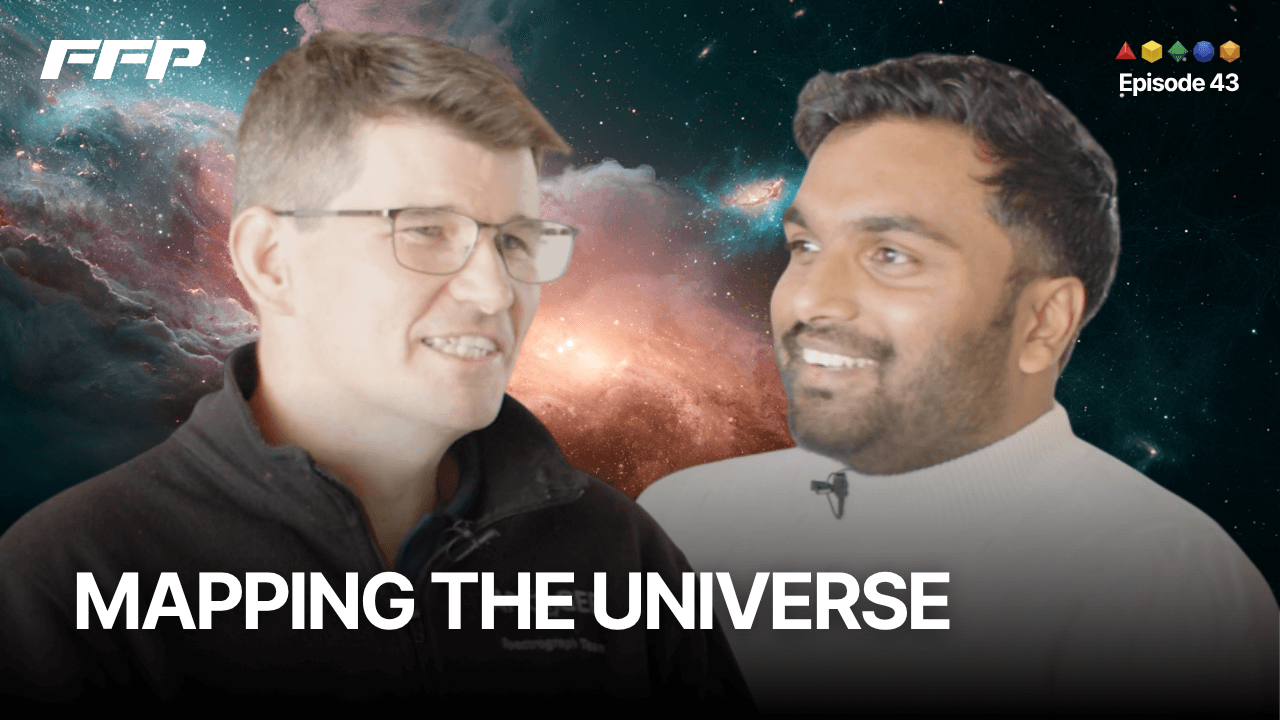
Blanton describes graduate research using ray tracing to determine exactly when and where a black hole's event horizon forms during the collapse of two colliding masses in a simulation, since an event horizon is defined by whether light can ever escape rather than by any single frame of the simulation. He contrasts that early, computationally limited work with the black hole visualizations in Interstellar, which use full ray tracing to render what an observer would actually see near a black hole.
- 01
Blanton recalls doing the work on primitive terminals and transferring finished simulation visuals to VHS tape frame by frame for professors to show at conferences.
- 02
He notes his team could only compute a few thousand light ray traces through the simulated spacetime, not enough to render full images the way Interstellar does.
- 03
Krishna mentions that Kip Thorne's group produced published scientific results as part of the visualization process for Interstellar.
776 words · auto-generated from the episode video
39:11the movie? >> I have. I have. >> And what did you think about those visualizations? Cuz I imagine that's kind of you know, the super you you were looking at numerical simulations around >> Yeah, actually Yeah, we were >> What did you think about that? >> We were doing visualizations. Uh >> Right. But with a much smaller computer, I bet. >> It was a much smaller computer. We did them uh we would We in fact we had to uh we did most of our work on green terms. Like these You know what these are? You know what I'm talking about? >> I I don't know actually. >> It's just You've got a keyboard. It's got a monitor that's 24 by 80 characters. >> Oh my gosh. Okay. >> Yeah, yeah. It's like you know, like in WarGames or whatever. Like it was one of those and then you know, on there Yeah.
39:51And then you were making these images and then to see the images, you walk over to a room where the monitor was. Anyway, it was a while ago. And then you wanted to put that video and then we would make videos for our professors to show at conferences. >> Nice. >> And like there was a whole 'nother room where it was like you slowly frame by frame put this onto a VHS. >> Yeah. >> Anyway, um it So, it was So, the visualization has gotten better. >> Yeah, definitely. >> Um, so what Interstellar does, I believe, um, and and which, uh, is is a really neat thing, is showing you like how the light actually
40:32how you would see it if you were in that space-time. >> Yeah, like and so they come >> Yeah, like do all the ray tracing. Yeah. So, so we did do ray tracing like similar to that. We were doing it, but we didn't do that for our visualization. We were doing that cuz there was a scientific question we were asking about Basically, we're asking like if you take two things, well, you know, we had these simulations that the graduate students and post docs had rhyme like of matter collapses forms a black hole. At that time, you couldn't make them do this. >> Okay. >> They could only come straight together. Uh, and they would form a black hole, but it's like when does the black hole
41:12form? >> Right. >> You only know the the definition of a black hole is the event horizon is when light can't get out. >> Right. >> No matter what. Like it forever can't get out. And and if you think about it, that's not really a local thing. You can't just say "Oh in this frame of this simulation at this particular moment, there's a black hole anywhere." You have to figure out if I shine light here, can it eventually get out? And if if if this if the thing's in motion, if the stuff is still flowing, then it's not obvious. >> Right, okay. >> Right? So, so so >> Which frame are you talking about and all >> Well, yeah, it's like well, it sort of
41:52depends on what these two clumps of matter do. If they're moving away from each other, maybe the light's fine. If they're coming together, there will be a black hole there, and this light won't get out. So, so we were doing ray tracing to figure out the answer to that question, like where the black hole actually formed. >> Right. >> Um, that was our job in the in the undergraduate group, but it was way like we would we could do a few thousand traces through the space-time. We we did not have the computing to like render an image rather through ray tracing. That that was that was beyond our capability. So, the stuff in Interstellar is is
42:32amazing in that way where these days you can you can literally make a picture of of what what you would see in in these situations. >> Yeah, and I think Kip Thorne's group actually did publish a few scientific results through the you know, the realization process of Interstellar, which I think is fascinating. >> Yeah. >> Um, well, it's been a great conversation with you. Thank you so much for taking the time. >> Um we really look forward to what you're going to do here at Carnegie. >> So do I. >> Yeah, and um, yeah, we'll we'll we'll see we'll see what happens. Thank you. >> Great. Thanks. >> Yeah. >> [music]
43:20[music]
AstronomyAstrophysicsOpen DataCosmology