ChemistryNeuroscienceNobel PrizeParticle PhysicsAstrobiology
How Nobel-winning science leads to vision research, memory-controlled metabolism, cosmic neutrinos and sensors for mirror molecules.
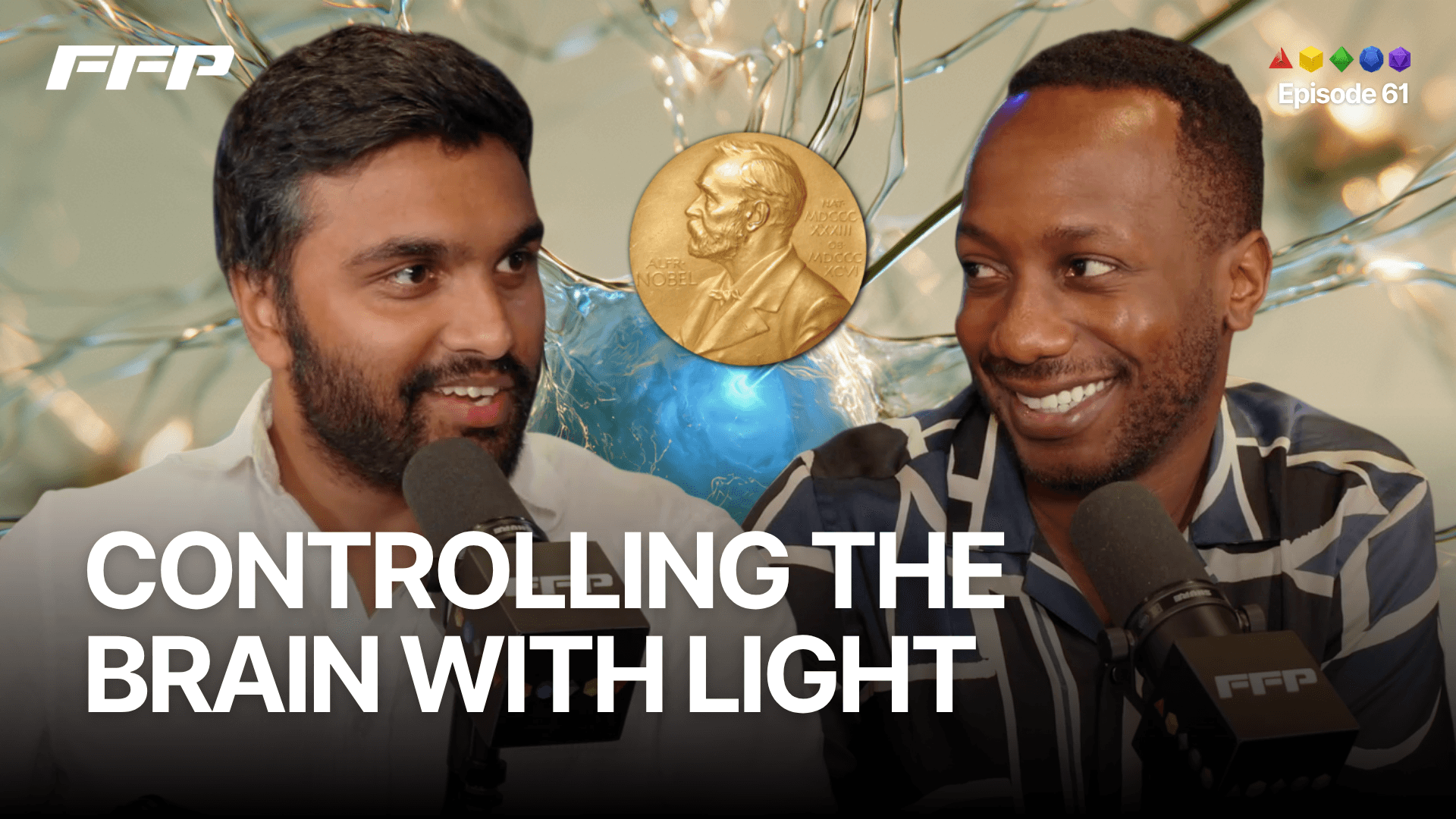
Can light restore aspects of sight? Can recalling a cold experience change an animal's metabolism? And what can ghost particles and mirror-image molecules tell us about the universe? Lester Nare and Krishna Choudhary follow up on our 2026 Nobel Prize episodes with research building on optogenetics, IceCube and molecular handedness. We unpack an early human vision-restoration trial, cold-memory experiments in mice, cosmic neutrino flavors, and a tiny electrical sensor for distinguishing left- and right-handed amino acids. Plus: how the Nobels work, our follow-up on the Nobel chemistry illustration, a brief look at neutrino Earth tomography, and why fundamental research matters. Which discovery would you like us to explore next? EDITORIAL NOTES The vision trial was small and exploratory. The cold-memory findings discussed are from mice. On-screen clarifications: 16:53 Both eyes were profoundly visually impaired; the worse-seeing eye was treated. 19:57 The untreated eye was patched during testing, not a normal-vision control. 54:41 Neutrino event rates depend on energy and selection, not just detector volume. 1:05:47 Flavor identification efficiency is distinct from interaction probability; both depend on energy. 1:13:35 Other astronomy-related Nobels include 2017 (LIGO) and 2019 (cosmology/exoplanets). 1:18:00 The LHC at CERN enabled the Higgs discovery; CERN itself was founded in 1954. 1:44:25 Both enantiomers produce current signals; waveform features distinguish them. 1:46:42 Murchison is a meteorite. Diego de Almagro and North of Antofagasta are soil sites. 1:47:40 The sensor study reports mixed agreement and limitations, not uniformly negative results. 1:49:00 Phobos is a Martian moon; a captured-asteroid origin is a hypothesis.
- EP 63
Nobel Prize in Chemistry 2026 Explained: Mirror Molecules
Why does life favor one molecular mirror image? We explain Kagan and Soai's Chemistry Nobel, chirality, autocatalysis, medicines and mirror-life risks.
- EP 62
Nobel Prize in Physics 2026 Explained: IceCube & Neutrinos
How does a telescope buried in Antarctic ice detect ghost particles from space? We explain Francis Halzen's 2026 Physics Nobel, IceCube and neutrino astronomy.
- EP 61
Nobel Prize in Medicine 2026 Explained: Optogenetics
How did proteins from algae give scientists control over brain cells? We explain the 2026 Medicine Nobel, optogenetics, memory experiments and early medical applications.
- EP 60
2026 Nobel Prize Predictions: Medicine, Physics & Chemistry
Our 2026 Nobel predictions: the science behind GLP-1, light-controlled neurons, quantum interference, cellular droplets and more.