
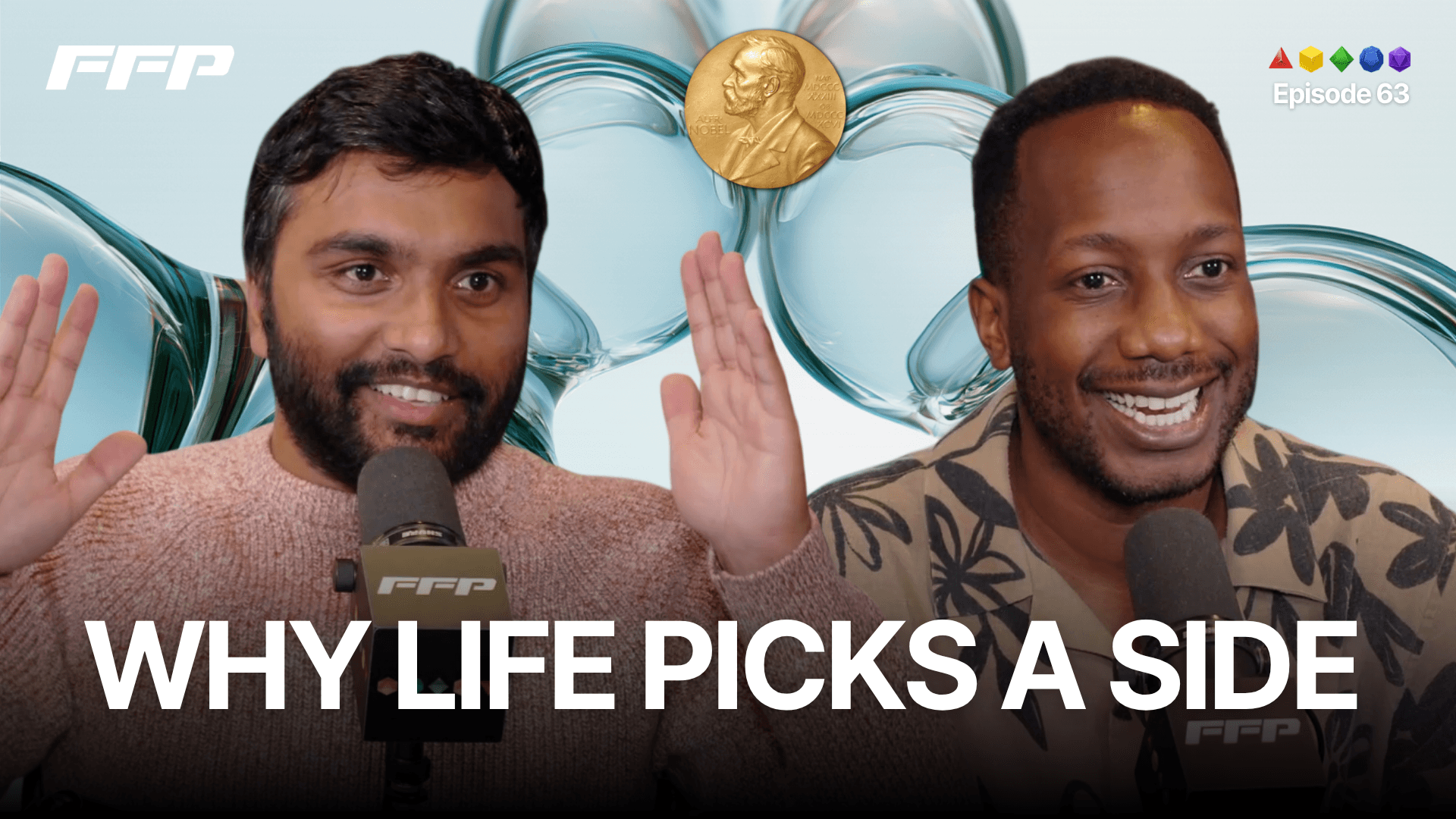
This closing segment recaps the episode's arc, from the basic geometric fact that two hands cannot be rotated into identical copies, through Pasteur's experiment making molecular symmetry visible, to Kagan's work showing mixed-handed catalysts do not simply average their effects, and Soai's self-amplifying reaction linking autocatalysis to nonlinearity. The hosts restate that a tiny starting imbalance can, under the right conditions, shape almost the entire outcome, and leave open the question of which other chemical systems could do the same. The rest of the segment is sign-off material: thanks to the co-host, a reminder that science is a team effort beyond prize winners, and previews of upcoming episodes.
1,008 words · auto-generated from the episode video
1:14:10We have spent a lot of time this week early putting all these materials together so we could have had daily drops with detailed understandings of each of the moving parts. I just wanna quickly kind of go through what we've talked about today. So we started with two hands that could not be made identical by rotating them. From that small geometric difference, we reached a problem that connects the molecules in medicine to the building blocks of life. Pasteur, we, Pasteur, made molecular symmetry experimentally visible. This was our wine example earlier. Kagan showed why the behavior of mixed handed catalysts need not be a simple average. And so I demonstrated a reaction in which self-production and amplification work together.
1:14:56This non-linearity we talked about then, this autocatalysis. A tiny starting imbalance does not always stay tiny. Fascinating. Under the right chemical conditions, it can shape almost the entire outcome. That is the idea behind this year's chemistry Nobel. And it leaves an excellent question open. Which other chemical systems can turn a small beginning into a strongly ordered result? Which is what we just ended on. Maybe we need to be a little bit careful when it comes to some of the mirror life stuff. If there's a step in the story that you would like us to unpack further, in addition to the FFP greater than Nobel committee in the comments, please let us know. Again, all the papers and the sources are available at FFPpod.com on socials.
1:15:42You can get all of our clips at FFPpod. Oh look, our little, give it a like, just popped up on the screen for those watching on YouTube. That timing was quite nice. Look, that was no hands, look, no hands. I wanna take a, I know this is running a little long, but I wanna just take a last moment since this is gonna be our last episode from the Nobels. I wanna give a huge, big shout out to our resident PhD, Krishna Choudhary this week, who's been an absolute champion. These are extremely dense and complex issues. As I mentioned, we are up all morning recording first thing after several hours to deliver a deeply technical, but conversational and approachable episode right when it
1:16:28happens, so you can really get this immediately. Krishna is a big part, not only in every episode, but especially in Nobel Prize week for us to be able to deliver the correct and accurate and still enjoyable result here. And I really just wanna give you some flowers. Thanks dude. It's a hugely challenging thing for us to accomplish this in this time period with just the two of us and to get it out to you with high production value, making us look pretty. So in the comments, if you made it to the end of the episode, please give Krishna a big shout
1:17:08out because this is real work and it's a pleasure to be able to produce this show alongside one of my favorite science communicators. My name is Lester Nare alongside again, one of my favorite people, Krishna. Is there anything from the week that you wanna just end on before we let the people go here? I wanna end on the fact that, I think in a grand scheme, if we zoom out, the Nobel Prizes are a great way to recognize scientists for a lifelong career in advancing a particular field, but
1:17:50prizes aren't everything and science is so much bigger than the few individuals that get the Nobel Prize. Even in today's episode, we talked about all of the stuff that led up to it in the Ice Cube episode. I mean, there's 450 people involved in Ice Cube. Only one person got the Nobel Prize. It was his baby and it kind of makes sense, but let's not forget about all of the scientists that work for creating science. They're just as much heroes as the Nobel Prize winners and that's why a big part of the show is just highlighting science as it happens throughout the year. It's a team sport. This is not tennis.
1:18:31And again, we do always try to, for example, when we show the papers, show the whole author byline, so everyone gets that recognition because I think it's a really good point. We are trying to create an entry point into this to make it enjoyable, but we are extremely grateful to the entire research community and we are trying to elevate your stories in this love letter to science. We go crazy. And one thing I will also say is that getting up at 2.30 in the morning, it's not just me. You're doing it too. And the fact that we can produce this thing, release a day of, release a bunch of social clips the day of, that's all Lester.
1:19:14And be sure to look at all of the advancements that we've had in our automatic caption creation and things like that. Pretty cool stuff. We are one of the best teams in science entertainment and we are trying to build off the shoulders of giants of the many researchers who don't get their stories told as often as other things. And so it's a pleasure for us both to be able to bring the show to you for many of the new listeners. We have a great back catalog. Check it out. We are going to go get some rest. Next episode will be our interview episode from the Golden Goose Awards, which was, I can't
1:19:55believe that was last week. When we were in DC, we'll have three interviews with all of the awardees that won this year and that will be followed up by our interview with AAAS CEO Sudip Parikh. And we may do a Halloween special, but we haven't decided. We're gonna take a couple days for a breather. We appreciate you all and FFP Nation for joining us and we will see you all next week.
Nobel PrizeChemistryBiochemistryChemical origin of lifeSynthetic Biology