
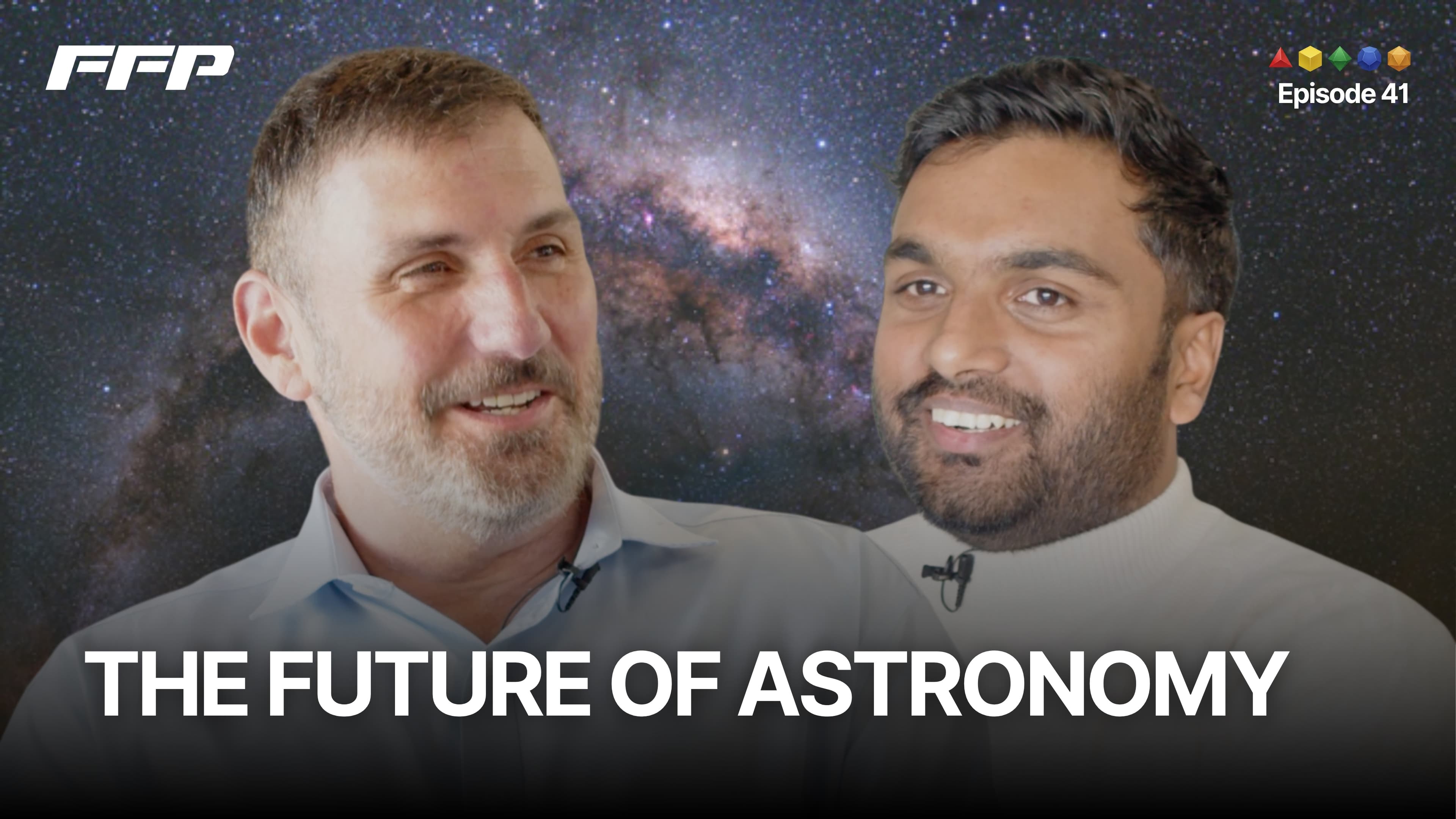
John Mulchaey describes Carnegie Science's model of giving researchers the freedom to follow promising questions. In conversation with Krishna Choudhary, he explains how arriving as a postdoctoral researcher allowed him to develop his work on galaxy groups beyond the subject of his thesis. He also discusses learning from Carnegie's biologists and Earth scientists as president, and the long-term ambition behind the Giant Magellan Telescope.
- 01
Mulchaey identifies scientific freedom as a major reason he built his career at Carnegie.
- 02
His account connects institutional support with the ability to pursue a research direction that was not the original plan.
- 03
Leading Carnegie involves learning from disciplines beyond his own background in astronomy.
1,891 words · auto-generated from the episode video
9:41>> Yeah. >> Probably not here for certainly. >> Yeah. Um, well, that's yeah, that's fascinating because again, it's like, you know, with science there's established theories and then the theories give you expectations and then there's a tendency to just run after those expectations. >> That's right. >> Right. >> I mean, and but if we did, you know, I mean, look at the James Webb stuff. This is you guys talked a lot about you talked about this a lot. James Webb is completely rewriting our understanding of the early universe. >> That's right. >> When people were designing, thinking about James Webb for the first time in like 1993, was when it really kind of started. You know, people were not Nobody was imagining we were going to find super massive black holes in formation at the early universe and I mean, everything that's coming out of James Webb is it's all new and surprising right at some
10:22level and that's really what's exciting about science. >> Yeah, I mean, just speaking of James Webb, before we set up for filming in this room, you guys were having a journal club and I think they were talking about the Bullet Cluster. >> Yes, another yes one. >> Yeah, James Webb had just done some spectroscopic analysis and the the key takeaway that whoever was presenting the paper was like, "So, the Bullet Cluster is way weirder than we thought." And it's like, "Nice. James Webb at it again." >> At it again. >> Yeah. Um, so, that got you this job at Carnegie and you've been here for quite a while. >> Yeah. >> Um, what has that been like? What did What did you like about Carnegie that you stayed for so long? >> Yeah, I came here as a postdoc with really no intention. I mean, I thought I would Most astronomers end up in
11:02universities or working for NASA. Those are really the two paths for almost all astronomers. Um, and I I when I came into Carnegie, I was first of all very like surprised that I could get a job here. Partly, I had this big result that didn't hurt of course. And but I came here and what I really love about Carnegie and what I still love about Carnegie is it it is a pretty a pretty unique environment, especially I'll speak as an astronomer, but it's also true in our biology and our Earth Science groups at Carnegie. Is the freedom. You know, Andrew Carnegie set up the organization up with the idea that people we would hire scientists and let them work on whatever they want. And that's really unheard of. I mean, you know, at a university you spend a lot of your time teaching and
11:43doing all these other things. And of course at NASA you're very involved in the missions. So to have the scientific freedom you have at a place like Carnegie is really unheard of. And it allowed me to move my career. So even though my thesis was on black holes, as soon as I arrived at Carnegie 6 to 8 months after this result, I took my career in a very very different direction working on these groups. So I everybody will tell you I'm known for these groups of galaxies. That wasn't even my thesis, right? But Carnegie allowed me to really expand in that direction when I came here. >> That's very cool. And you know, you've been here, you've you've done your job as the director of the observatories. Now you've moved up to president. >> Yeah. >> Quite recently, I think. >> Yeah, within the last year. >> Within the last year. Um you know, Carnegie science is not just an
12:24observatory now though. >> Right. >> It's doing biological research. >> That's right. >> Chemistry, all sorts of stuff. So how do you like context switch >> Yeah. >> between you know, your job as an astronomer and your passion as a lifelong astronomer to now all of these other different sciences? What's that like? >> Well, I think that that's actually probably the best aspect of the job for me is that in the last year I've got to learn I'm learning biology as I go. I I always tell my our biologists I took one biology class in my entire life, which was you know, sophomore year of high school. >> Okay. >> Which was a long time ago and biology is completely different field now. So I really >> don't know biology at all. So I'm I'm learning it, which is super exciting. One of the fun things is getting to have
13:05conversations with the biologists and understanding what they're doing. I keep giving this story over and over again. I'm going to tell it again, but I like I recently learned about photosynthesis. >> Okay. >> You know, we all know about photosynthesis, right? You know, plants take energy in. But photosynthesis is an exceptionally um inefficient process. >> Yes. Yeah. >> And I was talking to we have >> Are you going to talk about Rubisco? >> No, I'm not. But now you're out of my league. You're going to get out of my league very quickly. But, you know, a lot of our scientists are working on these things and you know, they're trying to figure out how why is photosynthesis so inefficient and you know, how can you improve it? And so, like to me to learn that I learned that in the last year that that's super cool to me. >> That is. You guys talk about a lot of science. You probably know more broad science. >> No, I don't I don't know much about it, but but that that is a really
13:45fascinating. And why? >> You know, because it's been around for what? Like a billion years now? Like bacteria been doing it for yes, at least >> Yeah, yeah, and they still can't and I think I was reading just a random tidbit is I was reading this like paper about you know, why it is that way and there were some physicists who were trying to answer that question from just a quantum mechanics point of view. And it's literally what they were arguing is that the CO2 molecule >> Yeah. >> and the oxygen molecule look literally the same. >> That makes sense, yeah. >> Okay, because it's the C the C is in the center and then there's O's and O's. >> So, you just separate it. >> Yeah, and then and then there's an oxygen, right? So, whatever enzyme is trying to pull apart CO2 gets confused with oxygen because if an
14:27oxygen goes into that active site, you know, it's just oxygen on both ends. And then the so and and the the size is very the size difference is really small and all it has is like that size difference to tell whether it's interacting with a CO2 molecule or oxygen molecule. So, if you just think about it yeah, it's like it's the best I can do because my Lego block looks exactly the same to me. >> Yeah, sure. >> You know, I but that's a really cool problem that you guys are working on. >> I I think it's really interesting, right? >> Yeah, it has potentially lots of applications for crops and things of that sort. >> Right. >> But for me as an astronomer, I mean, it's been super cool to learn about that, learn about our Earth science as well. We have a lot of people working, you know, Earth is an amazing planet, of course. You know, everything we know
15:08about life on Earth is because is is life here on Earth, right? But there's a lot of things that have happened here on Earth that have made got us to this point in time. Earth is very special in some ways. There's probably many Earths out there but >> uh but learning about those process, you know, understanding why magnetic fields, how do planets get water? We have people working on all these things that are um adjacent to astronomy, but not really. And so, for me, I'm now now get to learn about all this stuff. But, I have to say, the scientists have to teach me this cuz I'm not uh you know, I was I'm very very focused on the astronomy piece for for the last uh 30 years prior to this. >> Yeah, yeah. And I mean, speaking of other Earths, one of the big things that Carnegie was involved with over the past 10 years or so is the Giant Magellan
15:51Telescope that should be coming online soon, hopefully, um at the Las Campanas Observatory in Chile. So, you've you've been kind of instrumental in that. And one of the big, you know, mandates of Carne of that observatory are to, you know, look for exoplanets and look for atmospheric signatures, biosignatures. Could you take me through a little bit about how that um telescope started and how it's been going and what your role was? >> Sure. I So, I I we've been working on this telescope for quite a long time, over 20 years now. >> Oh, 20 years? >> Oh, yeah, yeah, um >> Yeah, I guess these things take a long time. >> a long time. I mean, James Webb took 30 years from beginning to to when it
16:32launched. And these will be similar for these giant telescopes. Um I mean, I think the thing uh as an astronomer, you know, we all we do is study light, right? And light is the always the limiting factor for us. And so, the reason bigger telescopes are more interesting in general is because they collect more light. They also give you higher resolution. So, the two combinations are important. But, as soon as our current Magellan Telescopes at Las Campanas, which are kind of our main workhorses now, came online around 2000, people in our building here started asking the question, well, what's next, right? And the challenge is that, you know, um you hit kind of a limit with the single mirrors, how big a mirror you can make to keep it uh to to really move it and have it keep its shape and things you need to do. And so, that's where the
17:13idea of the Giant Magellan Telescope came up, which is is using seven very large mirrors, each of them about 25 ft across, Uh uh in a single telescope. >> Wow. >> But, it's huge. It's So, it really The way I always tell people is that you right now, our best telescopes are about the size of one of those. >> Right. Yeah. >> So, you're really increasing >> doing seven in like a hexagon with one in the center? >> It's one in the center, and then and six around. And the the jump in in light collecting is just tremendous. >> Right, cuz it's going to go like the square. >> That's right. It goes to the square, so it's the area that matters. And and then also the resolution matters because the