
827 words · auto-generated from the episode video
1:29:20create at least a framework in my mind of what's happening here >> such that as I decide what direction I want to take my academic interest for the rest of my life, I'm getting this nice poperri buffet of everything. Yeah. and QFT is a little interesting, but I think I'm going to stick with uh stick with, you know, whatever. [laughter] Seasting, go in that direction. I mean, this stuff is just so deep. I just even I'm like, as I'm like thinking about it >> as as I read I have to read the the sections over and over again to make sure I get every little thing because it's just so beautiful. And I'm like, this can't be real. >> Right. >> Right. >> Right. that like >> I think about
1:30:00>> what we're just so like the unitary 2x two matrices that have a determinant of one like are all of a sudden like what so so so that that's just the world is just you know >> this is this is nerd paradise >> I know there are going to be some people who will be like I exactly >> like who just can can empathize and sympathize with >> it doesn't make any sense to me but at the same time it's making so much sense that it's just like what why is does this work? >> I don't I don't I don't >> it's weird man. Young So Yang Mill's theory is like really really crazy
1:30:41>> like the fact that this the standard model works this way right and all of the particles obey these these laws that just come out of symmetry principles >> of just like oh I can do something to my thingy and it doesn't change. That means that there's a conservation of baron number. That means there's a conservation of charge. That means there's a conservation of color. What are we what >> the the the fractal community is going to have a field day. >> It's crazy, dude. >> Everything is fractals. >> Yeah. >> Everything is symmetry. >> Yeah. I mean, okay, so to close out on the story of Young, um, he settled in the Institute for Advanced Study at Princeton for a while. >> Yes.
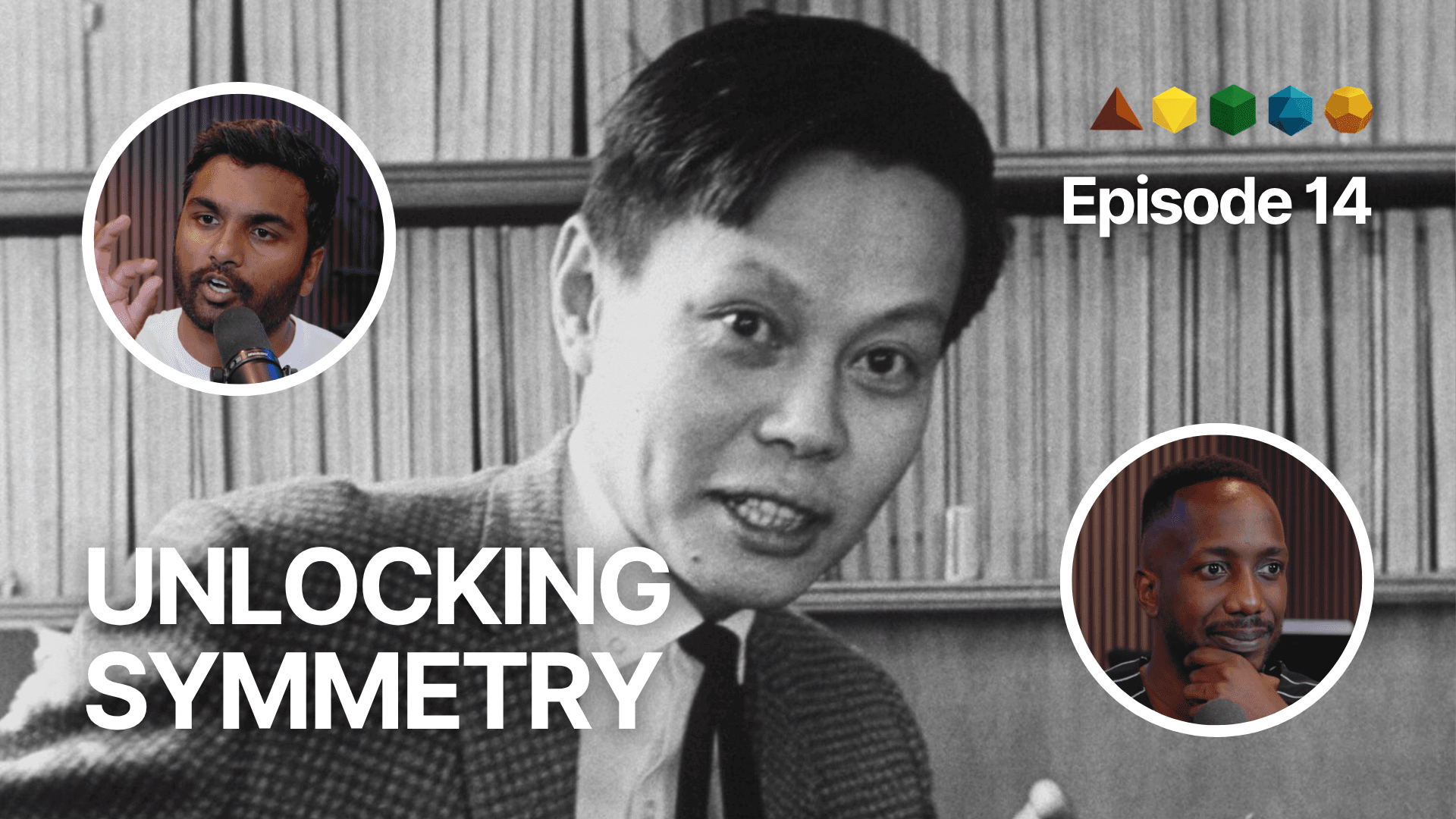
1:31:21>> Um, that there's a photo of him with all of the classic >> Wait, it's so funny. When I was setting this up, I was like, "Oh, that looks like Princeton." >> Yeah, it's [laughter] you know, the the window like the the table. >> No, it is. It's It's the table and the window and and the way the trees are. You just know it's >> I love how you also did not say anything. >> No, cuz I wanted you to I wanted to be like, "Yeah, no, [laughter] that was actually Princeton. That was at the Institute for Advanced Study." The architecture is all the same in the town. in that town. It's like there's a little bit of gothicness in like the Rocky College and like Blair, but then most of it is just like that classic American like colonial architecture >> 100%. >> Um so he moved to the State University
1:32:03of New York um at Stonybrook where he was the Albert Einstein professor. >> Um then he uh he actually became the first director of the Institute for theoretical Physics there. Now it's called the Cienyang Institute for Institute at Stonyie Brook University. um he was really big on scientific diplomacy. So in 1971 in the Nixon era when China US tensions sort of thawed he went back to China and he helped Chinese physics recover from that cultural revolution um which was >> you know really bad for academia and all of this other stuff. >> Um he established a committee on educational exchange with China. he returned to Singua University. Um, and
1:32:46in his 1957 Nobel Prize speech, he actually described himself as a product of both Chinese and Western cultures in harmony and in conflict. >> Um, I thought that was I thought that was really interesting. So, I looked I looked really into this. There was an interview that was done by Stony Brook University that asked him, "What did you mean by that in harmony?" What do you mean by that? >> Yeah. What do you mean by in harmony and in conflict? I'm a product of Chinese and Western traditions. He he went into a lot of Chinese history. He started talking about how China had this amazing, you know, 5,000
1:33:266,000y old storied history kind of went into decline in the 19th century and the British were trying to carve up China with the Opium Wars and all that other stuff. In 1900, there was the Boxer Rebellion. I don't know if you remember this. I remember this from AP World History. I had to learn about it. The Boxer
Nobel PrizeStandard ModelSymmetryParticle Physics