Nobel PrizeStandard ModelSymmetryParticle Physics
Chen Ning Yang, parity violation, and the birth of Yang–Mills.
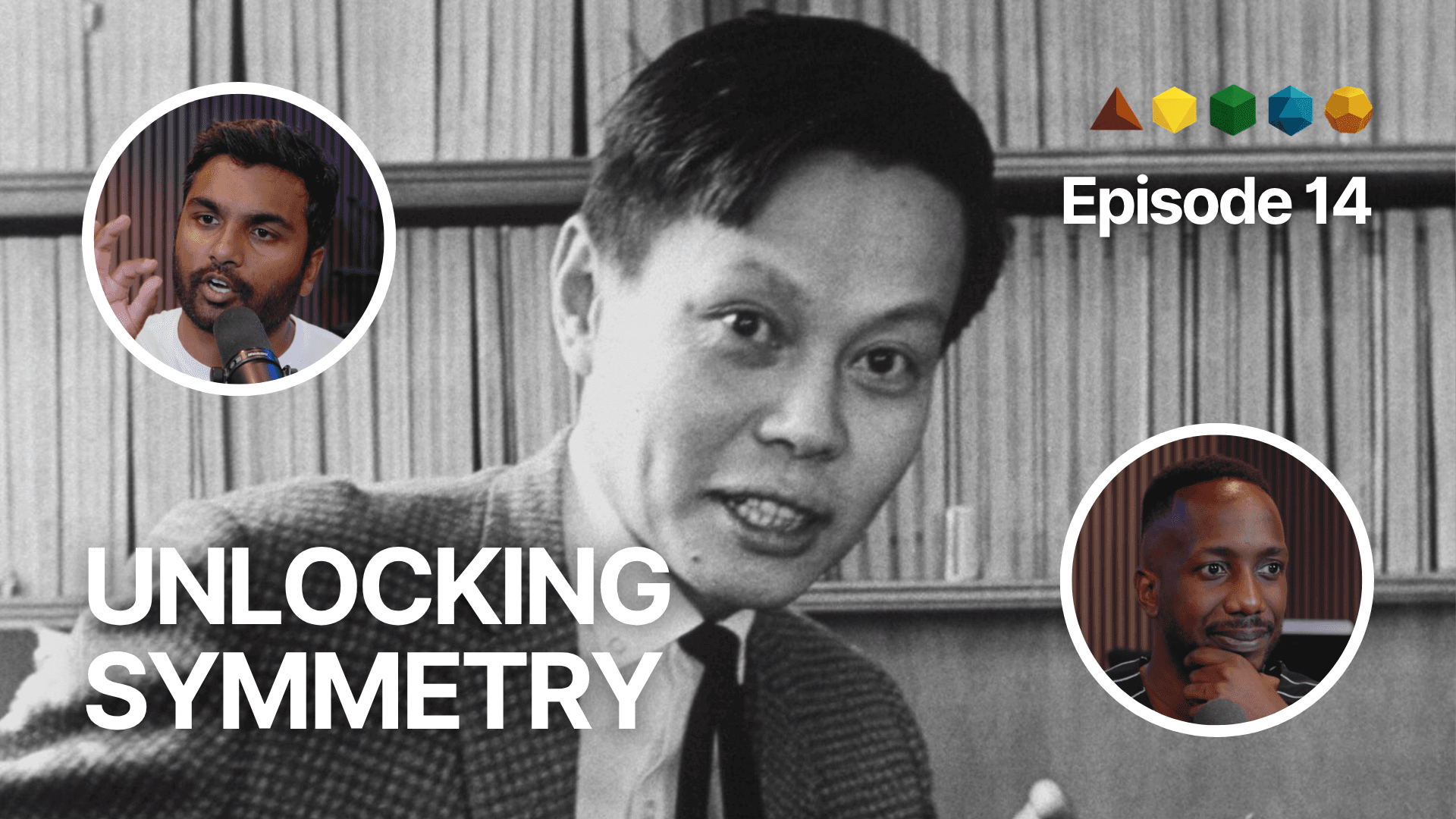
Hosted by Lester Nare and Krishna Choudhary, this From First Principles deep dive tells the story of Chen Ning Yang, one of the most influential theoretical physicists of the 20th century. From his early days in China to his Nobel-winning discovery of parity violation with Tsung-Dao Lee, Yang’s work on symmetry and gauge theory reshaped modern physics and laid the groundwork for today’s Standard Model. In this episode, Lester and Krishna trace Yang’s intellectual journey — from conversations with Subrahmanyan Chandrasekhar to his insights on gauge fields, topology, and why beauty and symmetry remain the compass of modern science. Summary Early Life & Mentorship — Growing up in China, moving to Chicago, and learning under Fermi and Chandrasekhar. Parity Violation — How Yang & Lee overturned one of physics’ sacred assumptions and changed our understanding of nature’s asymmetry. Gauge Symmetry & Yang-Mills Fields — The 1954 paper that became the foundation of the Standard Model. Legacy & Philosophy — Why Yang believed theoretical beauty is a clue to truth — and how that philosophy continues to shape physics today.
- Physical Review
Experimental Test of Parity Conservation in Beta Decay
Scientists studied how a very rare, artificial element called Fermium-250 breaks apart naturally. They found that this radioactive element decays in two different ways: most of the time (89.5%) it captures an electron from its own atoms, but sometimes (10.5%) it spits out an alpha particle instead.
- Physical Review
Conservation of Isotopic Spin and Isotopic Gauge Invariance
This theoretical framework could lead to the discovery of new fundamental particles and forces in nature. Just as electromagnetic gauge theory led to our understanding of photons and electromagnetic interactions, this isotopic gauge theory might reveal previously unknown particles that could be detected in high-energy physics experiments. Understanding these deeper symmetries of nature could advance our knowledge of the fundamental building blocks of matter and potentially lead to new technologies.
Transcript
Show →Hide19,021 words · auto-generated
Intro — Dodgers predictions + World Series setup
0:00Ciao internet. This is your captain speaking Lester Narre joined as always by my co-host and our resident PhD Krishna Chowdery. This is from first principles [music]
0:18[music]
0:24[music] my friend. How's it going? We have some travel coming up and uh so we want to do a quick special episode for this upcoming week which just so happens to be when the World Series is happening. >> And so as you can see we've prepared accordingly with our Japanese Otani jersey with our Dodgers memorabilia hat because we know the Dodgers are going to be backtoback World Series champions. >> That's right. I mean we're recording this a week before the World Series, but we already know how it's going to go. >> We already know how it's going to go. >> Yeah, it's going to go down. I mean, we're going up against Canadians. Look, h having been on both sides of the pond, born in Montreal.
1:04>> Oh, yeah. Yeah. Living in the States. Yeah. You're literally kind of Canadian. But, you know, you know what I mean. >> It's not the same thing. It's it's it's it's not the same thing. We are going to win. >> But because of our sort of travel schedule, we're going to do a special episode that's focused on one story. And this story actually comes from uh a direct message, a DM. Someone slid into the DMs uh on Tik Tok and they mentioned the recent passing of a physicist uh named uh Chening Yong. >> Yep. >> And people are saying he's one of the most influential physicists of the 20th century. Um and I was unfamiliar with the game. did a little bit of
1:46digging and some of the names that people associate in terms of the class he belongs in include Einstein, Boore, Heisenberg, Fineman. High praise. >> Yeah. Yeah. >> Very very high praise. Yeah. >> So are we really saying that Yang can be associated in that class of sort of
Baseball banter + Japanese Ohtani jersey
2:07untouchables when it comes to sort of physicists who are above reproach in terms of what they've provided over the course of their careers in knowledge and expertise in Nobels in I mean he won the Nobel Prize but and everybody talks about that right um there's a BBC article that came out um on his death and it said you know, Chinese Nobel laurate and physicist Chen Yang dies at the age of 103. That BBC article mostly talks about his Nobel Prize, which was given for um discovering the theoretical foundations for something called parody violation, which is what we're going to get to. But that's not actually why he's considered
2:48one of the greatests, >> okay, >> of the 20th century. I mean, as you said, the 20th century has some of the most influential physicists of all time. Einstein, Boore, Heisenberg. These are the people who not only contributed to our understanding of the modern world but totally reshaped how we think about doing physics in the first place, right? M and Yang is one of those people who completely kind of changed the the way in which we think about trying to do theoretical physics, you know, as theoretical physicists do. And and he came up with the thing that really
3:28immortalized him was this formulation of something called nonabelian gauge theory, which is known as young mil mills theory. >> I remember hearing oh gauge theory, gauge theory all the time. This is the guy who kind of started that whole thing. Okay, Yang Mills theory. And you know in physics circles we we just say Yang Mills theory. It's >> it's a bedrock foundation for the standard model which is one of the most successful um theoretical ideas that we've had as human beings. Okay. And it's rooted in this idea of symmetry. Okay. So in this episode, what I really want to do is go through some of Yang's
4:09work and talk about symmetry as a
Setting up the episode: symmetry and physics
4:12principle and how that relates to the to the modern world. Now symmetry, everybody knows what symmetry is, right? The my favorite symmetric object is the Taj Mahal in India. Um the first time I saw it was actually I I was quite old even though I was grew up in um grew up and was born in India. I didn't see it until after college. And it is one of the most beautiful buildings I have ever seen on planet earth. And all of that has to do with symmetry. If you look at the Taj Mahal, right? It's an extremely symmetric building. And we kind of know what that means, right? We have this deep sort of intuitive sense that symmetry means
4:52balance beauty harmony right? But when we think of symmetry, we think of it as a static property. It's something that we're looking at for a static object, right? But what do we actually mean when we say symmetry? >> The idea is, and this is something that um the great mathematician Herman While came up with, the idea of symmetry from a mathematical sense is that a thing is symmetrical if there is something we can do to it so that after we have done it, it looks the same as it did before. >> This is a tongue twister. It is. But here here's what's happening. You've got a thing that is symmetric. What does
5:34that mean? That means I can do something to it and when I'm done doing it, it looks just the same. The Taj Mahal. Here's an example. Right. The imagine the Taj Mahal in your head. >> Yes. >> Flip it. Flip it along the XY plane. >> Yes. >> Not on the XY plane, on the vertical. Right. So, so everything that's on the left goes to the right. So, those spires on the left go to the spires on the right. The dome is exactly symmetric to the central axis. The two little domes on the side are symmetric. So they just
What symmetry means in science
6:03flip around. So you can imagine if I were to take that photo of the Taj Mahal and then flip it >> right along the middle, I would get the same exact Taj Mahal. >> That means that it's symmetric. >> Does that mean does that make sense? It's symmetric upon reflection of that central axis. Yes. Now there's other kinds of symmetry and and we're used to it. Like for example, there's shapes that we can do. And what we can do is not just reflect along the central line. We can reflect along many lines. For example, the heart, the heart shape, you can reflect along the central line. The butterfly you can reflect along the central line and the and the the wings will go from one to the other. A square you can reflect along the central line on both axes and also along
6:45the diagonals and the square is going to come back to be the same square. Okay. There's another way to do symmetry not just with reflections. You can also do rotations of objects. If you look at like the red cross, the cross of the red cross or the thing that's in the middle of the Swiss flag, >> right? You can rotate that cross 90 degrees >> and it'll be the same cross, right? But if you take an arrow and you rotate it, it's going to point the other direction, right? It's going to point from up to left or whatever, however, however you do the the 90° rotation. So [snorts] in that sense we kind of know what symmetry means for um objects >> like thingies right um 2D things 3D
7:27things you can even think about a sphere right you can rotate a sphere in any direction and it's a continuous symmetry because no matter how you rotate the sphere it's still going to be a sphere >> and you can do similarly with a cube but only not in any direction but in certain explicit yes >> degrees of rotation. >> Yeah. And actually the five platonic solids that are our logo, you can you can rotate them in three dimensions and you'll come back with the same exact platonic solid. Right? So >> we're used to objects being symmetric, but in the early 1900s there was talk about maybe there's symmetry in the physical laws themselves. >> Okay. >> Okay. There's stuff you can do to
8:09physics laws that leave the physics laws exactly the same. >> Okay. >> Okay. >> Okay. I hear what you're saying. >> Yeah. So, let let's let's [laughter] dig into that. This was actually first um first sort of codified by um someone by
Reproducibility — laws of physics don’t change
8:26the name of Emmy Not who was a mathematician from Goting. She was actually like she people didn't want to publish her because she was a woman. So she would publish under her supervisor's name. But there there's a there's a theorem called not theorem >> which basically codifies this idea >> that there's something I can do to physical laws that will preserve the action of the physics underlying it. >> Okay. There's we've actually like it's it's quite intuitive at at the start. Okay. >> There's a translation in space that's a
9:06symmetry. For example, the laws of physics are the same here >> as they are anywhere else in the universe. So if I Yeah. And we've talked about this before. If I set up an experiment here in one lab and I do somethingy and I measure somethingy and then I go all the way across the United States to the east coast and I set up the experiment, I'm going to measure that same thingy. Right. >> This is a LIGO is a perfect example of this. >> Yes, exactly. There's one on Livingston, there's in Louisiana and there's one in Hanford in Washington. They're both operating the same way. This LIGO wouldn't be possible if translation in space wasn't a thing. >> Right. Yes. >> Right. And but there's an inherent
9:47assumption there that >> because we're on two separate parts of Earth, >> the Earth is not really part of the experiment, >> right? We're doing enough to cancel out the stuff of Earth and like that local environment to really focus on the physics that we want. And because of the translation symmetry of physics, that experiment in Louisiana is the same as the experiment in Washington, right? That's a translation in space. Okay? There's also a translation in time. Which means if I do an experiment now and then I don't change anything and then I do an experiment you know tomorrow or a month later as long as it
10:28doesn't somehow depend on the Earth's
No special place in space or time
10:31position in the solar system or something like that. Obviously, if you're trying to like measure stars or something, yeah, you're not going to >> sure. Yeah. You know, but if if you're doing something with subatomic particles or like gravitational waves, then >> yeah, whatever whatever thing I'm doing now is the same as what I'll be doing tomorrow is the same as what I'll be doing in a month and so on and so forth. Is this the kind of the where this idea of longitud longitudinal studies come from where you have these long period of time where you're just replicating the same experiment in order to see the impacts like over generational differences or any other kind of category but because you have this symmetry in time. Yeah. Yeah. Yeah. you
11:12at least can trust that the laws of physics aren't changing. Yeah. Yeah. That's if if that weren't true, then it's like whatever thing you're doing, it's like, oh, well, you did it a month later, right? [laughter] But so so there is this there is this like underlying notion that whatever the laws of physics are today are going to be the same as the laws of physics tomorrow and the day after, right? Um, >> and another one is the rotation in space. Okay? If I have an if if I have an apparatus that's oriented this way and then I just rotate the whole thing, as long as like I rotate everything that has to do with my experiment, my experiment should yield the same
11:54results right? >> Makes sense? >> So all of these things are symmetries. The fact that I can change my experiment in a way but the physics remains the same. This is underlying like you know the fact that I can replicate experiments and if I do an experiment and I publish something with all the methods somebody from the other side of the world can actually replicate that experiment. >> It's the bedrock of the scientific
Noether’s theorem explained (conservation and symmetry)
12:15process. >> It is it is and and and it's been shown to be true. There's so many experiments that show that you know this is the laws of physics. there's no special point in space and time or direction in space and time that like yield different laws of physics right um Emmy not in no's theorem what she actually showed was if we take if we take the um assumption that physics is the same after these translations that then something must be conserved >> every single time that we have this symmetry that's something that we can tackle in a later episode and actually prove no theorem. It's a beautiful proof um and it's quite intuitive. But at the
12:56end of the day, what ends up happening is any symmetry is associated with a conservation law. So for example, the fact that I can translate in space, meaning I do an experiment here, then I do an experiment somewhere else and the physics laws are exactly the same, that leads to a conservation of momentum. >> Okay? >> Yes. Yes. >> In any situation, >> right? If I do an experiment today and then I do it tomorrow and the and and the week after and the month after and all of the laws of physics are the same, that leads to a conservation of energy. Okay? If I do an experiment here and I change the rotation where I rotate my entire experimental apparatus and I do it again and the laws of physics are the same,
13:37that leads to the conservation of angular momentum. >> Right? It's a deep deep notion that we have. Okay, this was in the early 1900s where Amy Noter came up with this. >> I've never understood it intuitively because we've talked about all three of the we've talked about conservation of angular momentum quite a bit. We've talked about the conservation of energy uh and and the conserv conservation of momentum and have never understood it intuitively in this context of if you're doing your experiment here today and there tomorrow there like it >> there is no difference which means there Yeah, according to me. >> Yeah, >> that's it's that's actually very I just
14:19had a light bulb go off in my head. Apologies. >> It's so deep, dude, to think about, right? That like really like >> these laws that we have, these rules that these numbers are never going to change in any given setup has to do with the fact that the universe wants to conserve the laws of physics >> regardless of these transformations. >> Right. >> Right. It's it's a very deep statement to make. Okay. And that's something that Emmy noter came up with with not theorem. >> Now she did that for classical mechanics. This is before the quantum revolution and things like that. And Hermon while was one of her colleagues at Goting. He thought this was one of the craziest things he's ever heard,
15:00right? The fact that you can connect like an action on the physical laws to a conservation of the physical laws themselves. and he started um going
Translational symmetry → momentum conservation
15:10further with the new quantum revolution and trying to put that into this same language. Okay. Okay. And turns out it gets even deeper when you go into quantum mechanics. In quantum mechanics for example um you know everything is a wave function, >> right? >> Whatever whatever that means. But [laughter] what gets even weirder is that wave function is a complex number. >> Okay? It's a complex number which means it has a magnitude and it has a phase. It has a phase with respect to like uh some kind of zero some zero that you arbitrarily choose. That complex number has it's like a clock hand, right? It's
15:51got a length and it's got an angle. Well, according to quantum mechanics, what are the observables? The observables are probabilities of outcomes of experiments. And that comes from taking the magnitude of this complex number. The magnitude meaning only the length. So the the the phase actually doesn't matter when it comes to things that we can see. Right? Which means if I if I take an electron for example and I change the phase everywhere for that electron all over the universe, right? Cuz this wave function is everywhere. >> That's not going to change the outcome of my experiment. If I add a phase or I subtract a phase, if everywhere I'm just like making the clock go a little bit, a
16:32little bit, >> that's not going to change whatever thing I observe. Okay? And it turns out that that symmetry has to do with the conservation of charge. The fact that I can't create a positive or a negative charge anywhere. >> It's crazy, right? So, this is getting real interesting. >> Oh, interesting. >> This is getting really, really interesting. Okay, please continue. Right, cuz it's now it's again now from that foundation I'm extrapolating to a variety of other things we've talked about before that are making even more sense understanding this like correlation or this relationship. >> Yeah, it's I mean physics is is is
Time symmetry → energy conservation
17:12getting really weird and really beautiful at the same time, right? It's like getting weird. [laughter] Um in in any case, let's let's talk about Okay, so so we've talked about symmetries, right? and like the laws that are laws are going to be the same no matter what I do. >> Yes. >> Okay. Both both in a classical sense >> and and we we've just touched upon the quantum quantum sense of things, right? Um so let's talk about something that does break symmetry cuz not every trans transformation is going to preserve the laws of physics. For example, if you do a change of scale, right? Suppose I make my experiment and it's like you know 1 m by 1 meter or whatever and then I just
17:53like increase the the size of my experiment. Am I going to get the same physics? The answer is no. Because nature does have a fundamental scale, right? There are such things as atoms and those atoms are about 10us 10 m big like one angstrom, right? So to make my thingy bigger, I need to use more atoms and that's going to change the physics of my apparatus. So the physics of scale of stretching and squishing is not a symmetry of the universe because there is a fundamental scale. The other way when I was saying like you know the the the symmetry of time there's no t equals z. I guess there is when it comes to the big bang when it but when it comes to experiments that I do in the lab there's
18:34no t equals z >> in the perception of the way we understand and see the universe. It's a little bit of a different context. Yeah, that's a little bit of in cosmology there's a little bit of a different context, right? There is such a thing as t equals 0. But in in the scale of like experiments that I want to do in the lab, there isn't. There's no x equals 0, y equals 0. There's no like origin for the universe. So I can shift my
Rotational symmetry → angular momentum
18:56experiment anywhere and the translation of space is going to work. But there is a fundamental scale, right? That has to do with like how big atoms are. If you want to get really really nitty-gritty about it, there's a fundamental scale that's the plank length that has to do with like how big how how how you know close I can get electrons before they turn into black holes. But but there is such a thing, right? There's some meter stick. Yes. That that's here. And so this is actually something that um was first found by Galileo um in Galileo's dialogue concerning two new sciences. He published this thing. Um he had a really funny cartoon. He he he thought about like animals and what would happen if I had like a Clifford sized dog. >> Okay.
19:36>> Okay. Remember Clifford the big red dog? Yeah. So it's like I got I got a normal dog and then I got a Clifford sized dog. What would happen? Well, the Clifford sized dog um your your mass your weight scales like your volume, right? So it's going to go like the length cubed. >> Okay? >> Right? Uh the how much stuff you have goes like length cubed because volume goes like length cubed. On the other hand, tensile strength goes like length squared because it has to do with the cross-sectional area of your bone. >> Yeah. Yeah. Yeah. >> You notice that? >> So, I was just watching a video about this person hanging from rubber bands and seeing how many rubber bands it took to hold their weight up. And part of the discussion was about the tensil strength
20:18that is in the rubber bands in order to enable >> Yeah. holding it up holding. >> Exactly. Like if he had a that guy if he had a chain of rubber bands that wouldn't really help him. On the other hand, if he had a bunch of rubber bands in parallel, that would help him because the rubber bands in parallel would increase the the cross-sectional area of how much is holding you up. Bingo, right? And so, um, Galileo has this really cool cartoon of like what what a superdog bone would look like compared to a normal dog where the normal dog is like this like small bone. This is one of his drawings. And then the super dog bone is just massive, [laughter] but not so much scaled in the in the along the bone length, but like the air
20:59the the thickness of the bone is way bigger.
Gauge symmetry → electric charge conservation
21:02>> The girth, one would say. >> Exactly. The girth of that bone is way bigger. And that's where he scaled in. He's like, if I wanted a super dog or whatever, Clifford the big red dog, that guy's bones would be would be really thick because it needs to hold up the weight of the dog, right? I don't know why he chose dog, but anyways, maybe he had affinity to dog. Do dogs? Who knows? >> Look, I have three dogs, so I also have >> I love dogs. So, yeah. Yeah, I I get it. I get it. [laughter] If if he had cats, he would not be my favorite. >> Nothing against cats. Nothing. I'm sure there's there's cat lovers in the audience. I'm just not a cat person. Um, okay. Here's another broken symmetry, right? Um, we can think about
21:44motion. >> Okay. >> Okay. What if I what if I what if I put my experiment right I'm doing some experiment and then I put my experiment on a spaceship that is moving at a constant velocity actually according to Galilean relativity and later Einstein's relativity my experiment on that moving spaceship that's going at the on a in a straight line at constant velocity is going to have exactly the same results as my experiment that's on the ground that stationary, whatever that means. Because turns out if if I can't tell in my spaceship, I can't do any experiment that tells me if I'm moving and somebody
22:24else is stationary and so on and so forth, right? If both of our experiments are exactly the same, I can't tell who's moving and who's stationary. All I can say is somebody is moving relative to me. That was the big, you know, light bulb of Einstein to say that that's actually true. What are the consequences of that? Right? That's something called a Lorent transformation. So that's that's a symmetry of the universe. The fact that I can boost myself into a reference frame where I'm moving in a constant velocity, but my laws of physics won't change. On the other hand, you can think, okay, what about if I'm rotating at a constant angular velocity? Is that a symmetry?
23:04What that means is if I'm in a spaceship yes >> that's that's just let's say stationary, whatever that means, and I do an experiment and then I put myself on a rotating reference frame, for example, the Earth. >> Yes. >> Right. But take out gravity. Somehow I'm rotating, but there's no gravity. >> Would the experiment be the same? The answer is no. >> No. >> The answer is no. And I mean, you have you been to Griffith Observatory? >> Yes. >> Have you seen the big pendulum from the from the ceiling down? That's called Focal's pendulum. That's a great example
Transition — symmetry as beauty
23:37of a pendulum that is behaving differently because it's on a rotating reference frame. Because it's on a rotating reference frame, the pendulum is going to rotate within itself and knock over those little tiny uh thingies. >> Yes. >> And like show that the Earth is rotating. That was one of the first big, you know, proofs that the Earth is really rotating. And and you're visually kind of showing that there's like this basin, right? Where there's this pendulum that's floating like imagine a clock, but like it's now as it's as the earth rotates, the pendulum will move to different hours on the clock. >> Uh because that reference frame is changing. >> Exactly. >> Uh just in terms for the listeners visually like that's what you're
24:18describing is the rotation makes it so that if the pendulum starts going from 12 to 6, >> as the earth rotates, it's now going from 1 to 7. Yeah. 2 to 8, whatever it might be. >> Yeah. Exactly. And it goes at different it goes at different speeds based on how far up you are on the earth in terms of um latitude, you know. So >> that is not a symmetry, >> right? >> Okay. Like the fact that I can just like I can't just take my experiment and start rotating it at a constant velocity. I can turn it >> and then do stuff. That's that gets me angular momentum, but I can't like constantly be rotating. >> Okay. Okay. So interesting, >> right? So so so these so not everything
24:59is allowed, >> right, >> by the universe. Okay. Certain things are allowed and certain things are not allowed. >> The admin the admin exposed some parameters that are terrible, but it's like not not all of them. >> Not all of it. Yeah. Exactly. And so um in the in in the early 1900s, the question started becoming what are the things that are allowed and what are the things that are not? We've already talked about how uh translation in space is allowed. So I can move my apparatus from here to there. I can move my apparatus in time. So I can do stuff here. I can do stuff tomorrow and it'll be fine. I can rotate it and it'll be fine. What about parody? Okay. The question of the the question is are the
25:39laws of physics ambidextrous? >> Meaning [clears throat] does the law of physics do the laws of
Chen Ning Yang’s early life in China
25:46physics distinguish left from right? Okay. like the Taj Mahal. The Taj Mahal does not distinguish left from right, right? I can flip the Taj Mahal in the mirror and it'll look exactly the same. If I if I put a giant mirror in front of the Taj Mahal, right? And then I I got somebody to to be in the garden of the Taj Mahal and he's looking one way and he's looking the other way. If the mirror is big enough and if he's not allowed to move around, he could not tell which one's the real Taj Mahal and which one's the fake Taj Mahal because the Taj Mahal is symmetric under inversion. >> Mhm. >> Right. >> Mhm. >> The question is can someone devise a
26:30physics experiment to show that we are not doing that? Okay. And this is something that I've borrowed from uh Fineman. He he proposed a thought experiment. He said suppose we're making a clock. Okay. We're making a clock that's normal. So, it's going to go, you know, clockwise. >> Yes. >> Okay. And now I make a clock with that that looks like my grandfather clock but in the mirror. >> Right. Okay. So, we're seeing we're seeing an image with two clocks. One that looks like a normal clock where the 12, the 3, the 6, the 9 look like normal numbers. >> Look like normal numbers. And the the the hand is going to go from the 12 to the Yeah. >> And then there's a second clock that's basically the inverse. >> It's the inverse. So So the 12 is
27:10flipped. The three is where the nine should be. The nine is where the three should be. And then the the hand goes from the 12 to the inverted three. >> The three to the left. It's rotating counterclockwise instead of clockwise >> instead of clockwise. Right. So he's like, can I can I make a clock like that? Okay. This was part of his Fineman lectures of physics which I'm a huge fan of. Um so how do we make such a clock? Well, we got to be really careful. Okay. >> Okay. for example, um even the screws, all of the screws are right-handed on our grandfather clocks, right? Because because in in America and I think across the world, right? Righty tighty, lefty loosey. I think that's just a standard
27:52all over the world now. But that's just a human convention. If I wanted to make a truly symmetric mirror image clock, I'd have to I'd have to call up my guy and have him make left-handed threads, which is like probably super hard because the thingy that's making the thread is itself right-handed. So, he'd have to make like custom equipment and all, he'd probably have to 3D print or something like that. But, if we did, let's say we let's say we went through all of that trouble. >> Yes. >> Okay. And we made a mirror image clock. >> Yes. >> Okay. >> Would that clock go exactly like the mirror image of my >> normal clock? >> Normal clock. And intuitively it seems
28:34yes right? >> I mean, without thinking too hard about it, >> without thinking too hard about it, honestly, like it it does seem yes. Honestly, like if um if if the gears are are tuned different, if the screws are tuned different, if everything is reversed, then of course the clock is going to go in reverse, right? And and that was the that was the way to do it for the longest time. And another um another way to think about this this parody symmetry, right? Um, we just talked about like the the clock is really a microcosm of like can I make an experiment that that goes one way or the other, right? That can tell the
Mentorship under Fermi and Chandrasekhar
29:13difference. If the clock does in fact do something different, then that means the universe does care about left or right, right? But in this case, I mean, we're pretty convinced that like the clock is going to, right? All it's relying on is gravity. if there's a pendulum and then like electromagnetism which is just like the atoms pushing up against other atoms to like make the gear turn and you got some motors I guess not a motor right cuz the pendulum is providing that yeah in any case it seems like it should work another experiment that I thought was really cool that I found in his um in his lectures was the alien thought experiment okay so here's the challenge you're on the phone somehow the aliens have contacted us okay >> this is your dream come I I'm I look I'm
29:54trying to set it up. >> I'm trying to set up the group chat right now. >> Yeah. [laughter] Yeah. So, okay, imagine we're on a group chat. Okay. We can't send them any photos. >> Okay. >> Okay. All we can do is like chat with them. >> Okay. >> They're on some really far away planet. Okay. >> All right. Um how do you explain left or right to them? If if there was somebody in LA, right? It would be pretty easy to explain left or right. You could just like tell them to look at the Hollywood sign, >> for example, and then be like, "The H is on the left of the D." >> Easy. >> Easy clap. You're done. They don't have the Hollywood sign. >> Mhm. >> Okay. So, what do you do? Well, you
30:35could um you could, you know, if if they're on Mars, then they're still in our local neighborhood. Yes. >> So, you you could tell them to look at the constellations. Yes. >> Right. You could be like, "Oh, look at the Big Dipper." And then yeah, you see how there's like the four that are kind of in a rectangly like they're to the left of the handle. Okay, great. So now you've defined left or right. Now suppose they're in a completely different galaxy and somehow we've had a wormhole that lets us text. >> You know the the texts are going through the wormhole. [laughter] >> Okay, how do we how do we how do we tell them? >> How do we tell them? um he so a Fineman um puts out a really funny like little failed attempt
31:15>> that I thought was was interesting enough to highlight here. Okay, so he said, "Okay, well, you know, um if I take like sugar molecules like from, you know, sugar cane or something and I dissolve it in water and then I have plain polarized light, that's something that I can tell the alien how to make, right? Let's say they understand English. They just don't understand left and right. Um I can tell them you know a plain polarized light meaning like you know uh you guys know what light is. Yes. Then they'll be like yes. And I'll be like okay you guys understand that there's a polarization where the electric field is in one direction and the magnetic field is in the perpendicular direction. They're going to be like yes. We're going to be like okay so let's get plain polarized
31:56light which means all of the light has the electric field moving in one direction. And they're like okay cool. I can do that. Seems like something they can do. And then we're going to be like, "Okay, get a bunch of sugars." Sugars
Parity in physics before 1956
32:06meaning C6H1206 glucose. Okay, get a bunch of sugars and then put the put your plain polarized light through the sugars. Okay, and what's going to happen is as the plain polarized light goes through these sugars, it's going to rotate. It's going to rotate. And this we we've got a we've got a little visualization here. >> Yes. It's going to as as the plain polarized light goes through >> the electric field which is only moving up and down. That's how we prepared it. It's going to start rotating >> to the right. >> Okay. Okay. >> Yes. And so >> and so and so you can tell your alien, hey. Okay. So just watch how the how
32:46your light rotates through this sugar water thingy. Okay. And then you know the direction that the light comes out. That's the right. That's the right. >> Okay. And the other way is the left. >> Okay. >> Okay. >> Okay. >> Seems seems pretty cool. >> I'm I'm I'm tracking. >> See seems pretty good. >> The problem is the sugars that we make on Earth all have a certain kirality because the the sugars are a C6 H1206 ring. There's a ring of carbons, right? It's a it's a little hexagon of of carbons and oxygens. And the way in which they're arranged are always in one particular
33:28handedness. Okay? You got to you got to go you you you got to go clockwise to see the the the way that the elements are formed. But you could make sugars in the lab >> that are not >> that are the exact opposite direction. >> The corality is the opposite. >> Okay. The kirality is opposite. It's just that all of life on Earth >> for some reason makes onehandedness of sugars. And that has to do with the fact that all of the proteins that we have on Earth have onehandedness. Okay? So there's proteins like all of the primary amino acids in life, right? Except one glycine are chyro. And so there's
34:08isomers of these amino acids where you've got the D isomer and the L isomer. the left-handed form and the right-handed form. And most of our amino
Yang & Lee question mirror symmetry
34:19acids are the left-handed form. Okay? It just is what it is, right? >> Because and there there's actually this is a big um mystery in like the origin of life. Like how does everyone like in the same you know you could have picked two and everyone's picked one, right? And it's probably because whatever primordial ancestor was the first, you know, primordial origin of life on Earth picked the left-handed form and then as everyone descended from that, right, the DNA became left-handed, the proteins became left-handed, the glucose that comes out becomes a certain-handedness, everything becomes that handedness. And
35:01so you can make stuff in the lab, >> right? That is both, right? You can you can have both kirality in the lab, but when it comes to biology, we're always going to make onehandedness. >> That is fascinating. >> So So if if we're talking now, we're DMing this this alien, right? >> Yes. >> And we're like, make a bunch of C6H1206. >> Yes. >> He's actually going to be like, I'm getting both. I'm getting stuff that's going to the right and to the left. And we're going to be like, okay, which one can you eat? >> Uh, right. He'll be like, "Oh, maybe maybe he could eat the the ones that are left because the the primordial life on his planet >> was the other hand, right? So, that's
35:43not going to work. >> It's not going to work." >> I thought that was such a cool little >> That's very, you know, and [laughter] it's it's such a simple question that has such deep implications in terms of actually trying to >> Yeah. >> facilitate. It's again, it starts off like a silly go like, "Oh, how can you tell an alien left versus right?" Yeah. >> But there's actually some really deep fundamental. >> There's deep physics here. >> Yeah. Yeah. Yeah. >> Can you >> Yeah. Can you >> The question is, can you >> can you >> can you without sending him a photo? >> Right. >> Right. If I send him a photo, it's easy. >> But via strictly >> via just strictly I need you to do stuff. Yeah. >> There. >> Yes. In order to illustrate left versus
36:24right. >> Left versus right. Can I do this? Right. So it's still failing even if we do these uh this this chemical sort of
The Wu experiment — parity violation confirmed
36:32Okay. So so the chemistry is failing, right? All right. Now let's do a physics attempt. >> Okay. >> Okay. Um in in physics we're always talking about something called the right-h hand rule. Okay. Um right-hand rule is how we do crossroducts of vectors and it defines our coordinate system. For example, if you have a wire that's got current moving up, then you put your thumb on your right hand towards the current and then you curl your hand. And the way you curl your hand is the way that the magnetic field is going. >> So, so in this in this image, we're seeing uh someone with a thumbs up hand with this wire going through it. >> And and the the current is going up. So the thumb is pointing up
37:13>> and and there you know you can see the hand the fingernails are point like are in like in the front of the image and so the >> and the way that I curl the fingers the fingers are curled counterclockwise. >> Yes. >> And the and then it's also now flowing in >> the magnetic field is flowing where my fingers fingers are which is yeah that so that's called the right hand rule and we live a right hand we live in a right-handed coordinate system. What that really means is the following. Okay. What that means is if I have my x-axis let's say this way >> and my y ais this way >> then my z-axis is this way. >> So if if I have my x-axis pointing north >> but yeah let's say let's say pointing outward >> outward >> and my y-axis to the left. Yes.
37:54>> Then the z-axis is up >> up. Okay. >> Now somebody who created physics could have easily been left-handed >> right >> and said nah x ais this way >> y ais this way. So z-axis is pointing down. The fact that Z-axis is pointing up here and not down is just a human constru. >> It's a choice that we've made because probably the guy who who made it up, the made up the cross productduct was like, I'm going to use a right-handed coordinate system, right? >> Yes. >> And so our coordinate system is right-handed just by pure choice. But we could have had our Z-axis pointing the other way and it would have been completely fine. >> It's the same. >> It's the same. >> It's just this orientation. So, so we
38:36can't really use physics, right? And and to to illustrate this further, right? Let's think about what happens to like motions of particles and vectors in a mirror world. >> Okay. Okay. So, if I have a mirror that's right in front of me and I have a particle that's moving away from me. Yes. >> I would I would go to the other the other photo. >> Yes. If I have a if I have a if I have a mirror in front of me and I would go let's let's say the particle is going towards the mirror. >> Okay. >> Okay. So it's moving away from me. >> Yes. >> In the mirror world what I'm seeing is the particle would come towards me. >> Yes. >> Yes.
39:16>> Yes. >> So so the the trajectory of the particle is flipped.
Aftermath: 1957 Nobel Prize in Physics
39:20>> Yes. >> Yes. >> Yes. >> Okay. But if I have a current that is that is that is now let's let's say let's say I've got a current that creates a magnetic field. All magnetic fields are created by currents. Right? So if we go to photo 11 we'll actually see on on the left hand side we're going to see a current that is >> um twisted to the to the yeah to the right. >> Okay. >> Okay. So in our world it's twisted through the right which means that if I were to follow this loop of current right let's say I make a loop out of the current and it's twisted to the right so my right hand is following the thing then the B field is pointed up >> right but in the mirror world that
40:02current would be pointed to the left and so the B field would be pointed down >> right >> and everything in physics has to do with the everything when it comes to magnet magnetism and charged particles and how Those charged particles move in a magnetic field. >> In physics, that has to do with a crossroduct of my velocity. >> Yes. >> And my magnetic field. >> But what just happened is I just flipped both of those vectors. Right. The velocity became the negative. >> Yes. >> And the B field also flipped. So I got a negative times a negative which becomes a positive. >> This is ah this is okay. >> Right. So I can't do it. I can't I can't like >> Yes. I can't actually
40:45I can't actually do it >> with just pure electromagnetism. You cannot explain to the Martian >> Yeah. >> what is left versus right because of this like mirror symmetric. >> Yeah. Because all of the laws of physics so far >> Yes. >> are exactly mirror symmetric. >> Right. >> Right. Everything in the mirror world is the same as my world. >> Yes. There's no way for me to DM him and explain to him what is left and right. >> That's so >> it's so cool to think about, right? So, we we we've tackled gravity. Gravity doesn't gravity doesn't care. Gravity really doesn't care. Electromagnetism we
41:26thought kind of cared because we're we're always worried about the direction of the magnetic field and like the crossing of the product and the da da. But it turns out like in the mirror everything is flipped. So, the motion of the particle isn't actually going to change. >> Right? So, so we're really in a conundrum here. >> This Yeah. Like, right. >> Like, how are we going to tell this guy, >> right? >> Like, how are we going to explain to this guy the simple fact >> that like my heart is on the left hand side, >> right? >> You know, >> right? And I'm right with my right hand side. >> And what does that actually mean? >> Yeah. Does it mean anything? It becomes it becomes a very philosophical question, right? Does it mean like if is there really no difference between left and right? Does the universe really not
42:07care? Well, if we're talking about
The birth of gauge theory — Yang–Mills
42:09politics, there's certainly a difference between >> certain there's certainly a difference, right? >> Maybe that's why we shouldn't be labeling them in these directions because in physics there's there's >> it seems it seems there's no difference. >> Or maybe this is where horseshoe theory comes from. [laughter] It's the same. >> It's the same. Yeah. Exactly. Yeah. >> Exactly. So, so we've been discussing this question, right? Is parody conservation a law of the universe? And so far it seems yes. Okay. Meaning that if I have some experiment and I do some experiment and then I do the mirror image of that experiment, the results of the experiment are exactly going to be the same. Okay. So let's review a few a few things. Okay. Certain vectors flip sign. >> Okay. >> Okay. Like position for example, if I'm
42:51moving in this direction in the mirror image, it's going to flip sign. >> When you say this direction, how do you mean just flip? >> I mean like Yeah. For example, like let's say there's a mirror in front of me. If I'm moving towards the mirror, >> in the mirror world, that particle is going to be moving towards me, right? So, it's like it's like I'm >> I'm moving towards the wall. >> Let's say the mirror is on the wall and the particle is moving towards the wall. Well, in the mirror world, the particle is moving out of the wall, right? So, it's it's flipped its sign, right? That's what par means. We're flipping all of the x's. X becomes negative x, y becomes negative y, z becomes negative z. Okay? Now certain vectors these true vectors they flip their sign but then
43:32there's other vectors called axial vectors that do not. For example angular momentum suppose I have uh suppose I'm doing this with my hands >> uh rotating in a clockwise direction. >> Yeah. Rotating in a clockwise direction. So the spin is towards the wall. Okay. >> Right. It's towards the wall into the wall. >> Yeah. The righty tidy idea. >> Yeah. Righty tighty idea. Well, that rotation is going to look the same in the mirror in the mirror world, right? In the mirror world, if I'm doing my hand like this, the mirror's trajectory is also going to be going clockwise. So, in the mirror world, >> that the the the spin is going to be going into the wall, right? It's going
44:12to be going like the the the angular momentum actually doesn't change. >> Wait, this is actually really >> it's kind of trippy. I really need you to focus here and >> that's actually really crazy because what you're basically saying is in the mirror. >> Yeah. And and if Yeah. We pull it back up. Like on the left hand side we've got we've got a a wheel that's turning like this. And so the spin vector is to the right. >> Now I flipped it along the middle. >> Mhm. >> It's spinning, but the spin vector is still still right because it's like imagine I got I got a I got I got a mirror in front of me. >> I'm doing this in the mirror world. that thing is my hand is still doing the same kind of thing. >> It's because I've changed both x and y
44:53to be negative and negative and the spin is a product of my >> of those of those two coordinates. So the negative, you know, it's still going to be pointing in the same direction. >> So an electron that's spinning this way into the mirror is going to be still pointing like going the same direction in the mirror world. in the mirror world. >> It's this is this this is a crucial thing for you to understand. >> This is I've never >> And can you imagine it? >> No. So I I can in my head. Yeah. No, I can I can visually >> and it it's it's making me uncomfortable because it doesn't make sense. >> Yeah. like but not not even that it doesn't make sense but it's it's it's the the the distinction between the
45:35first use case we just talked about um of the um position vector like versus this axial vector and simply like we it's it seems like such a simple difference >> but the implications of that simple difference are are change everything >> and and and and the the real underlying substrate here is that axial vectors are not true vectors. They're kind of like okay >> they're they're products of two vectors, right? Angular momentum is R cross V. So So because you put a negative on one and the negative on the other, it's going to be the same, >> right? >> The position vector is literally like
From symmetry to the Standard Model
46:15where am I going where from where I went to? >> It's it's flat. There's no dimensionality. >> Yeah. There's no it's just there's nothing tricky about it. But when it comes to axial vectors like angular momentum, those things do not flip. >> That's it's it's I'm like I have so many thoughts. >> Yeah, [laughter] it's crazy, dude. So this this but this is central to the idea. Okay, some vectors >> change, other vectors do not. When it comes to par in the mirror world, right? If my angular momentum is >> that way, in the mirror world, it's also going to be that way. On the other hand, my position, if my position is is this way, the the the guy is coming at me,
46:55right? If if if I have like uh a bug that's flying away from me towards the mirror, >> Mhm. >> then that bug is flying towards me out of the mirror. >> Yes. >> So, the position vector is flipped. >> Mhm. >> But if my bug is like rotating like this, >> it's going to be coming towards me, but it's going to be rotating >> like like you know. So, so the position is but but it's still going to be rotating in that same clockwise way. >> Yes. Yes. Yes. And that it's actually like really trippy to think about. >> It's really trippy to think about, dude. It Yeah. This this Okay, I'm tracking, you know. >> No, no. I mean, this a total side note to this, but this kind of reminds me.
47:35It's not similar, but there's like this whole there's this gentleman who's created this thing called the true mirror because we're seeing a a reflection a mirrored version of ourselves when we look in a mirror >> versus what other people see when they look at us. >> Yeah. >> And there's actually this like physiological response that we as humans have when we see a mirror reflection of ourselves versus like what other people see of ourselves. And so like you because like like your brain processes the mirror image in a certain way. >> And so when you see it in the opposite there's like these outcomes like oh you tend to like not be searching gazing in
48:16the eye like trying to find the ey line. You naturally like are not uncomfortable and smile like there's this whole like arena of stuff. It's not the same thing, but it makes me think about that use case because I've never before thought about the idea that the way people see me in the world >> is not the same thing that I see in the mirror. >> No. >> And so everyone sees me the reverse of how I think my existence is. >> Yes. Yes. >> And that's very weird. >> Yeah. They're seeing just like I guess you I don't know. It's there's no flipping. >> There's no flipping. >> There's no flipping because flipping is a crazy thing, right? You're flipping axes and all this other But if I was like having angular momentum towards people towards [laughter] anyway.
48:57>> Yeah. Yeah. Yeah. Yeah. Exactly, dude. It's crazy. >> It's crazy to think about. But but my my main point here was some vectors like my velocity. >> Yes. >> Like my position, those are true vectors. Those are going to flip sign. >> Yes. >> My angular momentum is not going to flip sign. Right. >> Okay. Right. Now you know we start getting these weird experiments from um Otto Leaport. He's a student of Somfeld. Serrfeld we've talked about at the University of Munich. One of the great um physicists of Germany before the war who >> tutored the likes of Heisenberg and Powi and all these people. Never got the
49:37Nobel Prize. But he showed in experiments with iron that if you have, you know how like in quantum mechanics you have transitions between energy
The philosophy of beauty in equations
49:45levels of an atom, the electron is in some energy state and then it goes to another energy state and >> and they're discreet. >> Yeah. And they're discreet. And when that transition happens, it lets out light. And by measuring the light, you can tell what kind of transition that happened. Well, he found that there's certain transitions that never happen. >> Okay. >> Okay. If the electron is in some state, it's never going to go to some of these other states. Okay. And Eugene Wignner created these things called selection rules. Okay. Turns out that atoms have different two kinds of energy levels. There's one that has even parody which means that if I flip the coordinates it's the same. That's the one like if it's symmetric about the y-axis, right?
50:26And if I flip it's like the Taj Mahal. And then there's another one where if I flip the parody, it's going to be the negative of that. It's like it's like a flippingness of the Taj Mahal. Okay. But there's one state that looks like the Taj Mahal and then there's another state that looks exactly the opposite. Okay. And what he found was that >> when these electrons switch energy levels, they have to conserve par. Okay. One of them is even, the other one is odd. You can assign them numbers that are even and odd. And the total par before has to equal the total par after. So it became and and everybody liked it, right? It's like, okay, it's like intuitive, right? If I made a clock that's in the that's in this opposite
51:09mirror world, then it works the same way. >> Conservation of par comes from not theorem. So, it's all nice. >> It's all tracking. >> It's all tracking. The universe the universe can't distinguish between left and right. We're in a nice universe that's just agnostic about what is left and right. It doesn't care. Okay. Then comes the puzzle of the theta and the toao. Okay. These are maison. Maison are um at the time they didn't know what it was but um this was at now we know that a maison is basically a quark and anti-quark bound together in a single particle at the time we didn't know what it was in the 1950s these physicists
51:49they found two particles the theta and the toao okay and they were same the same in every regard okay they had the same mass they had the same charge they had the same lifetime even the lifetime part is weird Okay? Cuz they got the same lifetime, but they're different in one tiny thing. Okay? And the one tiny thing is in how they decay. One of them decayed into two pions, and the other one decayed into three pions. It's not important what pions are. The main point is pions carry a par charge. Okay? You know how I was saying that we can assign par numbers to our states? Well, pions have par numbers. And all of a sudden you had two identical particles in every
Reflections on Subrahmanyan Chandrasekhar
52:29other aspect but one of them had a different par decay and the other one had a different par decay. Okay? One of them was going into two, the other one was going into three. So one of them had an even par and the other one had an odd par. If you think that par is par is the same. Right? On the left hand side we've got the um the theta which is sorry on the left hand side we've actually got the tow that's going into three pons and on the right we've got the the pi that's going into two right that this is just a schematic diagram showing like that decay. >> Yes. >> This is very weird. >> Yeah. >> Because if the law of conservation of par is true which everyone assumed it's true then the decays must end in the
53:09same par. But here we've got the same particle that looks pretty much the same >> but they have aspect >> diverging >> but they have this diverging decay >> decay parody. >> Okay. >> Okay. >> And so now it's like how how how could these two be so similar and yet have such a different thing. >> Right. >> One one um possible resolution is that these are two very different particles. >> Okay. The other possible ability is that these two are the same particle but par is not conserved in this process. >> Okay. >> In all the stuff that we've talked about with electromagnetism with gravity par
53:51is conserved. But in this particular thing that we are observing >> not >> it is not. >> Okay. >> Okay. >> So the conservation of par is not universal. >> Yes. Maybe not all the laws of physics obey the conservation of par. Maybe there's an exception. Okay, >> maybe gravity is not the exception. Maybe electromagnetism is not the exception exception. But maybe there's something else. Okay, and this is where the hero of our story story um Yang Chen Ning comes in. Okay. >> Okay. So, Yang Chen Ning um born in 1922 in Hefe province in China. Um his dad was actually a professor at Singua
54:31University in Beijing. He was a math professor. He's one of the few people who actually did his PhD outside of China and then came back, okay, >> to teach in China. So he's had exposure to group theory from a very early age. Group theory is the mathematics of symmetry. >> Okay. So he's he's gearing up for this fight early on, right? Um he's forged in war actually like during the Japanese invasion of um Kunming in 1937. This was before the allout break of war in the Pacific theater where the United States got involved after um Pearl Harbor. The Japanese were doing all sorts of random stupid nonsense, terrible stuff in
55:11China. And so all of the Chinese academia actually went down to Leanda in the southwestern province and they sort of conglomerated all of their academic might >> in the south away from all of the fighting. And this is where Yang Cheng Ning >> um did his undergraduate and his PhD. >> Okay. No, sorry, not his not his PhD, his undergraduate and his masters. Okay. And he actually learned about quantum mechanics at a very early even back then. I mean it's it's quite remarkable because quantum mechanics was still quite early but he was the the university was so good that he was already getting exposure to quantum mechanics at that early undergrad mast's
55:54level um he gets on one of these liberty boats from China to the US he caught it in Kolkata actually these are boats that were set up um after the war to bring in people from the Indonesian Indo-Chinese theater that was happening in Burma >> to the United States so he goes through Kolkata through the Red Sea, through the Mediterranean to New York. There were no direct boats to San Francisco. So, he actually had to come the other way all the way around the Earth, right? Um he ends up in New York. Um he's he stays I was just watching some of his interviews from Stony Brook University, which is where he ended up and spent a majority of his academic career. Um they have these incredible interviews of of the
56:35man Yang Chang Ning. And um he was talking about how like you know when he
Legacy of theoretical elegance
56:40first got off the boat he he got a hotel room in Time Square which back then is not a you know now it's like all touristy but like back then >> it's sketches. >> Yeah. Not [laughter] not the same thing. >> It's not the great thing. Pre-gentrification. >> Yeah. So like his first his first uh his first exposure to America was Time Square in in the 1940s. Anyway, so so he gets there. Um, he goes to Colombia in search of Fermy because Fermy was officially on the roster of Colombia. He goes there, he asks the secretary about Fermy. The secretaries don't know who Fermy is >> because I don't even know. Fermy was Fermy was at the time he was never in
57:20Colombia because he was doing classified research for the government for the Manhattan Project. But I mean, come on. You don't know who Fermy is? Anyways, all right, fine. Um, he goes to Colombia. He can't find Fermy. He goes to Princeton. He actually meets Eugene Wigner. >> Mhm. >> There. Wignner tells him that he's going to sbatical at Oakidge, which is another classified thing. And because Yong Chung Ning is Chinese, you know, you can't >> you're not going to you're not going to get a job with >> Wner. You're not going to get read into the special access program. >> Yeah. It's like you just got here, you know. [laughter] It's like >> especially at that time. >> Yeah. At that time. Yeah. It's like we don't know. It's tough. It's tough. >> Yeah. It's tough. So then So then he goes talks to Wheeler. Wheeler, someone
58:02that we talked about, another Princeton great. Um, Wheeler gave him some problems. Those problems didn't really interest him. He tried as much. Um, and then he got word that Fermy was actually um, permanently going to Chicago, University of Chicago from Colombia. And so he applies there. He sends a telegram to Colombia to Chicago. Um, gets in immediately because his grades were so good in the Chinese undergrad and masters. So he gets in, he goes to the Chicago school. um under the guidance of these giants, Enrico Fermy, Edward Teller, um the villain of the Oen movie movie. Um he actually got his PhD under Edward Teller.
58:42>> Okay. Oh, very interesting. >> Edward Teller was his PhD adviser. And that's actually a really funny story because um he he wanted to at first get his PhD under Enrico Fermy, >> but Fermy had gone to Argon National Lab again for classified research. Yes. >> Right. So he's like, I can't really take you. I'm really sorry. Um, he goes to Teller. Teller gave gives him problems. These are problems that aren't really interesting to Young, right? So, Young's trying, couldn't solve them. He's like, "Okay, maybe I'll try my hand at experimental physics, fails miserably, like [laughter] every theoretical physicist does who tries to go into the lab, >> just has no idea what he's doing." Yeah. In his interview, he's actually talking
59:23about how the graduate students would like literally laugh at him, but they were like also best friends with him because he would solve their theoretical problems, >> right? But but he was just hopeless in the lab. In the lab, >> right? So he's there for three and a half years just doing nonsense, breaking And um he publishes during that time he publishes independently some papers about the symmetry groups and group theory and how that can be applied to um nuclear fishision and nuclear decay. >> Okay, this catches the eye of Teller again. Mhm. >> And Teller comes up to him and he's like, "So, at this point, he's kind of, you know, famous in the University of Chicago because there's not a lot of Chinese students, not not like nowadays
1:00:05when there's so many Chinese students in American universities, so many international students in American universities. Back then there's few and far bit far in between. Um, and he's so
Modern field theory implications
1:00:14good at theoretical physics." So, um, and he publishes these papers. So, Teller comes up to him and he's like, "So, I heard you're you're doing pretty bad in this lab." and he's like, "Yeah, man. I'm I'm really struggling." And but Teller says, "You know, I liked your paper >> that you put out. Um, you know, if you want to submit that as part of your thesis, I'll be your adviser." Because this was something that Teller hadn't even thought about, >> Edward Teller. >> But he's like, you know, this is interesting stuff. So if you want to if you want to, you know, graduate with a PhD under me, just like make it a little bit longer, [laughter] you know, it can't be like I can't submit like a three-page paper as your thesis, but you know, I could talk if you you're doing like a little bit
1:00:54longer. He he comes back with a little bit longer paper. Teller's like, "This isn't long enough." Like [laughter] I I was meaning like substantially longer. >> I was trying to be nice. >> Yeah. Like so so so Yang goes back comes back with a longer paper and Teller was like all right this is fine. Actually at a at a later celebration of Yang's birthday Teller went up to speak and he talked about how the third submission that Yang had of his paper was still too short. But he was just like this is hopeless. Like [laughter] this guy's clearly a very good physicist. Let's just let's just >> I'm just going to talk to his I'll I'll go to bat for him. You know, like [laughter] look, having Edward Teller go to bat for you is not >> not a bad thing.
1:01:35>> It's not bad at all. 1948, he gets his um >> his paper. Um one of the cool things about his time at his time at Chicago was he was actually in a twoperson class with um Sunung Da under the toutelage of Subramanium Chandra Shaker. Okay. Subramanium Chandra Shaker is one of my heroes personally. He's somebody that I um Subramanium Chundra Shaker is one of the heroes of Indian physics. He um discovered the Chundra Shaker limit which is the white dwarf limit. How big a star can get before it can no longer be a white dwarf. Um at the age of like 19 or 20 he discovered this. He faced
1:02:17intense racism in Great Britain um by someone by the name of Arthur Edington who himself great physicist or whatever but you know whatever gatekeeper we get it. >> Yeah we we get it. So he he was hired by the University of Chicago and at the time he was working at the Jüks Observatory in Wisconsin. Um he offered this course. I forget what the course was actually but only two people signed up. It was Sununga Lee and Yang Chen Lee Yang Chen Ning. Okay. Um he would drive 200 miles from York's Observatory to Chicago every week to um do this course and teach this course.
1:02:58But good thing for him because that course holds the world record for number
What Yang taught the next generation
1:03:05of Nobel prizes. [laughter] 100% of the attendees of that course, 100% of the attendees of that course won the Nobel Prize. No other course has that, >> you know, cuz he got two students and both won the Nobel Prize. >> So, [laughter] that's actually pretty crazy. >> That's a great like like that's a record that I don't think it's ever going to be beat. >> We're going to put that in the stat locker for FFP when we start the leaderboard. >> Oh, that'll be a great one. Classes. Yeah, >> we're going to build out a stats library just like all major professional sports do for when they when the announcers like, "Oh, this is the Oh, the last time we saw 300 yards, 42 D was it 19 d."
1:03:50>> Yeah, >> we're starting the same stats library. NextGen Stats. >> NextG Stats. And that's going to be that's going to be one that's like never going to be okay. You had two students, both won the Nobel Prize. 100% Nobel Prize winner class. Imagine, right? Um so Sunung Dali is actually um instrumental in the next part of our story >> because Sunung Dali and Yang they are the ones who start looking at that towel theta puzzle that we were talking about right you got these two identical particles they're decaying in weird ways >> the par there there's no conservation of the par uh because they're decaying into
1:04:30two and three which is weird because there's like same size >> same same different. But why are they different? >> Why are they different? >> Like is it is it that they are different or is it that the laws of physics are a bit different? >> Right. Are not cons don't the conservation of parody has exceptions. >> Exactly. Yeah. So so Yang Ching Ning um sorry Yang and Lee they propose a revolutionary idea. What they do is they go back and look at all of the literature. Okay. There's a funny story here where they were in um Colombia at the time and they're searching for parking and they're in the car. He he talks about this in his memoir. They're in the car discussing
1:05:10this issue of the theta and the toao and they're like is par conserved? Like what's going on? And they have this idea but they're looking for parking. They can't find parking because it's Manhattan. There's no parking in Manhattan. Manhattan. So they park in this like restaurant, this Chinese restaurant that hadn't opened yet, but like you know they still the the restaurant had parking. So they find parking, they go into cafe and they continue their their discussion. And what they're really focusing on is has anyone actually checked if beta decay obeys par. There's been all of these experiments to check that electromagnetism obeys this mirror rule.
1:05:51There's been all of these experiments to show that nuclear stuff like the strong nuclear force obeys the mirror symmetry. But has anyone actually done it for the weak nuclear force which is what's involved in beta decay? >> So they decide to go through the literature and they actually find out no. No one has said one way or the other whether beta decay obeys the parody conservation law. >> Mhm. So they write up a paper and they
Parity and philosophical takeaways
1:06:18actually talk about certain experiments that you could do, >> okay, >> to maybe find out if something if beta decay is different in the mirror world. >> Yes. >> Okay. Everything else is the same. But beta decay is something that no one's actually bothered to check. Okay. They they contact Chen Chung Wu >> who is um an experimental physicist at Colombia. She's one of the great great experimental physicists of the 20th century and she was basically the expert in the entire world about beta decay and beta decay spectroscopy. So they're like there's one person that we can go to and
1:06:59it's um Chian Jang Woo. >> Um they proposed this they proposed this idea this like I want to check if this thing is symmetric. So Woo comes up with this ingenious experiment. Okay. >> Okay. Here's what she does. She gets cobalt 60, which is an isotope of cobalt. Okay. It's got 60 um neutrons and protons in its nucleus. And what they're going to do is they're going to wait for the cobalt 60 to decay into nickel 60. So notice the atomic number has remained the same which means what's happened is a neutron has turned into a proton. >> A neutron turning into a proton that's a
1:07:40neutral charge going into a positive charge which means it has to release a negative charge by the negative charge. >> Exactly. By the conservation of charge the charges before and have to remain the same. So if I've created a positive charge and I started at zero I need to create a negative charge to balance it out. >> Mhm. So this is a process of beta decay. Okay, this is something that has to do with the weak nuclear force. Okay, the question is is the electron that gets spit out, does it have a preferred orientation? >> This goes back to our right-handedness, left-handedness. >> Exactly. >> Does it does the electron that gets spit out, does it have a way of only
1:08:23preferring left or right or one of the other? >> Yeah, >> that's the question. It's a very simple experiment, right? That's and this is the genius of Woo. I mean, the the experiment sounds simple. It's insane, right? You got to you got to get these cobalt 60 atoms. Then you got to cool it down to near absolute zero because you don't want the cobalt 60 to be, right? You want to tell which way the electron is moving. So, you got to columnate all of the cobalt 60 so that it's all oriented in the same direction. The cobalt 60 itself has a spin on its own, right? So you want all of the cobalt 60 atoms to be oriented in the same direction which means you got to cool [snorts] everything down to near absolute zero. This is something like 10 millich keelvin which is like difficult
1:09:04even now but back then like she had to do it at the um NIST the NIST offices in Washington DC because they were experts at making really really cold things. So she actually told them this was in um December of 1957. Okay. Or 1956, actually, December of 1956, she goes down to Washington DC and she sets up this apparatus. She wants to do it fast because she knows this is going to be big. So she's like, "No, I I I am Lady Woo. I am in charge of beta decay everywhere around the world. I'm going to do this." So she gets Cobalt 60. She cools it down, puts a magnetic field on it so that all of the Cobalt 60 atoms, let's say, are oriented in this
1:09:45direction. Let's say away from me. So they're they're they're pointing in this direction and she waits for the electrons to come out right during this decay. Now here is the critical thing. Okay, there's two scenarios that could happen. The cobalt 60 is oriented in one direction. The electron could go forward
Why symmetry remains the compass of physics
1:10:05or it could go backwards. Right? If my cobalt 60 is oriented in one direction, the electron could spit out forward or backwards. Yes. Now, they're always going to be the the spin is always going to be oriented in the same direction as the cobalt 60 because of conservation of angular momentum, right? Be like the the Cobalt 60 has an initial angular momentum that is away from me. >> Yes. >> So, the electron that's going out is always going to have an angular momentum that's away from me. The question is the direction of motion. Is it gonna be away from me or towards me? >> Those are the two scenarios, right?
1:10:46>> And in a world that doesn't care about left or right-handedness, both of those directions should be exactly >> equally probable. Got >> right. I should have an equal number of electrons coming from the front as from the back because I've oriented the cobalt in in in the front direction, let's say. But if the world doesn't care, then the electrons should come out from the front and from the back equally likely because they're all oriented. I mean, sure, the electrons are all right-handed orientation, but if the universe doesn't care about right-handed orientation, then the front and the back should be equally likely. That is not what she saw. >> So, okay, got it.
1:11:27>> All of the electrons came out from the back. >> Interesting. >> All of the electrons came out from the back. So, the universe does care. >> The universe does care. >> That's so funny because after all of that, >> after all that, >> after all that. >> Yeah, [laughter] >> it does actually matter. >> It does actually matter. Left and right-handedness is something that the universe does care about. This is schematic. You've got the magnetic field in one direction. The cobalt 60 is oriented in that one direction. There's two possibilities. The electrons going out front and going out back. But the electrons only come out the back because they're constrained by which way they can spin. >> Okay? >> Right? So, so if I could spin this way,
1:12:09I can only come out this way >> in some mirror world. Let's say that I have an anti- cobalt made out of anti-rotons and anti-neutrons and the thing that's coming out is a posetron instead of a electron. Then it would come out the front. M this goes back to the same analogy of of like when we're looking at the mirror it's the same direction. Um it it's it's okay. So let me take a step back. >> It's crazy dude. >> So the experiment proved that there's not symmetry in the mirror image. >> No, the mirror image physics is different >> is different >> from our image. >> From our image.
1:12:49>> Yeah. Let me let me let me get a little bit more specific. Okay. >> Okay. Let me get a little bit more. Um, yeah, let me let let me let me say it this way. Okay, I've got my cobalt nucleus, right? My cobalt nucleus is >> in this direction. It's spinning clockwise. >> Yes. >> Right. In my mirror world, the cobalt nucleus is also spinning clockwise. >> Yes. >> Yes. >> Okay. So in my world, the cobalt nucleus is spinning clockwise, but the electrons are shooting out towards me. >> Yes. >> Right. >> Yes. >> In the mirror world, if everything was
1:13:30exactly symmetric, the electrons shoot should be shooting towards the mirror Krishna. >> Not right. Not towards >> it'd be coming towards the real Krishna. >> Right. Right. Yeah. Yeah. Yeah. >> The physics is different. You see what I'm saying? in the mirror. >> In the mirror world, the electrons should be going that way, but they'd be coming back this way. >> Back this way. >> So, there is not there is not this um conservation of par. >> There's not a conservation of par when it comes to beta decay. >> When it comes to the weak nuclear force, >> when it comes to the weak nuclear force >> specifically. So, there is it's one of
1:14:10those things where there is an exception. um specific to not to gravity, not to the strong nuclear force, >> not to the not to the um electromagnetism either. >> Not to electromagnetism either. But the weak the tiny >> the tiny the weakling >> Yeah. The weak nuclear force >> does not have this conservation law that is true everywhere else, which is fascinating. >> That's crazy. >> No, that is crazy. >> That is Dude, it's like cuz now we can DM our aliens. >> Right. Right. We can DM our alien be like, "Hey, prepare some cobalt 60," [laughter] >> right? And then and then and then orient
Closing reflections — honoring Yang’s legacy
1:14:48it in whatever whatever way you want. >> Orient it in whatever magnetic field you want. And the electron that comes out the way it's going to come out. Now pretend the electron is going out this way. Then the way that it >> the turns uh the the left my heart is on the left. The way that it turns >> Yes. is left is left. This was Fineman's original Martian problem. This is this is Fineman Fineman like talked about all of these things in the context of this Martian problem in his in his Fineman lecture >> and this is the actual solution to how can you tell the Martian left or right is you can use beta decay or the weak nuclear force as as the >> one area where there's an exception to the conservation of par as the
1:15:30methodology by which you can communicate left-handed >> left-handed and now now we can do that by simply describing an experiment This is huge. It means the universe does care. >> Okay. Yes. About left and right. >> Yes. Which is so funny. That's crazy. >> That's so that and the the story arc we got to get there. And again, this is goes back to why from first principles matters so much because people don't just like make things up out of whole cloth. You know what I mean? There's this decadesl long conversation. >> Yeah. that's going back and forth and people are really thinking about the fundamentals and creating experiments in which to be able to say yes or no. And a lot of times the it's fail. It's it's
1:16:12not a success until someone like Woo in this case creates that experimental design that just perfectly. >> It's just per and it's there's no bells and whistles. >> It just it's like so obvious, right? [laughter] >> In retrospect. >> In retrospect it is. Yeah. Yeah. Somebody Yeah. It's that's it's really unfortunate actually. She didn't win the Nobel Prize for it. Sung Da Lee and Yang won the Nobel Prize and it really should have been a three-part Nobel Prize. And it is one of the most it's a real shame. >> It's the one that almost every physicist agrees like without a doubt >> Woo should have won that Nobel Prize >> because there's no Sun Da Leong without
1:16:54Woo, >> right? >> Actually proving it. >> Right. Right. That that was what created the actual experimental. >> Yeah. Yeah. Yeah. And and and like people like Pow Lei were pissed off about it. Wner was pissed off. Like everybody in the community was like, "What are you guys doing that you haven't you didn't give it to Woo?" It was almost Yeah. Yeah. So it it was really unfortunate you know for this this you know giant of physics >> a seminal figure >> seinal figure like there's no like even you don't have to there is it might be because she was a woman probably honestly back then in the 1950s at the time >> probably it's so it's so unfortunate
1:17:35because you know it's it's it's like clear and obvious how big of a deal >> this is >> we need we need V for uh the Nobels because that was a clear and obvious error by the officials at the time >> and and and at the time like this was in December she you know took off her holidays she canceled her holidays to do this experiment because she knew how big it would be right I mean and um in January when when all of the results came out even before the paper was published everyone in the physics community was talking about it they were writing letters to each other it was by telegram the paper was under peer review but It's spread like the new gospel >> that parody is no longer a rule in the
The beauty of theory vs. experiment
1:18:17universe >> which is a big >> that's a big deal. That's a big deal because parody had that pedestal. >> Yeah. >> That was the same as translation in space translation in time of energy. Like imagine if someone rolled up like oh the conservation of energy actually is not a thing. It's not a thing. Like >> yes [laughter] that would BE LIKE YO WHAT ARE YOU TALKING ABOUT? >> WHAT ARE YOU TALKING ABOUT? >> IT would be a huge it would be a huge deal. Yeah. it spread like wildfire across across the world, you know, through the telegrams. Um, so it's really unfortunate that she didn't win the Nobel Prize. >> Um, and that is what won Young the Nobel Prize, >> right? >> Okay. What he's most known for actually
1:18:58nowadays, and I'm just going to go through this real quick because I don't have the expertise yet. I'm I'm reading this textbook called um, Physics from Symmetry. Mhm. >> Um I'll put the I'll put the the author. I I forget the author, but there's this it's an amazing textbook, physics from symmetry, and it's and it's going through talking about um how to build up physics >> from an axiomatic perspective of like what if the symmetries are axioms? How do we build up a universe >> based on those >> based on those? And that sort of way of thinking about stuff came from something called Young Mills theory. Okay, this is Young His Tour to Force, the reason why
1:19:41he's considered the great, right? Like the this parody stuff is cute. >> Yeah. >> Okay. >> The real reason why he's considered like one of the greatests of the 20th century is because of the Yang Mills theory. So Yang's been obsessed with symmetry for the very longest time, right? And um while started working on these, Herman Wild started working on symmetries in physics. he piggybacked off of not to and he renamed these symmetries something called gauge symmetries after like the gauges of um railroad tracks and how they're all like you know standardized. I literally remember being in Terrace at Princeton and hearing any number of you guys talk. Someone was
1:20:22constantly on about gauge theory uh constantly. Dude, gauge theory once once I mean I'm just getting into it with this textbook and it's it's like intoxicating how beautiful it is. Like imagine it's completely inverting the logic of how you want to study the universe, >> right? because it's saying like it's postulating a symmetry to derive a forceh >> right it's saying we can take as an axiom >> the fact that these symmetries exist and then ask what is the kind of universe that we would live in >> if these symmetries exist
1:21:02>> right it's almost dude it's like >> dare I say a little religious [laughter] in some sense it's it's it's insane right so so here here's what I here's here's the Only thing that I'm going to say about like sort of how the math that works um >> well we talked about how the wave function right it's a complex number it's everywhere in space if I change the phase of that wave function that complex number and the only thing I care about in terms of observables is the magnitude of that complex number then it doesn't matter how how much I change the phase as long as I change the phase everywhere the observable is going to be the same that gives me conservation of charge okay >> um we can ask what if I want to change the phase differently everywhere
1:21:43everywhere in space and time. Yes. >> Okay. So instead of a global symmetry which is which is where I change the phase everywhere, I change the phase locally. Is there a local symmetry that I can do? And that's where we what what you can do is you can say okay if I change the local phase everywhere then I
Wrap-up banter and travel notes
1:22:00can't really do a derivative in the right sense right because the derivative a spatial derivative in some sense is the change between this quantity and this quantity divided by how how far apart they are. Well, if I change this guy and I don't change this guy, now my derivative is really not well defined. If I change them by the same amount, then that change cancels out and my derivative is fine. But if it's a local thing, then the derivative is no longer well defined. But what I can do is I can compensate for it. And um there was um there was a a famous physicist who actually said it's kind of like you know if every city had its own local currency >> and they just decided to change their
1:22:41currency denomination or whatever you would need some way some exchange rate >> to to make sure that I'm still paying for the right amount of stuff. >> Right? >> That's where a gauge field comes in. A gauge field is something you introduce to preserve the local symmetry where it's like okay I changed the phase here but not here. What do I have to do to to compensate for that to make sure that all of my mathematics is still fine then my I can still do a derivative. It's something that becomes like a covariant derivative where it depends on like where I'm taking the derivative. But all of these things introduce this thing called a gauge field which is a new entity. This can also be known as a
1:23:22connection. And the sole purpose of this field is to connect the different symmetry choices that I have in all of these different neighboring points. And it provides a rule on how to compare all of my different thingies. >> It's the like a currency exchange is like is like the easiest analys. >> Exactly. Yeah. And um it turns out that currency exchange is itself a field that is very very much real because that currency exchange has a certain value at each point, right? Depending on this city versus this city, this city versus this city, that that exchange rate has a different value at each point. So it becomes kind of like a field. That makes
1:24:02sense, >> right? Kind of like and so and so that field permeates spacetime. And the real miracle of gauge theory is that that field is when it's curved, when when it like changes, that exerts a force on the stuff that it's affecting >> and that force is it can manifest in real things. For example, in the electromagnetic field, that force is the electromagnetic force. That is the photon. the thing from the field that gauge field >> is like the the electromagnetic for vector that becomes a photon
1:24:44>> okay now this is >> this is getting crazy but that's what Yang Mills was doing dude >> okay >> that's what and Yang Mills was like this is crazy what if I take this to new heights and I start applying it to the the strong nuclear force and the weak nuclear force this is he he was actually at um he he had a shared office at Brook Haven at the time Brook Haven had this thing called the cosmotron and he shared an office with um Robert Mills >> and the two of them start talking about Mills's like fascination with symmetry right and the two of them start thinking okay how can I make this something that has to do with nuclear forces right can I can I make a quantum field theory for nuclear binding that explains all of the
1:25:25physics just based on symmetry it becomes it it's the start of something called Yang Mills theory >> right it was not at its when they devised it it was not at its final form. There were still problems. They were getting these things called like massless particles where like everything had no mass and they're like, "Nah, >> we have some photons." >> Yeah. Yeah. But not everything has no mass. And and and there were still a bunch of things that had to happen. Steven Weinberg came in later to to say, "Okay, we can actually combine that
Reflections on symmetry in life and science
1:25:55gauge theory with with a kind of symmetry breaking, which we don't have to get into, but but he introduced this idea of symmetry breaking. Then we get something like the Higs which comes in to give mass to the W and Z bosons. >> And so all of the standard model starts percolating out of this idea that we can take symmetries of stuff, >> right? >> And and start creating physics >> from those >> from that axiomatic kind of framework. >> We we are we are definitely I have so many thoughts about this. It's >> But are are you starting to see why he's such a big deal in the 20th century? >> No, I I 100% get it because
1:26:35>> it's not the the parody experiment is nice, but this stuff is just like >> whoa. I feel the the other time I felt the same way as this when we was when we talk about the Heisenberg uncertainty principle. It makes me feel the same level of like, >> oh yeah, >> you know what I mean? >> Makes you feel weird in a nice way, but in a weird way, >> right? Like it's it's in from just again for my from my layman's perspective like that's the easiest like category analogy that I can cuz I can much more almost intuitively understand like GR and like where Einstein was coming from. Like that's just for whatever reason easier for me to >> Yeah. He was a sage. That's what I mean.
1:27:16He was a sage. >> That's Yeah. >> Not a magician. >> Not a magician. >> Yeah. [laughter] >> But this this just feels like handwavy and it works. and it works and I but it's just like but like can we go back to >> like wait a minute. >> Yeah. Yeah. And I mean I'm still honestly I'll be honest I'm still kind of there with you on that. Whoa. Right. I still I need to reread this textbook. I need to go through like some quantum field theory textbooks to really try to get what is going on. I in in in my coursework I went all the way up to um you know quantum 3 in my grad graduate school. So we did like elementary quantum field theory. I had I I I know
1:27:57how to derive the DACA equation and things like that. But Yang Mills I'm still sort of wrapping my head around. >> It's it like you the way you've created the journey, >> but that's the that's the way that I've talked about it now is sort of how I've constructed >> right >> the the understanding in my head, >> right? you know, and because I know you so well, I it helps me like you've created a construction that I can engage in at a very very rudimentary level, but you've at least given me the Lego blocks and the building blocks of the framework of like what it is and why it matters. Um, and like why it's this like this inversion of the way to think about
1:28:37things by starting from this like a axiomatic symmetry >> viewpoint argument as like your starting point to then build around. >> Yeah. >> Versus like the other It's just >> my brain. >> Yeah. >> This is Look, for the for those watching, this is what this is. What happens if we only do one story? >> Yeah. >> Yeah. Cuz then cuz then I like really then we just go in. [laughter] And so if you're still listening at this point in the pod, number one, leave a comment so we know. >> Yeah. >> Uh that you you actually like are on the journey with us >> because part of this like I really am trying to grock these concepts and
Significance of foundational physics
1:29:20create at least a framework in my mind of what's happening here >> such that as I decide what direction I want to take my academic interest for the rest of my life, I'm getting this nice poperri buffet of everything. Yeah. and QFT is a little interesting, but I think I'm going to stick with uh stick with, you know, whatever. [laughter] Seasting, go in that direction. I mean, this stuff is just so deep. I just even I'm like, as I'm like thinking about it >> as as I read I have to read the the sections over and over again to make sure I get every little thing because it's just so beautiful. And I'm like, this can't be real. >> Right. >> Right. >> Right. that like >> I think about
1:30:00>> what we're just so like the unitary 2x two matrices that have a determinant of one like are all of a sudden like what so so so that that's just the world is just you know >> this is this is nerd paradise >> I know there are going to be some people who will be like I exactly >> like who just can can empathize and sympathize with >> it doesn't make any sense to me but at the same time it's making so much sense that it's just like what why is does this work? >> I don't I don't I don't >> it's weird man. Young So Yang Mill's theory is like really really crazy
1:30:41>> like the fact that this the standard model works this way right and all of the particles obey these these laws that just come out of symmetry principles >> of just like oh I can do something to my thingy and it doesn't change. That means that there's a conservation of baron number. That means there's a conservation of charge. That means there's a conservation of color. What are we what >> the the the fractal community is going to have a field day. >> It's crazy, dude. >> Everything is fractals. >> Yeah. >> Everything is symmetry. >> Yeah. I mean, okay, so to close out on the story of Young, um, he settled in the Institute for Advanced Study at Princeton for a while. >> Yes.
1:31:21>> Um, that there's a photo of him with all of the classic >> Wait, it's so funny. When I was setting this up, I was like, "Oh, that looks like Princeton." >> Yeah, it's [laughter] you know, the the window like the the table. >> No, it is. It's It's the table and the window and and the way the trees are. You just know it's >> I love how you also did not say anything. >> No, cuz I wanted you to I wanted to be like, "Yeah, no, [laughter] that was actually Princeton. That was at the Institute for Advanced Study." The architecture is all the same in the town. in that town. It's like there's a little bit of gothicness in like the Rocky College and like Blair, but then most of it is just like that classic American like colonial architecture >> 100%. >> Um so he moved to the State University
1:32:03of New York um at Stonybrook where he was the Albert Einstein professor. >> Um then he uh he actually became the first director of the Institute for theoretical Physics there. Now it's called the Cienyang Institute for Institute at Stonyie Brook University. um he was really big on scientific diplomacy. So in 1971 in the Nixon era when China US tensions sort of thawed he went back to China and he helped Chinese physics recover from that cultural revolution um which was >> you know really bad for academia and all of this other stuff. >> Um he established a committee on educational exchange with China. he returned to Singua University. Um, and
1:32:46in his 1957 Nobel Prize speech, he actually described himself as a product of both Chinese and Western cultures in harmony and in conflict. >> Um, I thought that was I thought that was really interesting. So, I looked I looked really into this. There was an interview that was done by Stony Brook University that asked him, "What did you mean by that in harmony?" What do you mean by that? >> Yeah. What do you mean by in harmony and in conflict? I'm a product of Chinese and Western traditions. He he went into a lot of Chinese history. He started talking about how China had this amazing, you know, 5,000
1:33:266,000y old storied history kind of went into decline in the 19th century and the British were trying to carve up China with the Opium Wars and all that other stuff. In 1900, there was the Boxer Rebellion. I don't know if you remember this. I remember this from AP World History. I had to learn about it. The Boxer
Tribute — a love letter to the work
1:33:46Rebellion was a way for um the Chinese to fight back on the imperialists. There was an alliance of eight nations. It was the US, Russia, Germany, Japan, Italy, Britain, France, Austria, Hungary. So all of the guys who were fighting during World War II, all of these imperial imperialist nations, they came together to subdue the Boxer Rebellion in 1900. They asked for reparations because that always works. [laughter] And something like hundreds of millions of ounces of silver, which is an astronomical thing at the time, from China in in reparations for the Boxer Rebellion. 10
1:34:28years after that rebellion, the US Congress passed a law saying that part of the US spoils from all of that silver was going to go back to China to fund academia and scholarships. So they actually funded Singua University in Beijing. They started Singua University which is where his dad was employed where he sort of got his start in academia. They also funded scholarships which is the same scholarship program that he came to the US in. So it was this full circle sort of thing that Yang was involved with. He became very emotional but that's what he meant when
1:35:09it's in harmony and in conflict right because in conflict that's what started it but in harmony he comes to the United States. He goes to Chicago, earns his degree um under Edward Teller, goes on to be one of the great great physicists of the 20th century. After his retirement from Stonybrook, he goes back to China. He goes back to his alma mater, Singua University, becomes the honorary director of the newly established Institute for Advanced Study over there. Mhm. >> He really goes back and returns and pours a lot of effort into advancing fundamental disciplines and cultivating
1:35:51a new generation of scientific talent in China. And a lot of people give him a lot of credit for where China is in fundamental physics today. I was going to say this is what we talked about in a previous episode. In this like in the US, we still have this probably outdated conception around scientific research in China as all being basically driven by this great power war between the US and China. And so there's an incentive to basically fudge the numbers in order to project this idea that they're making
Why Yang’s story still matters
1:36:21these advancements that are effectively hot air. And that conception >> may have been true 20 30 years ago, but it is certainly it is certainly not true today. And you can not only see that in the fundamental research side, but you can also see that in how that research ends up in enduser products where the best phones, the the best cars, like all the frontier modern western things that we have historically been like with the exception of really AI right now, which is still, you know, we still have the edge. The the Huawei stock phones are better. the the Yang Wang cars are better. Um, not only like and that's proven by them selling in the West,
1:37:01right? And feature for feature. And so this is like a really like you can certainly say that these some of these seminal figures have their roots that they've now reestablished are clearly bearing fruit. Yeah. >> And the evidence of that is undeniable at this point. >> Exactly. Yeah. >> It's Oh my god. >> Yeah. Exactly. and you know he's he he was an instrumental part of that reawakening of China's fundamental science and fundamental physics ecosystem. Um in 2015 he actually renounced his US citizen so he could obtain and resume his Chinese citizenship. Um he spoke candidly pretty much about this journey. He actually said that um when he became a US citizen, his father never forgave him
1:37:43for that until he lived, which that's crazy. And I can understand like I mean my dad would never do that, but if if your dad does that and you want to, you know, I can understand. So So he went back to his um his Chinese citizenship. He loved the United States. He called it a beautiful country that had given given him incredible opportunities to pursue science. He's also not one of these evangelists, these particle physics evangelists. When China wanted to make the next particle accelerator, he was actually against it >> because he was like, "Particle physics is not like going places." >> Yeah. >> What are you going to do with a larger accelerator? You're not going to find new particles.
1:38:23>> You're just going to make a bigger accelerator. >> Which and everyone in the particle physics community was like didn't talk to him for like 2 years or something. But, you know, he he was very candid about what he thought about where physics is going. Um, it's it's an he it's an incredible life that he lived, >> you know. >> Yeah. >> Um, coming up during the war during World War II in China, which is not >> the best place to be in World War II. It's one of the worst, in fact, >> um, given all of the atrocities that happened under Japanese imperialism there. He managed to make it out, managed to create a name for himself in
1:39:04America, managed to not only create a name, but like, you know, he's he's sitting down with Einstein and Fineman and and the big guys. And he's holding his own. And to to those in the high energy physics community and the particle physics community and the mathematical physics community, Yang is the mount one of the Mount Rushmore. You know, Young Mills theory is is really really like fundamental. And I hope you get an idea of now that I've talked to you about like what it really means like how it turns its head, how it turns the head of all of physics >> to become this axiomatic kind of pursuit
1:39:44from symmetry to to laws rather than from laws to the other way around >> everything else.
Final thoughts — next week’s teaser
1:39:50>> Yeah. Um he died very recently and we have one final photo of Chinese students lined up at Singua University to pay tribute with photos with flowers. Um there was a line to to to pay respects to him. He was a huge deal in China as he should be >> as he should be. >> He he was the first Chinese to win the Nobel Prize >> along with Tangali. So, you know, together um but yeah, he's completely transformed physics in the 20th century, right? Um one one could say there's few people that you could say is the father of the standard model, but he'd be one of them.
1:40:30>> Yeah. >> Just it's just what a journey. >> Yeah. Yeah. >> One big story. >> Yeah. >> Uh to one of the goats of the 20th century, Nobel Prize winner. I know it was long, but I really had to I mean I I had to share with you all of the things that I I found. I mean, I knew about Young Mills theory, but not to the extent. >> Yeah. Yeah. >> Yeah. >> It's just an incredible an incredible life story. It has everything. >> Yeah. >> It has war, love, geopolitics, fundamental research. uh you know those who should have been there with you, those who were not able
1:41:10to be there with you, this this sort of intersectionality like you know globalists everyone's like oh the globalists are terrible I mean you know we are we have now been given this gift uh because again we have allowed smart folks to come in and go to institutions like Chicago, go to institutions like go to Stonybrook um >> and give back something that is just I'm going to be thinking about this one for for some time. This was our one big story >> uh on one of the goats of physics uh Yang Chang Ning uh both on this parody concept conservation
1:41:53of parody and Yang Mills theory Nobel Prize winner. We're going to claim he's a Princonian. >> Yeah. Yeah. Yeah. It counts. >> He was there. >> He was there. It counts. >> Guys, there's a picture of him there. I sat where he was sitting. >> Yeah. Yeah. Yeah. >> So, we'll take the win. Um but in in all sense, >> drank a few beers there on that table, too. >> 100%. Um to to what a wonderful life lived and to and just this is meant to be a love letter to the work. >> Uh and maybe unlocking interest for some listeners who might not have been interested in this area that one day may continue on the legacy and build on the foundation that's been here um or that's been built rather. As always, my name is
1:42:34Lassern Nar joined by my co-host and our resident PhD Krishna Chowdery. Thank you for joining us for this deep dive special episode. We will be back next week. This is from first principles. [music]
1:42:56[music]
1:43:03>> [music]
- EP 63
Nobel Prize in Chemistry 2026 Explained: Mirror Molecules
Why does life favor one molecular mirror image? We explain Kagan and Soai's Chemistry Nobel, chirality, autocatalysis, medicines and mirror-life risks.

- EP 62
Nobel Prize in Physics 2026 Explained: IceCube & Neutrinos
How does a telescope buried in Antarctic ice detect ghost particles from space? We explain Francis Halzen's 2026 Physics Nobel, IceCube and neutrino astronomy.

- EP 61
Nobel Prize in Medicine 2026 Explained: Optogenetics
How did proteins from algae give scientists control over brain cells? We explain the 2026 Medicine Nobel, optogenetics, memory experiments and early medical applications.

- EP 60
2026 Nobel Prize Predictions: Medicine, Physics & Chemistry
Our 2026 Nobel predictions: the science behind GLP-1, light-controlled neurons, quantum interference, cellular droplets and more.