
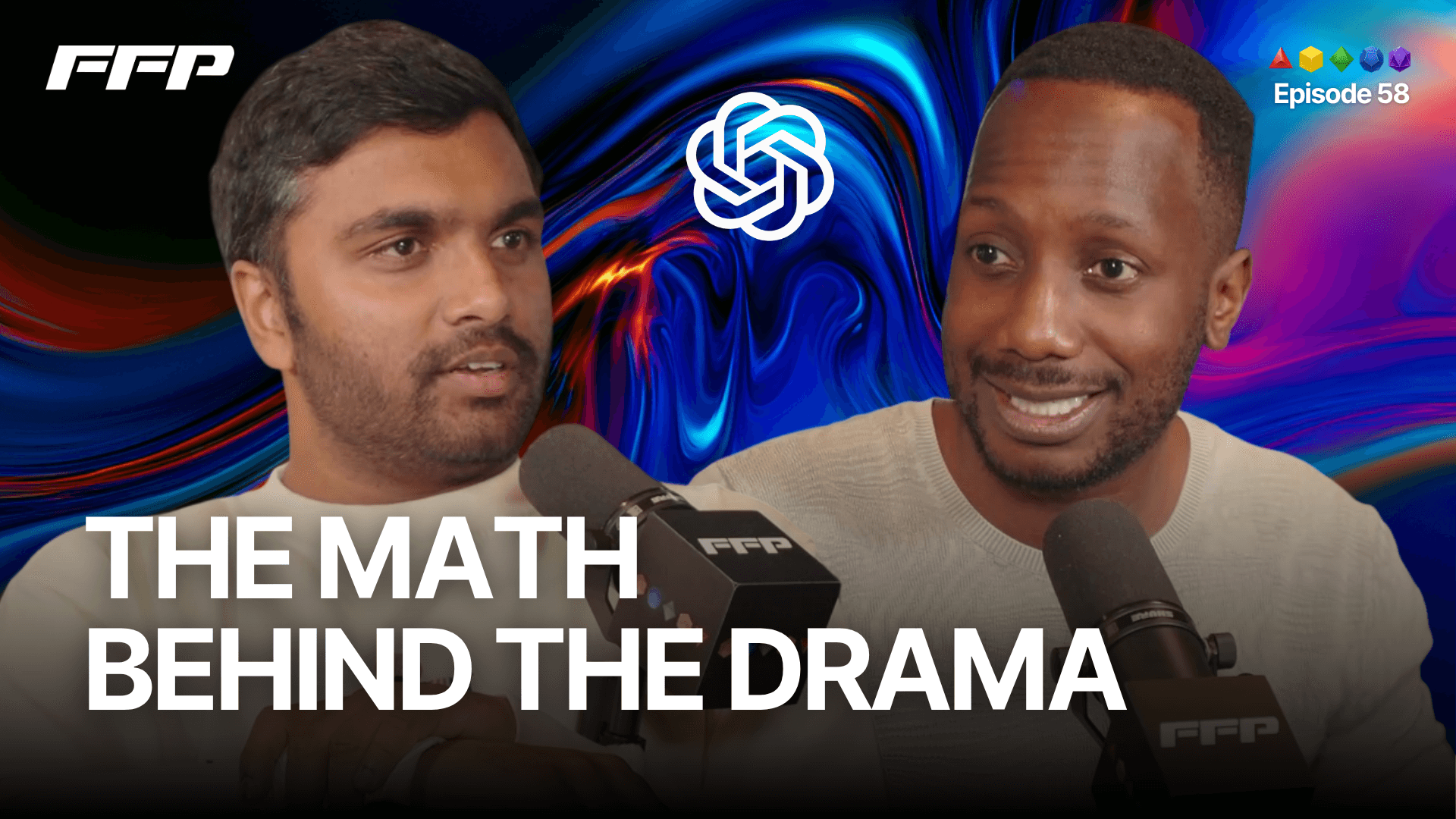
OpenAI has claimed to have produced a 165-page proof addressing the Navier-Stokes existence and smoothness problem, one of the six remaining Millennium Prize problems, and the announcement triggered a very different reaction than earlier AI math claims. Unlike Anthropic's earlier work on the Jacobian conjecture and a Riemann hypothesis-related problem, which mostly drew astonishment at AI's mathematical ability, this announcement set off a dispute over academic credit, with allegations that OpenAI's result may have relied on unacknowledged prior work. NYU mathematician Tristan Buckmaster published a short document raising these concerns and arguing that if OpenAI has genuinely solved the problem, the mathematics itself should be laid out plainly.
- 01
The credit dispute involves NYU mathematician Tristan Buckmaster and Anthropic researcher Levant Alpoge, who previously worked on the Jacobian conjecture result discussed in an earlier episode.
- 02
Buckmaster's document was reportedly only two pages long but was enough to kick off the controversy over academic misconduct and credit.
- 03
The hosts frame the episode's approach as building the Navier-Stokes mathematics first before addressing the credit dispute and its wider context.
1,431 words · auto-generated from the episode video
2:20It's not a question of if, but when. All of the people that have been paying attention to what AI has been doing in mathematics, that is what they are asking. When is AI going to solve one of the six open millennium problems? There's six of them that are left. They're kind of like the Infinity Stones. And I'd say AI is kind of like Thanos. You know, AI is coming. And the question was always when is he going to get the first stone? Well, it seems he might have got it. Okay. the Navier Stokes existence and smoothness problem might have been solved. And naturally, we were on vacation. I was in beautiful Lake Geneva in Wisconsin. Um, and somebody forwarded me a tweet. And this
3:02is what I was feeling. I made a meme about it, you know, where we're also anticipating GTA 6. Yes. >> And this is the ah, here we go again. Because honestly, I didn't I didn't want to keep talking about AI and math. We'd already done the Jacobian conjecture. we'd already done the remon hypothesis or a problem related to that both by anthropic but this this this is history if it's true um you know this is a big deal and it's not anthropic this time it's open AI and the announcement was met with a different kind of reaction than the other two in the other two there was a reaction of oh my gosh AI is so good at mathematics
3:43this is incredible there's a bit of an existential crisis in mathematics and so on and so forth. But here there was also something else. There was a fight. There were allegations of academic misconduct. Um there were questions about who deserved credit. There's questions about what Open AI proved themselves and what they maybe stole from other people's work. That's someone else being the NYU mathematician Tristan Buckmaster and anthropic researcher Levant Alpog who was the hero behind the Jacobian conjecture a few episodes back. So there's a lot to unpack but before we get into any of that as you said we're going to do something very deliberately.
4:23We're going to talk about the mathematics because at the end of this two-page document that Buckmaster published um he which really kicked off the controversy this this document where he talked about all the shenanigans that had happened behind the scenes. He makes the argument that if OpenAI has really solved Navier Stokes then they should just say so and he'd rather be discussing the mathematics than anything else. And honestly same for me same. So that's where we're going to begin. We're going to do the math first. We're going to do the drama second. So here's the road map for the episode. We're going to start from first principles and try to build up the Navier Stokes equations. They're set of two equations. And at the
5:03end of that segment, I want you to have an intuitive understanding of every single term in that equation. So it's not just a bunch of words and fancy symbols. At the end of that, we'll confront the actual millennium problem. This question of existence and smoothness. There is going to be some calculus involved. There's going to be some equations. But I have a lot of visuals, so hopefully it's not going to be that bad. And we'll describe it for our audio listeners, but I do suggest this is a very visual heavy episode, as most of our episodes are. Um, then we'll take a tour through the mathematics over the last several decades and get to the main event, which is OpenAI's 165page proof. Um, the claim is that they have
5:44solved it. Now, I am not a fluid dynamicist. Um and I'm certainly not an expert in the kinds of linear partial differential equations that the Navier Stokes problem is. This is a problem that has attracted some of the greatest mathematicians of our time including ter Terren Tao among others. So I'm approaching this from a perspective of a physicist who's trying to understand fluid mechanics. And so I went back to our trusty old Lando Lifchits course in theoretical physics um volume six fluid mechanics. Lando Lifchitz goes through some amazing amazing mathematics here and Navier Stokes is in the first in the early chapters because there's so much more to fluids than just Navier Stokes.
6:26Um shout out to my professor Robin Bruinsma who taught me this course. It was an amazing course where we had we got to apply some of my favorite mathematics i.e complex analysis to calculate the wing the the lift on the on a wing of an airplane using like a complex integral which was one of the most mind-blowing things that you could use complex mechanics to like talk about like real things you know um not just prime numbers as as we've been known. So, at the end of all that, we're going to be understanding the solution and then we'll talk about the drama and then all of the existential stuff about what all of this means because we're going to have to zoom out. This is not happening in a vacuum and there is a lot of crazy
7:09developments that are honestly happening happening daily. It it is really happening daily. And once Krishna has kind of walked us through the mathematics, I kind of want to look at the larger world that this announcement like happened in. Um there is legitimate disputes over the credit and how we think about acknowledgement in scientific discovery and understanding. Um and this is also happening in the context of an already existing and accelerating battle between multiple stakeholders as it relates to this issue. You have the Frontier Labs, you have the investor and venture capital community, you have politicians beginning to finally weigh in on this.
7:49Obviously, you have the general public who for many people don't really see real world impact on this in their everyday life. And you know for context around some of these AI tools I'm personally have been a user of them just as a technologist and someone who's interested in these subjects in the way that we cover on the show since GPT2 and I've seen what the progress looks like from a very direct personal context. And I do think that there is a challenge in discussing this issue right now because you have to fit into one of two boxes which is this is all hype and this is
8:31going to cause human extinction. >> Yeah. >> And in my view there's a lot of space in between this is all hype and this is going to cause human extinction. And I would love for us to be better able to have conversations within that gap. And so we're going to talk through some of the larger context to help frame this because this will be a technology, a transformation that will be with us for the foreseeable future. And I think it's going to be important to look at these two things and we'll look at some concrete examples of other things that have happened like the hugging face incident where there were some issues with OpenAI's models as it relates to the company hugging face because I think
9:12that will help really ground us around this shift from this is fancy autocomplete or this is just a better way to do search >> and this agentic world that has been actually a driver behind how Open AAI got to this solution. So, we're going to get into all of that. A real brief moment of housekeeping for those of you who may be joining us for the first time. Welcome to the best science show on the planet. You can find us on all platforms where you listen to your favorite podcasts as well as social for clips. Our website has all of the research papers, background material, and other ways to look into what's
9:52happening in Frontier Science Research at ffpod.com. Any engagement that you do on our videos on all platforms help us reach more people with what we think are some of the most fun and informative conversations about science. And we have some great merch. So with that, we're going to jump right in to what is the meat and bones of what's going to be, I think, a very fantastic episode. Yes. And we will start with the mathematics.