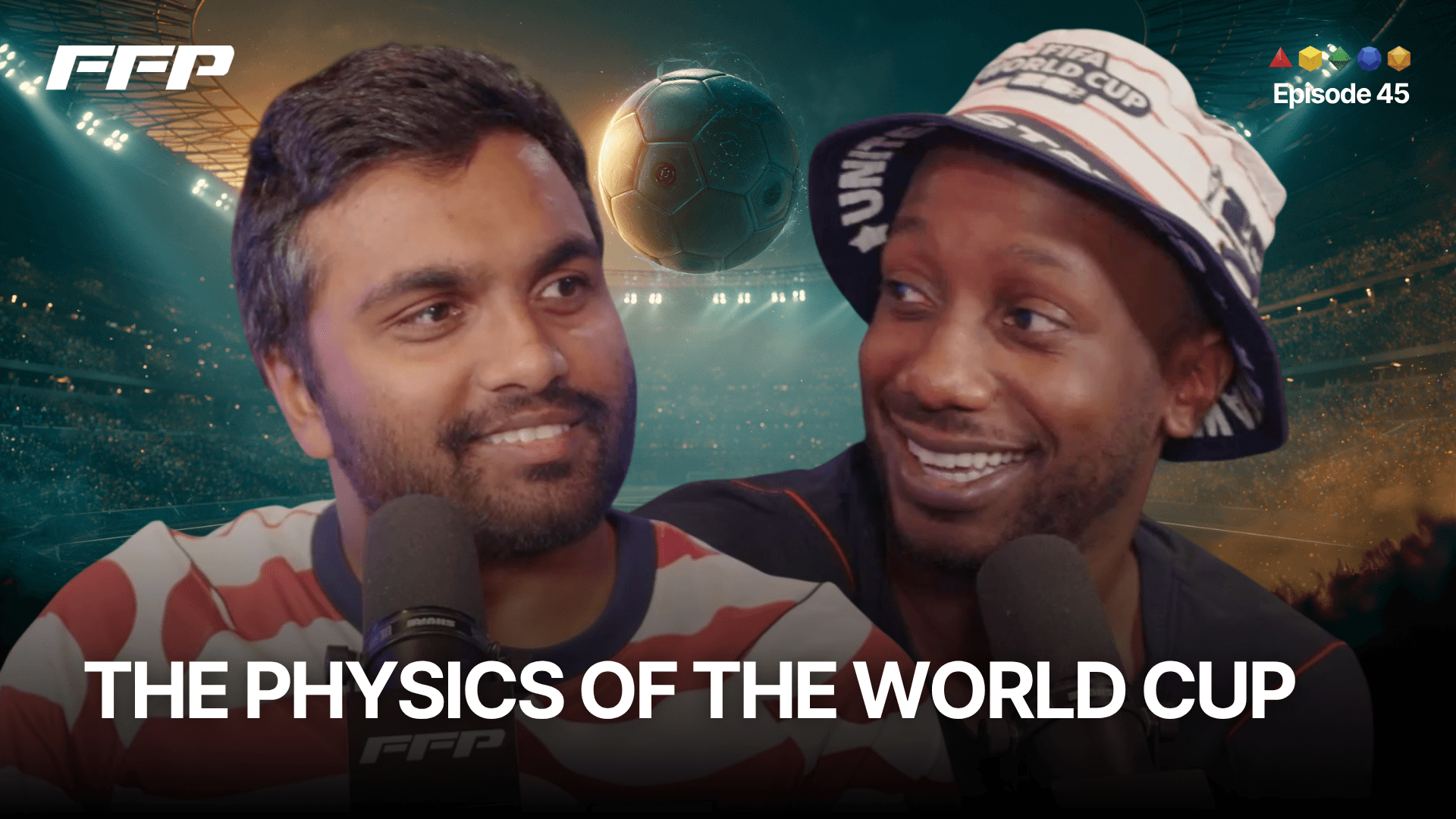
PhysicsSports ScienceWorld CupTechnology
A World Cup special on the science behind the beautiful game, from VAR and smart-ball sensors to soccer ball aerodynamics, pitch engineering, and match momentum analytics.
Hosted by Lester Nare and Krishna Choudhary, this episode is our World Cup special — a deep dive into the science, physics, engineering, and data behind the beautiful game. We start with the offside rule and the controversy around semi-automated VAR. How can a system decide whether a player is onside or offside by only a few inches? Krishna breaks the problem down like an experimental physicist: player speed, ball-contact time, camera frame rate, significant digits, and the error budget behind the line on screen. From there, we get into the actual technology: player tracking, digital twins, high-resolution cameras, and the connected match ball sensor that helps determine when the pass was played. Then we move from refereeing technology to the ball itself. Why does the 2026 World Cup ball look the way it does? How do Platonic solids, panel geometry, and surface seams affect the way a soccer ball flies? And why was the 2010 Jabulani ball so controversial? We go through drag, drag coefficients, wind tunnels, the drag crisis, golf ball dimples, and why the roughness of a ball can completely change its trajectory. Finally, we look at the hidden engineering of the World Cup pitch — real grass in NFL stadiums, LED grow lights, drainage systems, turfgrass science, and even 3D-printed cleat-foot testing devices — before ending with match momentum, possession value, hydration breaks, and the data science behind modern football analytics.
Transcript
Show →Hide11,739 words · auto-generated
Intro
0:00If we take a look at that image, the ruling is extremely precise. That means that the VAR is able to discern down to just a few inches. How are you getting that precision? What they do is Hawkeye creates digital twins. The players get scanned head-to-toe and you create a digital twin of their body scanned by a computer. The ball actually has an internal sensor. It's a 14-gram sensor and inertial measurement unit. That thing takes data at 500 Hz. 500 data points per second and it's measuring acceleration and things like that. So, when you hit it, you'll know within 500th of a second
World Cup special
0:40when the ball was hit. Hello internet, this is your captain speaking, Lester Naray, joined as always by my co-host and our resident PhD, Krishna Choudhary. This week we are going to get into our World Cup special as we are all enjoying the world's beautiful game of football and we're going to talk about some of the technology, physics, and science behind the beautiful game as we see it today. As always, we are going to talk about the science from the ground up today because this is from first [music] principles.
Why the World Cup matters to us
1:19>> [music]
1:30>> So, the World Cup means a lot to the both of us. We were just at the Iran versus Belgium game at Los Angeles Stadium. >> Los Angeles Stadium. >> In Inglewood. Um the game ended in a 0-0 draw. It was still pretty sick nonetheless. The Iran goalie did an amazing job. >> The stadium was crazy. The energy There's a huge I think the second the largest Iranian population outside of Iran is in Los Angeles. There was a lot of a lot of energy in the stadium. >> And I mean, the World Cup means a lot because I grew up in India, and in India, like or in any really developing nation, World Cup means you you stop what you're doing and you watch all the games. We
2:12used to root for either Argentina or Brazil. A lot of Brazil fans in India um against whoever was playing. Um Argentina because I think a lot of my parents' generation grew up with watching Maradona when in like '86 against England and everyone's like, "Yeah." >> [laughter] >> So So it's you know, I grew up watching it and then to to to actually see a game live, it was it was also unbelievable. >> I mean, for me, my my family's a soccer family. I've played soccer my whole life. You know, I mean, the '94 World Cup, I was I was four. You know, I have those faint memories of like, you know, my dad's, you know, in his post-doc program, there was a bunch of Brazilians,
2:52and you know, I played when I was young. My little brother plays professionally in the US currently. And so as someone who is, you know, been in the national team pool, I was in the Olympic development program when I was younger. I I wanted to play for the men's national team. I didn't make it. I wasn't good enough. But the idea that, you know, especially in this World Cup hosted at home, um to see the progression of the US men's national team. Quick shout-out to the US women's national team, which is four-time World Cup winner. And so we we do have great football heritage in this country. >> Um we've just not seen that translate into the the men's game yet. I mean, it's just a such an emotional thing to see um it finally get its just desserts and not
3:34being called a foot fairy anymore. >> Yeah, and we're doing quite well. >> You know, so far so good. >> So far, I think we are topping our group. Um and you know, we're going to I think we're going to win it all, but you know, we'll we'll see what happens. >> We'll see.
The offside call that started the rabbit hole
3:49>> Um so I've been watching a lot of the games, and I'm going to start with some the first thing that actually got me going down this rabbit hole of technology behind the World Cup. I was watching the game with England versus Croatia in the group stage, and at like right before halftime, Croatia got an equalizer right before the half to make it 2-2. Ivan Perišić delivered a perfectly weighted pass to Petar Musa, and from this perspective, it looks offside to me. That Petar Musa is the blue shirt right outside the the bigger box, whatever that's called. Um and he seems to be on this side of all the all the English defense.
4:29So, then we can go into the the next photo, which shows the actual judgment, right? Um looks offside to me. >> [laughter]
How the offside rule actually works
4:40>> So So, this is this is the offside rule is is is been something that has been changed and complained about for a long time. And I think what's interesting about the offside's rule that is is not as well understood is that the specific verbage, because the idea is you have the usually the goalkeeper is the last defender before the goal. And then, you know, if you're in between basically if you're in between the the second-to-last defender as a forward, like you're offside, right? And the idea is you want to stop camping and all this stuff, people just hanging around by the goal. In this case, people are asking, "Well, his arm is offside." >> Yeah. >> So, why is he not offside? And
5:20technically, the the definition for the offside rule is that it has to be a playable body part. And the way that's defined is that means the head, the torso, the legs and feet. So, hands and arms do not count as uh as offside because you can't really play with those. So, this is where this is where you're seeing players now lean, but the issue is the shoulder. You don't want your shoulder to get over there, but if the arm is over, technically based on the current rules, uh it's not offside. And so, like again, there's sort of small details there. >> Right. >> Uh but this is a the offside is very
6:01controversial. Some people have argued that we should, you know, the games would be more exciting and more goals if it's your full body, >> Yeah. >> not a part of your body. >> If I were to choose, I'm kind of
Should offside require the whole body?
6:13inclined to say, "Yeah, I think it should be full body." >> Yeah, more goals, baby. >> Like I don't like if I'm leaning just over the line, like >> So, here's So, here's the deal. Go back to Go back to that image. >> Yeah, yeah, yeah. >> This is This is, you know, I was watching this in the commentary. England was pissed. The British lady on Fox 1 was pissed. [laughter] I was confused. And here's why I'm confused okay? If we take a look at that image,
VAR precision and the error-budget problem
6:37the ruling is extremely precise, okay? They're saying, "Oh, the arm is over the line, but the body is not," as you're saying, right? Um but that means that the VAR, this video referee thingy, >> Assistant referee, yeah. >> Yeah. is able to discern down to just a few inches. >> Yes. >> Okay? >> Yes. >> That's where the judgment is happening. It's like [clears throat] if his body was a few inches this way or that way, it would have been offside or onside. Okay. That is where I started calling BS. Okay? Because as any good experimental physicist, >> [laughter] >> you are worried about those margins, okay? And what you're telling me
7:18is that the plus or minus, like in that judgment, is is within a few inches. >> Yeah. >> Okay? How are you getting that precision?
Offside as a physics measurement
7:27>> I I think a lot of people would like to know. >> Right? >> because this is also something that's relatively newish, the semi-automated technology. >> Yeah, yeah. And And it it like from just a mental perspective, it didn't really make sense to me. So, I'm going to lay out the argument here, okay? So, offside depends on two things. Where the player is compared to the other players. So, where the players are. And also, when the ball was kicked, right? Because it's the placement of the players when somebody made the pass, okay? >> Yep. >> So, let's go into what the errors are in each of those measurements, okay? The impact or the contact time when I'm like kicking a ball, the the passer's foot in the ball, that's going to be approximately
8:08um a hundredth of a second, okay? So, 10 milliseconds. Now, a player that's making a run, let's say that's sprinting at his like peak velocity. In that case, it wasn't peak velocity, but let's just imagine, right? At its peak velocity, he's going to be going like 10 m/s. Rough ballpark, right? Roughly. Um And so, while the passer is making contact with the ball over that 10 milliseconds, the player will have moved 10 cm. That should be like it's Do you understand? So, so you're not it's when the when part is ill-defined by 10 milliseconds, which means the where part
8:49should be if you knew exactly where the player was, it would already >> be >> be ill-defined by 10 cm, >> [laughter] >> okay? But, I don't even think that that's that's And And this is this is this is um hedging on the fact that I know exactly where the players are. >> Right. >> That again, I don't understand. Because you've got like from my camera perspective, right? Um the the error in the cameras should be another few inches. So, that's only going to add to that error budget. Um
Camera frame rates and significant digits
9:19But, then I start thinking, okay, the passer's foot and the ball make contact in 10 milliseconds, right? But, like the camera that's doing this judgment is at like 30 frames per second, which means that like from one frame to the next is 30 milliseconds, right? 30 times That's that's your time resolution. So, again, now you're going to a third of a meter. That's a foot. That's this big. >> And it's a difference >> air. And and that the offside judgment there was like they were like, "Oh, this is here and the the line is like cutting through his body." Didn't make sense to me. >> I think a lot of people who are anti-VAR going to love this conversation. >> But but so so from a from a fundamental
10:01physics perspective, right? When you're And this is something that you learn in undergraduate physics very very early. There's an importance in significant digits. When you don't like you don't like um you know, when you're even like measuring the the most simple experiment that you do like the first week or two of undergraduate physics lab is you measure gravity. >> Mhm. >> Okay? And in order to do that you're not really measuring grab like that's not the important part. The important part is to measure the distance between two timing like photo gates and then drop a ball so that you measure the time difference between this and this and then this and the impact to the ground. And then you measure these two
10:42distances. And the real exercise there is to say how precise do I know this distance and this distance. How precise do I know when the ball hit the ground, right? And how many significant like is it 0.1 seconds, 0.01 seconds, so on and so forth. Is it within a centimeter? Like is it 9 cm? It could be 10 cm. No, it couldn't. But it could be 9. 5 or 9.7, right? There's a plus or minus there in the deviation. And so from that you can then calculate gravity and you're not going to report it as 9.847265. Right? Because you need a much more precise experiment to actually determine
11:22that level of precision of gravity. >> As we talk about, you know, a variety of fundamental research papers, the instrumentation is a key thing we talk about and the level of precision of that instrumentation matters quite a bit. It's why we have electron, you know, it's why we have very, very, very precise detection machines
Why instrumentation matters
11:42in order to reduce >> Yeah. >> that error. >> That error budget. Okay? And so that's why like I was just doing these calculations while watching this going like this is this is nonsense. There's no way that this could possibly be happening because you need to bring down both the time of contact of the ball, right? To within a very small time step of like when did the player hit the ball? And then two, where the players are. Okay? They need to bring both of those errors down. Well, I looked into it and they have. Okay? >> This is This is so interesting because a lot of people I'm so excited. I'm so excited about this.
Hawkeye, digital twins, and player tracking
12:18>> Yeah. And so it it it turns out they hired this company called Hawkeye that's what what they do is Hawkeye creates digital twins. So on photo four you'll see the the players get scanned head to toe and you create a digital twin of their body scanned by a computer and then that digital twin of the athlete can be dropped into a virtual simulation of the game to determine their exact position based on 20 16 different high resolution cameras. So in photo five we've got the photos of the high resolution cameras and one of the one of the things that you learn in experimental science is like the error goes down by one over the square root of n. So in
12:59this case whatever if you had just one camera and you you were trying to track the position with 16 your error goes down by a fourth. Okay? Four times smaller. >> Yep. Yep. [clears throat] >> Okay, that's quite good. But that's still not enough. The real magic here is the digital twins because it's something that we do a lot in science which is we've got a model of our system and then we've got data. We fit the model to the data to get really high precision. We do this a lot with atmospheric um transits of like exoplanets, right? Like the exoplanet goes through, we get some spectra. The spectra is noisy, but we try to fit models to that spectra to really understand what is going on. In this case, our model is the player's 3D
13:41digital twin, and we're fitting that model to the data from the 16 different sensors. >> I I think most people didn't even know that they got scanned into 3D for reasons other than to be put into the FIFA Excuse me, uh FC 26 the game because now FIFA no longer gives EA Sports the rights. So, it's no longer FIFA insert year, it's now FC. But like for most people when they think about like they think about motion capture and 3D scanning, that's the context. >> Yeah. >> I think it's a very important detail that that's why when you see those little die like the little example photo we just showed, >> Yeah, yeah. >> like it's used >> the 3D model of the player. >> the player itself. >> Of the player itself. They're using like computer vision to actually like fit the 3D model to the player. And this is
14:23something that like we do all the time like even in neuroscience and behavior experiments, like when you have like a rat running around in a maze, you've got a camera that tracks the rat, right? And then there's you can create a 3D model of like the rat's joints to figure out his body position, correlate that to the neurons that are firing, and so on and so forth. It's used a lot in behavior experiments. I'm sure like similar technology is being used to recreate the player positioning at every given moment. So, >> Cuz cuz uh Ivan Perišić and Erling Haaland are very different players. >> Yes, exactly. >> You know. [laughter] And so, it matters. >> Yeah, and it is kind of cool that like they have that kind of granularity. So, that's the where >> Mhm. >> of where the players are. Now, what about the when? Right? Because I said
15:03the 30 frames per second is not going to do you any good. Even the 50 frames per second if you have a high-speed camera is not going to do you any good.
The smart ball sensor and timing the pass
15:10Um and by the by the judging by the size of that camera, like that's not like one of these like 100 frame per second cameras right? >> So, to get the the timing down >> of when the ball was hit. >> of when the ball was hit. The ball actually has an internal sensor. It's a 14 g sensor, an inertial measurement unit, an IMU, that's used in like gyroscopes and things like that for airspace. In this case, they stuck it it's inside the FIFA ball like just beneath the surface. That thing takes data at 500 Hz, 500 data points per second, and it's measuring acceleration and things like that. So, when you hit it, you'll know within 500th of a second when the ball was hit. So, now you can
15:50finally get the the um >> like a level of resolution >> down to that size. So, now when they show that line, that line has a thickness of about a centimeter or less. Otherwise, it should be a blurred out line. >> Right. It would be >> Because I don't know where the where the ball was when the ball was hit. >> Yes. >> Right? So, that kind of made sense. And combined, this gives the comprehensive VAR system. You've got the 500 Hz from the ball, you've got these 3D positions from the players, and that's where you get that line. >> And and so, when people hear VAR, they think And they you it did used to be this way where it was just some some people in a room and they would draw
16:30lines manually >> Yeah. >> on on the video. >> on a video >> with at an angle that was not the correct angle. It was all these things. >> Yeah, all these things. And it's like I But now it kind of makes sense. >> it's it's it's actually >> the amount of data that's going in, I can understand if the error budget is for like that thickness of the line is like way smaller. >> reasonable. >> Yeah, it's reasonable. >> Now now again, in the World Cup, not in all leagues in the world, not club level, that everyone's a little different, but specifically for the World Cup and their VAR system. >> Yeah. >> Yeah. >> And so, I wasn't done there because this got me thinking about other stuff. Okay? Like for example, you've got the sensor that's in the ball. How come the sensor
17:12is off like to the side just underneath the ball surface. >> Yeah, yeah. Um and if you look at the 2022 World Cup, that also had a sensor, but it's at the center. It's suspended at the center. That kind of naively made sense to me, but off to the uh just under the ball
Why the ball sensor is off-center
17:30doesn't make sense to me because it's kind of lopsided now. >> And and so just for folks who may be listening, you know, the the 2026 ball basically has like an AirPods size case, an AirPods case, or like a wireless headphone case size just nodule just below the surface on one particular spot in the ball. Versus in 2022, it was sort of looks like the structure of um when you when we talk about there's a center point in the center of the ball where the sensor is. And again, naively, it's like, yeah, the center point. >> Cuz you want to tell where the ball is going. >> balls on all sides. Why if it's on one side, how would it know on the other side? >> And it's like And if it's on one side, wouldn't it be like lopsided? It would like affect the rotation, right? Um so, there's a reason why the sensor
18:10should be right underneath the surface. And this kind of also makes sense. I just thought it it was it was it was a bit weird that they didn't do it even in the beginning then if this is the reason. And the reason is that you want higher linear speed. Like if if you've got the sensor right at the center, right? And the ball is not moving and just spinning,
Accelerometers, spin, and signal-to-noise
18:30the the sensor is not going to register a lot of movement. And these things are accelerometers at the end of the day. And an accelerometer measures linear acceleration. It discerns spin based on linear acceleration and how >> like oh >> at one point there's a acceleration in the X direction, then it's in the Y direction, then it's in the X direction, then it's in the Y direction. And this cycling is going to get you the spin rate. Well, if you're closer to the edge of the ball, then as the ball spins, you have higher linear acceleration, and so your signal-to-noise effectively is like larger. >> Right. >> Right? >> Right. It makes sense. >> Um and and so that makes sense why it would be over there. Um but that means that you have to balance it. And actually, um it I thought back to my
19:11classical mechanics days, and it's very easy to balance something and make it look like a sphere because all you have to do is if you have one thing over here and you know you want the center axis to be like that origin point, then you just make a similar weight on the other side, but that can't be enough because now you have a preferred axis. So, you need two other on this end and on this end. And then what ends up happening is um for those who are in undergraduate physics and have taken an advanced course in classical mechanics, what you're doing is making the inertia tensor diagonal. And then like there's a matrix and everything else is a zero except the stuff in the diagonal, and all of the diagonal elements are the same because you have the same mass here, here, and
19:51here. And so, you can just factor out everything and it becomes the identity matrix where you have zeros everywhere and just 1 1 1, and it looks exactly like a sphere. And this is one of the coolest problems I remember homework problems in my classical mechanics was like proving that like a sphere spins the same way as a cube in for all intents and purposes. Which is kind of crazy to think about like a sphere literally looks the same from every side, right? In the sense that like for example, I can take a sphere, like let's say a uniform sphere, and I can attach a a string to it to the to the to the ceiling, and then when I when I like twist it,
20:32it's going to oscillate like this, and the frequency of oscillation like this doesn't matter where I attach on the sphere. Because if I rotate the sphere this way and then try to try to do it, the torsion pendulum is going to be exactly the same, okay? The frequency of oscillation. For a cube, naively you would think oh if I if I if I attach the string on the on the flat part, or if I attached it to the corner, the frequency of oscillation should be different. But no, because the inertia tensor is identical in the sphere and the cube for even one orientation, no matter how you rotate it, those things like don't change the inertia tensors.
21:14It's called a unitary transformation. I just remember this from like um uh it was like a undergrad problem uh at Princeton. It was the the class was called Death Mech. Um and and this was
Balancing the ball and the inertia tensor
21:26one of the problems that they to to like prove that like this this is the case. But um yeah, it turns out it's like super easy to do now. So, now you've got a sphere, you just make the balancing and everything works out. Okay? >> And so, part of that point there is that it's not just that there's one sensor on one point of the ball in that one hole like in the image. They've now internally >> Yeah, like they just offset the mass on on all the three axes. And as long as they're perfectly perpendicular, you're good to go. >> Which is why the manufacturing process also does matter quite a bit here because, you know, making it perfectly perpendicular is not >> Yeah, and you do have to make it perfectly cuz otherwise I think these players at the top level are going to know this. >> to know the difference. >> Yeah, and and the other thing that that brings me to like a Adidas is like making new balls every World Cup.
22:08>> Yes. >> I didn't know that. I thought it was the same ball. But no, it's like different balls. >> So, if you go to the FIFA store or if you go to a game, what you'll see in one of the stores is they have the mini soccer ball collection, these like size one balls. They'll have every World Cup ball. Right? As a as a box set. Right? Because that's their whole stick. That's that's their whole thing. >> Yeah. And and we're going to talk more about these the history of those balls coming up. But before we do that, >> some housekeeping. As you can see, and for me, I'm loving this. Talking about my favorite game in the world and the pod is incredible, but from a
Housekeeping and support
22:41science-based perspective. And if you love this show and want to continue to support us, sharing it with family member, a friend, a colleague, throwing it in the group chat, shooting the DM, you can always watch all of our episodes on YouTube and Spotify. That's where we have all our full episodes as well as directly on the website at ffp.com ffp pod excuse me.com. We also include our research papers where they when they are there and we have some special new interesting interactive explorers that we're going to be putting out over the next couple of weeks which I'll only tease that much but we have a birthday coming up so that
23:22may be related. If you like our clips you're scrolling on Instagram you're scrolling on Tik Tok on X we always put clips out for each episode makes it super easy to share. If you want to support the pod directly you can donate at ffpod.com/donate. Any amount helps the two of us continue to talk about the amazing science that not only FIFA apparently is doing but particularly fundamental science research which is really what we talk about very often and again we will continue to take book suggestions for the new bookshelf that will go somewhere in between the two of us back here in the studio. We are about to receive our new neon signs which I'm super excited
24:03about as long as they are not too big but I'm so excited about this episode I want to get back talking about the new ball. >> Yes and also one more thing about housekeeping in the comments please comment on our YouTube or on Spotify who do you support winning this World Cup and it better be America. >> that's a that's a good one. >> It's coming home. >> It's coming home. I love how they play West Virginia after the >> Take me home country roads. >> take me home it's talking about the World Cup. We're taking the World Cup home. >> Home. >> Home here to the US. >> Yeah the tour of the 50 states baby. >> it's going to be basically tour of the world in our own country. >> [laughter] >> All right so let's talk about this new
24:43ball all right so this year it's called the Triunda.
The 2026 World Cup ball: Trionda
24:48It was officially unveiled on October 2025 by Adidas the official match ball. Who is that guy? >> Jude Bellingham the as sometimes the darling of English football, sometimes the the villain of English football. The number 10, really the his his his celebration when he scores a goal, he puts his hands out like he's the Jesus statue in Brazil. >> Oh, hilarious. >> Um, great player, used to play at Dortmund, made the jump to Real Madrid. Um, you know, I think uh he >> now for England? It's on the English squad. >> and at first you know, he has a little bit of beef with part of it was media-driven, part of it was real. The so the English media
25:28>> is crazy. >> They're crazy about they're crazy on this. So the >> And they're talking I'm sorry, but they're talking a lot of [ __ ] about America. >> yeah. >> I'm not a fan of that. >> I'm not a fan of that. >> I'm not a fan of that. Look, some of us, we watch the Premier League, we have nothing negative to say. Just relax, okay? You don't have to point it at us. The the small Jude thing that's that's funny is the so the the current English manager is Thomas Tuchel. He's a German. The English were not happy about that cuz they thought it was sabotage. >> Oh. >> What he Kind of like how they're uh their royal family is German, but they don't have a problem with that, so. >> [laughter] >> What's going on there, Bryce? Hm? Anyways. >> So Thomas So Thomas Tuchel, former
26:09Chelsea manager by the way, is now the English manager, and him and Jude have had some personal beef. >> [snorts] >> Thomas Tuchel runs a really tight shop. He doesn't like ego. It's a team. And at first, the media was like, "Is Jude going to play? Is he not going to play?" But he started and he's played. He's scored a goal. He's done well. He's a key part of their team. However, he's also an Adidas athlete. Uh and so he's
World Cup commercials and football culture
26:31always in a lot of the Adidas commercials uh because he's you know, obviously a big player in the world. I will also love to hear people's thoughts about each World Cup, Nike and Adidas both put out these like huge commercials with all of their stars. Adidas had one version, Nike had another, very different creative directions. I I have my thoughts, but I'm curious to see how people how what people thought about the World Cup commercials. The long The full ones, not the clips, the full thing from both. Have you seen either of them? >> So, the Adidas one is the Timothy Chalamet one? >> Yes. >> Right? >> Yes. >> And uh the Nike one is the one where Cristiano Ronaldo comes out of the fire, right? And it reminds me of like V for
27:13Vendetta. >> It It's Yes. Yes. Very very different. There's a huge legacy to these. Like they've each like they've had like you know, there's the Joga Bonito era with Nike and but >> I was more just like impressed at how many big names were in each of them. >> Yeah. >> Right? It was like crazy. >> of money. >> Yeah. >> A lot A lot of money. I'm not a huge fan of the non-football players being in these commercials. >> Yeah. >> I don't know if I'm into that. I If they're celebrities, if they're just like normal background actors who played play for like that's fine. >> Oh, yeah. But like LeBron LeBron was in the Adidas one. >> You know, the the the the uh the Nike one. >> Oh, yeah. That was the Nike one. I'm sorry.
27:53>> Don't sue us. >> I get it. I get it. You have, you know, cross-sport branding, but LeBron has his own commercials. >> Yeah. >> need to be there. Travis Scott >> [laughter] >> I don't know that he needs to be there. I don't know that he needs to be there. I don't know. >> Yeah. I mean, just like I don't know if you need to be in the Odyssey. >> But okay. [laughter]
The design challenge of a three-host-country ball
28:12Moving on. Moving on. >> All right. Okay. This this episode As you can see, it's it's it's casual. >> Cup fever. >> Cup It's World Cup fever. All right. So, um the trionda, right? It consists of three countries that are hosting. Um so, you've got the the Mexican like I guess the the the talon thingy, then the maple leaf, and then um America has the stars in the in the blue. Okay? Now, the challenge is the following. You want to make an artsy ball, but you got to play with the number three. Right? And three is kind of a weird number because it's not it's odd. So, it's like not symmetric about a sphere type stuff. You got to like fit three
28:53somehow. Okay? Now, to understand this challenge, let's begin with the inaugural cup in 1930. Okay? In the 1930 finals, they had this volleyball looking thing. Um both
The 1930 World Cup used two different balls
29:05Argentina and Uruguay had actually different preferred balls. And Argentina used theirs in the first half, Uruguay used theirs in the second half. So, they had different balls for the two halves of the World Cup and um Argentina was leading at halftime with their ball and then Uruguay won the match, which is kind of hilarious to think about, right? Um so, that was in the 1930s and then Buckminster Fuller >> Bucky. >> Yeah, he's an American architect. Um and he changed the ball in the 1970 World
Adidas, Telstar, and the classic soccer ball
29:38Cup and it was the first time that Adidas actually manufactured the official ball. Um Adidas has made the official balls ever since. What he did was use geometric shapes. He was a big fan of using like, you know, the Epcot like ball. That Epcot Center that that's it looks a lot like that. Um so, the Fuller's ball that Buckminster fullerene it's the classic ball that we know from the Pelé 1970 World Cup. This pattern is now so iconic, right? It's got the black pentagons and I think that's photo 13. Black pentagons, white hexagons. 20 white hexagons for 12 black pentagons. Now, this is like the soccer ball.
30:19>> Yeah. If you grew up playing at any point in time prior to like the modern era, this is everything you played with. >> Yeah. And because it's got so many panels, what you're trying to do is create a shape from that fabric that is a sphere, right? That's the challenge. And now this ball is so spherical that now players can start curving their kicks intentionally. they can allow the shape to have a predictable path through the air. How does that soccer ball actually work
Icosahedrons and soccer ball geometry
30:50though, okay? Well, it's actually derived from a Platonic solid, which is our emblem here, our part of our logo. You start with an icosahedron, which is a bunch of triangles. And then you take the points and you just squish them. >> Mhm. >> Okay? So, an icosahedron is a bunch of equilateral triangles put together. >> Mhm. >> And you take all of the pointy edges and you start squishing them. So, here's the icosahedron starts out. You start squishing them until you get a regular hexagon. A regular hexagon meaning the pink part, all of the edges are the same size. That's when you get the soccer ball shape. Okay? >> Mhm.
Trionda and the tetrahedron
31:29>> Very, very nice, very, very beautiful. This year's ball is also derived from a Platonic solid, but actually from the simplest one. From the tetrahedron, not from the icosahedron. And this is where the genius of like starting to use three, because you still want to use triangles cuz triangles have that three. So, what you do is you take the triangle, the equilateral triangle in your tetrahedron, you start shifting the shape such that the points become these flaps. Those flaps then have the patterns for the three countries. >> Mhm. >> And then you put that together just as the tetrahedron was, but now in terms of a sphere. >> Mhm. >> Okay? >> And so, we're just basically sort of slight taking the the core shape of the triangle and just taking the stat
32:09surface area and making it a blob. >> Yeah. >> That can then be patched together. >> That can then be patched together, right? Now, the problem is compared to the buckyball, this has fewer seams, right? >> Yes. >> And if it's got fewer seams, there are fewer grooves within the ball. >> Right. >> Right? The buckyball has um 20 hexagons, 12 pentagons, so a lot of these edges. >> Yes. >> And so, there's a a roughness there. >> Yes. >> With this one, there's fewer seams, so there's fewer grooves. The ball is going to be a little bit smooth. So, you have to counteract for that. And this was especially bad in South Africa with the Jabulani ball that apparently everyone hated.
32:49>> Yes, and this was 2010. >> Yeah. >> The Jabulani ball >> Jabulani. >> was famous. We were sophomores? >> Yeah, I was I was just graduating. So, I had just graduated. >> Uh yes, yes, yes. >> I just I remember I just graduated high school and we were in India for >> for the for the World Cup for the World Cup. >> for the World Cup, yeah. >> This is so and you know, at the time, it's so funny because I remember
The Jabulani controversy
33:16you know, you don't always cuz you play in in both high school and college and club. You usually you play with select or sometimes you'll play with some of these Adidas or Nike balls, right? They became a little bit more popular later on. But you wouldn't really play with the World Cup ball, you know, practice or whatever. But when the Jabulani came out, one of the things people love it it it it it it had this weird knuckle. So, like this is when like, you know, Cristiano Ronaldo is making these 40-yard free kicks in the Premier League and the the people Goalkeepers hated it especially. A lot of players hated it, too, but people who were like goal scorers or people who wanted to take free kicks, they liked it cuz it would it would move around weird. >> Okay. >> And so, they were just like, this is great for me cuz it's
33:56I'm going to score and the keeper has no where it's going. And I don't really like I think I I remember at the time one of the things that would struck me about it was and I I didn't necessarily think about it is the surface was so smooth. >> Mhm. >> In part because it didn't have all the seams that you just talked about. Um but it was extremely uh extremely controversial alongside the vuvuzelas. >> Yeah, the vuvuzelas also very controversial. >> controversial. >> Yeah. And that's exactly what Right, you were saying that, you know, it moved weird. >> It moved so weird. >> goalkeepers hated it. >> hated it. >> Right? There is nice fundamental physics reason for why it moves weird, and that's what we're
Surface roughness and ball flight
34:36going to cover here. Okay, the physics of soccer ball flight and how the texture of the ball affects that. Cuz the shape of the ball is just it's it's a sphere, right? But the the roughness is really where the magic lies. Okay? So, um when you have a new ball, you got to make sure it's not the Jabulani or whatever, right? You got to make sure it's not that. And so, Adidas actually did a bunch of tests, 300 lab tests. Those aren't published, but a group of scientists did independent tests. Um this is from the University of Puget Sound in Washington, and then there's also some universities in Japan that
35:16lent their wind tunnel to do some of this testing. And it's really cool cuz they published a paper in Applied Sciences out of the MDPI publishing hub. Trionda enhanced surface roughness relative to the previous World Cup soccer balls. And they compared the physics between this soccer ball and all the previous ones. And it's actually really really cool. The main thing that
Drag, velocity squared, and air resistance
35:36they care about here is drag. And that's the thing that, you know, most anyone cares about when it comes to aerodynamics. So, drag is, you know, the resistance of the air to your motion. Okay? And it's always proportional to the velocity squared. That kind of makes sense because the faster you go, the harder you're hitting the particles and the more particles you're hitting. So, there's a double factor of the velocity, right? There's like you're moving through this, so you're hitting the air molecules at a faster speed, so you're transferring momentum faster. And also, there's more stuff that you're hitting the faster you go. So, that's why you get a a V squared. It's also proportional to the area because the larger the cross-sectional area, the the
36:17more air particles you're going to be hitting. It's proportional to the density of the air, obviously, because like you know, the denser the air, the more of drag is going to be. The >> the the denser the fluid, right? And then there's um something called the drag coefficient, which in this case is the CD. That's the coefficient of drag. And that's like the number that gives you the drag force. Okay, there's like all of those factors plus something having to do with the surface of the ball and the shape. The surface of the object and the shape, I should say. Okay?
The drag crisis explained
36:47Now, with real objects like balls, there is something called the drag crisis. And that's what happens when you calculate the drag coefficient, the drag force um for different speeds. Naively, you would think that the drag coefficient is a constant. It does It shouldn't depend on how fast I'm going. The The The effect of velocity is already in that equation, right? But there is a non-linear effect on the coefficient itself that doesn't have to do with this physics argument, okay? There's something us else that's going on. And actually it turns out the drag coefficient drops suddenly when there's higher speed. That's weird.
37:28>> That's weird. >> At higher speed, it's easier to go through. So, you can see in the wind
Wind tunnels, wakes, and low pressure
37:32tunnel tests why this is happening. So, this is at NASA Ames Research Center. NASA loves aerodynamically testing these balls. So, here you've got a soccer ball in a wind tunnel. The air is coming in from the left, and as you're spinning, what's happening is your laminar flow of the really nice air is getting broken up at the surface of the ball, and it's creating turbulent flow behind it, right? >> That has a very weird effect on the drag. >> Mhm. >> Okay? Here's what's going to happen. The wake behind that ball is going to create a region of low pressure. You can imagine like here the ball is stationary and the wind is going through, right? But in real soccer play,
38:13the ball is going to be moving through like in towards the right in this direction, right? Um now, on the right-hand side, the the ball is hitting the air particles, so there's high pressure, right? Because it's like a piston that's like sort of compressing air. And on the behind it, there's going to be low pressure. So, there's going to be a force backwards that is not just the particles hitting, but there's like a pressure difference. >> Yeah, yeah, yeah. >> And that's going to cause some weird stuff. >> Okay, okay. >> Okay? >> Yep. >> And it turns out that the faster you move, that that low pressure effect becomes less and less. >> Interesting. >> Which is a little bit non-trivial. So, let's go to the next
38:54photo, which is photo number 20. Yeah, here's what we're doing. The ball is moving to the right hand side, okay? On the left panel, the ball is not moving that fast. When the ball is not moving that fast, the wake is actually a lot bigger. So, the region of low pressure is a lot more, which means that pressure difference is bigger. And if the pressure difference is bigger, the drag force is going to be bigger. There's going to be a bigger contribution due to that drag pressure difference. On the right hand side, now you've got the ball moving faster. When you go faster, the laminar flow disconnects from the ball faster. And when that happens, you can actually like flow through the ball.
39:35Like you can you can follow the curve of the ball more, which is a little bit non-intuitive. Like the faster you move, the more the laminar flow hugs the ball. And so, your low pressure region is actually smaller, meaning that the pressure difference is not that much, which means your drag has actually gone down. The faster you move, the drag actually goes down. >> This makes me think of all the science to F1 cars, which deal with a variety of concepts very heavily but >> That This is a big part of it. You want to You want to make that low pressure region behind you not that big, so that you have like a lot >> Which is why the cars are designed the way they are. >> Yeah. And so, the wake can be different at different speeds, right? And if you go to um
40:16the photo number 21,
Drag coefficient curves
40:18this is the curve that you're going to be looking at. On the x-axis is the speed of the ball. On the y-axis is the drag coefficient. At low speeds, you've got a laminar boundary. And so, the ball is going to hug I mean, sorry, the laminar flow is going to hug the ball, but then it's going to disconnect very quickly. And you're going to get a massive low-pressure region that's going to cause a lot of drag. >> Oh, actually, that makes sense. >> As I as I increase the speed of the ball, the the laminar flow is going to hug the ball, and there's not going to be that much low pressure, which means that the ball is just going to be fine. That at least that effect is is gone. And so, your drag coefficient there's there's a period where the drag crisis happens. That's the drag crisis regime,
40:59right? It should be it should be flat, but it's not. There's a part that goes down. >> It's It's almost like the If you give the the the flow more time, it will dissipate outwards. But basically, the faster it's moving, you don't give it enough time almost to get out of the that sort of contour of moving around the object that's coming through it. >> Exactly. >> And so, that's where you get the lower >> Exactly. And this is why this is why golf balls are not perfectly spherical. They have those dimples. Actually, if you go to the next one, photo number 22,
Why golf balls have dimples
41:29this is a golf ball in a aerodynamics simulation. The left is a ping-pong ball. There you can see the the laminar flow leaves basically at the equator here. >> Yeah, yeah, yeah, yeah. >> Right? From pole to pole, and you have a massive low-pressure region. And so, the ping-pong ball is going to experience a lot of drag, and it's going to do like weird stuff. And that's by design, because you want the ping-pong ball to be light and to be able to sort of stop within the distance of a ping-pong table. The golf ball, on the other hand, has these dimples, and that creates turbulence. The turbulence is by design to make that low pressure less of an effect, so that it goes farther. >> Farther away. >> Right? >> Yeah. >> And that's the whole point of roughness
42:12on a soccer ball. >> Yeah, that makes it that makes it and
Why the Jabulani moved so weirdly
42:15this now gets to the idea of why the Jabulani was so different because again we'd had the sort of classic style for such a long period of time. >> ball with all of those seams and all of that roughness. That's kind of like the golf ball's dimples, right? >> we tried to get all fancy, you know. >> And why specifically, right? So if the ball is too smooth, what that's going to do is there's going to be a transition as you saw in those curves, right? There's a transition from low speed to high turbulence speed. And what I want is to tune that transition, where that transition is happening. Now, if the transition happens too far up,
Drag crisis and free-kick speeds
42:53right? >> Yeah, yeah, yeah. >> Yeah, let's let's stay on this one. So if the transition happens too far up, what's that What is that going to do? That means that it's in the typical range of free kicks, corner kicks, and all of those things, right? The long passes. And when this occurs, the ball is kicked at high speed, but as it slows down, it's going to be in that transition point and it's going to go into a spot with from low drag coefficient to high drag coefficient and it's going to start doing weird things. What you want is most of the ball's trajectory to be in that low drag coefficient spot. >> This is why with the Jabulani all it would start going really fast and then at the last minute >> Yeah, last because because it's transit it slowed down into the high regime. This is exactly what these scientists
43:34saw in the wind tunnel measurements. So on the on the x-axis is the drag coefficient, on the y-axis is your velocity. >> All of the other balls, the Al Rihla >> on the x-axis is >> On the x-axis is the velocity, on the y-axis is the drag coefficient. The main thing to see is that all of the other balls, the Triangles is in red, all of the other balls are in the other colors from all the different other FIFA World Cups. The Jabulani is in the yellow. >> Yeah, that one. >> only one where the drag crisis is happening at a higher speed. >> Yeah, yeah, yeah, yeah. Which and and that I mean this correlates to exactly what people saw. >> Exactly. Yeah. >> Uh that's fascinating. >> So so but this is like now quantitatively you can see that Jabulani is the outlier.
44:15>> Yeah, yeah. >> Right? >> And every other one effectively trends across the similar profile. >> And what you want is whenever you make a new ball you want it to basically do the same thing that the others did. Right? You want don't want it to do new things. >> make it look pretty but make it work the same. >> Yeah, make it work the same so that like whatever the players trained with that's what they're playing with. Right?
Why ball consistency matters
44:32>> Yeah. >> And I I think just as someone who's played like the way the ball work like it is it is it is good like from a playing perspective. Like I would not want I can't really think of how I would want it to operate differently. Like there's there's you know futsal is an indoor soccer game where the ball is weighted totally differently cuz it's not supposed to go in the air. >> Yeah. >> And it's very very very different and I don't like it. I don't but I get it. Like I get >> It's a different game. >> It's just a different game it's a different game. >> Yeah. And they also calculated the trajectory. So they they took all of their drag coefficient data and they
Trajectory simulations and the Jabulani outlier
45:04said okay, let's simulate a trajectory. The Y axis isn't important it's a kind of like what percent of deviation was the trajectory different um based on like something that was purely a a flat drag coefficient. Um and the X axis shows the velocity but again the main thing to see is the Jabulani in the yellow is the outlier. It's doing this weird >> It's almost the inverse. >> Every everything else is following the similar trajectory. >> Yeah. >> Right? Of like how how the data looks. >> Yeah. >> But in all of their graphs that then they have multiple sort of plots showing the behavior of all the different balls and in every single one Jabulani is just showing something completely different. >> I can't believe they got away with this. >> Yeah. >> This is this is actually it's it's also
45:46um you know I think the fact that the science is backing up the visual observations >> Yeah, it's kind of cool. >> and the player observations or the player experiences that folks had is
Trionda testing and microgravity
45:56it's kind of nice. >> Yeah, I think that's pretty cool. So this this particular Triangles ball this is the most tested ball in history. It also went up in the NASA ISS. They were doing center of mass and balance in microgravity experiments, which I I'm going to be honest, I really don't understand. Um like what? Like we're going to be playing Ender's Game football [laughter] in like zero G or something? Like what what what is the need? But I also I mean it reminds me of that one show um with Steve Carell about Space Force where he's asked like why are you sending an orange to space for $10,000? And he's like, "You know what? Sometimes these astronauts that are up there for a year need to remember cuz they're like eating airline food,
46:37they need to remember what an orange tastes like." And so sometimes maybe they're just playing football. >> Yeah. >> But then just say that. Don't be like, "Oh, microgravity." Why No. I don't want I don't care how the how the FIFA ball does in microgravity. >> [laughter] >> That's I That's so, you know. Hey, shout-out to Adidas. >> Shout-out to Adidas. Shout-out to NASA. >> First football photo. >> Yeah. >> A great photo. >> Yeah. Okay, so that's not everything, right? Because the ball So the ball is moving in the air, but
The science of the World Cup pitch
47:07it's also got to interact with the turf. The turf is actually pretty cool. It's non-trivial to make the turf because we've got a lot of different stadiums across an entire continent, which means different climates. Some Some of them are in a covered stadium. Some of them are in the scorching heat. Some of them are in like Seattle and Vancouver. And this is a living breathing entity, right? FIFA says that you have to have like living grass. >> Yeah, the pitch is grass. I want to be careful because people associate turf with artificial. >> Oh, yeah. That's what I mean by yeah. >> The pitch, the field. >> The pitch, the field. Yeah, it has to be grass. Living grass. >> Not the NFL's turf, which they're very
47:47upset about that we've taken over all these NFL stadiums and we've put in real grass. And they're like, "Why can't we get cuz for especially for football and like I can't believe they don't do real grass, but it can be done. >> Yeah, I mean like real grass is also a big thing in the Wimbledon, right? It's like their their courts have to be like really precise grass. Um and so and once the grass is installed, you got to keep it alive >> Yes. >> for several weeks. Um and that's a difficult task. So FIFA
Turfologists and grass engineering
48:13has assembled a crack team of turfologists. Yeah. [laughter] Led by John Sorochan of the University of Tennessee and John Rogers of Michigan State University. They're kind of managing this whole thing. >> The two Johns, we got the two Johns. We got the two Johns. >> And and they they do research on turf grass conditions. Um like this this next photo, this is from the University of Tennessee. They've got an indoor turf research building that is showing how like LED lights can be used to grow grass. Like the purple light is something that is the chlorophyll centers of the grass are sensitive to. That's going to cause the grass to grow more. It's kind of crazy that like so much is going into it. Um
48:54Sorochan's team actually invented something called FLEX, which is a
The fLEX cleat-foot testing device
48:58portable device that's outfitted with a 3D printed foot with soccer cleats. And this thing is this thing is like it's it's it it puts down how a normal foot would go on the grass to measure the responsiveness of the grass and to sort of calibrate all of the grass to be the same across all of the stadiums. Like the amount of the amount of stuff that people are inventing to to keep this beautiful game going. I think that's kind of cool. >> This is this is this is really sick. And I'm going to make a brief plug. Um I'm I'm I'm I'm pretty sure it's the the
Real Madrid’s underground pitch system
49:35the Bernabeu, the new Real Madrid stadium. They have like multiple So where the pitch is, it's it's it's literally they will lower it down several stories. And there's multiple There's like multiple pitches stacked vertically on top of each other. So it drops down and then it slides and so they can literally replace the So, it's like imagine imagine you have like an oven, a pizza oven with multiple racks for pizza, right? And so, they literally will swap out pitches, bring them into the underground facility to mess up with it, but they can just basically it's like this multi-level multi-pitch. It is an unbelievable system. Um,
50:16we may want to do a follow-up on that because it is one of the coolest things I have ever seen and they spent a lot of money for it, but it's also the cathedral of football because they're the biggest most winningest team ever. Although, you know, I won't comment as a as a Chelsea boy. Up the Chels. Um, but you know, there is I think the point just being like there is a lot of work that gets put into this. When this World Cup started the the pre-World Cup matches [clears throat] were not done in FIFA World Cup stadiums. And everyone's like, "The Americans don't know what they're doing with the pitches." Da da da. Relax.
Los Angeles Stadium grass installation
50:52>> Relax. I mean, look at this next video that we're going to show of the 2026 World Cup and how SoFi Stadium, sorry, Los Angeles Stadium prepped for it. Okay? Here, they're showing they put the sand they're putting like black tarp down, then they're putting sand on top because the sand is sort of where the water is going to go and then get drained out. And on top of that, they're putting the turf. Then they've got these LED lights that have that go in every single night to make the grass grow. It It's an incredible engineering feat and all of this turf, sorry, all of this grass is coming from like Colorado or something, you know? >> Right. So, they got to ship it in. >> got it like this is an incredible endeavor for a stadium that as big as
51:35Los Angeles. >> Yeah, which is a massive and the grounds which we were there at are great and again, obviously, the actual event the actual match stadiums were going to have the best. >> Yeah, yeah. And and like they've got a drainage system to get the water out cuz the the grass has to be wet. Um they've got fans to blow air across to stave off fungi. Like it's dope. >> When when it comes to entertainment in the US, >> Yeah. >> we spare no expense. >> Yeah, exactly. The last thing that I
Match momentum
52:05wanted to touch on was as I was watching these games, I noticed something called match momentum. >> Momentum. >> I love data visualization and data analytics. So I got interested in this thing because I was like, how does how does that work? Like how do you know cuz it it it tracked to me visually when I was like, oh, like this team is doing well, the momentum for them was up. But as an analytics guy, you start asking like, okay, how do you actually calculate that? Cuz there's some there's some there's not some guy being like, oh, I judge the momentum to be this now. There's some automated algorithm that is doing it, right? And so what is that algorithm? I couldn't find much on it, but I found a few things. First thing
Possession value
52:41what they do is they calculate something called possession value. Okay? So possession value measures the impact of individual events, like individual passes and things like that that are going on on the pitch, on the probability of one team scoring within the next 10 seconds. And they have some like data way to train what that is. Like for example, we've got um the example that they use is Kevin De Bruyne. >> Uh >> Uh >> Oh, Kevin De Bruyne. Yeah, and the example they use is So for example, let's say Kevin De Bruyne is at the center. >> Yeah. >> And then he passes it into a dangerous area in the opposition. >> Yeah. >> Right? Like he passes it over so now
53:23it's closer to the goal. >> Yes. >> Now, the possession value of that move was something like .1 or .2 because he's increased the chance of getting to goal. >> Yeah, yeah. >> Now, in order to calculate momentum, what you're going to do is you're going to look at the maximum possession value for each team every single minute. This is kind of cool because what they're doing is they're comparing the two most
Calculating momentum from maximum threat
53:47threatening situations in that minute. They're not actually doing a average over all the passes. They're looking at the extrema. Like, what was the most dangerous thing that team A did versus what was the most dangerous thing that B did? >> minute interval. >> Yeah. That's kind of nice because now you're not washing out the stuff that actually matters. Because in football, like things can happen very quickly, right? So, you want to reward the maximum stuff more than like oh, just passes here and there. If you just average, you're going to like water down everything. So, that's one thing that I thought was really cool. And a lot of times in data analytics, you have to make these kinds of choices about what is the part of the data that you care about. So, they measure the possession
54:27value of that maximum move over the past minute, and they weight it based on how long ago that happened. So, they've got like some time kernel that they convolve with. >> That's actually a good way to do it. >> Because if you just did it on like raw possession stats, like you know, you could have even in the Belgium-Iran game, right? Belgium would be way over weighted, and they were in large pockets where they were not particularly dangerous. And Iran had these like, you know, moments that were much more um impactful even though they were mostly out of possession at least in the first half. >> Yeah, exactly. That's why I think I like that they they only keep these like the the maximum part instead of averaging. And then the the momentum is given by
55:08the difference between the two. >> Yeah. Okay. >> And one really cool sort of visualization that I saw was I mean, there was a tweet by someone saying that like the match hydration breaks
Hydration breaks and momentum shifts
55:18>> Boo! >> are like >> Boo! >> They're showing that the match hydration breaks change the momentum. Right? And this is from the I think this is the Curaçao versus Germany game. They're showing that like Curaçao was just getting going, and then and then the match hydration break happened. Um I don't know what's the best way to sort of quantifiably measure this difference, right? Because like you'd have to compare with all the games you'd have to make the same kind of data analytics, but then also like at any given moment match momentum shifts, right? So, how do we make the
55:58judgment that it only shifted during the hydration breaks? Um, and it could shift either way, right? It could shift to being more of Germany or more of Curacao and things like that. So, you can't really only look at um, look at like the match momentum switching as an effect because it could mean that like it made the momentum even bigger for one side or the other. I don't I don't really know and if if people have ideas for how to do data analytics to like do an AB testing of this kind of thing. One idea I had was to look at the time constant of how quickly the match momentum is shifting in either direction. So, now you're agnostic to which direction the match momentum is shifting and you're looking for the the the timing of the squiggles.
56:41And if this is true, what you would see is that the time constant of the shift should be shorter >> Yeah. >> during the hydration breaks than it should be during normal game play. >> Right. >> Right? Or during like the same 22 minutes for a match that didn't have match momentum. That's sort of like a first pass at how I would do the data analytics here if I was given this thing. I mean, the the problem there is there is also already an inherent time constant in how they're measuring it, right? I can't go slower than a minute or like 5 minutes depending on how they smooth this thing. >> Yeah. >> So, it's a tough question. The eye test
The eye test vs. the data
57:20is telling me at least in this game that it works, but that's N of 1, so I don't know. >> Hydration breaks are terrible and it's a stain on the game >> [laughter] >> and it should not exist. The only circumstance is if it's above X temperature Fahrenheit or centigrade or whatever, but otherwise um it should not exist in the game. It's It's It is a total catastrophe. It's very upsetting to me. >> But that's not a scientific opinion. >> Yeah, right. >> Um you know, whether or not it interrupts the momentum I think there are good arguments that it does from the eye test. Um This is not the beautiful game that we were raised on. >> Yeah.
Final thoughts: the scientists behind the World Cup
58:00>> Unbelievable. This World Cup has been incredible. >> Yeah, it's already been great. >> It's groups expanded, the group stages is exciting, we're seeing the dark horse teams that are supposed to do well not do well. Cape Verde's Cape Verde's doing like it's just >> Killing it. >> Um unbelievable. We have a new top goal scorer of all time and Lionel Messi. Uh Lamine Yamal has made his first World Cup goal ever. Erling Haaland has arrived. Kylian Mbappé said "Do not forget about me. I'm still here. I'm still fighting. Um it's been super fun. The group chat Our group chat's going so crazy over all the games. It's been a blessing to have it in the US. There is a lot of people who do a lot of work to make things like the
58:42World Cup happen and it's not just the coaching staff. It's not just the media ecosystem. >> And some of them are scientists. >> And some of them are scientists and the science of the World Cup is indeed very fascinating. We We hit another hour on this one. Even though we were trying to keep it tight, keep it light, but what happens when you're doing this is just It's fun. We like to talk a lot about it. I am your host Lesson Leary joined as always by my co-host and our resident PhD Go team USA Christian Choudhury. We will see you all next week and we will be winning the World Cup in about two to three weeks from now. And so when that happens, come back and comment and let
59:22me know. And when it doesn't happen, don't come back and don't comment.
59:40>> [music]
- EP 59
Golden Goose Awards 2026: The Science Behind the Winners (Part 1)
Explore the science behind the 2026 Golden Goose Awards, from ultrasound that destroys tumors to NASA’s night lights and the deep physics of everyday life.
- EP 58
What OpenAI Actually Did to Navier-Stokes
From Newton’s laws to finite-time blowup: what OpenAI’s Navier-Stokes claim means for fluid mathematics, scientific credit and AI research.
- EP 57
What’s Next in Science? Nobel Prizes, Space Missions & More
Nobel season, the value of basic research, and the space missions to watch: Roman, Mars’ moons and Mercury. Plus a tour of FFP’s favorite episodes.

- EP 56
The Yak Mutation That Could Help Repair the Brain
A high-altitude genetic adaptation led researchers to a new neuron-to-glia signaling pathway that promotes myelin repair in preclinical models.