
Intro — three incredible stories
Transcript
This chapter, from the episode video's captions · 324 words
0:00Hello internet. This is your captain speaking Lester Nar joined as always by my co-host and our resident PhD Krishna Chowdery. My friend, how are you? >> Pretty good. >> You have any exciting Thanksgiving plans for the week? >> Uh yeah, I'm actually I'm going to go to Maui >> with um my parents. It's going to be great. Yeah, that's awesome. Yeah, hopefully I'm going to get to see the the Daniel K. Inway telescope. >> I was actually going to ask if you're going to make a trip out to that. >> Yeah. Yeah, we're definitely going to make a trip out. I don't know if the telescope is operating, but um you know, it'd be nice to see whatever I can. >> Absolutely. Absolutely. And it's uh an interesting dovetail, at least on the
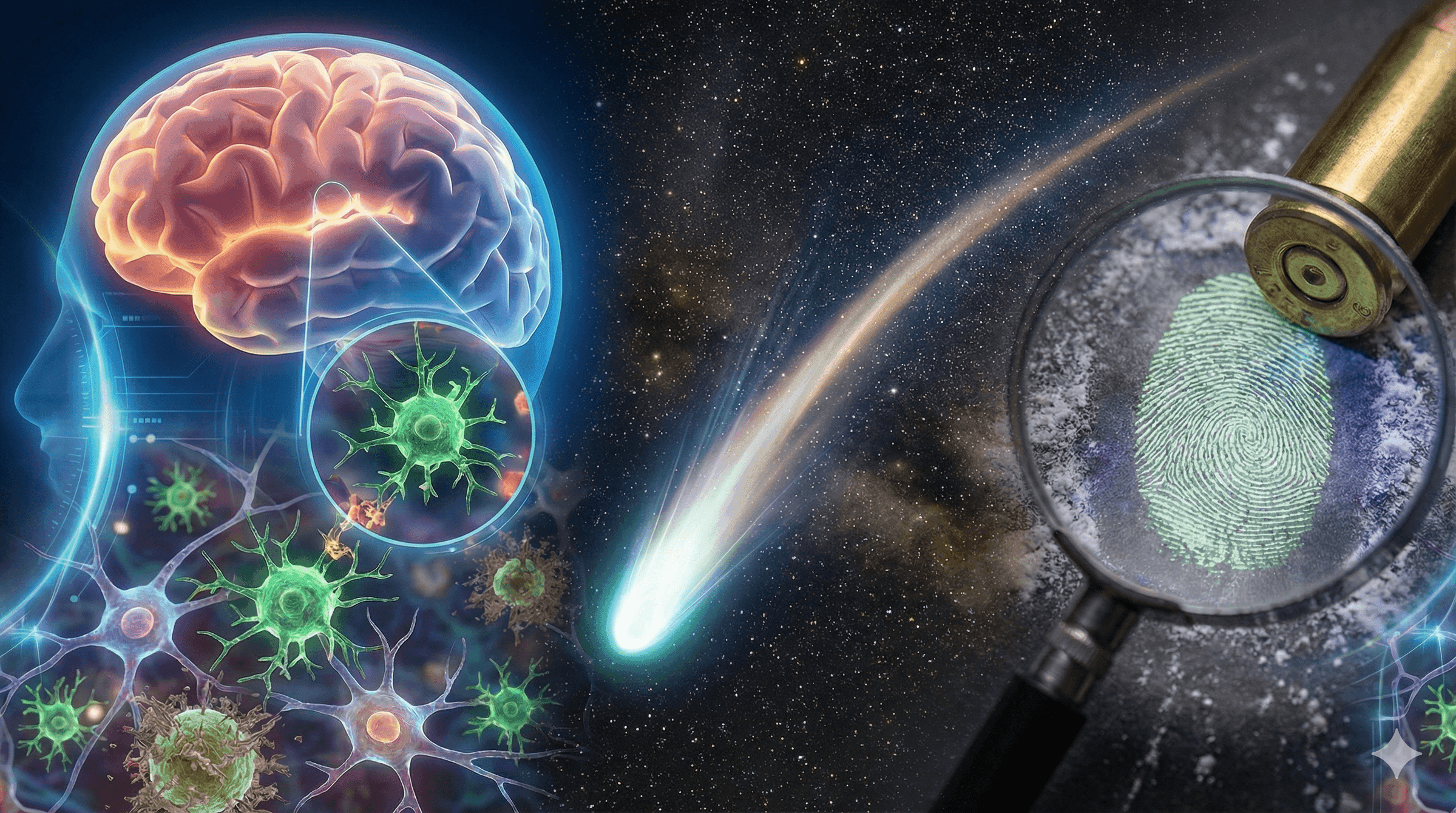
0:41observatory piece for >> the story we're going to spend a lot of time on today, which is >> we're going to talk about Atlas. We now have the observations. >> We've had time to put it together. We did touch this on this once before. >> Yes. So, we're doing a little bit of an update based on all of the latest and greatest. It's been in high demand. We're going to start off with three Atlas today, >> followed up by a new story that's going to be out of May University in Ireland. It was in forensic chemistry around a new technique for taking fingerprints off of fired bullet casings. So, this is a a new forensic technique that will uh help us catch the bad guys even better. ending with a a a new Alzheimer's uh
1:23sort of discovery around microgia uh or immune cells that are in our brain. This is a combination of a couple of universities in nature, Icon School of Medicine at Mount Sinai, Max Plaque Institute of Biology and Aging and the University of Cologne. So, three
From 3I/ATLAS Explained, Forensic Fingerprints & Alzheimer's Breakthrough
Interstellar object, forensic leap, and an Alzheimer's immune rethink.