Alzheimer'sForensicsAstronomy
Interstellar object, forensic leap, and an Alzheimer's immune rethink.
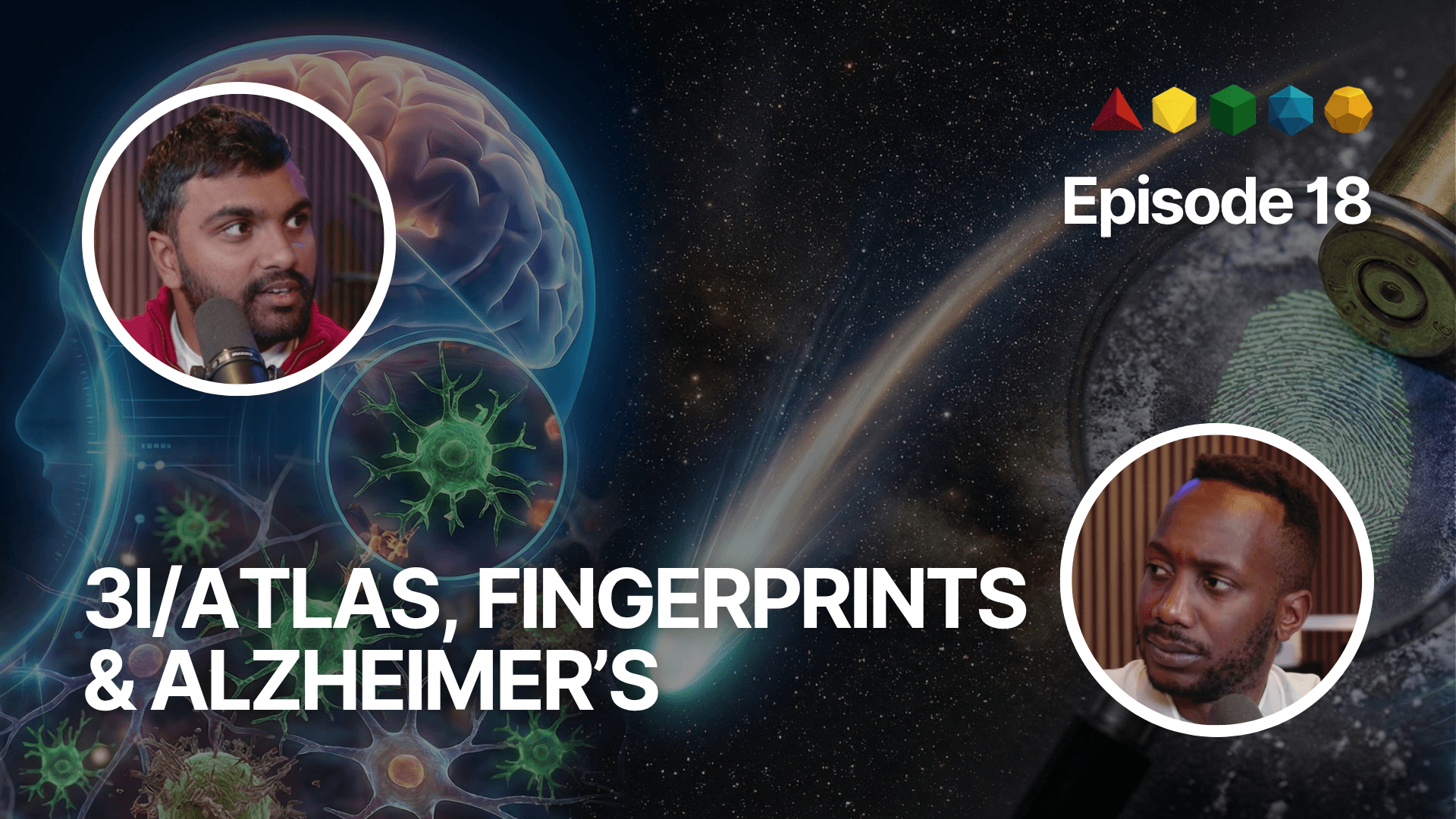
Hosted by Lester Nare and Krishna Choudhary, this episode spans astrophysics, forensic chemistry, and neuroimmunology. We begin with a deep dive into 3I/ATLAS, only the third confirmed interstellar object to ever pass through our solar system — larger and stranger than ‘Oumuamua and Borisov, with new imagery released as NASA reopened operations. Then we break down a true-crime forensic breakthrough from Maynooth University that reveals how to recover fingerprints from fired bullet casings — a technique that could radically accelerate criminal investigations. And we close with a Max Planck Institute discovery identifying a regulatory microglial state in the brain that may finally clarify why Alzheimer’s develops — and how immune dysfunction, not just plaques, drives the disease. Summary The third interstellar visitor — 3I/ATLAS joins ‘Oumuamua and Borisov as only the third object ever observed entering the solar system from interstellar space, with new NASA imagery revealing structure, trajectory, and compositional clues. A forensic chemistry breakthrough — researchers at Maynooth University develop a technique to retrieve latent fingerprints from fired shell casings, combining heat-stable organic residues with spectroscopic imaging. A new model of Alzheimer’s — Max Planck Institute scientists uncover a microglial “regulatory” state (a T-reg–like analogue) activated through CD28-dependent pathways, reshaping how the field thinks about plaques, neuroinflammation, and therapeutic targets.
- Forensic Chemistry
Electrodeposition of redox materials with potential for enhanced visualisation of latent finger-marks on brass substrates and ammunition casings.
Scientists developed a new way to reveal fingerprints on brass bullet casings using electricity and special chemicals. This method can show incredibly detailed fingerprints - even tiny pores in the skin ridges - and works even after the brass has been heated to 700°C or aged for over 15 months, which could help solve crimes where traditional fingerprint methods fail.
- Nature
Lymphoid gene expression supports neuroprotective microglia function
Brain immune cells called microglia can either protect against or worsen Alzheimer's disease, and scientists found that a specific protein called CD28 helps these cells stay in "protective mode" by reducing harmful brain inflammation. This discovery could lead to new treatments that boost the brain's natural defenses against Alzheimer's.
Transcript
Show →Hide16,355 words · auto-generated
Intro — three incredible stories
0:00Hello internet. This is your captain speaking Lester Nar joined as always by my co-host and our resident PhD Krishna Chowdery. My friend, how are you? >> Pretty good. >> You have any exciting Thanksgiving plans for the week? >> Uh yeah, I'm actually I'm going to go to Maui >> with um my parents. It's going to be great. Yeah, that's awesome. Yeah, hopefully I'm going to get to see the the Daniel K. Inway telescope. >> I was actually going to ask if you're going to make a trip out to that. >> Yeah. Yeah, we're definitely going to make a trip out. I don't know if the telescope is operating, but um you know, it'd be nice to see whatever I can. >> Absolutely. Absolutely. And it's uh an interesting dovetail, at least on the
0:41observatory piece for >> the story we're going to spend a lot of time on today, which is >> we're going to talk about Atlas. We now have the observations. >> We've had time to put it together. We did touch this on this once before. >> Yes. So, we're doing a little bit of an update based on all of the latest and greatest. It's been in high demand. We're going to start off with three Atlas today, >> followed up by a new story that's going to be out of May University in Ireland. It was in forensic chemistry around a new technique for taking fingerprints off of fired bullet casings. So, this is a a new forensic technique that will uh help us catch the bad guys even better. ending with a a a new Alzheimer's uh
1:23sort of discovery around microgia uh or immune cells that are in our brain. This is a combination of a couple of universities in nature, Icon School of Medicine at Mount Sinai, Max Plaque Institute of Biology and Aging and the University of Cologne. So, three
Episode overview & show framing
1:39incredible stories. We're going to touch on all the details. Yep. This is from first principles. [music] >> [music]
What 3I/ATLAS is & why it matters
2:01>> So, our first story of the day is ThreeI Atlas. Uh, this is the one that
NASA reopens & releases new imagery
2:06obviously everyone keeps asking us about because the government is back open. >> Yeah. >> And so NASA has now released new imagery. Yes. Um, so let's sort of just start right from from the top here.
What counts as an interstellar visitor
2:20>> Yeah. I mean, it's it's a it's a interstellar visitor as we all know.
The third confirmed interstellar object
2:25It's the third interstellar object.
‘Oumuamua vs 2I Borisov vs 3I/ATLAS
2:27There's been two predecessors that it's had. The first one was um AmuA Mua. The second one was 2 I Borisov. And this is
Why ATLAS is much larger than its predecessors
2:36the third and the largest one that we have by far. >> Okay. >> Okay. Um AmuA Mua was a really strange
Elongation, rotation & odd morphology
2:44woods. It was an inert, highly elongated object that was flying through. Then we had two I Borisov which was basically just like a normal comet comet like any
Comparison to typical comets
2:54other comet that we'd seen. The only thing that was really different was that it was moving so fast that it wasn't trapped by the sun's gravity, right? And then now we've got finally this guy three atlas. The I stands for interstellar. The three stands for the fact that it's the third and the atlas stands for the fact that it was discovered by the Atlas system which is the asteroid terrestrial impact last alert system. These are a bunch of telescopes all over the world. The one that actually discovered this was in Chile and the whole point of this telescope system is to find near-earth objects or objects that are coming
Ephemeral events — why capturing data matters
3:30through and going to be a little bit close right in our solar system. um it preferentially looks in the plane of the planets. >> Okay. >> Right. So >> meaning >> meaning so if the sun is here all of the
Community mobilization to observe ATLAS
3:45planets revolve around the sun >> in the same sort of plate. >> Right. It's not like the big bang atom. >> Okay. Yeah. >> From the from the show where it's like you know there's one going this way, there's another going the other way. They're all sort of along the same plane. Makes sense, right? And that's because when the solar system first formed, there was some some angular momentum of that cloud. So when it collapsed, you know, everything has to be on that plane to preserve the angular
Follow-up windows & December 19th note
4:11momentum. Makes >> sense. >> Um, so that's actually why we discovered this thing and one of the reasons why it's sort of taking a tour of the planetary systems, right? It's kind of by design that Atlas finds objects that are along this plane, >> right? So it begs the question, there might be other objects that are not in the plane that we're not really sensitive to, but perhaps with the new Vera Rubin telescopes and things like that, we will be. >> But in any case, that's how it got its name right? >> It's inbound. Um, it's got an extremely hyperbolic orbit. So an eccentricity of pro approximately 6.2. Um, the Earth is
4:52basically at a one. It looks like a circle, right? But this thing is extremely hyperbolic. You can see that it's going so fast, 58 km/s, that it barely even changes its orbit >> as it >> as it passes the sun. Right. Right. >> Unlike the uh you know the Wicked um movie, there's that one of my favorite songs is like uh like a comet pulled from orbit as it passes the sun. This is not doing that. [laughter] >> Yeah, it is not changed in any in any real sense for the better or the worse. Um, but it 58 km/s, right? That's an that's a velocity that's three times higher than what's expected for a usual
5:34star encounter. >> So, this thing is moving extremely extremely quickly. >> Yeah. Yeah. And it begs the question like what even gave it its speed? >> How did it reach that? >> Yeah. How does how does something move that fast through the solar system? And the orientation is it's also retrograde. The other weird thing is, you know, in the Milky Way, the sun is moving around the Milky Way, right? >> Yeah. >> And the plane of the planets is about perpendicular >> to the motion. So our the we're our entire sort of solar systems moving through the Milky Way galaxy like let's say on the X ais, but then the orbit of
6:15the planets in that context while we're doing that is on the Yaxis is in the Y direction. And so and so when when 3II Atlas when we say that it's taking a tour of the solar system, what it's really doing is it's like going piercing through the Milky Way >> in some sense, right? It's not moving. I mean, obviously it has some >> direction along the Milky Way's rotation as well, but it's going through the plate of the Milky Way as well. That's why it's going through all the planets in the plane of our ecliptic, >> which which is which is sort of a cosmic uh the cosmic serendipity there is is is >> it's kind of a mystery where it came
6:56from and things like that and we're going to get into some of that later. So, um there's been some milestones that have happened since the last time we talked. >> Um it flew by Mars on October 3rd, 2025. That was when it got the as close as it possibly could. And that was a really cool way of providing a local observation, right? Because we have the Mars Reconnaissance Orbiter around Mars. The ESA, the European Space Agency has a bunch of stuff around there. And it's about 28 million km away from these guys. So, you can get some at least some close-ups. You know, it's still far away but >> 28 million km. >> Yeah. Yeah. Yeah. It's still It's like It's close enough, right?
7:36>> Yep. Um, and then on October 30th, 29th, it had its closest approach to the sun, which was a which was at a distance of 1.36 astronomical units. One astronomical unit is the orbit of the Earth. So, it didn't even get closer than Earth is to the Sun. Got it. >> Okay. Um, a lot of comets, you know, the the really bright ones get within Earth's orbit. Sometimes even like as close as Mercury, right? As close as like between Venus and Mercury. And those are the ones that glow and you can see with your naked eye. Um, this one, not so much, right? It it it wasn't that it wasn't that close. And then finally, in December 19th, it's going to be well
8:17outside the Earth's orbit, but that's when it's actually going to be the closest to Earth. It's going to be 80% of the distance between Earth and the Sun, but it's going to be in the other side. Yep. >> Right. So, the sun will be in front of us, the comet will be kind of behind us. >> Um, that's when it's going to get closer. >> Okay. So, I told you that it's it's got a really weird orbit, right? It's it's coming through really fast and it's going along the plane of the planets. Um, it's unclear whether it's coming from a part of our Milky Way called the thin disc, which is really what you see when you look out in the night sky and you see the Milky Way or from the thick disc. Because if you trace back, the yellow trajectory here shows where the
8:59the comet is and the red trajectory is where we are. where the sun is and it's sort of like playing tag and go with our sun because it's >> about the same distance away from the center of the Milky Way as we are. And so it's going to be kind of sharing our orbit the same way that you know um you can imagine the Trojan asteroids outside of um Jupiter. They share the same orbit with Jupiter and they move around with Jupiter. The James Web telescope is orbiting the sun with the Earth, right? because it's it's feeling the same gravitational pull from the sun that the earth is and the moon is. >> Um so >> the question is where where did it come from? >> The the idea is as we are traveling
9:39through the Milky Way, we're going on a particular orbit and the the way that Atlas moves through the Milky Way is in that similar similar circular orbit in in the radius of that orbit is almost identical. >> It's almost identical, right? I mean, hence it's right here. And the Milky Way is just has a gravitational potential because of all the stars and gas in it. Y >> and the sun is feeling the same gravitational potential that the the comet is. >> Y >> um and because of Newton's law of gravitation, the acceleration that we feel is independent of our mass. So even though um the comet 3A atlas is really
10:20really small compared to the sun, all objects fall at the same rate >> according to Galileo, right? So >> it doesn't like in terms of the orbit, it's not really going to matter if it's the sun or a star, right? >> Yep. That's a that's a good >> that's the that's the point. That's why the um James Webb telescope is moving around the sun the same way that we are, >> right? Even though it's obviously smaller than than the Earth, right? Um, so the first paper that tried to answer this was from Oxford in the Astrophysical Journal letters. This was in July and they said that it's from the thick disc. The thick disc is the part of the Milky Way that's just above all of the stars and the real gas.
11:02So the stuff that we see in the night sky when we look up, there's a that's the thin disc. The thick disc is the part that's right above or below. That's an old population of stars. We know that because we can look at the spectral signatures of the stars that are above there. And um you know there are these very red um longlasting stars with um lots of metal which means they've been doing fusion for a while. Um actually um it depends actually but depends on whether it's high metal or low metal. High metal could also mean that you're you've you're the second or third generation of stars that that are coming from the the ashes of the older stars that have made the metal. And then low metalicity could mean that okay, you
11:43just have hydrogen and helium. So like it's like from the big bang, you got [laughter] nothing else, you know? But so there there's ways of quantifying it, but in any case, they've quantified that a lot of these stars are between 7 to 14 billion years old. Right. So it's it's much older than the sun, which is about five billion years old. Right. Right. So that that was the first one. Then there's some new work that came out in September. Um this is not in a journal but it's it's on the archive and it was from the Tenneref Observatory. A bunch of um people there in Spain. They were trying to trace back the object's origins in a similar way. And they showed that they they used this
12:26um Python package called Milky Way potential 2022 which basically what what it can do is it can take your object and then run back the clock >> Mhm. >> for however long that you want given the Milky Way potential. And what they found was that if you integrate over the millions of stars in that database and you go back >> at least in the last 10 million years, there's no close encounter that's going to cause this giant velocity. >> Okay. If you if you go through all of the and those are the stars that the the that it had close encounters with. >> Yep. >> And none of them were close enough to
13:06really add any velocity to this thing. The the point being threeey atlas had to get its acceleration from an encounter with some celestial object at some point in its history. Yeah. And from >> but it can't be the recent history. >> But it can't be the recent history. Okay. And then when we look in this uh uh Milky Way potential 2022 >> and trace back the journey that it had made and the stars that it would have passed, these celestial objects would have passed on the way. None of those are of sufficient mass and size. >> Yeah. And and it wasn't close enough >> enough to generate the acceleration that we're seeing. That's what the paper's trying to say. >> That's what the paper is trying to say,
13:47right? So then they say, okay, what we can do is we can really just run back the clock, right? And we can say, okay, if it's not in our recent history, let's just treat the Milky Way as this like potential landscape and ask how far does it deviate away from the thin disc, right? Because what it could do, what the original paper was saying was that you know because it's got such a high velocity perpendicular to the disc, it must be coming from up there. >> Yeah. >> Right. But the potential landscape is such that when it goes above the disc, the disc is going to start pulling back. And so there's going to be some oscillation >> through the disc, right? It's going to go up >> and then it's going to come back down
14:27and it's going to go down. Then it's going to get pulled back up again, right? So how big is that amplitude, >> right, >> of that oscillation? basically how how high how far above and below the thin disc. Yes. Is it is it sort of >> is it going right? Is it going all the way to the thick disc? Because we also have um velocity profiles of the stars that are up there. There's some typical >> trajectories that those guys take and there's some typical trajectories that the that the thin disc takes. >> Which one does this thing belong to? Got it. >> Right. And so that's what they did. And what they think is happening is that it stayed basically within the thin thin disc and they're ruling out the fact that it could be in that upper thick
15:08disc. >> Okay. >> They found where >> the velocity profile of this comet is compared to the stars in these two regions and it's more aligned with the thin disc. >> Interesting. >> Right. So this is kind of a clapback from to the Oxford paper >> which was that original one. >> Which was that original one. So, we're going to have to see if if Oxford comes back and says, "Nah, >> this this is good because when we [laughter] when we first covered this, the Oxford paper was the only one >> was the only one." And everyone was like, "Okay, that's got to be it." But the process of science is extremely dynamic. You know, there's a bunch of researchers vying for the spotlight, >> right? >> So, you know, someone's going to someone's going to say this, the other person's going to say that. Um, >> this is very good. So, so we now we now
15:50are in a position in terms of the locationational origin of thei atlas which initially was believed to be coming from above where we are on the thin disc in in the thick disc but it there's at least now a rebuttal. >> Yes. >> There's at least now a rebuttal to that that can explain away the thick disc origin hypothesis. >> Yeah. Yeah. Exactly. And now it calls into question um whether it is as old as they say they are because it used to be we were really excited right this is going to be the oldest thing in the solar system. It's going to be older than 7 billion years old because all of the the stars that are up there are super old and if it came from there then it's got to be super old too now. Well, if it's just one of these thin disc
16:31populations that just got bumped maybe a bunch a long long time ago, right? >> It's no longer maybe that old, right? Maybe it is it is quite contemporary. So there there's a bunch of you know >> very cool science that is still happening trying to figure this out >> trying to trace back its location origin location. >> Yeah. So so that's that's the that's the origin story. It's still in question. >> Yes. >> Now let's talk about what it actually is >> and why it is so interesting. It is quite a bizarre comet. >> Okay. If we're completely honest, there's a typical comet that we see in our solar system and this is a pretty bizarre one. It's not unprecedented. We have seen comets that do the weird
17:13things that this thing is doing, but it's been like one or two. Okay. So, it's it's rare, but it's not like totally >> unprecedented. >> Unprecedented. Okay. Um, >> so it's got a nucleus. The radius is about anywhere between 222 km to 2.8 km. That's how we constrained it. Um, there's a lot of activity on this thing. Hyperpt. It's called a hyperactive comet. Okay. There's as the comet gets closer and closer to the sun, the the solar radiation and the photons from the sun start creating chemical reactions and physical reactions on the comet surface and that's going to just make it glow and do all of the cool things that
17:54it does. And a lot of the weird stuff that it does has it's been implied that you know maybe there's something weird going on if there's a techno signature blah blah blah. Um, a lot of this actually came from Avi Loe at Harvard. But then, um, in September of or sorry, October of this year, he came out with this model, which is a physical model for the ice of three Atlas >> with, um, >> Avi Lobo and one of his collaborators, um, Eric Kito. >> And this one is trying to suggest how the physics of a comet could produce all of the weird stuff that we're seeing. just normal comet, maybe not a normal comet, but kind of a weird comet, but
18:34just ordinary physics, stuff that we know. Okay, one of the things that it tries to explain is something called the anti-ale. This was very weird, right? There was a if you can see over there, this is from the Hubble Space Telescope. On the right is where the sun is and there's some projection. And there's like a jet from the comet coming out towards the sun, >> which which is which is counterintuitive because the idea would be if the comet is traveling at high velocity towards the sun, you would imagine the quote unquote jet would be pointing in the opposite >> opposite direction. And there is one. Yeah. And there is one. There is an anti-tail. And because of the way that we're looking, right, it's coming at us.
19:15So the anti-tail is kind of behind the comet and the sunfacing one is towards us. So because of our vantage point, it looks like the sunfacing emission is that much brighter. But that's not actually true. But in any case, there is a sunfacing emission, right? Okay. >> And then when it >> went past perihelion, so it went past the sun on the other side. Now there's no anti- sunail. >> Sorry. Now there's no towards the suntale. There's only the anti-tail. Okay? So it disappeared. This is from the very large array sorry the very large telescope the VT in Chile. >> So the nucleus has been has done this thing where it had jets pointing in both directions and then on the other side of
19:55the sun it no longer has that. >> So what's going on the model that um Kito and Lo proposed is the following. Okay. So when >> when the comet is coming towards the sun >> Mhm. >> there's going to be something called sublimation. And sublimation is what what happens with dry ice where you go directly from a solid form to a gas form. There's no in between of liquid because the temperature the the energy is enough to cause these the CO2 molecule to just free itself from the from the gas not transition through that liquid phase. Now, when it's happening and it's coming towards us, that sublimation is actually going to cause
20:36chunks of CO2 to sort of shoot out from the comet. Okay? And if you're far enough away, those chunks of CO2 are going to shoot out, but they're going to follow with the comet because of the same thing that I said earlier, right? They're falling towards the sun the same way the comet is. Even though the comet is this giant mountain of stuff and let's say a chunk of CO2 is, you know, centimeters to meters to maybe tens of meters big, >> that thing is still feeling the sun's gravity. So, it's going to follow in the same sort of path, but maybe a little bit ahead because it got shot towards the sun. >> Yep. Yep. Got it. Got it. >> And the solar radiation >> out there far away is not enough to
21:18quickly melt these chunks. Okay. So, it's sort of like the comet is here. You've got these chunks of of CO2 ahead and it and it's moving along the sun right now. As it gets close to the sun, >> there's going to be so much pressure, radiation pressure and ionization pressure that these chunks as soon as they get out of the comet, they're just going to immediately evaporate. And so, that's why we're seeing that loss. >> Yeah, that makes sense. Yeah. Yeah. >> Of the of the front-facing tail, >> right? Cuz the closer you get, the more the the the shorter the liespan of the stuff that's getting ejected >> at when it at distance we're seeing these large chunks break off, right? But
21:59they're in such large size and the pressure is not high enough yet that they maintain its structure. >> Yeah. And they just follow along, >> right? At this slightly, you know, again, because it's basically getting uh uh broken off from the front side. >> Yeah. as it's making its way over. But as you get so close, the heat the the radiation is so high that that the lifespan of that tail that is appearing in front doesn't basically is not doesn't have long enough time to exist before it >> evaporates into going from that sublimation process going from solid to liquid which if I recall correctly was also part of the original walkthrough we did about where the origins of this
22:40could have been where it could have been around a star that had this accumulation. Yes, exactly. >> And then then it broke up. So there in that first episode, it's interesting that same process was discussed well before even this keto loan paper came out. >> Yeah. And that was that was in how it formed it formed in the snow line in that ice line, right? Where the CO2 goes from gas to being able to freeze. So there's a there's a bunch of frozen stuff right at this ice line and maybe the comet formed there which is why there's so much CO2 compared to water >> and and which and that's it's basically the opposite process on the formation. Now we're seeing it >> now we're seeing it on.
23:21>> So if we if you go back and watch that episode it does a good job. We go into detail about the concept of sublimation and that formation process that actually kind of dovetales to what you just talked about quite nicely. >> Exactly. Yeah. So, so that's the that's sort of um the keto lobe hypothesis, right, for why we're seeing a tail sometimes and not other times. >> The the sunward extension. >> Yeah. >> Uh specifically, the thing that was weird. >> Yeah. Yeah. So, I wanted to highlight that um that paper cuz I thought that that was a quite interesting physical model. Y >> um that's out of Harvard astronomy. So, now let's get into some of the observations that have been happening. Yes. So the James W space telescope
24:03infrared chemical Frank fingerprinting. So this is in the um infrared range. The space telescope took that photo. The coma is highly dominated by emission that's coming from CO2 and H2O. And one can see that the mixing ratio between the CO2 and H2O is 7.6 >> which is way higher. >> Oh yeah. than the typical solar system comets, right? The typical solar system comets are at 0.1 to 0.2. 3 Atlas is all the way up there. >> So, yeah. So, we're looking at this this uh >> it's a plot. >> It's a plot. And then we we see basically that Atlas is well above
24:43>> the trend line, >> the trend line. Well, well above the trend line. >> There are a few that like the C 2016 R2. That's another comet that's local and that's even more above than 3 atlas. But these are exceptions. That's the point. Yes, >> these are very much exceptions. And the fact that, you know, we've had two interstellar visitors. One is typical, the other is crazy. Of course, like n equals 2 is a very small >> um sample size. But it begs the question, are most interstellar comets >> atypical? Right. Right. Right. Right. Right. >> It's kind of an interesting question because we don't know where they formed and how they formed around what stars they formed and things like that. The other thing that's kind of weird about three atlas is there's a lot of nickel and there's not a lot of iron. This is
25:26very strange because those two usually come side by side together. >> Okay. They're they're formed at the core of stars during explosions, things like that. And one can imagine that whenever they form in a dust cloud and and they're in summer environment, they have typically the same kind of elemental mass. So they're going to be forming together. It's not unprecedented. again. But it's definitely unusual that >> there's a lot of nickel. There's not a lot of iron. >> The ratio between these two is so >> Yeah. >> Uh the the delta is so large. >> Yeah. Yeah. Yeah. So, so that again there's another question mark there. How do you get a lot of nickel on a comet but no iron? >> So, so we the the one one of the questions is like the velocity question
26:08which goes to origin. One of the questions is the uh >> the sunward extension CO2 piece. Yeah. And and then and then this is now like the like a third question which is the um the composition itself just to try to like quickly summarize those those three key points that are quote in question. >> Yeah. >> Exactly. Um another really cool local view that we got I was telling you about the Mars fleet that we had. So the Maven um >> probe which is on Mars imaged atlas. We found a massive neutral hydrogen corona using the alignment alpha line which is one of the spectral lines of hydrogen that this maven instrument actually had access to. So
26:49from that we can actually derive a water production rate and there's a lot of water sublimation that's happening on that comet. Okay, which is kind of cool, but that's not really that unprecedented. Comets have a lot of water. It used to be thought actually that um and it still is thought that a lot of the earth's water >> came from >> came from comets because when earth was forming >> probably all the water just got evaporated and then comets came and deposited their water during the early bombardment of earth when it was forming and one can actually look at the isotopic >> ratios of different isotopes in water in comets and in the ocean and they're the same. Mh.
27:30>> So that suggests that there is a link. >> Mhm. >> Um the the the last piece from Mars that I want to highlight is the Mars Reconnaissance Orbiter high-rise. This confirmed that there is a nuclear diameter which is probably less than 30 km. That's the limit of the high resolution imager. I mean we've had tighter constraints before actually. Um I saw a interview of Avi Lo on like NBC where he was just like this this like there's nothing new here. Like the data kind of sucks. like it's like, you know, I mean, give them a break that they were supposed to they were supposed to image Mars with this thing. They didn't know that they were going to have like a comet on their hand that's like a
28:10astronomical unit away. But I just thought it was funny cuz like everybody's like really excited about this data. But because the orbiters around Mars are built for Mars, right, as as like, you know, within hundreds of kilometers to thousands of kilometers, now you're asking them to image something that's 30 million km away, that's much smaller than Mars. They're not going to have a good time. This I think this this is this was this is an important sort of side note because this I think this has been the one thing that um a lot of people have been like leaning on which is like we spend billions of dollars and like you know why is it that you know we can't um capture imagery that is you know
28:51equivalent to like this and they just bring up an example of something else >> and I think for the Mars spec for the Mars uh orbiters specifically >> you know it would be like asking you to take a picture of someone holding a penny on the Empire State Building from Los Angeles with your iPhone, you know, and it's like it's not built for that. >> It's not built for that. Yeah. >> You know, maybe you could use a specialized tool to do so, but that just wasn't what was up there at the time. >> Yeah. Exactly. Like wildlife photographers use giant telephoto lenses >> to get to get those shots. >> They they spend thousands of dollars on that. That they don't just all go up with an iPhone. >> I as someone who's had to take photos of my little brother at sports games and uh having video lenses, not a telephoto lens, uh Yeah.
29:32>> Yeah. Yeah. There's a reason why the lens matters and like it's it's a hardware problem at some point, right? Um the other really cool way of monitoring this thing was with something called stereo A, which is solar conjunction monitoring. This is a really cool set of satellites we have on two sides of Earth's orbit. >> Mhm. >> That monitor the sun all the time because the Earth only sees the side of the sun that it's seeing. >> Right. >> Right. >> Right. What we'd like to do is see all of the sun all the time. So what they do is as the Earth is revolving around the sun, they have two satellites that share
30:13Earth's orbit but are on 180° away from each other. So they're imaging the sun from two different sides. >> One is leading the Earth, the other is trailing behind us. >> And so with this, >> we can actually track 3 Atlas as it goes behind the sun, >> right? because when it was coming towards Earth, it actually went behind the sun and we could no longer see it. Well, with these two satellites, we can we can track it. >> And we were tracking it and the object kept its structural integrity. >> Okay, >> again, this thing is built for imaging the sun, not comets, but at least it could see that, okay, this thing still exists on the other side. >> It didn't like totally disintegrate like some comets sometimes do.
30:53>> Yep. Yep. Um and then finally I want to mention that ISRO the Indian Space Research Organization um did some observations with the 1.2 meter Mount Abu Infrared Observatory. I have actually been to that observatory because my dad used to work there. It was >> Yeah, that's that's me when I was probably like 9 or 10 years old. Um taking a photo with that >> 1.2 m telescope. >> Yes. Yes. So um that was pretty cool that I saw that you know one of these observatories that my dad did a lot of research at um back when we were in India um did some things. They've got a really nice spectrometer there. So they found some key molecules in that
31:33spectrum. They found the swan bands which are C2 and C3 that's two carbons and three carbons and they also found cyanogen which is carbon and nitrogen. Like those bonds have very specific spectra and from that spectrum we can actually find that okay these these molecules do exist and it sort of refutes any lingering claims that there's some like inert or artificial composition because again comets are very typically have these kinds of carbon spectral lines. >> Mhm. So, that's sort of where we're at in terms of 3II Atlas, the the current data, all of the current observations. Not all of them. I mean, we we still keep doing a
32:14bunch. There's a lot of actually um amateur astronomers that are taking really great photos of this thing. Yep. >> Which um which I find really awesome. >> Yep. >> It's it's a weird comet for sure. probably came from a metalrich star system. That's why it's got a bunch of nickel. The fact that it doesn't have a lot of iron is kind of weird. Um, but there's a lot of there's a lot of stuff that we can do with it, right? I'm really excited for the Vera Rubin Observatory that's going to come online. I'm also really excited for an ESA mission called the Comet Interceptor. It's >> it's this new type of mission where it's scheduled for 2029. It's gonna
32:55it's designed for high-speed flybys. >> Okay. And this thing is the highest speed possible. Right. >> So now we've got sort of a parameter space on how high we think flybys can should should be capable of. >> Right. Right. Right. Right. Because because we have a real world data point now atlas of knowing like okay we we are going to see objects that are moving this quickly. >> Yeah. Yeah. Yeah. And and so now we need to meet those expectations of okay, we found this thing in July or in uh yeah, in July we found it. We've got like a few months to scramble the fighter jets, to scramble the the rockets and get this thing going. That's the capability that we need in order to really like study these things really up close. >> Yep. >> So So now we have some data points to
33:38actually, you know, give us that ballpark estimate. >> Yeah. And it basically gives like a sort of a mission orientation. >> Yes. >> Uh for the like you know >> what how how fast do we need to set up a rapid response. >> Yeah. >> Uh and what are the sort of implement like what are the keys to implementation in order to be able to accomplish it and do so. >> Yeah. >> Um but and I cannot wait for I keep thinking about how with Vera Rubin uh the number of these interstellar objects is gonna just uh balloon and explode. it if if they if they are there to be dis if they are there to be discovered it will be discovered >> it will be discovered by the Vera Rubin
34:19>> 100% um the Vera Rubin would have discovered this thing >> right >> had it gone online 3 weeks earlier >> which is so crazy >> right >> it's so crazy and would the the the quality of that data would have been >> fantastic you know again this being a tool that is built for that type of observation >> in contrast to the Mars orbiters which just happened to be closer in proximity >> and also able to see it at a time where we were on the other side of the sun. >> Uh so very women would have been would not have been helpful during that window of time. Yeah, definitely not. Just that window of time. >> Um >> fascinating. So we still >> jury is still out on origins. >> Yep.
35:00>> Uh locationally like where it is coming from. >> Yeah. >> We have >> and thus jury is still out on age >> because location is tied to age. So, we still don't know like where and how old. >> Yeah. >> Um, we have an an interesting explanation for the Sunword extension. >> Mhm. >> But that still is being developed. >> Yeah. >> Um, it's >> again that's on archive that's not been um peer-reviewed and published. >> Right. Right. Um, and we, you know, >> uh, don't quite have the explanation for the nickel iron ratio. >> No. >> So, these are still open questions. Yeah. >> Um, which is fair and understandable and it's interesting to see the >> I mean this thing's a few months old.
35:42>> Right now we're still in the capture all the data you can. It's going to it's in December it's going to be close to Jupiter, >> right? >> So that'll be interesting. We have some probes there that perhaps can go um you know orient and and take a look. >> I don't know what the plans are there. I think what's what is interesting is it's you know there hasn't it hasn't been clear or we haven't had a lot of these so we we've never had the opportunity to say hey we have all these instruments in our solar system now >> which we didn't have before. No >> we have a ton of stuff that's just out there >> and when there is a these these ephemeral events these events that happen you know >> in in a moment in time >> where are these tools going to be used
36:23to capture this data or not? And this is like proof positive that like everyone understands the import and the unique opportunity and chose to do so. So, >> uh, another update on the Atlas. I'm sure we'll do another one once it's all gone. >> Once it's all gone and everyone's really doing that deep diving. >> Yeah. Or once it once it um puts probes in Jupiter. >> Yeah. [laughter] Right. Right. Apparently, we'll know in a month. >> Uh, December 19th. It's still not done yet. So, we're waiting for uh >> quote [clears throat] unquote whatever. December 19th. Um, that was our story
Story 1 concludes
36:52number one. uh which was again a quick update on 3i Atlas. >> Uh we're gonna now move on to story number two which is uh a very different
Story 2 begins — the show’s first forensic story
37:03context. We're going into a a forensic
Maynooth University & Forensic Chemistry paper
37:06story. >> Yeah, we've never done a forensic story. >> I think it's our first uh it's our first uh >> but I thought this was really cool. >> A true crime. Uh so if you're a fan of true crime, you're going to love this one. Uh this is out of forensic chemistry uh research out of May
The problem: why fired casings lose fingerprints
37:19University in Ireland for fingerprints from fired bullet casings. So I think
Heat-stable residue chemistry
37:24the the top line is there's a new technique that is making it more
New spectroscopic technique to recover prints
37:28efficient to figure out who done it.
“Who done it?” efficiency gains
37:29>> Yeah. Yeah. and from fired bullet casings, which is which is really quite something because um it's kind of the holy grail of modern forensics, okay, is to find fingerprints from bullet cases that have already been fired, >> right? Because >> then you can tie a suspect to actually loading the gun rather than just possession of the firearm. >> That's actually that's an important distinction. Yeah, >> that's that's that's pretty big. Yes. >> Um it's a it's a really cool methodology
Implications for policing & cold cases
38:00involving electro deposition. Um the paper is out in forensic chemistry by Mayouth University in Ireland. The fingerprints are typically destroyed whenever a firearm discharges, right? Because you have stuff like 500° C, pressures of 50,000 lbs per square in. Um and this method exploits some organic residue >> that's that remains even after all of this stress. and it like amplifies that organic residue to create a fingerprint. All right. And it's it's very cool that the the electrochemical techniques that they're using to do this. Okay. And the significance is as I was saying, right, the print on the casing >> links individuals to the act of loading
38:42the gun. And before we really only have the possession of the firearm, but it could somebody else could have done it. Somebody could have taken the firearm and done something. >> Um. >> Yep. And the prevailing consensus is the violent process of actually firing a bullet would destroy the fingerprint on the casing. >> Right. The the the theory of the case is you're never going to get the fingerprint off of the fired bullet. >> Exactly. Yeah. And it is a pretty violent process, right, of firing I' I've fired a gun only once. I went to a shooting range and it was like one of the crazy craziest exhilarating experiences I've ever had. I've never done it again. Um, so I don't I don't I
39:22had to do a lot of research on how the gun works and the physics of the gun, but this is my twominute summary of of the process. This whole thing happens in under two milliseconds. You've got a casing that has gunpowder >> and then you've got the bullet, which is the projectile in the front. You've got a firing pin, and when you hit the firing pin with the the trigger, that causes a chemical reaction which raises the temperature inside of the casing. all of that gunpowder or whatever goes up in temperature around something like you can you can get as much as 2,000° C and then that's going to expand a lot of air which is going to shoot the gun forward. Okay, that's not the end
40:03though because afterwards you have to take out the casing and replace it with the next one. Right? So there's like a thing that grabs the case, pulls it back, throws it away, and then loads up the next one. Right? M. So all of that stuff is going to mess with the fingerprint that's on the outside because when the bullet is fired, that expansion of the air is also going to first of all it's going to heat up everything. So any organic residue that you have like the proteins or any carbon that's just going to burn up >> burned off. Yeah. then the the casing itself is going to expand into the chamber >> and when it and when you pull it back that friction is going to then again
40:44destroy any residue of a fingerprint that's on the outside. Right? So there's all of these different things that are happening that will completely mess with the fingerprint that's on the outside. Okay. So the recovery relies on some persistence of like a decomposition product that's on the outside. Okay. And what this particular um paper is focusing on is the carbonized ash. So there's going to be some inorganic salts that are left by our sweat and our oils that is going to remain. It's going to get burned up, but the ash is going to remain on the outside. >> There's the the idea being the theory of the case is there's no organic residue that
41:26will be left after the bullet is fired because it's just going to get burned out. >> Yeah. like the proteins, the oils, and the lipids, it's gone. But their hypothesis was there's going to be a little indicator still left >> despite all of that. >> Mhm. Yeah. And and it should be the burned up ash of all of that stuff. >> Of all of that stuff. >> And there should be a little bit left. >> Mhm. >> Right. And if there's even a little bit left, there's a chance. >> You're So you're saying So you're saying there's a chance. >> Exactly. And so And so that's that's what they're doing here. This isn't completely unprecedented. Okay, so in 2008, there was a guy, Dr. John Bond. He came up with a mechanism to actually
42:08figure out these casings. Um, >> there that's crazy that his name is Bond. >> Yeah. Yeah. And it I I I thought it was like part of the Bond when I was reading it because my summary just had Bond and even the the the news articles about this just have Bond and I'm like like James Bond like like this is you know maybe this is one of um Q's >> like weird techniques that he's that he's made but no this is Dr. John Bond and he came up with a way of using really high voltage 2.5 kovts, right? And what you do is you realize that most of these casings are made out of brass. >> Mhm. >> Which is um copper and zinc.
42:48>> Okay. And the zinc and the copper are going to react with the oils on my finger in different ways. >> Okay. >> Okay. So, where the fingerprint was, that's actually going to create a chemical reaction and a corrosion of the zinc part. M >> not the copper part. >> Okay. So, there's going to be different resistance. There's going to be different tiny layer of different metals. And what I'm going to do is subject this casing to really high voltage. >> People are crazy. >> And then put a fine conducting powder on top. And then that powder is going to be attracted to the corrosion sites because that's going to be high more conductive than the rest, right? And then I can I can make a a fingerprint out of that.
43:29>> That's so brilliant. >> It's it's pretty brilliant. So in 2008 this has already happened. This is going one step further further. Okay. Okay. And so the the we've we've identified that we can basically put like current into a a substrate and it will basically reveal this red like this pattern which is the fingerprint we're looking for because the zinc interacts the way itself the metal itself interacted differently with the organic you know residue which is just us touching the outside of the brass bullet casing where he's like let's just pump it and and then it just shows That's so I know that's like a bastard, but that's so >> I think that's pretty cool.
44:10>> That's pretty cool in and of itself. >> Yeah. The the problem is it works on brass because it requires this alloy, right, of copper and zinc. >> Yep. >> Well, now I mean I think there are now casings made out of steel, stainless steel and things like that. It's not going to work because the chemistry is not going to work with the iron and the and the carbon that's in the steel. >> Okay. >> So, what these guys did was use a process called cyclic voltometry. So you start with an electrochemical cell which is a three electrode setup. You've got a working electrode. In this case, this is going to be our brass casing, the thing that we want to actually test on. There's going to be a counter electrode which basically completes the circuit. And then there's a reference electrode that keeps the circuit at a certain
44:50voltage. >> And you've got so so imagine you you take your breast casing, you put it in a chamber with a bunch of electrolyte around it. So chemically conducting water effectively. You attach a electrode lead to it. You have other leads. And now what you can do is start turning on the voltage very gradually. >> Okay? And that's called cyclic voltometry. You turn on the voltage extremely gradually. And what you do is you measure the current. There's going to be a blip in the current. There's going to be a peak in the current. And that corresponds to something called the oxidation potential. Effectively, there's some current that is going to allow a chemical reaction to take place on that surface. Okay. Mhm.
45:33Once you tune it to that peak current, you can keep that current at as low as possible so you you don't make any other weird chemistry that's happening and really tune it to that residue that you want. >> Mhm. >> Right. And this is the ash that's been left over after the the casings come out. Right. Yep. So you're at a low enough voltage >> where you're not destroying any you're not causing anything else to start destroying the ash that's there. You're only tuning it barely to that ash >> ash itself. >> Okay? >> Barely to that ash itself. >> And what ends up happening is you you get these two polymers called E dot and
46:13P dot. It doesn't matter what they are. The the effect the effect is they're polymers that are long chains but still really really small in terms of you know every day but they're but they're like single chemicals >> and what those single chemicals are going to do is when this chemical reaction is happening this oxidation reaction the chemicals are going to get deposited on the ash >> okay >> or actually no sorry they're going to get deposited on the metal and they're going to leave the ash alone >> okay Cuz the ash is going to be insulating. >> I got you. >> I should say that. I should say that again. >> You you you stick the electrode in, you charge up the casing. >> Yes.
46:53>> That's going to have a bunch of carbon ash and residue on it. That ash is going to be insulating compared to the metal. So, the chemicals are going to get deposited on the metal, but leave holes >> where the ash is. >> It's It's like the opposite of the tracer stuff that they put in mice when they're trying to test them to follow it. It's like the opposite imprint of of like that. >> Exactly. Exactly. What's left is what we're looking for. >> Yes. Exactly. And so now we have a way of of actually doing this right now. Why is this better than the 2008 method? >> Okay. Yeah. >> For one, >> I can do this on steel. >> Okay. >> Right. >> I don't need the brass zinc and all that stuff. >> The other is you get a lot higher
47:35resolution on this. Okay. This E doine method consistently yields grade three visualization. I didn't know this about fingerprints. With fingerprints, there's level one pattern, which is the fingerprint itself. The level two pattern is the detail on the ridges. And the level three pattern is within each of our ridges, there's little pores. >> That's crazy. >> Where the the pattern of that pore is also unique, >> okay, >> to each individual. >> Okay. >> Right. And so to really like start getting something that I can admit in court and all this other kind of stuff, it'd be really nice to get level three patterns cuz sometimes level two patterns like let's say you have like
48:16just the edge of someone's fingerprint. Well, that edge could maybe match to somebody else's fingerprint and things like that, but if you have the edge of someone's fingerprint and you have the pattern of the holes, >> that's now extremely hard >> to to match to erroneously. >> Yeah. Yeah. Yeah. >> Right. And so this current method actually lets you resolve those pores with these micro deposits, right? You've got you've got a mechanism to now actually visualize those pores with those electrolyte contacts. And this is from the paper. You can see very clearly the pores and the ridges, right? And this is at tens of microns of resolution. >> That's the other key that's very
48:56different. In the 2008 method from Dr. bond. He used a conductive powder. >> That powder, the size of the powder >> is your >> is bigger than the pores. >> Yeah. That's your limiting factor for resolution. >> Here we're doing single molecule deposition. >> Right. Right. Right. Right. Right. Right. So it makes total sense the this is so I'm just like been out of shape at how clever >> Yeah. >> conceptually like people think about this stuff. >> Yeah. Why don't we put it in a >> and put some electrolytes around it and then we know because we know the other aspects of this chemistry we can just in it right it should this should probably
49:38work >> and then when you do it and and you see you know the example image we just looked at where it's getting the the the level of detail oh sorry not this one but number eight where we now see in the real world that detail difference. >> Yeah. Um I mean like again even as as sort of someone who's maybe not in forensics, you could understand why you would want something with this the level of fidelity on the right versus on the left. >> Yeah. Yeah. Exactly. And then it it's it's pretty awesome. >> It's pretty cool. >> Yeah. Um the other cool thing that they did was actually like so you know your casing goes in Yep. um in order to maintain a uniform electric field around that casing during this electrochemical reaction, they had a customuilt cylindrical chamber that would sort of
50:20make a uniform electric field. >> Okay? >> Because if you put it inside a box, then the edges the edge effects are going to be different and you're not going to get the complete fingerprint around the thing, you know? So now it moves to a place where okay if we want to implement this in industry for each different size of casing we should have different size chambers to actually do this reaction. The other cool thing about this is >> the Dr. Bond method took 2.5 kts. That's not something that I can like hook up to my car battery and like right >> this thing takes less than one.1 volts. So this could be handheld. M you can have basic >> buy the crime fighting units.
51:03>> Yeah. Yeah. Yeah. Yeah. And they you could do it on site. You wouldn't necessarily have to send it to a lab. >> Yes. And then you know with that stuff timing is everything. So So there's a lot of really new stuff that's happening now. Before it actually gets implemented it needs to pass something called the Dobert standard which is the standard that they have in forensics before you can admit something in court. Okay. like DNA testing had to go through this things like that. It relies on testability. You got to have peer review. They already have peer review with this paper. Um you got to figure out what the error rates are among a general population like not just let's say white males but okay, how does
51:45it work with women? How does it work with different races? Things like that. And generally to accept everything, all of these things have to be checked. So that's the next step. It's sort of like the regulatory process or the governing standard for this moving from being something that is interesting and people could utilize but not then have be admissible in court to it being be able being able to be used uh to actually say you know as evidence that someone is the shooter. >> Yeah, exactly. And um one last thing that I want to talk about is the fact that they can actually do old casings as well. They tried to do a fingerprint from a 16-month-old casing and they were actually able to recover a fingerprint
52:25>> which is uh you know so this isn't like just now they could be going back. >> This is okay. >> Yeah. >> Look. >> So >> look >> if you thought you got away I don't know. [laughter] >> Yeah >> that's actually very a very important detail. Yeah, >> because it it kind of you know I think because for example if for all the fans of true crime podcast etc >> with the advent of DNA >> testing a lot of cold cases have affect have been reopened >> and you know people have started to you know >> uh get caught for stuff they did ages ago. >> Uh this is another >> there's another one >> another lever that could unlock a lot of stuff there. I mean there's a lot of recent cases I can think of where this
53:07existing uh would have been I mean me the stallion and had a case with uh that little rapper that I can't remember his name right now who's in jail and like it has this issue of they fingerprinted the gun but uh they they not the casings that were shot and so like that would be a case where it would be >> interesting. Another one is obviously the recent unfortunate assassination of Charlie Kirk. Like >> yes, >> that would be an example where like this would really go a cuz there's a lot of issue about the weapon and the suspect and all of the kind of the timeline doesn't >> Yeah. quite Yeah. Yeah.
53:47>> So I mean this would be something you know an empirical thing that would be um valuable in that context. >> Yeah. I think I think it's it's a very cool use of just fundamental electrochemistry for a problem that's been around for ages. >> Uh Tory Lanes. I had to say the name cuz I was going to be mad if I couldn't remember it. That was Megan the Stallion and Tory Lanz. [laughter] >> Yeah. Okay. >> I didn't forget, guys. It's a little brain fart. I got it. I got it. I got it. >> I don't know who either. I I'll know who either of [laughter] those people are. >> It's funny because it was a very on Tik Tok. It was a very Anyway, um story
Story 2 concludes
54:24number two. Our first forensic story. We should do more of that. We should do >> that was that was um that was cool. >> A nice little true crime vibe. Um and so again, we have now a new way to identify >> fingerprints from fired bullet casings. This is out of May University in Ireland and it was in forensic chemistry. We're going to move on to our last story. Mhm. >> Um we've done a lot of uh uh health related or healthcare related stories um just because science is having an absolute just tear >> uh I think on just these some of these new new models new detection mechanisms
Story 3 begins — Alzheimer’s breakthrough
55:02and so this last story is about Alzheimer's. >> Yes. And we have sort of a kind it's a paper in nature icon school of medicine at Mount Si Maxplank Institute of for
Max Planck Institute & Univ. of Cologne study
55:13Biology of Aging and the University of Cologne seem to have uh a new detection. >> Yeah, it's a new type of immune system or it's a new type of immune cell that
New immune state in microglia
55:24they found in in the brain. Um and even that is kind of >> let me let me be very careful. It's not
Not a new cell type — a new state
55:31a new type of immune cell because we already knew the microglea existed, but it's a state that the cell is in >> that is very important for mitigating
Why microglial regulation matters
55:43Alzheimer's. And we're honing in on what exactly that cell needs to be >> in order to help Alzheimer's not happen. >> Interest got it. >> Um Alzheimer's is an incredibly
The fall of the old “amyloid-only” model
55:56difficult disease. Okay. Incredibly difficult. There used to be this thing called the amyoid hypothesis where the
Beta-amyloid misfolding & clumping
56:04basic idea was there's a protein in our brain called beta amyoid that misfolds starts aggregating and then starts creating clumps and then those clumps
Neuron death, synapse loss & plaques
56:15are what get in the way of neurons they start killing neurons they start killing synapses and then that is what leads to Alzheimer's that's been sort of shut out by a lot of recent evidence suggesting that that might not actually be the case. Okay.
Evidence that plaques aren’t the root cause
56:32>> So the the hypothesis was basically there's a blockage that starts growing. >> Yeah. >> And then that's what impacts the brain activity is this growth of this blockage. >> Exactly. And now we're slowly shifting from there's this like protein blockage to there's might be an innate immune system in the brain that might be
Neuroinflammation theory rises
56:49failing at doing its job. >> Oh, this shift that we're we're sort of in the middle of actually right now as more and more papers come out. I think I know where this is going. >> Okay. And um Okay. >> So the the core study that came out in nature um first author Ayata lymphoid gene expression supports neuroproductive microgle function. What they've what they found is a novel immunelike micro gleal state that and they've identified exactly the transcription factor that is required. Mhm. >> They've identified exactly the genes that are involved in this micro gal
57:30state and they've identified how those genes and those transcription factors create the downstream effect of mitigating Alzheimer's. So it's a top down all the way. >> They have a full map. >> They have a full map of of how it's happening and it's it's very very cool. >> Very interesting. >> Okay. So let's start with Alzheimer's, right? It's it's an evolving landscape. Alwa Alzheimer's 1906 described these scenile plaques and neuro fibrilly tangles and the field of neuroderadation has been intellectually sort of focused on these plaques. You can see the really dark plaque in the middle of brain tissue that's going to just get in the way of stuff, right? >> Um then we started targeting
Modest success of plaque-clearing immunotherapies
58:12imunotherapies that would um that were capable of stripping the brain of these amyoid plaques, right? And those had only modest effects on cognitive decline. And that suggests that these plaques are like kind of a match that starts a much larger fire.
The “spark vs. fire” model of Alzheimer’s
58:29>> Okay. There's something else downstream of the plaques that's really the cause. >> There's something more fundamental. >> Yes. Exactly. And that thing that is
Something downstream drives the disease
58:38more fundamental people thought could be neuroinflammation, which is the inflammation of the brain because of stress, because of an immune response. Effectively, it's kind of like an
Immune hyperactivation inside the brain
58:48autoimmune response but local to our brain. >> Okay. >> Okay. There's the the the immune system itself that's supposed to be cleaning everything is now in a stage where it's just attacking all the time. Okay. So,
Genetic evidence — Alzheimer’s risk sits in microglia
59:03there's some genetic evidence for this because the vast majority of the late onset Alzheimer's genetic risk like we can we can we can tell because some people have Alzheimer's and others don't. We can look at what the genetic mutations are. All of those are targeted
Risk loci active in microglia, not neurons
59:16on these things called microg ga not neurons. Okay. >> Okay. Those genetic loi are activated in microg ga and not in
Microglia as housekeeping cells — but malfunctioning
59:27neurons. >> So that's telling us that the riskiness of the Alzheimer's at least from a genetic standpoint is happening in the cells that are the microglea not on the neurons >> not on the computation but on these housekeeping cells that might be acting up. >> Y right. Um, microglea are a specific type of cell. They actually originate in the yolk sack, the stem cells in the
Microglia originate in the yolk sac (embryonic origin)
59:50yolk sack. Back when we're an embryo, um, they colonize the brain act before the bloodb brain barrier forms. >> Oh, okay. >> Okay. So, they get inside and then the bloodb brain barrier forms and then they maintain themselves within the bloodb brain barrier. So, they they don't come from the bone marrow like other immune cells do. Okay. They're sort of innate in the brain and then they stay in the brain. Okay. >> Okay. It's another big reason why it's hard to access these things is they're inside the bloodb brain barrier, right? So you can't really like poke it with drugs and things like that. Um, >> and a lot of times they're basically in homeostasis, so they're doing their normal thing where they're moving around, they're cleaning up um byproducts. They have these things
1:00:31called um processes which are um if you've ever seen immune cells like in in real time, they'll like protrude out. They'll have these arms that stick out and they're basically just surveying, right? They don't have eyes. So, they're they're using these >> protrusions to increase their surface area and sense the chemical environment. And if they sense something that's bad, >> then they go into a state of response where they try to eat whatever thing is bad or they try to deal with the the plaques and and stuff like that. But if you have too much of that, then that's going to destroy the neurons around you as well,
1:01:11>> right? So if you have too much upregulation of that state, that's pretty bad, >> right? >> And what ends up happening is you've got this aggressive amoid deposition that happens in let's say mice models, right? >> Yep. >> This is the this is something that mimics the Alzheimer's. So you've got a neuron in the middle and all of these plaques that are sort of getting in the way of the neuron trying to do everything. Yes. >> And if your micro gleal cell like actually senses some of these plaques, senses too much of the plaques or just has this upregulation and can't downregulate, then it's the a runaway reaction of immune stuff that's happening in our
1:01:52brain. So what what we're sort of getting at here is this idea that these immune cells might be overactivated >> uh based on some stimuli and that overactivation >> um is actually the driver for the neurodeeneration. Yeah, it could be one of the drivers >> one one of the drivers >> um of of the the decline in in cog in cognition because now >> it's these arms that are going to pick up stuff. >> Yeah. >> Are are are just everywhere doing too much. Doing too much picking up too many people off the street. >> Yeah. And when they're doing too much,
1:02:34they're not doing their original job >> job >> of like cleaning >> cleaning the plaque and like compacting it and all this other kind of stuff. It's like if the janitor [snorts] uh became a vigilante at night at the building and so instead of doing the normal janitor stuff. >> Yeah. Now the building the building's falling apart while the janitor is going to be a vigilante. >> Yeah. Yeah. And he's not good at vigilanteism either. It's like bro, [laughter] >> you know. Um so so they had a bunch of different methodologies that they used um which was which was quite cool. They used a mouse model and the mouse model um mimics the the adult Alzheimer's. They also have um this crelocks recombination system which what you can do is you can induce gene deletion four
1:03:15to six weeks after they're born right usually you imagine with gene deletion the deletion needs to happen and then you create the life form >> but then you have problems because like what if the development is perturbed >> right then you've created this defective life form you're making conclusions and you don't know if it's the development or the actual gene that's happening in the adult population. So here this is a way to delay um deleting a gene and then it ensures that any phenotypes that are observed and anything that we observe in the experiment is due to a loss of gene function in the adult deceased brain because Alzheimer's is the adult >> it's not it's not something that you
1:03:56know it's this gene is doing something bad once you're getting old right and so that's what we want to mimic. So, so they were able to do that. They also have this um they the other really cool thing that they could do was [snorts] something called trap which is translating ribosome affinity purification. The idea is I want to prove that the the transcripts the mRNA that's that's getting translated in the microg GA like so the instructions from the DNA into making protein those instructions that the microg ga is paying attention to it's coming from the actual microg ga and not because the microg ga is like let's say eating
1:04:37another immune cell right because if the microglea eats another immune cell well that immune cell is going to have its own >> mRNA And when I sequence, I don't know if this mRNA came from me doing my own thing or me eating something else and then that food is what's getting transcribed, right? So, how do we how do we make that distinction? There's this incredible um way of doing it called GFP tagging where you take this green fluorescent protein, you tag a ribosome with it. Okay? So the ribosome has attached this green fluorescent protein and now the ribosome is going along and it's transcribing your mRNA. You take that you take those cells in that culture
1:05:18and you have another part that attaches to the GFP that green fluorescent protein but that thing is attached to a magnetic bead. >> Okay. >> Okay. And now with a magnetic field, I can rip >> only the ribosomes from the from the microglea, right? Cuz the magnetic bead is something I can use a force on. >> Right. Right. Right. Right. [laughter] >> And then and and then and then I have and the ribosome is going to have an MRA NA attached, right? Cuz it's in the middle of doing some job. Now all of a sudden you like pick it up. So it's like dragging the mRNA with it. And then you're like, "Okay, now I'm going to I'm going to sequence this mRNA." That gives
1:05:58me an insight into the actual transcriptto of the of the immune cell rather than all of the mRNA in the immune cell. That makes sense. Right. I'm actively looking at only the mRNA that is being transcribed into protein that's actually being >> put >> Yes. >> through this machinery. >> Yes. Yes. >> Right. I thought that's a really cool technique. I I I I just [laughter] >> who the the way that folks think about this >> um as like the solution to the problem >> because like it it makes sense you want to be able to know what is actively being translated. >> Yeah. >> Yes. >> And so you need to be able to track like in order to be able to validate like
1:06:40what is your process by which you can actually do validation and it's a very clever way. >> It's very clever. It's like just like yeah basically tag the factory >> right >> that's making the stuff >> right and [snorts] so any problem >> and then and then drag the factory out right >> and then see what's inside the factory >> right so if you want only the cars in that particular >> like let's say city and you don't want all the cars that are >> right >> being ridden around by the by the general population you just tag the factory drag out the factory >> factory no that yeah that's that's really good >> you know >> that's really good >> it's it it It was It was very cool. So, um, now let's get into >> It's funny they call it trap, too.
1:07:21>> Yeah, they [laughter] they literally call it trap. Yeah. Yeah. Um, a lot of times with these acronyms, they come they I'm pretty sure they start with the acronym and then they're like, "Okay, what are the words >> that like can make it happen?" >> I like trap. Yeah. We're >> And then they put down Okay. In the lab meaning translating. Okay. Ribosome. There's an R. [laughter] >> Yeah. Exactly. So funny. Um so um let let's let's get into what they actually found. Okay. >> Okay. They focused on a transcription factor called PU1. Okay. A transcription factor is basically something that
1:08:03gets attached to the DNA and promotes RNA polymerase which is the factory that creates mRNA to actually transcribe a gene. Okay. So this is how we get from gene to mRNA to protein. That first step, you need something called a transcription factor to get where that DNA is, bring in an RNA polymerase and be like, all right, you need to start here, look for that start code on, and then and then start transcribing. >> The transcription factor is like identifying like where the things need to happen, like where the the polymerase needs to come in to do stuff. >> Yes. And each gene usually has different transcription factors. So this particular one, this gene S spi1
1:08:44has a transcription factor PU1. Okay? And different genes have different transcription factors. These transcription factors have different affinities, right? There's some that'll bind immediately. So even at low concentration, it's going to find that DN that bit of DNA and bind. Those are re those are usually the housekeeping genes that you can't live without. Okay? Those are the ones that like it's like how do I how do I make sure that I stay alive as a cell? Okay. Then there's stuff that have to do with function specific states like this PU1 gene is is the the one that is controlling whether microglea glo are chilling or if they're doing the vigilante stuff right and what they found was that when microglea were
1:09:26in the plaque environment that plaque environment actually enforces low PU1. >> Okay. It's very counterintuitive. Okay, >> you would think that, >> you know, I I want like super a lot of inflammation and a lot of policing >> around my plaques. That's not what's happening. >> What's happening is near the plaques, there's a down reggulation of PU1 of that transcription factor, which is already a first clue that perhaps we don't fully understand >> this this ecosystem of what's happening, right? Mhm. [snorts] >> So then they actually used um they used a bunch of tools to figure out what is
1:10:06the signal transduction pathway that goes from I sense a myoid, I sense my plaques to I downregulate PU1. And they used some knockout versions of mice to actually link all of these signal transduction pathways together. >> They also had they they also showed that there is an upregulation of a T- cell associated gene. >> Okay. Okay. In those low PU1 populations, >> so so when when there's low PU, right, right, there's this >> uh there's a T- cell G there's a T gene that now >> more frequently uh arises or or is um or
1:10:48pr proliferates because of that low population environment. >> Exactly. And and what what what they think is happening is when you don't have that transcription factor or when you don't have a lot of that transcription factor, the chromatin around that that that part sort of relaxes and it exposes some of the genes. And one of these genes that it exposes is CD28, which is a neuroprotective master switch. You might recognize CD28 from our Nobel Prize videos. I was literally going to say, >> okay, CD28 is the gene that sort of regulates TE-C cells from becoming normal TE- cells to T- regulatory cells, right? So >> that same gene, that same part of the
1:11:29gene is also being having a role in microglea in the brain. >> That's actually crazy. So it's like the brain is the these cells are borrowing a motif from innate immunity elsewhere in the body and saying well I can actually use this for my own gains over here >> right right for this this this function which which ultimately sort of generates this new protective master switch. So, and so, so the idea is because if we come back and because I just want to make sure I'm tracking here. Yeah. So, we have this we have this mechanism by which >> the [snorts] the micro ga is we we don't want it when
1:12:11it's close to these plaque regions. >> Uh it is less active. >> Yeah. It's the the P1 >> the P1 is less is less active. there's not enough PU1 in the cell, >> right? And that because of that that induces >> Yeah. Then the chromatin sort of relaxes >> and now parts of the DNA get exposed and one of the parts that gets exposed is the CD28 and and that and that one is sort of that this is that neuroprotective master switch which is so like we can sort it's like the Tylenol button. It's like go fix and make all my problems go away, right? And it and because of that low PU it is what helps to release more of that. Yeah. >> And so
1:12:51what you don't want to happen is that process to get >> uh prevented because that is potentially then what is causing the neurodeeneration. >> Exactly. >> Because we're not basically and you know releasing the Tylenol response. >> Yep. Yeah. And so exactly the that master switch is the switch that is controlling the sulfate of these micro GA that's turning it vigilante janitor. >> Yeah. That's okay. you know, and and so and so if we can control that and we can have therapies that now now that we understand this entire chain of of all of the stuff that's happening, we can actually, you know, maybe do something, right? >> Right. And and so these micro ga are
1:13:33now, you know, they're calling it the T-regs of the brain. >> T-Rex being again the thing that won these three
Regulatory microglia (“T-regs of the brain”)
1:13:40>> scientists the Nobel Prize, >> the military police, uh the police of the police, right? the system that by which that regulates the things that regulate your body uh can in it in and of itself break down. >> Exactly. And maybe that's what's happening in these Alzheimer's brains which is causing this these runaway effects that we see as symptoms. But maybe this is the cause, right? This is
Dysregulation leads to runaway inflammation
1:14:04or one of the causes. Obviously Alzheimer's is extremely >> sure >> complicated, right? And there's probably multiaceted genes that are happening all in an environment. But you know step by step we're getting you know closer to understanding what is really going on. And they are called the T-regs of the brain because it's very similar. They've
CD28-dependent activation state
1:14:22got a very small population just like regulatory tea cells. Um dominant suppressive effect. So they suppress immune responses just like the T T T T T T T T T T T T T T T T T T T T T-Rex. And then they're also dependent on the CD28.
How this model explains symptoms
1:14:33The same gene. >> The same gene is in both. I'm I'm this this is I understand the the connection to T-Rex because the deep dive we did for the Nobel Prize we went really really deep on and it is definitely worth watching in the context of we have so many uh throwback connections to past episodes in this one >> because >> it I can now much more intuitively translate in my head the idea of it being the T-Rex of the brain because of understanding the function of regulatory tea cells in the immune response and why a breakdown in the regulatory tea cells can sort of be a driver for
1:15:16like problems that we see arise. So like you can map it's a very direct >> very directly >> map to this problem set just in terms of the framework of how to think about it. Um, obviously understanding it's is a combinatorial problem set. There's multiple blah blah blah. >> Exactly. >> But very very interesting. >> But it is it is very cool. And they they they used not only mouse models, they also had human brain tissue. >> Okay. >> And the same results >> Mhm. >> were were in the human brain tissue which is very important. Obviously you can't do the invivo effects and things like that. But um on on the tissue as much as you can sort of express one thing, express the other thing, all of this stuff tracks even in humans, right? Um, the one really cool thing that that
1:15:57I thought they did was they used hippocample tissue and they looked at
Emerging treatments targeting microglial states
1:16:01something called LTP, which is long-term potentiation. This is the idea that synapses will grow and shrink based on how they're how the neurons are talking to one another. This is this the the you know physical mechanism by which we learn. Like when we say our the connections are strengthening, literally what's happening is the size of the the synapses the connections is getting bigger and smaller. it's increasing in surface area and that's causing the connection to get strengthened. This is something that doesn't happen >> in um Alzheimer's. >> Okay. So, so what they did was they used they used these brain slices and they showed that if they have these manipulations where they downregulate
1:16:41PU1 using and then the CD28 comes out stuff like that you can restore >> this LTP you can restore this ability of the hippocampus to start forming connections and have a dynamic way of expanding connections contracting connections so on and so forth >> that is very >> so so there was a mechanistic link here >> to straight up learning Right. That that is that is tied to the >> and like and the hippocampus is the center for consolidation of memories, right? And the access to the long-term memories and things like that, right? So having this happen in hypocample slices is also super super important to show
1:17:21that you know this this is this could be a target for therapies in the future >> and and because you know the idea would be you want to try to target uh to the lowest level of abstraction possible. Yeah. >> Um, and [clears throat] because of like this again analogy of T-Rex with the brain, this seems to be an interesting place to target because it has so many derivative like it's like it's like it's at the foundation and then that is going to impact processes that happen at a higher higher orders and all that. So that that is interesting. Yeah. Yeah. So now when we look at translational horizons, it's promising but we have to be very very careful. Okay. One way to think about it was, okay, what if we just, okay, it depends on CD28, right?
1:18:02What if we just like stimulate CD28 and we boost these populations? Um, >> that sounds simple and biology is never that simple. There's actually this
Closing reflections — understanding the true cause
1:18:10really famous disaster that happened in 2006 when >> it went to phase 1 trials of doing exactly this. This wasn't in the brain, but this was in the body. They were trying to stimulate CD28 to get the autoimmunity to go away and things like that. get the T-Rex to come back. Um, this was called the TGN412 disaster. Six patients. It resulted in cytoine release syndrome in all six volunteers, multiple organ failures because basically all the T- cells just got activated >> and then it didn't care that usually the T- cell is presented with some kind of antigen and then and then they act. This is they just like started acting
1:18:51>> and it was really bad, right? So we have to be very careful with messing with the immune system, right? And you could have something called specific antibodies like bicep specific antibodies where it targets not just CD28 but it also targets something that is very specific to microglea and you need both. It's an and not an or that like >> makes this thing >> yeah activate. >> Activate. >> Yep. >> Perhaps that's one way of doing it. You have brain penetrating vectors that go through the bloodb brain barrier. That's always like iffy though because now something's in my brain. I don't like the brain is >> if if if if that thing also matches in shape to some other random thing in my
1:19:31neurons then what's going to happen? So like trying to create translational therapies is one thing and that's that's its own like >> bag of yeah can of worms. Um but understanding the mechanism itself is the first step right the fundamental science needs to happen first before we start saying okay what part of this pathway can I poke >> we we have to figure first define the treasure map and then we can figure out the plan of how we're going to go get the treasure and now we have an interesting treasure map uh that is specific to issue that again also >> might have insights that are connected to other related >> topics. This is This is such a great
1:20:12piggyback off of our T-Rex episode. >> Yeah. Yeah. I think I think it's a it's it's a pretty good story, right? It's >> it it shows just how complicated the brain is, >> right? Right. Like like the brain is not just neurons. It's the blood vessels. It's immune cells. Those immune cells have been there since forever, since we were born. Right. All of these microglea are just hanging out in our brain and we're not getting any new ones. >> Right. Right. >> Because and they can't go through blood brain >> barrier. Right. Right. Because it stops at some point in that development. It's so good. >> This is this is so good. This so this this was a and and kudos to you know
1:20:52another multi-institution. >> Yes. >> Nature paper. >> Yeah. Multi-institution. Multi-ountry. >> Multi-country. Yeah. >> Um you know again with um Icon School of Medicine at Mount Si Maxplank Institute for Biology of Aging and the University of Cologne. I mean this is again people are working really hard like obviously we lose a lot of people to >> Alzheimer's every year it is a >> it's the next frontier >> it's the next frontier um it's going to be hugely impactful >> if we can sort of take this and continue to iterate to the point >> where hopefully we again we don't want to have another TN you know issue >> disaster but we have better tools now we
1:21:33have better understandings >> yeah and I think we [clears throat] learned a lot from that disaster on how to start phase one trials for immunology. Maybe we do a lot more testing >> in vitro, >> right, >> before going in vivo into a human at least, you know? >> But that the other thing with with this kind of stuff is it's incredibly hard to because this is such a unique sort of late stage evolution uh problem. And what I mean by that is a lot of these problems with Alzheimer's are is something that happens because the brain, the human brain is the most recent organ. to be to have evolved, right? A lot of the mutations that are different that
1:22:14make us different from the chimpanzees have to do with neuro development. I mean, ah, duh, right? But what that also means is the locations the location the part of our genome and the and the part of our brain that is so new also means there's a lot of stuff that can go wrong, right? Because it's kind of by design. We're still evolving this thing, >> right? All of a sudden, we kind of put evolution on pause because survival of the fittest isn't the same in the classical sense anymore. We're not having 20 kids and then the smartest ones like, you know, we're we're a completely different animal now where our the evolution that's happening in humans is now >> not something that is in Darwin's or
1:22:56origin of the species, but the genetics doesn't know that. >> Right. >> Right. Our our genome doesn't know that. And so the mutation rate is still really high and the the genome is still kind of experimenting with what the brain is doing, right? And and that's going to cause all of these failure mechanisms, right? >> So it's really hard to find, >> you know, you can't just with heart disease, you can you can sometimes even take a pig's heart, put it into a human, and it'll work, >> right? >> Can't do that with with the brain. >> Yeah. Right. >> Right. It's like >> that's actually a really good design. >> You know, it's it's it's because it's by design the most recent organ. It's going to have these failure modes that are
1:23:36just way more complicated than normal. >> God. So, and and also the accessibility problem. >> Yeah. >> Right. Like it's kind of hard to get in there. >> Yes. Yeah. >> As compared to the rest of the body. Um that's just another layer of complexity. Um three great stories this week. Um, we touched on uh a review of ThreeI Atlas uh which was the most demanded story. >> Yeah. Yeah. >> And it it is what >> I hope you're happy now. Another wicked reference. We got [laughter] two. >> And it it it is very similar to what we said in our original coverage of it. Yeah. >> It basically >> it's a weird comment. >> It's panned out exactly the way we described it the first time. What are
1:24:17the things that were going to be weird? What were the areas that still needed more information? We discussed about the why we would be able to get stuff on from the Mars orbiters, why it wouldn't be that good. >> Yeah, we we talked about >> we talked about >> even the guys were like, "Guys, you guys know it's not going to be that good, right?" [laughter] >> We we brought it up. This is months ago at this point. But again, good. Still so much to be learned. >> Yeah. >> We followed that up with the fingerprint story, which is so clever. >> Yeah, that's clever. >> That one is just clever. We can now pull fingerprints off of fired bullet casings. Uh, and it works retroactively. Old stuff does works for that, too. So, >> uh, >> at least 16 months.
1:24:58>> At least 16 months. >> And they I don't know. We haven't pushed it. >> We And they're going to push it. >> No, there are. Yeah, >> they're going to push it. Yeah. >> And then we finally ended with a great story about a better understanding of the different states uh that are helping us better understand how Al Alzheimer's sort of the process by which it begins and a potential pathway for us to think about therapeutics >> to try to address what is one of the most uh prevalent neurodeenerative diseases that we're seeing in the human population. Uh I'm ready for some good food. This week, >> uh, I'm gonna eat a lot. >> Thanksgiving is always, uh, you know,
1:25:40um, my birthday is the same week as Thanksgiving, and so it's always a little bit of, uh, uh, I have to be thankful when it's we're supposed to be celebrating me, >> right? [laughter] >> That's what like, why am I this week is supposed to be about me, but I get >> They should be thankful for you. >> Yeah, [laughter] that's exactly right. Um, but it'll be it'll be good. >> I'm excited to travel. >> You're gonna have a little time. >> Good time in Hawaii. >> That's going to be great. >> After three weeks of rain here or whatever it was, it'll be nice to get to some nice weather for a little bit. >> Um, as always, we really appreciate the listeners, especially those of you >> who get to the banter at the end,
1:26:21>> who reach us all the way here. Uh we are going to have a couple of more episodes through the end of the year and we may do some best of coverage for the end of year wrap-up. So if you're interested in us choosing our favorite stories from the year and doing like a huge summary kind of top 10 top five kind of video in the comments wherever you see this put we want >> if you made it this if you made it this far you know put some stuff in the comments. Yeah, >> give us ideas for the next month. >> Yeah, we we want to try to do something for the holidays. We think we want to do top 10 or a top best of kind of list to
Episode close & credits
1:27:00wrap up the year, but let us know in the comments. I'm your host Lester Nar joined as always by my co-host and our resident PhD Krishna Chowdery for another fantastic episode. This is from first principles. >> [music] [music]
1:27:30>> Heat.
- EP 63
Nobel Prize in Chemistry 2026 Explained: Mirror Molecules
Why does life favor one molecular mirror image? We explain Kagan and Soai's Chemistry Nobel, chirality, autocatalysis, medicines and mirror-life risks.

- EP 62
Nobel Prize in Physics 2026 Explained: IceCube & Neutrinos
How does a telescope buried in Antarctic ice detect ghost particles from space? We explain Francis Halzen's 2026 Physics Nobel, IceCube and neutrino astronomy.
- EP 61
Nobel Prize in Medicine 2026 Explained: Optogenetics
How did proteins from algae give scientists control over brain cells? We explain the 2026 Medicine Nobel, optogenetics, memory experiments and early medical applications.
- EP 60
2026 Nobel Prize Predictions: Medicine, Physics & Chemistry
Our 2026 Nobel predictions: the science behind GLP-1, light-controlled neurons, quantum interference, cellular droplets and more.