
In vitro neurons learn and exhibit sentience when embodied in a simulated game-world
TL;DR
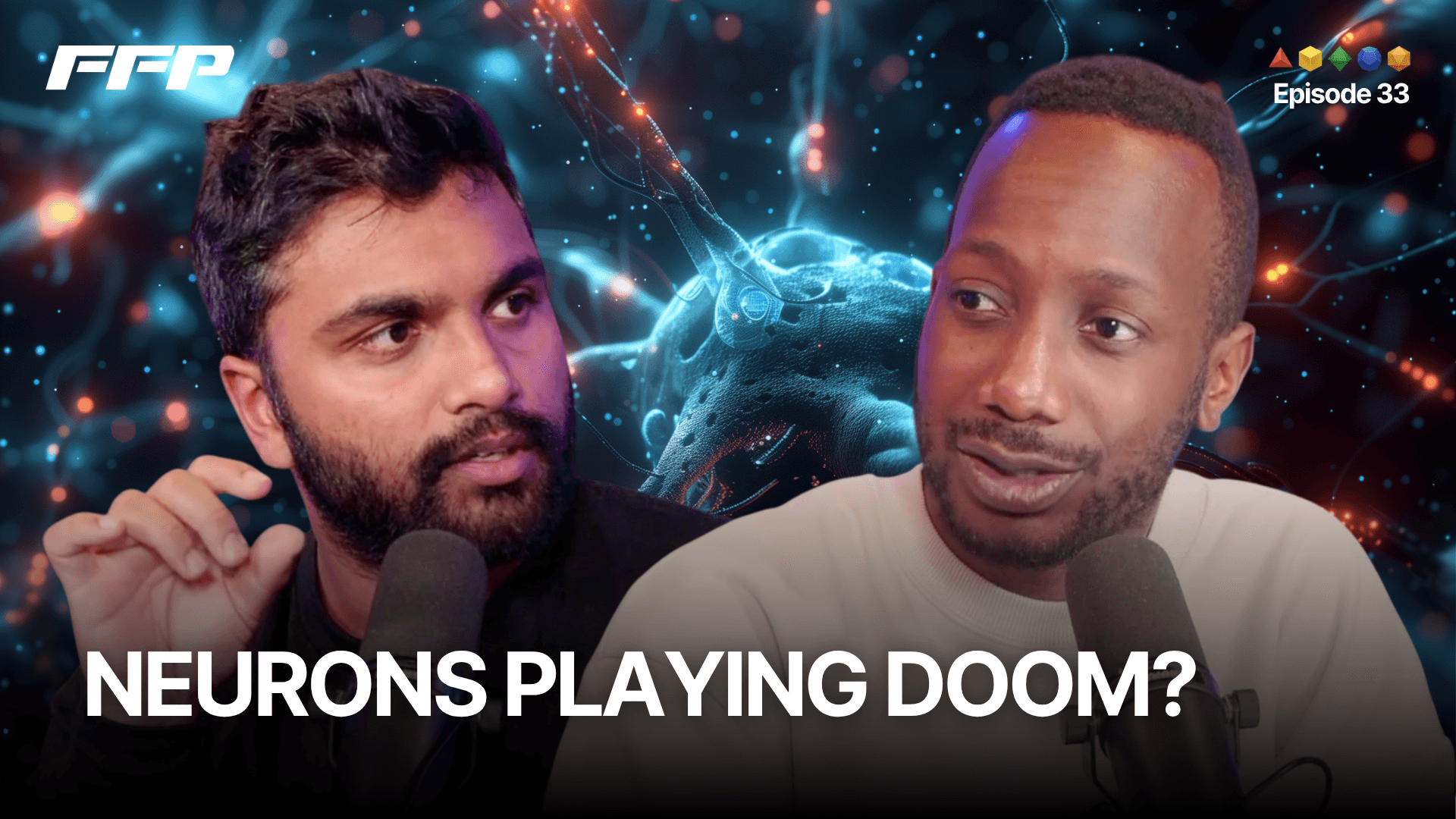
Imagine taking brain cells from humans and mice, growing them in a petri dish, and then connecting them to a computer so they can play the classic video game Pong. That's essentially what these researchers did. They created a system called 'DishBrain' where real neurons (brain cells) were hooked up to electrodes that could both send signals to the cells and read their electrical activity. When the 'paddle' hit the ball in Pong, the cells got predictable feedback, but when they missed, the feedback was chaotic and unpredictable. Amazingly, within just 5 minutes, these brain cells learned to play better - they got better at keeping the ball in play. The cells essentially figured out that hitting the ball led to orderly, predictable signals, while missing led to chaos, so they adapted their behavior to hit the ball more often.
Integrating neurons into digital systems may enable performance infeasible with silicon alone. Here, we develop DishBrain, a system that harnesses the inherent adaptive computation of neurons in a structured environment. In vitro neural networks from human or rodent origins are integrated with in silico computing via a high-density multielectrode array. Through electrophysiological stimulation and recording, cultures are embedded in a simulated game-world, mimicking the arcade game "Pong." Applying implications from the theory of active inference via the free energy principle, we find apparent learning within five minutes of real-time gameplay not observed in control conditions. Further experiments demonstrate the importance of closed-loop structured feedback in eliciting learning over time. Cultures display the ability to self-organize activity in a goal-directed manner in response to sparse sensory information about the consequences of their actions, which we term synthetic biological intelligence. Future applications may provide further insights into the cellular correlates of intelligence.
- 1In vitro cortical neurons from both human (hiPSC-derived) and mouse (primary E15.5) sources demonstrated significant learning within five minutes of real-time gameplay in a simulated Pong environment, as measured by increased average rally length over time.
- 2Closed-loop feedback was essential for learning: cultures receiving structured stimulus feedback (predictable on hit, unpredictable on miss) outperformed those with silent feedback or no feedback, demonstrating that information alone is insufficient to drive learning.
- 3Human cortical cells initially performed worse than controls but ultimately outperformed mouse cortical cells at the second timepoint, providing preliminary empirical evidence that human neurons may have superior information-processing capacity.
- 4Electrophysiological analysis revealed that gameplay increased functional plasticity, strengthened sensory-motor cross-correlations, and reduced information entropy during predictable exchanges, while unpredictable feedback increased entropy, consistent with the free energy principle.
- 5The DishBrain system demonstrated that monolayers of neurons can self-organize firing activity in a goal-directed manner through closed-loop embodiment, representing the first synthetic biological intelligence device to exhibit adaptive real-time behavior.
The 2026 World Cup's grass is an engineering problem
Imagine you're trying to play soccer in 16 different places across the United States, Canada, and Mexico — some in freezing cold, some blazing hot, some in stadiums with roofs that block sunlight. Half of those stadiums normally use fake grass. Now FIFA, the organization that runs the World Cup, wants every single pitch to feel and play exactly the same way, like a video game where every level has identical physics. To do that, they hired grass scientists — yes, that's a real job — who figured out how to grow special grass on thin mats with plastic underneath so it can be transported like a carpet, stitched with synthetic fibers so it doesn't rip when players sprint and tackle, and tested by literally shooting balls at it with a cannon to make sure it bounces right. Different grass species are used depending on whether a stadium is hot, cool, or dark. It's basically a giant, living, high-tech floor installation that has to survive the world's best athletes running on it.
Non-Mendelian inheritance of DNA methylation patterns in mice
Imagine your DNA is like a huge book of instructions. Mendel's laws are the normal rules for how chapters of that book get passed from parents to children. But there's also a layer of sticky notes on top of the book—called epigenetic marks—that tell cells which chapters to read and which to ignore. This study found that most of the time (about 93%), these sticky notes follow the normal inheritance rules. But about 7% of the time, they do something unexpected: new patterns appear that neither parent had, or a mark from one parent somehow silences the same mark from the other parent (called paramutation), or males and females end up with completely different sticky notes even when they inherit the same DNA. Scientists discovered this by using a new ultra-precise DNA reading technology in mice, and it opens the door to understanding hidden layers of how traits—and possibly diseases—are passed down through generations.
Adversarial AI reveals mechanisms and treatments for disorders of consciousness
Imagine your brain is like a city with millions of roads and traffic systems. When you're awake and conscious, traffic flows in complex, coordinated patterns. In a coma, something has gone wrong — but we've never had a great way to figure out exactly which roads are broken or how to fix them. This study built a very smart AI that learned to tell the difference between 'awake brain' and 'coma brain' by studying hundreds of thousands of brainwave recordings. Then, like a detective, the AI was pitted against a simulated model of the brain to figure out: what changes in the brain's wiring would explain the difference? The AI figured out — on its own, without being told — that two key things go wrong in a coma: a specific circuit deep in the brain (called the basal ganglia indirect pathway) gets disrupted, and the brain's 'braking system' (inhibitory neurons) starts working too hard in the wrong places. The researchers then checked these predictions against real patient data, and both checked out. The AI also suggested that zapping a specific deep brain region with high-frequency electrical pulses might help wake people up — and early evidence from human patients supports this idea.
Trionda: Enhanced Surface Roughness Relative to Previous FIFA World Cup Match Balls
Imagine throwing a ball through air. The air pushes back on the ball, slowing it down—that's called drag. But something interesting happens: at a certain speed, the air flowing around the ball switches from a smooth, lazy flow to a chaotic, turbulent flow, and paradoxically the ball actually experiences LESS drag in that turbulent zone. Think of it like a golf ball—those dimples are there precisely to trigger this turbulence early and make the ball fly farther. The speed at which this switch happens is called the 'critical speed' or 'drag crisis.' Scientists put the Trionda ball in a wind tunnel—basically a giant fan tube—and measured exactly how much air resistance it faces at different speeds. They found that Trionda's surface is effectively rougher than most previous World Cup balls, meaning it hits that drag crisis switch at a lower speed (11.9 meters per second, roughly 27 mph). In plain terms, Trionda behaves more predictably in flight than some past balls, but very long, powerful kicks may travel slightly shorter distances than they would have with previous balls.