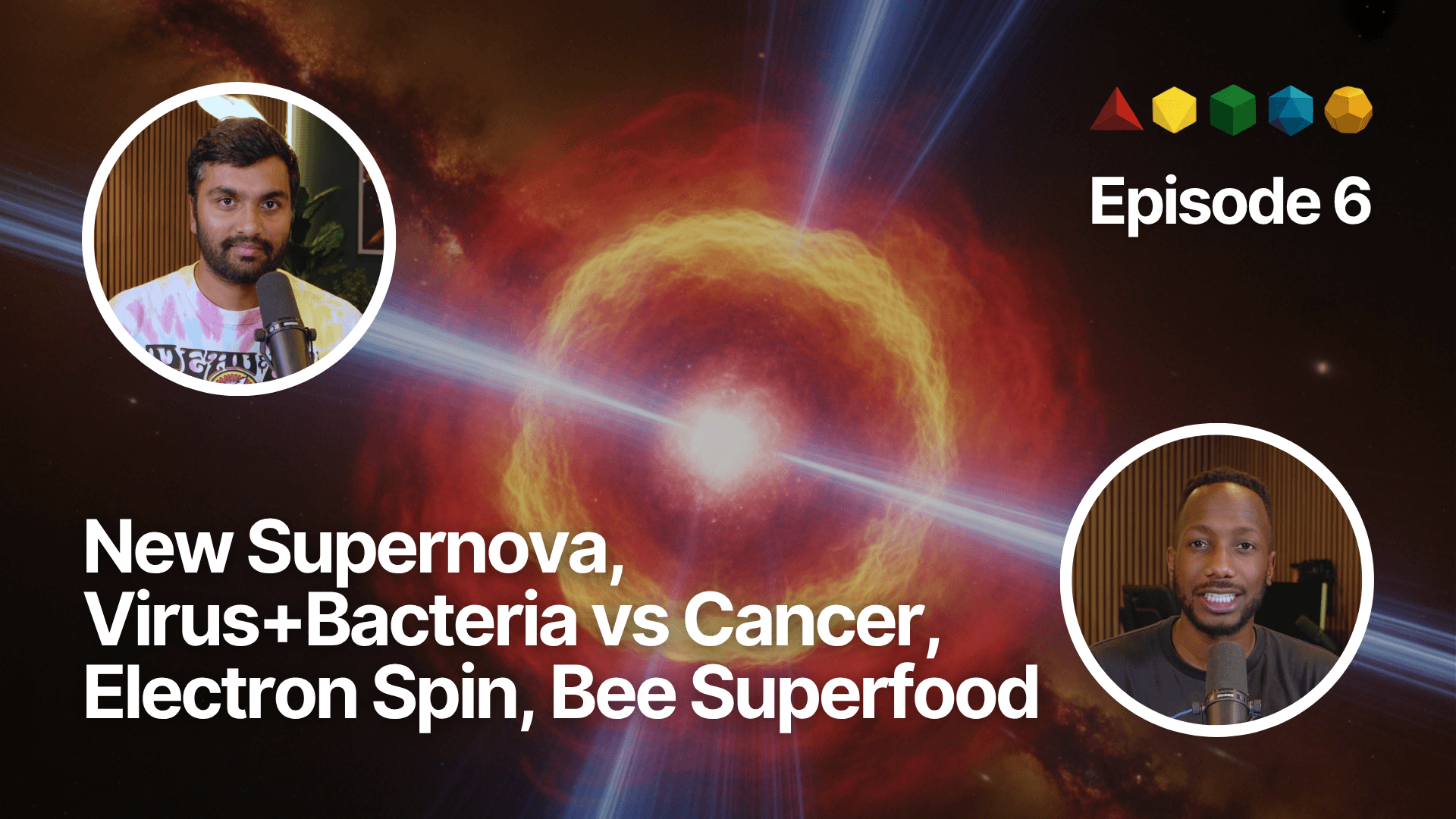
Synthetic BiologySpintronicsCancer BioengineeringAstrophysics
Supernova, cancer microbes, spintronics, and bee superfood.
This episode touches on frozen university research grants — the kind of work federal R&D dollars make possible.
Federal R&D grew from $20.7B in 1953 to $141.2B in 2023, in 2017 dollars.
Total federal research and development funding, adjusted for inflation.
Transcript
Show →Hide16,486 words · auto-generated
0:00Hello internet. This is your captain speaking Lester Narre joined as always by my co-host and our resident PhD Krishna Chowdery. This is from first principles. We have a great episode this week. We're going to cover four new breaking research science stories. Starting off with move over Taylor Swift tour tickets because this cosmic event just sold out the night sky as scientists just caught a brand new supernova in action followed up by unlike Ryan Reynolds and Robert Downey Jr. on set of the new Avengers movie who can't stop fighting. Uh viruses and bacteria apparently are teaming up to battle cancer. This is an interesting
0:41one. Our third story, uh, politicians keep spinning the news as we know, but scientists have figured out how to spin electrons and it could power the next generation of tech. And we will end our story with forgetting about billionaires and the race to Mars. Because the real heroes are scientists who are racing to save the bees because no bees means no breakfast. Let's get after it. This is from First Principles. [Music]
1:24Hello my friend. How are you? >> Pretty good. Pretty good. We are back for episode 6. >> Yeah. >> Still here. >> Yep. Still cooking. >> Still going. >> Still cooking. And we we have a couple interesting stories. We'll dive into the first story here. which I made a Taylor Swift reference. >> Uh, I think this is going to sell more tickets. >> It's definitely going to sell more tickets. >> And this across the universe. >> Across the universe. Headline from CNN. New type of supernova. Looks like nothing anyone has seen before. >> Yeah. >> Astronomer says, >> "Yeah, it's it's it's pretty insane. Um, it's an unprecedented discovery. It's a
2:05new type of supernova that's super rare. I'd like to call it a naked supernova because we're seeing the guts of a star before it explodes. It tells us everything about how supernovas form and also like how how we form, you know, the atoms that make us up. This is this is pretty cool. We're going to rate this episode ma because we're talking about naked supernovas. >> The by line on this CNN article again, the story is coming out of a combination of institutions. Yeah. Uh we have Northwestern, Caltech and the Wiseman Institute. And the by line goes, "Ast astronomers have observed what they are calling a new type of supernova which has provided
2:46an unparalleled glimpse into what happens deep within a star just before it explodes. Right. Yeah. This is like Taylor Swift's first album. >> Mhm. >> We're looking deeply in. >> Yeah. This is like the first album. Yeah. Not the not the not all the random modern nonsense that she's doing now. >> Sorry. I'm a huge fan of Taylor Swift. >> Yes. >> But like when I was in high school and college yes. >> The the the new stuff, not not so much. >> So, we've talked about this before and I think I have a little bit of an understanding. You know, supernovas are when these stars just >> explode. >> Yes. At the end of their life. >> At the end of their life. >> But tell me more about what this story means, uh, this research and and why it
3:28matters. >> Yeah. So studying supernovas is extremely important for understanding not just like how stars live their life but also like how we get the atoms that make us up. Okay. Because um stars like our sun >> only create atoms up to the element iron. >> Okay. >> Okay. But you know the periodic table has a lot of elements after iron. Every single element after iron was created in a supernova explosion. >> Interesting. Okay. And so understanding supernovas at a, you know, granular level tells us something about like how these higher order elements formed. >> We're trying to figure out all the
4:08ingredients. >> Yeah. >> And supernovas help us figure out a large set of those ingredients after iron. >> Yeah. Yeah. Yeah. Supernovas are like the crucible for finding um elements like gold, nickel, zinc, um all of these things that are like pretty important for daily life on Earth, but also just for like making us, >> right? Um and they're these co stars are these cosmic crucibles, right? Like in the beginning, >> yeah, in the beginning after the big bang, there was only really two elements, hydrogen and helium. Right. >> Right. But clearly we're made out of a bunch of other stuff. Okay. Now um every element up to iron can be made by
4:49smaller stars like our sun. Okay, the sun can make stuff like oxygen, carbon um in very trace amounts. To get the real kinds of abundance that we see on Earth, you need bigger stars to make those kinds of elements. Okay? And then to get anything above iron, you need the star to explode. Okay? That's because there's something fundamental about the nuclei of atoms. Okay? Fusion, which is the process of taking lighter nuclei and fusing them to make bigger nuclei. So, you know, the fundamental form that's happening in our sun is hydrogen, four hydrogen's fusing to make a helium. >> Mhm. >> Um and then helium can fuse to make
5:30carbon, three of them. um that process requires the energy of the nuclei to be lower than the constituents that made it up. >> Okay? >> Because of the second law of thermodynamics, right? The energy of the stuff that was making up the product has to be higher. That way, like it's thermodynamically more favorable >> to make that. >> Makes sense. >> Does that make sense? >> You lose a little bit of energy when you >> Yeah. Yeah. Yeah. And you want to and and the universe wants to dissipate heat because of the second law of thermodynamics. And so this process actually dissipates heat, which is fine. Great. The universe is like you guys do that all you want. Once you get to iron,
6:11>> fusing elements higher than iron means that you need to inject heat. Okay? So, and that's something that the thermodynamics doesn't let you do, right? Because second law of thermodynamics says that like the energy should should go off everywhere, not concentrate into a single spot, right? the entropy should increase not decrease. But this requires a decrease in entropy. And in order to get anything higher than iron, the energy per nucleon is actually higher. Which means that you need a giant like event giant energetic event to actually start fusing stuff from iron to make zinc and gold and copper and uranium and all this other stuff. >> This is why the explosion matters.
6:52>> Yes. And this is why the explosion matters. Now, supernova, we've we've we've characterized supernova all over all over the universe. Okay, the usual supernova is either a big star collapses, um it can no longer hold its own weight, so it collapses, it explodes, and then you get this kind of stuff, right? Um and usually with supernova, you get to see the the star as a whole collapsing. Okay, this one is pretty crazy because like there were these intermediate stages where the star sort of shed its outer layers >> and you got to see the real core of the star, >> right? And we got to see like the inside and we got to confirm a lot of these
7:33models that we have about stellar evolution. >> This is a really important point because you know our models are only as good as our observations. >> Yeah. >> That provide you know quote unquote the training data for the models we create. M. >> And so as we start looking at stuff that we haven't seen before, >> it allows us to refine our understanding of the universe even more each time we see these new novel use cases. >> Yes, exactly. The the the prevailing model >> um and it it's I guess been confirmed by this particular um supernova is this this thing called the onion skin model of of big stars. Okay. What ends up happening is you got a big star. Every
8:14star basically starts off with about 75% hydrogen, 25% helium. Okay. Um once you start off with that, the first thing the star does is the cheapest thing to to burn is hydrogen. Okay. It's super easy. It wants to turn into helium. You just give it a little pressure and a little bit of heat and it's like, "All right, I'm going to go into helium." Now, um pretty soon the hydrogen starts running out for these big stars within like tens to hundreds of millions of years. Um, and then what's going to end up happening is the core is going to run out of the hydrogen. So, it's going to start contracting because there's not enough hydrogen to push out. There's not enough fusion happening to push out the gravity pressure. So, it's going to start contracting. As it contracts, the
8:54heat is going to go up. The pressure is going to go up. And all of a sudden, helium burning is going to turn on. >> Got it? >> Okay. So, now the helium is going to start burning into carbon and oxygen and things like that, right? And when that helium burning starts, the outward radiative pressure is going to get really big. Yep. So then the the outside is going to expand and that's when you get these red giants like Beetlejuice. Yes. >> Right. Or even the the sun is going to end up doing this at some point. >> Some French people were uh commenting on our pronunciation of >> Oh. Um I don't geese. >> I I don't I don't respect the French. >> Yeah. So whether you say Beetlejuice or Bettle Geese, we won. So we can decide how we say Yeah. Yeah. And you
9:35surrendered. Sorry. >> Zebra, not zebra. Um, so but this this onion model, celestial onions. Yeah. And so this mo this this expansion of the outer shell. Yeah. So you you start expanding the outer shell and you become this like red giant, right? >> And then and then and then the core has like contracted though and now it's starting to burn helium. Well, pretty soon it's going to run out of helium too. And then it's going to go into this thing called the CNO cycle, which is the carbon, nitrogen, oxygen cycle, where this like cycle between these three elements that's going to like start burning helium because carbon is a 12, oxygen is a um 16. Yes. Right. So you're going to go from carbon, you're going to add a helium, and then you're going to
10:16go to oxygen, but like iteratively. And so it it becomes this like sort of like cycle of like trying to burn the fuel that you have. So the carbon is going to go, but then like that's going to start running out and you're going to start making silicon >> and like burning the silicon and then there's going to be this iron core. So you have this onion skin model of all of these different processes happening in a star where the the center is this iron that's not doing anything. Right outside you have the silicon that's like burning. Right outside you got carbon, nitrogen, oxygen that's burning. Right outside you got helium that's burning and outside you got hydrogen that's burning. That's been the model that we know can happen from fundamental physics, right? We we understand nuclei
10:57very well. We understand the atom really well. We understand the strong nuclear force really well. So we can like say, okay, these are the energy scales where these things happen. If I were to simulate this in a star, then it would happen at these radi because that's where the pressure and temperature is ideal for this kind of stuff. Um so this is the onion skin model, right? >> Yes. Um, and we've confirmed sort of the outer layers of that onion skin, but like the deeper part, that silicon and the iron part, like that stuff's been elusive and it's sort of we're just going off, well, we know how >> the stuff works and we know how the nuclei works, so it's probably right. >> Right. But now we've made this
11:37observational confirmation that this model that we have of the onion of of how stars create these layers, >> Yeah. It has now been experimentally >> because we've gone to the deepest parts of the onion. Somehow this particular star, it's called supernova 2021 YFJ because it was discovered in 2021. >> Um somehow this particular supernova shed its outer layers >> through a process that we we might get get to later on. >> Yes. >> And and so what we could see is the the inside that silicon part that we had never seen before. >> Yeah. And when when they first discovered this this supernova, they were like, "What are those lines? What
12:18what silicon? That's crazy." And immediately they knew that they had like a candidate for an extremely rare event, >> right? And it was really exciting when they when they caught this in 2021. So the idea here in part is that timing kind of matters. Um like like we caught it timing wise when it was at that stage when we made the observation. It was in this state that allowed us to see that. >> Yeah. >> That that that more. >> But the thing is, we've seen supernova with this timing before. >> Oh, so this one is rare. This is like special. This is a special supernova. They actually um >> interesting. >> They actually calculated the event rate of this thing and they said it was 30
13:00per cubic gigapars per year. And um that didn't mean anything to me because I don't really know like I don't have an intu I know what a giga parseek is right it's 10 to the big parse which is like something to do with a parallax between the earth going around the sun and I was just like okay so how does this work um so I I looked it up the universe the the observable universe is 30 gapar sex in diameter >> okay >> okay so let's assume it's a sphere >> um so we'll Say the radi is 15 gap parex. That's the observable universe, right? Um volume of a c volume of a sphere is 4/3 p<unk> r cubed. So 15
13:43cubed is like 3,000. Um 3,00 * 4/3 * pi. Let's say the 3 and the 3 cancel. We're we're going to be engineers now, right? The pi pi is three, like the engineers like to say. So then that's, you know, that's about 3,000 * 4. It's about 12,000 um gigapex. And then and then you've got this event rate which is 30 g 30 per gigap pars per year. So that that gets you to about 300,000 per year in the whole universe. And that's actually insane, >> dude. 300,000 that's like that's a countable number of zeros. There's only five zeros after the three number of you know like the universe is like what
14:24billions of billions of trillions of stars and all this other stuff. Like there's only 300,000 events in the entire observable universe in a single year. That's like actually extremely rare. >> And so the the idea is we really caught a needle in >> No, this thing is Yeah, this thing was this thing was insanely hard and insanely rare. And we caught it because of some of the efforts that we've done in astronomy when it comes to this time domain astronomy. We had a previous episode where we were talking about the Vera Rubin. observatory. The Vera Rubin is going to catch more of these things. Right. >> Right. >> This one was caught not by the Vera Rubin Observatory. It was caught by the
15:06Zwicki transient facility. Okay. >> Okay. Um this is a facility that basically commandeered one of the um observatories on Palomar, Mount Palomar, which is um just south of us near San Diego. Um it's a Caltech observatory. The the Ziki transient facility uses a telescope that's much smaller and a camera that's much smaller than the Vera Rubin. Yes. But it was kind of a precursor to understand what are the challenges going to be when we make the Vera Rubin. Right. You want to do in science you want to do baby steps. You want to be like okay let's start with in this case a 48 in telescope which is just like >> a little bit more than a meter.
15:46>> Okay. >> It's like 1.3 m telescope. >> Yep. compared to Vera Rubin's 8. And then the camera is way smaller. This thing started in 2017. >> Um, and it's and it does something very similar to the Vera Rubin, which is like go through the northern sky because it's in the northern hemisphere. It goes through the northern sky every 3 days. Okay. Every three nights, I should say. Um, so it's doing sort of the same thing. So, so we could have a dry run on what the challenges would be for the Vera Rubin by operating this Ziki transient facility. >> In in our in the in the tech world, we always love to say, let's have a crawl, walk, run approach to this problem. And this is a very similar idea.
16:26>> Exactly that. You got to crawl first. Okay. What are the challenges to be able to walk? Yep. We walk and now >> and now we're running with Ver Ruben, right? But but there there's an important point that the crawl or walk stages still have value. >> Oh yeah. >> Um in and of themselves independent of the fact that we've continued to increase our capabilities in these other tools. >> Yeah. Yeah. It's it's it's I mean we always do this in science, right? We've got limited funding so we better get it right. So you always want to beta test before you actually launch the product. >> Right. Right. If we're going to spend billions and billions, we want to make sure that it makes sense. >> Exactly. Yeah. So, so the Ziki transient facility, it's been online since 2017.
17:07And this was caught in 2021. Okay. It was caught on September 7th, 2021 >> at like 9:56 UTC. And as soon as it was caught, >> um they knew this was this was this was a candidate for something big. Okay. Um so immediately afterwards that night um the KEK telescope which goes online right after California cuz Hawaii is like you know basically downstream in terms of the night sky from us. Um >> the whoever was in charge of the KEK telescope um got the telegram or whatever and was like oh maybe my research can take a hold for a bit. He pointed the test ke telescope there and he got the spectra.
17:50Okay. Because the Zwicki transient facility at Palomar, it's only looking for changes in brightness. Okay. So, it caught the supernova, which is basically, oh, there's a bright star that appeared there that wasn't there before. The KEK telescope was like, I'm going to I'm going to point there. And it got the spectra, >> and the spectra was unlike anything you've ever seen before. Okay. It had lines of ionized silicon, sulfur, and argon. These are pretty heavy elements. Okay. Still lighter than than iron. >> Yes. But pretty heavy. Yes. Okay. And this is something that we've like never seen before. The main thing was it also didn't have any hydrogen lines. >> Interesting. That's weird.
18:30>> Yeah. Yeah. That is >> Every star has hydrogen. >> Oh, yeah. Yeah. Yeah. So, what's going on there? >> Right. Every star has hydrogen, but this guy had like sulfur and like argon, but no hydrogen. >> So, then they were immediately like, "Oh, this is weird. This is weird." So then there were a bunch of telescopes that worked together for 120 days after this explosion >> to just keep monitoring it. We had the KEK, we had the VT down in Chile. We had the Lake Observatory which is right outside San Jose in California. We had the Liverpool telescope in England. >> Liverpool. >> Little Scouses look too. >> Yeah. And then and then we had the Nordic optical telescope as well in
19:10Norway. Mhm. >> So, we had all of these telescopes working in conjunction to keep track of this thing for 120 days. It was it was an incredible effort across the globe to try to just have like, you know, full surveillance on this guy because because immediately from that very first spectra that KEK took, it was like this is something new. This is something crazy. >> Everyone drop your pants. >> Yeah. Everyone was like, okay, this is and it turns out it's a new type of supernova. >> Mhm. You know, we thought we had categorized the supernova. There's like the supernova where the star explodes. There's the supernova where a white dwarf starts um siphoning mass from another binary star that we've talked
19:52about in an earlier episode. And then that white dwarf reaches a mass limit and then that explodes. So, there's all these other types of supernova, but this had a signature that was unlike any other. >> It was like a rare Pokemon. We on Zabados Mew Mewtwo. >> Yeah. And as soon as as soon as we say every human was like, "Okay, we got we got to track we got to track this guy. >> We got to see what he's doing." >> I think one thing that's so interesting about this is is it's a great reminder of the inherently collaborative nature of science. >> Yeah. Because >> in astronomy especially because because we have to make observations and necessarily >> because of planet Earth and that we have different tools on different points on
20:32the sphere. >> Yeah. And and the Earth is rotating. So I only got like 8 hours of good good night time and then like hey you call you call up the the Liverpool folks like hey it's coming your way you know click >> and they're like okay this is really okay this is really so so I mean this is this is a pretty you know given we already have a really robust you know and starting point in terms of already having theoretically and experimentally or observationally captured you know a whole catalog of types of supernovas The idea that we found a supernova that's like this 300,000 per year in the universe >> in the un in the observable universe.
21:14>> Observable universe. >> That's insane. >> Which as we've talked about previously is very large. >> Yeah. >> Yeah. >> Very very very large. >> Um the the opportunity again this is rarer than Taylor Swift and Travis Kelce's engagement. This is much more rare. >> This is rarer than >> I don't know how many Taylor Swifts are out there in all the galaxies. >> Yeah. Right. Right. >> It could be quite a bit. >> Yeah. There's billions and billions of galaxies. Right. >> Right. Billions of billions. >> Billions of billions. >> Like 10 10 the 9* 10 the 9. Right. >> Right. And but here there's like 300,000 of these. >> Right. Which I I know what 300,000 means. >> Yeah. That's like I can visualize that.
21:56>> I can't visualize the universe, >> but I can visualize that number. >> I look there. >> That's insanely small for the universe. Houses used to cost $300,000. >> Yeah. >> Right. And so >> they still do in some parts of America. >> That is true. That is true. >> Not in LA. I'll tell you that. >> Southern California is not a beneficiary of of that level of cost of living. Yeah. >> Um >> but exceptional um discovery. Again, Northwestern. >> Yeah. >> Caltech. Wiseman Institute. >> Uh so a little bit of everything, you know, America heavy. >> America heavy. Yeah. >> You know, but a little international collaboration. >> Yeah. There's also like a Chinese group because the a Chinese group actually had access to KEK at the time. >> Uhhuh. >> And and we we were like, "Yo, this is
22:38dope." And they were like, "Yeah, we'll we'll move it." >> Look, even even given the geopolitical >> even No, dude, everyone knows when when you see like a supernova, it's like, "Let's just check its lines." And once they checked its lines, it's like, "Oh, this is this is this is a this is a good paper. I'm going to be on it." It it's it it reminds me of like kind of how like anytime we talk about space, it sort of melts away the light >> because we're on a single planet and we're trying to make sense of what the whatever the hell is out there. Yeah. Right. Yeah. I think Yeah. Everybody who's an astronomer understands the speck of dust that we're on and the insignificance of all of these geopolitical con conflicts when it comes
23:19to understanding a universe that is giga parex on giga parex big. the uh I think the first time I heard the word gigap or parseek in general was star wars uh because that's how they talk about going traveling in between it's five parsects. >> Yeah, >> let's do a jump drive. >> Yeah. >> Um great story on the new supernova. >> Yeah, it's it's an amazing dude and and I think it tells us a lot about like first of all like how we get >> the elements that we have, right? It also tells us a lot about this onion skin model. The fact that we're right because it turns out like so one of the questions is like why do we why are we
24:00seeing only sulfur and silicon but we're not seeing hydrogen. It could be because like what's what's ended up happening is this things the star has been like pulsing right and as it pulses it removes these outer layers right so that when it finally like exploded >> the only layers that were left were these silicon layers right and so the light that we're seeing is coming through these silicon and sulfur layers and then that's what we're seeing yeah there's still actually a mystery in this in this discovery there were faint >> lines of helium and carbon Okay, >> which is weird because helium and carbon should be like >> out there, but we don't see any nitrogen which should have been inside, right? So
24:41like if we don't see nitrogen, that means the nitrogen layer is already gone, but like there's still helium. >> So how did the >> So how did Yeah. Like how did the nitrogen dissipate without >> Yeah. And there's it's still a mystery. Um, people think that it's probably like the this thing is part of a binary star system. Okay. And then the star system, the other star has a bunch of helium that like we're like seeing through, right? Because because what we're seeing through is like like the the the light coming from the supernova is like effectively like white light, right? Okay. It's just it's just pure energy >> from this collapse into an explosion. But like what the the the lines that we're seeing are are the stuff that's getting in the way. Right. >> Right. And so helium might be like this
25:24this thing that's coming from the binary star. There's still a lot more that we can do from finagling the the the data, right? >> But um yeah, it's super exciting because it's a totally new type of supernova, right? Um extremely rare. It's like nothing we've ever seen before. And it's great that it like confirms these models that we have just built on fundamental physics. Right. Right. These are these are models based on just what we know about nuclei from experiments that we've done on Earth >> and can it's insane that we can extrapolate from what we understand from the strong nuclear force and how protons and neutrons interact from what we've done on Earth to like then go all the
26:04way and see this thing that's like you know half a megapar away 120 days of data right >> yeah it's it's It's It's really cool the success and that's what I mean when I say like, you know, we're pretty good at physics. >> Yeah. >> This is what I mean. Like we're we're pretty good at like making a model of a giant star that's 16 to 50 solar masses >> and be like, "Okay, it should be like a shell thing because the gravity here and the pressure here means that the temperature is going to be at this much and the pressure is going to be at this much, which means that what I know about nucleiosynthesis means that these are the kinds of elements that should be there, right? like we we can we can
26:45trace all of these things just on a chalkboard. >> It's it's it's really incredible. >> We we we love a good story that uh takes uh rare spacebased events, connects it to the history >> of scientific discovery that we've already established >> on our little third rock that goes around the sun >> and and know like oh yeah, we've been right. Yeah, it's it's really cool. We've been right and then there's some enigma and that's probably because there's there's like some other thing that we're not seeing, you know, and we have the tools >> Yeah. >> to to see it. >> Mhm. >> Um great h I love I love our space
27:28stories. Um >> Yeah. And I can't wait to to see how many Vera Rubin is going to catch. >> Oh my god. >> Right. Now that it goes online. Like >> check out our our episode three or four because we do a deep dive on it and and I I I greatest observatory >> ever created by humanity to date to date. >> And I I just I think about it a lot actually. Every day I'm like, "Oh, it did another >> Yeah. >> Did another >> And you can just go online and check like what did it find?" >> The explore the online explorer is incredible. Uh the data access which we talked about is incredible. Um it's for everybody. Uh and and so we've started like we always do or regularly do
28:08something very big. We're now going into the opposite direction and our next two stories are going to be stuff that's very very small. Um >> yeah, >> there's been a lot of this news or or rumors and gossip that there's been turmoil on the set of the new Avengers movie. >> Yeah, I saw a lot of memes about it, you know, >> and the details are a little fuzzy, >> but apparently uh Robert Downey Jr., RDJ Iron Man, who is the tent pole of the whole franchise, the only reason it exists, has been having some conflicts with one of the more aggressive characters in the Marvel universe, Deadpool, aka Ryan Reynolds.
28:48>> Right. Right. >> Who apparently can't stop fighting each other on set. But weirdly, how this connects to our story is our story number two is that apparently a virus and bacteria are teaming up and are able to battle cancer as if it's Thanos in Endgame. >> Yeah. >> Uh there are no five rings on the thingy. >> No, >> but >> but this team up could actually change the game for cancer therapy. So this story is coming out of Columbia engineering. Researchers at Columbia Engineering by line is uh uh researchers at Columbia Engineering have built a cancer therapy that makes bacteria and
29:28viruses work as a team. It was published in Nature Biomedical Engineering. Um, and it the synthetic biological systems lab shows how their system hides a virus inside a tumor seeking bacterium and smuggles it past the immune system and unleashes in it inside these cancerous tumors. Unleashes the force. >> It's insane. >> So, there's there's there's a there's an immigration story here. We love there's a smuggling story here. Yeah. >> Uh uh Colia was obviously the center point for a lot of controversy as it relates to >> No, they're doing good work science and research and funding, but tell me, you
30:09know, this sounds like a great buddy cop movie. It is. It is exactly that. Yeah, it is exactly that. It's like um it's like two two cops that are that are teaming up. >> Yes. >> To to take care of a bad guy. It's almost like um what's the what's the one movie where they they take the criminals and then they and then they're like u Suicide Squad. >> Oh yeah. >> Right. Where they're like they take the criminals and then they're like okay we're going to make you good now and then you're going to get the even worse bad guys. That's what this is. >> Okay. Got it. >> Right. You know what I mean? Because it's like bacteria. We don't like that. >> Viruses. We don't like that. But the two of them together are now fighting cancer which we really don't like. It's a super
30:51evil duo to fight the even more >> even more evil duo. Yeah, it's that it's that it's that um the the meme with um Thor being like, I know I can't, but but she can. You know what I mean? >> But it's like it's like this virus bacteria chimera that that that they've created. It's it's an incredible paradigm shift in cancer treatment. So what I understand about cancer treatment which is very little is is fundamentally it's very like the existing options we have for the patients whether it's chemo all the it's it's like very hard on the body. >> Yeah. It's very hard on the body and it's also very non-specific.
31:31>> That's the main thing. >> It's it's a shotgun approach. >> Yeah. Yeah. It's just like it's just like it's just like with chemo all you're doing is targeting um cells that replicate really fast. Okay. So, you're getting rid of the cancer cells, but you're also getting rid of hair cells because they hair hair follicles because they replicate really fast. Bone marrow, they replicate really fast. Um, digestive cells that replicate really fast. That's why you get nausea, anemia, hair loss, you know. Um, so it's non-specific. >> Yes. >> And then with radiotherapy, it's like sort of like, you know, you're just sort of blasting some location. And sure, you can get specific with like like proton therapy and things like that, but at the
32:12end of the day, it's not like targeting from a biological sense, >> only the cancer cells, right? >> So over the years, we've had these things called adaptive therapies. Okay? And adaptive therapies, what they've done is sort of target only the cancer cells and leave everything else alone. Okay? There's been there's been sort of a bunch of approaches. There's been this thing called CARTT therapy, which is where you take the body's own immune cells >> and then you engineer those immune cells to then target the antigen, which is like sort of a marker on these cancer cells. So, you train the body's own immune system to then target these
32:54cancer cells and recognize these cancer cells. The problem with that therapy is, okay, it's it's got to be extremely specific to the patient. You got to literally extract immune cells from the patient and then you've got to engineer those >> on a per patient basis. >> On a per patient basis. And then also at the end of the day, a lot of these cancers are clever, dude. They're going to they've created methods to actually create cold tumors. It's what we call when they suppress the immune response. >> Okay? Mhm. >> Even even with the CARTT and all this stuff, like they're suppressing the immune response actively cuz they're secretting stuff that confuses the immune system. >> It's like it's like you say, "Oh, we're going to build a wall." And they're
33:34like, "We have ladders." >> Yeah. Yeah. It's Yeah. And it's like or like we're making the wall invisible. And then it's like, "Oh, okay. Now I can't I can't the my immune system can't actually see everything." Right. So um over the years we've shifted towards something called adaptive therapies which are these like single agent biootherapies where we're now actually leveraging um biology itself to attack biology. Okay. So there's two approaches. One approach is to use bacteria. Okay. What we do is we we take um some bacteria >> and um we try to get that bacteria to attack cancer. Yes. Okay.
34:15There's some advantages to this. The advantage is um there's certain types of bacteria like salmonella that like anoxic environments. So environments that don't have a lot of oxygen. Tumors tend to have not a lot of oxygen especially at their core because the blood vessels are on the periphery and at the core there the oxygen isn't getting to it. So the bacteria naturally are like ooh I like that. And then they get to the core and then they start sort of you know destroying the cancer from within. Um the problem with that is they get to the core but they're not really attacking the periphery and they're not attacking like maybe a metastasis that happens somewhere else, right? And the other problem obviously is like okay
34:56bact like you're literally giving me salmonella, right? You can like you can you can genetically engineer and everything but like >> it's still a bacteria. >> It's you're giving me a pathogenic bacteria, right? And there there's a risk of um systemic infection and dose related toxicity and all this other kind of stuff. Okay. >> Mhm. >> The other problem, the other way to approach this problem is with viruses. Okay. You have something called enkolytic vyrotherapy where you take viruses that attack cancer cells and you inject that into the patient. Right now, with ankalytic vitherapy, there's two problems. Um, one is the delivery challenge. Okay? You got
35:37to really get into the tumor and like and like put that in thereirect. Okay? Inject direct. So if there's a tumor that's very very deep or if there's like some random tumors elsewhere that haven't been identified. >> Yeah. Yeah. >> Out of luck. >> It's not like a systemic approach. >> Yeah. And the other thing is um the immune system of the body has already been primed with a bunch of viruses that you've seen over the years, right? So the immune system itself is going to be like you're not getting in. What are you doing? And then and then the the immune system is going to attack that virus. Right? >> Makes sense. So this particular therapy called the capsid c a p s i d >> right with two ps. >> Yes.
36:18>> This particular therapy is getting the best of both worlds. >> Okay. >> Yes. >> It's combining the virus which is really good at killing the cancer cells. >> Yes. >> But it's hard getting in. It's got a tough time getting in. >> It can't get past the the security at the door. >> It's Yeah. So it's it's the the virus is becoming like the Greek soldiers inside the Trojan horse and the bacteria becomes a Trojan horse. Okay? Because the bacteria has an easy time getting into the center of the tumor, right? And it knows where to go because of the anoxic environment. It's seeking this place without any oxygen. So it goes to the center of the tumor. So what what this team at Columbia Engineering is
36:59doing is combining both of those therapies. Yes. To give this like two-pronged approach. It's it's a synergistic >> Yes. >> biootherapy. That combines the best of both worlds. >> Yes. >> To >> target the tumor. >> Yes. >> And then infect the tumor with the viruses. >> Yes. >> And then also have that viral um infection spread to other tumors in the body. >> Dude, it's it's like it's almost out of science fiction. I can't like the amount of stuff that needed to happen. >> Yes. for this to be a reality, right? Where we're now manipulating viruses, bacteria >> together in combination. In combination
37:40where they're learning together. Yeah, dude. It's It's actually insane. It looks like this. So, cap capsid. It looks like it's short for coordinated activity of proariot and picorno picornirus. >> Yeah. >> Uh of safe intercellular delivery. >> Yes. Proariote means um a type of life that doesn't have a nucleus. So that's bacteria, right? Okay. And coronavirus is the particular type of virus that they've used to genetically engineer to create this kind of viral therapy. >> Not corona virus. >> No, not corona virus. >> Yeah. This is um this is like a type of it's a senica virus. Senica virus a. >> Yes. >> Yeah.
38:20>> Yes. >> This is this is >> it's dude it's a game changer and there's there's a lot of like hurdles that you have to get through. >> Right. >> Right. Because like Okay. For example, um one thing would be like, okay, I've got this bacteria and it's got a viral DNA inside. Like, what's to guarantee that the viral DNA isn't just going to like express itself not in the tumor? What I'd like is for the virus to only target the tumor, right? I don't want it to I got a bunch of healthy cells, right? I don't want a viral infection everywhere. >> Then we're back to the same issue with the chemo and radiotherapy, which is it's non-specific. >> It's non-specific. So, how do I make this specific, right? So they engineered
39:01a way such that the viral DNA would only be expressed once the bacteria was inside the tumor. >> That's sick. Once it's in the club, then >> once it's in the club, then then that's when it does all of its [ __ ] Right. >> Right. And and the way they did that was they attached it to a promoter, which we talked about, right? Like the the gene expression that's happening would only be expressed once the bacteria was in its environment where it wants to be pathogenic. >> Okay? And then and then once it did that, the viral DNA now starts transcribing. The other thing that was really cool that they did was they included um a T7 um RNA polymerase. So you've got this DNA that is really the
39:44viral DNA inside the bacteria, right? >> And um what you want to do usually what you want to do is viruses they they hijack the host cell, right? And then they replicate DNA using the host cell. Yes. This thing's got it's got its own machinery >> to replicate the viral DNA. So, it doesn't need to require the host cell because the host cell is cancerous. It could be doing all sorts of random crap. Right. Right. Like it's it's like replicating like crazy. So, it's doing all sorts of crap >> and and so it's maybe not as dependable as as a >> Exactly. We don't we don't want to depend on this dysfunctional machinery of cancer cells in order to replicate the virus that is going to destroy the cancer cell. Right. So we've created our
40:25own little polymerase that will do that >> which is which is which is really cool. >> Yes. >> Yeah. Yes. I want to make a quick shout out to uh Charles M. Rice who is an expert in verology at the Rockefeller University who is a part of the study and collaborated with the Columbia team. So I want to make sure we give >> right across the island of Manhattan. Rockefeller and Colombia. They're east side versus west side. >> A little quick yacht trip across across there. So, just making sure that we give uh uh Charles a shout out there. Uh as well as again the team over at Columbia. >> Yeah, dude. It was insane. And dude, you want to you want to hear the the the experiment? That was like nailing the
41:06>> coffee cuz we love talking about experimental design. >> The experimental design here is is amazing. So, they got these um they got these mice models. >> Yes. >> Again, uh transgenic mice models that sort of mimic um the small cell lung cancer. Okay. 100% survival rate. >> Jesus. >> Okay, here's what they did. And this is and not just that. Okay, here's what's crazy. Okay, so this M mouse model has a tumor in each of its lungs. >> Okay, right flank, left flank. >> What they did was they um they injected this therapy into the right flank. >> Mhm. >> And the therapy killed the cancer in the right flank and then it went to the left flank
41:47>> and killed it there too. Right. Because the virus inside the the right flank lung does the infection, creates these antibodies, right? And and these viral particles. Those viral particles then >> travel through the bloodstream and start targeting the the cancer in the other in the other location as well, right? And the whole point was now we've the the immune system is now overrun because before if we just inject the viral particles, the immune system is going to be like that's not enough. But now we have this full-fledged viral inflection. But all this virus is targeting are cancer cells. Right. Right. It just wants to eat cancer cells because that's >> what the particles are sort of lock and
42:27keying into, you know. Yeah. >> So, so, so now you can you can put this into one part and as long as if if it's the same cancer that's spread to other parts of the body, it'll target those other cancers. >> That's so crazy. This this is so important. >> That's so cool. This is so important because this goes back to what we talked about at the beginning of the story, which is it's it's no longer non-specific. And not only is it non-specific, you can uh insert it into the sort of body in a singular location and it will independently >> Yeah. locate and then also kill other similar cancer locations for that exact
43:08same targeted focus. >> Yeah. >> Which >> again for patients like like this comes back to like what is the impact for >> you know research like this on real people. It's like these therapies can become much more can be more effective with less of an impact on the body. >> Exactly. in these like other ways in which the non-specific therapies which we have available to us now. >> Yeah. Like CARTT therapy is a specific therapy that happens like patient by patient but it's got problems right like um the the CARTT therapy these immune cells for example they can't get to the the the the center of the tumor because because the tumor has these natural mechanisms where it wants to fight off the immune cells right on the other on
43:50and then also um >> you know it's CARTT therapy you got to train these immune cells to identify specific antigens but cancer is just like >> such to to work with because cancer is always mutating, right? So, okay, you don't like this antigen, I'll give you another one. And then the CARTT therapy is not going to work because it's only trained on a single antigen, right? And now I've just changed the shape to how you recognize me and like my ID is now different and so you'll just let me go, right? And so here with with the viral DNA is constantly evolving as well, right? So it can mitigate this heterogenity, this like difference, right,
44:31>> that's happening with these rapidly mutating cancer lines, right? >> Which is one of the key aspects of why cancer is such a pernicious issue to deal with. >> Yeah, dude. It's so hard because it changes so fast. But this we're like harnessing the fact that viruses also do that >> do that and they and they create like all of these different versions >> and then when one works >> Yeah. And then that'll go and then and then like it'll find another version that'll work. You know, it's it's like synthetic biology, which is crazy to think about. Like we're literally engineering like little tiny micro molecular robots to now just target these bad guys, these cancer cells, right? I mean, we're we're far away from
45:11like FDA approval, right? There there's lots of concerns obviously like >> I I talked about mutation just now, right? like what what what >> what's stopping this virus from mutating into like its original version of where like I hate it, >> right? So, um >> it's like recruit we've created our own micro molecular suicide squad. Yeah. >> But we haven't like there's still the concerns, but they are still the suicide. >> Yeah, they're still the suicide squad. So, like in order to get to actually like human trials, cuz right now they've done it on mice and they've done it on in vitro sort of human cell lines and things like that. in order to get it to sort of FDA approval, we have to first of all um mitigate the risks. One of the
45:53ways that they're actually doing it, and they described it in this paper, is instead of a single nucleotide mutation that will take the virus and put it back into its wild type, which is the part that we don't like, they made it two mutations. Okay? So what that means is now like you know if the probability of like going to a mutation was 1 over 100 now it's geometric so it's 1 over 100 squared so 1 over 10,000 which is like obviously way better than one over 100 you can imagine like doing this for for for multiple single nucleotide mutations. We also need to um test it on um higher order organisms, right? Right now we did it on mice. We need to like start graduating and slowly going
46:35towards human human beings. Um but I think it's I think it's extremely promising. The other thing is like this thing like it's currently been targeted for neuroendocrine like cancer cells. So it's like like you know small cell lung cancer and things like that. But one can imagine this is a modular thing right? The bacteria could have any sort of virus and the bacteria could be any other kind of bacteria that we sort of engineered to to get in here. So, it's this like, >> you know, Lego block thing that we talk about all the time where it's like it's like we can have different types of Lego blocks that we put in here and here. It's this modular thing that we can adapt to different kinds of viruses. I think it's I think it's extremely special. >> Adaptive biootherapy was what you sort
47:17of started with. I mean the there's a key insight here >> fundamentally. >> Yeah. >> That has so many uh different paths that it can now go down because it's a key similar how crisper was a key insight. >> That's right. >> That had then multiple of these like >> because it was modular at the end of the day. >> At the end of the day it's not just an acute specific singular insight. And like that's what's again so fascinating about this study in particular in terms of the now instead of there being one door, two doors, three doors. >> Yeah. Now it's like we can just like mix and match and get a bunch of doors. Every door you want >> want is is is is a potentially available
47:57obviously with the caveats of you know downstream research to >> and obviously we need to make sure it's safe. But I think this is really promising. >> Fascinating fat. We're we're we're you know we're moving into a place again we always we talk about this a lot between the fundamental research stuff in sort of this you know biotech arena and then you add you know the ability to then sort of rapidly iterate with things like AI progress is going to continue >> it's going to it's going to be really cool yeah it's going to be it's going to be awesome >> and while we have a lot of progress uh in some of these biomolecular research areas one area we don't have a lot of progress is in politics where politicians
48:37>> continue to like to spin the news. Uh but our third story is that scientists have figured out how to spin electrons. >> That's right. >> And it could maybe power the next generation of tech. This next research paper is out of the National Research Council of Science and Technology in Korea. Uh most famously known right now for K-pop demon hunters and Squid Games. But Korea has a huge technical uh uh just >> that's where Samsung is >> right like a huge in terms of amount of people >> one of the big fabs in the world >> in the world like they have a huge uh population of like highly technical people and this study is fascinating so
49:20this was a little bit different for me the so the the headline here is turning spin loss into energy new principle can enable ultra low power devices so one of the things we've talked about in a previous episode is if we look at all the technology revolutions that are currently happening. Yeah. The the one underlying thing that's true and is a part of the part of the great power war that all these nation states are having is uh we need more power. >> Yeah. >> If we want to have all this AGI and artificial general intelligence, all these things, >> we need a lot more power. >> Yeah. >> Uh the Chinese are solving it right now by building nuclear at levels we've never seen before. >> But this maybe has sort of some impacts in this power generation problem set.
50:02Yeah, it it lets us I mean it lets us do more with less. Okay. >> At the end of the day, >> right? It lets us compute more with less if >> this becomes um an economically viable and a commercially viable product. >> Okay. So, I will give you that caveat, but it's a proof of concept of something that people have been after for quite a while. Okay. Um, in order to get into the idea of Spintronics, which is this new paradigm of electronics, >> I think Spintronics was just actually performing at Burning Man. Uh, this week, >> is there is there a band that does that? >> I'm pretty sure Spintronics is an EDM DJ. Literally, >> that's hilarious. I hope he's good because Spintronics could be the future
50:43of electronics. Um, so in order to in order to really understand the story, I think I've got to tell you about a little bit about spinronics, which is different from electronics. >> We've we've The only context I have is up spin down spin. >> That's good. Yeah, that's already plenty. Okay, that's already plenty because it turns out the electron has both a charge, >> yes, >> a negative one, let's call it, and it's got a spin, but the spin can be both positive one and negative one. It could be spinning this way or it could be be spinning the other way. M um so conventional electronics like the ones in your lights in this computer everywhere else right >> most of that is exploiting the charge of
51:24the electron >> only right it's only exploiting the charge of the electron um current for example is the flow of charge where physical electrons are flowing right >> and um memory for example is the the storage of charge like a one means that your capacitor is charged and a zero means is your capacitor is discharged. That's how you get memory. Um, and that is pretty soon going to run into some problems. Okay? Because Moore's law is not forever. You know about Moors law, right? It's like like everything doubles every 2 years, whatever it is. Um, well, we're we're we're pretty soon getting to that limit where um Moore's laws is
52:07running into fundamental physics. >> It's it's slowing down. We can't get because the idea of the you you double the amount of transistors on a chip every 18 to 24 months. We're already at like 3 nanometer chips with like TSMC and Apple. >> But we can't it's hard and the problem Yeah. Yeah. It's hard to get much smaller. And the problem we're starting to have is power dissipation. >> Okay. Because like if we have capacitors that are that small then now we're starting to get into like we can't store charge for that long on such a small capacitor. pretty soon we're going to have to keep like um you have to keep charging up the capacitor to keep it at that otherwise it's going to decay and then you're going to lose memory right
52:47so so that's that's one of the things right silicon chips consume an insane amount of power right which is why everybody's like oh like one query in chachi cost this many gallons of water okay yeah like yes has the same problem yeah crypto has the same problem yeah the other the other um big thing is called the vonoman bottle bottleneck named after John Vonoman. >> Oh, he did he did the probes and the bottleneck. >> Oh, dude. Von Noman did like >> everything. >> Von Noman was um Vonoman was one of those few individuals where um other people like Fairmy >> would be like how what what do you how did you do
53:30that? >> Was he a magician more than he was a sage? >> He he was he was a magician more than he was a sage. But um you know he he had his caveats um and we can get get into that in another episode. There was there was one thing where he he like proved that the Copenhagen interpretation of quantum mechanics was the only interpretation of quantum mechanics. And because it was vonoman who proved that everyone else would just not question it. >> Like if somebody were to question it they'd just be like yeah but vonoman proved that Copenhagen interpretation is the only interpretation of quantum mechanics. And that would just settle the debate, >> right? Which is why it took like 30 years for someone like
54:10>> um like Bell's inequality and for for someone with different versions like the the pilot wave theory and all this other kind of like all these other different versions of quantum mechanics because literally vonoman had an incorrect proof >> to prove that anyways the Copenhagen interpretation was correct. Anyways, but he he was an in incredibly smart guy and he actually um he he characterized this thing called the vonoan bottleneck now which is this difference between how memory and processing units work. Okay, because um fundamentally you know before we had solid state drives we had this the and even now that we have solid state drives we have this separation
54:51between RAM and hard disk. >> Right. >> Okay. >> Right. >> Right. And the the hard disk is where you store your permanent memory. The RAM is where you're doing the computation of whatever the thingy that you're doing. >> So, for example, if I want to have a local, if I want to take OpenAI's open- source model and run it locally on my computer, >> I need a Mac that has a lot of RAM. >> Yeah. >> Not necessarily a big hard disk. >> Yeah. Not necessarily a big hard disk, but like like something that will compute efficiently. Correct. Like currently now. >> Now, >> right. And so, there's a need for a new paradigm where perhaps maybe Memory and RAM are the same thing. >> Okay. >> Right. >> Okay.
55:32>> And with these increasing demands with AI, big data, and all this other kind of stuff, we want to have a new paradigm where the it doesn't cost us that much power to upkeep all of this amount of stuff. >> Makes sense. >> Okay. And so that's where the idea of spinronics comes in >> because there's two paths here. It's just increase the amount of power availability is like the brute force way and then it's like be more efficient with the power we have is is this way. >> Yeah. And the and like even if we were to increase the amount of power availability, like we'd have to increase the size of our computers because we've reached this sort of limit of like how dense we can make stuff before the power consumption per square inch goes away.
56:12>> Johnny, I would not be very happy that you know what I'm Yeah. But you know what I'm saying? Like it's like it's like now we've like sort of plateaued in this landscape. Yes. Right. And so spintronics is this idea of utilizing the electron spin in addition to its charge to store information and to process information. >> Okay. >> Okay. >> Okay. >> So um the first the first big win for Spintronics actually happened um way back in like the 1990s when we got hard discs. The hard discs that um maybe we don't use today because we got solid state hard discs, but remember the hard discs like way back when like your computer would do a Yeah. Yeah. Oh, I remember. >> Yeah. Right. But but there was literally
56:54a spinning disc. Like it was an electromechanical disc that was spinning, right? And that spinning disc represented the you know 126 GB of memory. And everyone was like, "Oh, 126 GB of memory." But like that was that was a big deal back in the day, right? And the inventors of this, they actually discovered something called um >> giant magno resistance. >> Okay. Okay, giant magnet giant magneto resistance. Okay, and it's this idea that what we can do is just like a transistor, the way a transistor works is you've got you've got like a state of the transistor that lets current through
57:36and then there's a state of the transistor that doesn't let current through and that's going to be your zero and one and that's how you sort of >> represent data, right? Yes. What what these guys um discovered they were Albert Ferret and Peter Grunberg. Um what they discovered was this giant magneto resistance. um they figured out that if I've got two magnets, okay, that are both oriented in the same direction with an insulator in the middle, >> then current will pass through it because of this quantum mechanical thing called tunneling >> where the electron will actually go through a barrier because they're equal magnetization. Okay? But if they're opposite magnetization, then it's going
58:18to get stopped. And they were like, "Okay, that could actually be our zero and one." And then what you could do is you could control whether it's a 0 and one based on the direction of the magnetic field that a particular piece of >> of physical thingy had. Yes. Right. And so the way that the hard disk actually works is you've got this reader. Yes. >> Okay. So there's a reader that comes down and it's like reading the hard disk and the hard disk is Yes. Exactly. It's a record player that's like coming down and the the hard disk is spinning and the reader actually has these two these two these two things. Okay, the top one is rigid. It's going to stay fixed. The
58:59bottom one is going to flip based on the the way the disc is moving. Okay, so if at the time of the disc the magnetic field is this way, then the bottom one is going to flip this way and it's going to let through current. But as soon as it moves and the other one is this way, it's going to flip this way and then it's going to stop current. So now my little record player can read zeros and ones and you can pack these little magnetic things super close >> and and have a hard disk that is electromechanical because it's electrical but it's also mechanical because it's spinning. >> Yes. >> Right. And then that is going to be my sort of memory. And now all of a sudden we went from like memory being stored in
59:39like things that were the size of refrigerators to like things that could be stored in the size of >> like a computer, a desktop computer, right? Right. So that was a big deal. 2007 they won the Nobel Prize for it. >> Okay. >> Welld deserved. Right. And so that was sort of the first big win for Spintronics. >> Got it. It was proof that using both um >> charge >> charge and spin >> and spin of the combination >> can have like production commercial applications. >> Yeah. Yeah. Yep. >> Exactly. Right. So now it's like okay like what can we can we take this further? Right. Because if we could have RAM that was magnetic, right? Then all of a sudden, like you know how like you're working on a word document and
1:00:20then the power cuts off and you just lose everything. Like I had that during finals week actually dude junior year. This one time I was working on my my my my paper, >> right? And and I had like like worked but like an idiot. I didn't save so it didn't go to the hard >> cuz we still had to manually save. >> Yeah. Yeah. Cuz we still have to manually there's no auto save, >> right? Yeah. Yeah. Yeah. So, so I didn't and so and so and and then the power cuts off for some [ __ ] random reason and then all of my all of my stuff was was gone. >> I I literally like I'm feeling I feel >> right because because the the RAM didn't store it in the hard disk but the RAM is a bunch of capacitors. So if you lose power then the capacitors go and and
1:01:02then I lose everything and I log back in the the computer's like do you want to go back to the previous saved and it's like from like yesterday? you know so so so imagine if we had a magnetic ram where where the the the memory was stored in the polarization of these magnets now if I take out the power >> magnets are going to maintain their polarization >> right so I could have this like way without like this nonvolatile it's called volatility in a memory but I could have a nonvolatile memory >> because it's stored in the physical orientation of the magnets right >> yes >> okay >> that Yes. >> So that's a great goal. >> That's very >> and that's what we want. And and and and
1:01:43then and then we can actually bridge this gap between memory and processing, right? Because now all of a sudden the same paradigm that we're using for memory, we can start using for processing and it could be this like bridge between the two. And so now we don't have this vonoman bottleneck. >> Yep. >> So this is this is great. We want this. We want this. Okay. Um there are problems. >> Okay. >> As there always are. >> As there always are. There are problems when it comes to what we want to do is we want to reliably switch the magnetization state. Yes. >> Right. We want to we want to be able to say okay this this particular unit has a magnetization state of one. We want to reliably switch it to zero. Okay. How do we do that? Well, usually what we do is
1:02:25we use this thing called spin orbit torqus. Um which use this thing called the spin hall effect. Okay. And the way that you can imagine this is basically electron spins when you when you when you put it through a heavy metal, the heavy metal has a bunch of electron spins that are moving up, moving down, right? Uncorrelated. Um, when you put a current through it, the spin up ones are going to go in one direction and the spin down ones are going to go in the other direction. The way you can think about this is kind of like the Magnus effect. If you've ever seen the Magnus effect, you you've got a spinning there there's like these videos of like a spinning basketball that's like thrown down. And because it's spinning, the way that it interacts with the air around it
1:03:06makes it move in one direction or the other, right? So, if it's spinning this way, it's going to move in one direction. If it's spinning the other way, it's going to move in the other direction. >> You know where I've seen this is in all those Dude Perfect videos where they try to throw a basketball off of like the Hoover Dam, right? And they spin it to in a particular >> That's exactly right. That's exactly right. That's the Magnus effect, right? So the the spin orbit torque is literally like the Magnus effect happening with electrons and an electric field, right? You're driving a current this way and the spin in one direction is going to move it this way and the spin down is going to move it the other way. So what you can do is you can have like this heavy metal layer where you're putting the the the the current through. >> Yes. >> And a ferroagnetic layer which is where
1:03:47the magnets are and the in a ferroagnet all of the spins are moving are in the same direction. Right? That's what gives it its big magnetic field. Like right all of the spins are in the same direction. So they all add up to give it a magnetic field. So now if I if underneath I have this like heavy metal layer and I and I have the spins the spin going up is going to go towards the ferroagnetic layer and it's going to apply a torque to it >> on the ferroagnetic layer and it's going to change the ferroagnetic layers magnetization. So all of the magnetic fields in the ferroagnet are going to switch. Yes. >> Okay. So that's usually how we want to manipulate the magnetic field of these little devices, right? It's like it's
1:04:29okay. I want to switch it to a zero. I'm going to poke it underneath with this current. The current is going to induce the spin orbital effect. And that thing is going to switch the ferroagnetic layer on top. And then now all of a sudden the thing that was a one is now a zero. Okay. The problem with this is there's a lot of dissipation. Okay. There's a lot of stuff called jewel heating, which is just like the friction. Okay. There's a lot of friction that's going on. >> Nothing to do with vapes. >> Yeah. Yeah. >> Nothing to do. >> Nothing to do with jewel meaning J O U L E like the jewel of energy. >> Um although I'm pretty sure the vape is named, you know, it might be that's something that we should we should research. Yeah. Um there's also a loss of angular momentum because like all of
1:05:10this like you know just like Julian, the friction is going to lose a lot of the spin right? >> Yes. So what these guys did >> Mhm. >> Um what these researchers from Korea, they actually used the dissipation of spin to their advantage. >> Ah >> yeah it's something that no one really had thought of before. Everyone's trying to minimize the dissipation of friction like >> but they're using the friction to their advantage and they're they're actually leveraging the friction. Okay. They had this they had this idea of using the intrinsic spin currents of the ferroagnet itself. Okay, because there's two types of currents. Okay, there's the electric current which is literally
1:05:51electrons moving. >> But you can also have a different type of current which is a spin current. Okay, >> so a normal current is just electrons moving in this way. There's more electrons moving this way than this way. So there's charge transferred. A spin current is where the electrons spinning this way are moving this way and the electrons spinning this way are moving the other way. Okay. So now you have the total electric current is is zero because the number of electrons moving left and the number of electrons moving right are exactly the same. So there's no charge transfer but there's a transfer of angular momentum because this the spin up is going this way and the spin down is going the other way.
1:06:31Right? So you can now start affecting magnetization. Yes. >> And so what they did was they said, "Okay, like what what I can do is I can have a ferroagnetic layer in the middle which has all of the spins aligned in a certain direction. >> And I'm going to I'm going to >> I'm going to run uh a current through that. Okay. Now, the spin the the spin up is going to go one way, the spin down is going to go the other way. Okay. And I'm going to surround it with an insulator on the top and bottom. >> Okay. But one of these insulators is going to be different than the other. The one on the top is just going to be a normal insulator. It doesn't like charge. It doesn't like spin. Yes. Okay. So all of the spin that goes up is going
1:07:13to just bounce right off. Right. >> Okay. The one on the bottom is going to be something called an anti- ferromagnet. >> Okay. So a ferroagnet is when all of the spins are aligned. >> An anti-feromagnet is when all of the spins are exactly alternating. Okay. So it doesn't have a a big magnetization, but like it can act like a spin sink. >> You know what I'm saying? It can act like an angular momentum sink. So now when I put it through the middle and I have all these spins going everywhere, the the ones that go to the top that are of a particular spin are just going to bounce right off. But the ones that are going to the bottom are just going to sink into this anti-feromagnet. And so the stuff that goes at the top, it's going to bounce right back and it's
1:07:54going to start >> changing the spin of the ferroagnet in the middle. Yes. Yes. >> So now using spin dissipation, which is all of the spins are dissipating at the bottom, using this friction, we're actually taking the leftover stuff and we're flipping the spin. >> Yes. Yes. Yes. >> It's so It's so interesting, dude. That's so and and it was it was a way in which to find these sort of combinatorial dynamics in a way where it's like we're just like now engineering like what happens >> such that we get an intended outcome. >> Yeah. >> And and the intended outcome now is instead of instead of the spin dissipation just being a loss
1:08:37>> Yeah. >> you now make it a function >> now now the loss is actually the point. >> Right. Right. >> It's crazy dude. like the the the loss, the dissipation is actually the point of the whole study, right? And and from this, they've actually made a device that is up to three times more energy efficient >> because they're harnessing the loss as a feature, not a bug. >> Right. Right. It's very nice. This is such a good point about um how what why framing and perception matters in terms of like cuz the initial context is like oh this is just functionally a loss in the system >> and there's nothing we can do about it >> and everyone's everyone's worried about minimizing it >> right >> everyone's worried about like how do we
1:09:17get the jolating down how do we get the dissipation down and these guys are like no no actually the more the dissipation >> right >> the better the fidelity in my switching from 0 to one >> it's pretty crazy >> so it's like it's using the dissipation is almost like this this um not a validation system but it could create a consistency. Now, it I think what's so interesting about this is this is kind of goes back to why it's important to be able to have so many people attacking the same problem from different directions because the problems are so open-ended and like the blue ocean >> it's like it's like there's no like there's no like playbook, >> right? Right.
1:09:57>> For Spintronics, right, because it's such a new concept, right? >> Right. Yeah. Do do you think that this is going to bring a because of the >> I think this could be big. So, so even if just from the re, so let's take out commercial application for a second. >> Even just from now inspiring other research institutions, it's a proof of concept that like okay, this is a total different avenue that we've not even bothered exploring that now we can start exploring. Yeah, I can definitely see some like research labs now like starting to to take this more seriously. >> So, if you're a future PhD candidate, you know, this is an area that >> this is really cool. And the other thing I mean the the commercial applications
1:10:38are actually really cool because like the architecture that they used is super simple. It's a single ferroagnetic layer and a single anti-feramagnetic layer which is actually super easy to construct with like normal silicon fabs, >> right? So So it's not like it's not like some exotic material that they had to dig out of the ground or something, right? Like this is just like nickel, silicon oxide, like stuff that stuff that normal like chips are made out of like so it's not it's not that exotic to like try to now replicate this and make this bigger and make this smaller and blah blah blah. So for to extrapolate from that so the kind of what you're saying is if I already am TSMC or I'm
1:11:19Foxcon and I'm assembling Apple chips or all these other chips and I have this machinery infrastructure. >> Yeah. It's it's not too difficult. It it it I can potentially there's some reuse of my existing infrastructure from a mass uh manufacturing scale perspective where it's like if we change order of operations some of the ingredients. >> Yeah. Yeah. It's it's like viable in some sense. Yeah. you know, it's like I mean there's still a lot more that needs to go on in terms of connecting this to modern infrastructure and like current computing infrastructure and things like that, but um the viability of this is not like something that's like >> really far ahead. >> We don't have to rebuild the entire stack from scratch
1:12:00>> in order to that is actually a very important >> Yeah, I think it's an important point. Um >> fascinating. That's not where I thought we were going to go with our K-pop demon hunters. Yeah. >> Uh starting point, but using Electron spin to an advantage. Uh one man's trash >> is another man's treasure. >> That's exactly what this is. Yep. >> Which is so fascinating. We're going to go to our last story. Uh it's not about billionaires racing to Mars. >> No, >> it's not that important. They're not the real heroes. >> No, >> the real heroes are the scientists race racing to save bees. And the headline on
1:12:41this story coming out of University of Oxford is that scientists make superfood that could save honeybees. Uh this was in the BBC uh from our friends across the pond. Um and the by line is scientists have developed a honeybee superfood that could protect animals against the threats of climate change and habitat loss. So, all I know about bees is what I see on all these memes and trending stories about we got to save the bees because they're such a critical part of like the circle the circle of life and if the bees go away there's like a collapse of the ecosystem that arises >> and agriculture like human ages out of that. So, this is like an
1:13:22important like this is how does this connect to my everyday life like this this >> is this matters a lot like like your food. >> Yeah. like if you like food, >> uh you're going to want to save the bees. So, so what exactly is going on here? >> Yeah. Um bees are extremely important and I think I think it's it's urgent for us to address this. Okay. Because we are facing like uh a death spiral when it comes to how our agriculture sustains itself. Okay. Um I have some numbers for you. 35% of the world's food crops depend on animal pollinators. Okay, >> bees are the things that take um you know the female part of one flower, put
1:14:02it into the male part of another another flower and then we get fruit. Okay, so anything that has fruit really requires pollinators. Okay, something like one in three bites of human food >> requires a pollinator. Okay, um the economic value is something like $500 billion in the US alone. It's something like $30 billion annually. Um, and a single honeybee's um, pollination, like a single honeybee colony's pollination um, is worth 100 times more to the community than it is to the beekeeper. >> Oh, interesting. >> Okay. Like we've seen, you know, when we go out to um, Los Olivos and all all these all these other guys like
1:14:43>> we see these bee communities, right? Like yeah, that that bee colony is worth a hundred times more than it is to the bee. So instead of focusing on cutting programs, Doge should have focused on saving the beast. >> Yeah. Yeah. If only. Right. >> We would have saved more money. >> If only. Yeah. And and those bee populations are declining. Okay. Something like 40% per year. >> Like rapidly. >> Rapidly, dude. It's it's the losses in 2025 are projected to be around 60 to 70%. Okay. And this comes from a variety of factors. It's environmental, climate change, like warmer temperatures are not good for the bees. um plants bloom at times the bees are
1:15:24not active. And one of the other big ones is a core nutritional gap >> between when you have these like colonies that are that are um sort of reared by beekeepers. Um there's a nutritional gap between what the beekeepers can give to the bees and what they actually require. Okay. And um it's been really hard to actually bridge that gap because what what they're really lacking is these things called essential steriles. It's like cholesterol and other types of like fatty acids that are really hard to synthesize in a industrial manner. Cuz a lot of times what the what these beekeepers do is they they're not relying on like the the
1:16:05flowers >> to feed the bees. they have like artificial y >> like you know feed but um >> you're you're not able to fulfill the entire nut nutritional needs okay and that is what this >> paper is addressing what they did was they bio-engineered yeast >> to make all of the essential oils that bees require >> this is okay fascinating right so we have a key issue the collapse of the bee population which is fundamental to the entire agricultural and ecosystem infrastructure that enables human life as we know it today to exist >> uh we currently have a variety of very sort of uh impactful like the be the job that beekeepers are doing is is is a valuable addition to trying to do
1:16:46something about the problem but they're fundamentally limited >> because the artificial the the feed that they are providing >> is not sufficient for the needs of these population we're trying to continue like sustain >> exly yeah and so and so again synthetic biology came to the rescue okay what what this team at Oxford did was they they took yeast yeast um a biosafe yeast. So something that's okay for consumption um and it had um high levels of acetal coa which is acetal co-enzyme A. It's something that every molecular biology um person is going to know about. It's something that's used in the KB cycle. It's something used like it's like essential for energy in a cell. Um
1:17:28and what they did was they commandeered this process using our favorite thing Christopher Cas 9. Yay. Yay. Yeah. So they they got Christopher Cas9 and what they did was they they got genes from green phytolanton, tomatoes, potatoes cuz these are the genes that make these particular steriles, right? >> Beans, beans, potatoes, tomatoes, >> tomatoes, chicken, turkey. >> Yeah, exactly. They they they snipped out these genes using crisper cast 9. They put it inside the yeast and then the yeast is now starting to make these essential oils >> in some sense for the bees. And then what they could do is they could heat inactivate those yeast, dry it up, and then that would become feed for the
1:18:08bees, >> right? And it it also provides proteins for the bees, lipids, vitamins. It became this like one fits all product >> for beefeed. And the results are, dude, absolutely insane. The the bees that had this particular feed, 15 times more viable pupé, >> a 15 times more viable >> 15x >> 15x, >> not a 15%. No, not 15%, 15x. This is a paradigm shift. This could like save save our ass, dude. >> This is this is a really big deal. >> This could this could enriched colonies continued to rear the the brood for like 90 days up until the the experiment ended. And then they were like, "Okay, I
1:18:49guess we got our data cuz these guys were just going at it, right?" And before it's the the pupé, the laral stage was the part that was getting affected because they're the ones that as they grow they really require these >> Yeah. Yeah. >> these nutrients. >> It's I mean it's it's not the baby formula versus breastfeeding kind of. >> No, but but this is even worse. This is like at least baby formula has all the essential ingredients, right? This this didn't even it's like it's like all you're eating is rice. You're you're going to get wrecked, >> you know? >> Yeah. Yeah. Yeah. Yeah. This this reminds me or has a little bit of a correlation to what um the the new company that Freedberg,
1:19:29David Friedberg uh is is creating around trying to increase the yield of crops. It's different. >> It's different, but it's it's similar. >> Yeah. Yeah. It's precision sort of nutrition, right? Right. At the at the sort of like uh you know the level of what you're trying to give humans versus in this case. But like we can actually go in finagle >> Yeah. >> and and increase outcomes, positive outcomes. 15x is crazy. >> 15x is crazy, dude. >> Crazy. >> Like this is this could be a game changer for bee populations worldwide. And the other big um advantage is like, you know, when when you have beekeepers with bee colonies, like they are
1:20:12constantly competing with native bee populations and native pollinators to get the food. Now, if we've got a complete diet for these bee colonies, then the native population that is like there in the ecosystem doesn't have to compete with the agricultural population that is there to pollinate all this stuff, right? Like there's an ecosystem balance that is happening. That is like even better, right? Because then Yeah. It's the the there's a currently this this uh resource scarcity. >> Exactly. And and so the sort of farm raised versus uh you know wild have to compete. Exactly. But now they don't have to. >> That's a big That's actually >> That's a really big one.
1:20:52>> That's a really big deal. No, that's a really big deal. Like >> that's a really big deal. >> Yeah. >> Um >> I I think it's really cool. I mean, again, Chris 9, dude, >> I think this it's stuff that you never think about. >> I think we've covered it in at least half of our stories. >> Yeah. And every time it's like so cool >> and it's like it's also just like one little var variable in like the like the story is something totally >> related but without it it wouldn't work. >> It wouldn't work. And again this the compounding value of these like key insights similar to I think what was the first story we talked about? Um the key insight on No, the key insight on the second story the viruses and bacteria
1:21:33>> is going to have all these tendrils. >> Exactly. Uh that we might hear a story about saving the bee population cuz we use the same virus. Yeah. Yeah. >> To I'm being a little facicious. >> No, but totally, dude. Like like the bacteria virus thing could be like a chimera that could be used for all sorts of random crap. >> And so this is a real superfood. >> I think it's really cool. >> Um we need to save the bees. >> I love the bees, right? Like I don't like I don't like getting stung, right? >> And when a bee comes near me, I'm like But >> I like bees and what they do. Yes. And we understand their importance to the ecosystem. Exactly. >> Um it's for it's for the entirety of the planet that we love. And you know I I
1:22:14think this sort of just brings up a last note we can wrap up with which is >> you know all of these stories only get enabled >> uh in the world we live in by funding. Yes. Like this stuff costs money. >> Um Exactly. And we've sort of had a reunderwriting of the importance of fundamental science research particularly in the US or the west in general. >> It's been it's been tough. Um as California natives >> we are home to the in the US the largest population of Nobel laureates, patents, research institutions. Um we really are the driver of a lot of like a variety. There's other places obviously, but we
1:22:55are one of the key players in the state of California uh to drive this fundamental research that is is literally going to be species and individual life and family saving outcomes in our lifetime, right? Um and one of the challenges that we've seen is that the University of California, California research grant system has there's been an attempt to gut it from all its funding. And we'll just end on this story that just came out in the last week. You know, the this has been a debacle in the courts because in the US we're a big legal system. Um the Ninth Circuit has now denied the federal government's attempt to stop the
1:23:38reinstatement of the University of California research grants. at least a third of that funding, which is probably in the order of about hundreds of millions of dollars, that was frozen and was potentially just poof gone away, that the courts have said that's not going to happen. >> I I just And you know, I mean, if I may, I I just got to say like it this this story actually makes me appreciate America a little bit because I come from a country, right, I I grew up in India for um a minority of my early life, right? like until I was 12 years old. And in that >> in in countries like that, >> the federal government is basically a a say I I say what happens and then it
1:24:21happens. But here, because of the the federalism and this distribution of powers that is still somehow intact despite the president's attempts to undermine it, right, we've got a a judicial system now that can just be like, "Nah, you're not you're not a Yeah, you're not doing that." And then now and then now it just like got reversed and everyone's like, "Okay, cool. We get funding back." You know, it's like not the the resilience of the American system to little tiny blips up or down. >> Mhm. >> I think that's great. And yeah, the um if you've ne never read the Federalist Papers or you don't really understand >> Alexander Hamilton,
1:25:01>> if you've never been in the room where it happens, >> um >> there's really interesting intellectual thought that went into the fundamental structures that ultimately created the system we are today. And a lot of it was written down. Thank thank goodness. Thank goodness because we can actually see >> and we take it seriously. >> Yes. >> As a country. >> Yes. >> It's like no, you can't. It says right here, you can do that, >> right? >> And and it's going to continue to be as always, you know, one of the planet's greatest experiments. It will always eb and flow. Yeah. >> Um but we >> and of course like this ninth circuit is going to go up probably Trump is going to like come back >> like come back. It's going to go to Supreme Court and then we're going to be gritting our teeth again. But like the
1:25:42the process is working, you know, >> right? Right. the inst you know I know there's a lot of anti- bureaucracy and anti-institutional thinking nowadays which there does need to be reformed that's fine and they're not perfect and they can always be better >> but the institutions that are there are preventing this cascade into >> exactly >> total uh yeah sort of chaos >> like imagine if we'd had no checks and balances how how far down the rabbit hole we would have gone it's insane >> right um just a nice little a pseudo mystery talks um because we focus so much on like breaking fundamental research. >> Yeah. But it couldn't be possible without >> it would not be possible uh without
1:26:23federal funding because it's not yet commercially viable. So private entity, private corporations, >> some aspects of this stuff they will do if it's very specific to their like use case. But the majority of it it's too early and we otherwise again we talked about a story even today where this sort of using electron spin to an advantage. No, >> like that's not getting you know >> that's been almost all academics >> meta Apple >> they're waiting for they're waiting and then they're going to be like oh I can do that do that and then they're going to implement it. So it does really matter for all the things we care about um and all the things we're going to need as life on planet Earth continues to get harder and harder for a number of
1:27:06reasons. fascinating stories. We talked about new supernovas. >> Uh an un an unforeseen buddy cop movie between viruses and bacteria for cancer treatments. >> Uh figuring out how spin electrons can power the next generation of tech >> and saving the bees >> with superfood. It's just another again every week I'm just like mind blown. Uh and if you love getting into the weeds and talking about stories from first principles, please join us next week. I am your host again, Lester Nar, joined as always by our co-host and resident PhD, Krishna
1:27:46Chowdery. This is from first principles. We will see you all next week. [Music]
- EP 63
Nobel Prize in Chemistry 2026 Explained: Mirror Molecules
Why does life favor one molecular mirror image? We explain Kagan and Soai's Chemistry Nobel, chirality, autocatalysis, medicines and mirror-life risks.
- EP 62
Nobel Prize in Physics 2026 Explained: IceCube & Neutrinos
How does a telescope buried in Antarctic ice detect ghost particles from space? We explain Francis Halzen's 2026 Physics Nobel, IceCube and neutrino astronomy.
- EP 61
Nobel Prize in Medicine 2026 Explained: Optogenetics
How did proteins from algae give scientists control over brain cells? We explain the 2026 Medicine Nobel, optogenetics, memory experiments and early medical applications.
- EP 60
2026 Nobel Prize Predictions: Medicine, Physics & Chemistry
Our 2026 Nobel predictions: the science behind GLP-1, light-controlled neurons, quantum interference, cellular droplets and more.