Interstellar ObjectsCRISPRParticle PhysicsAstronomy
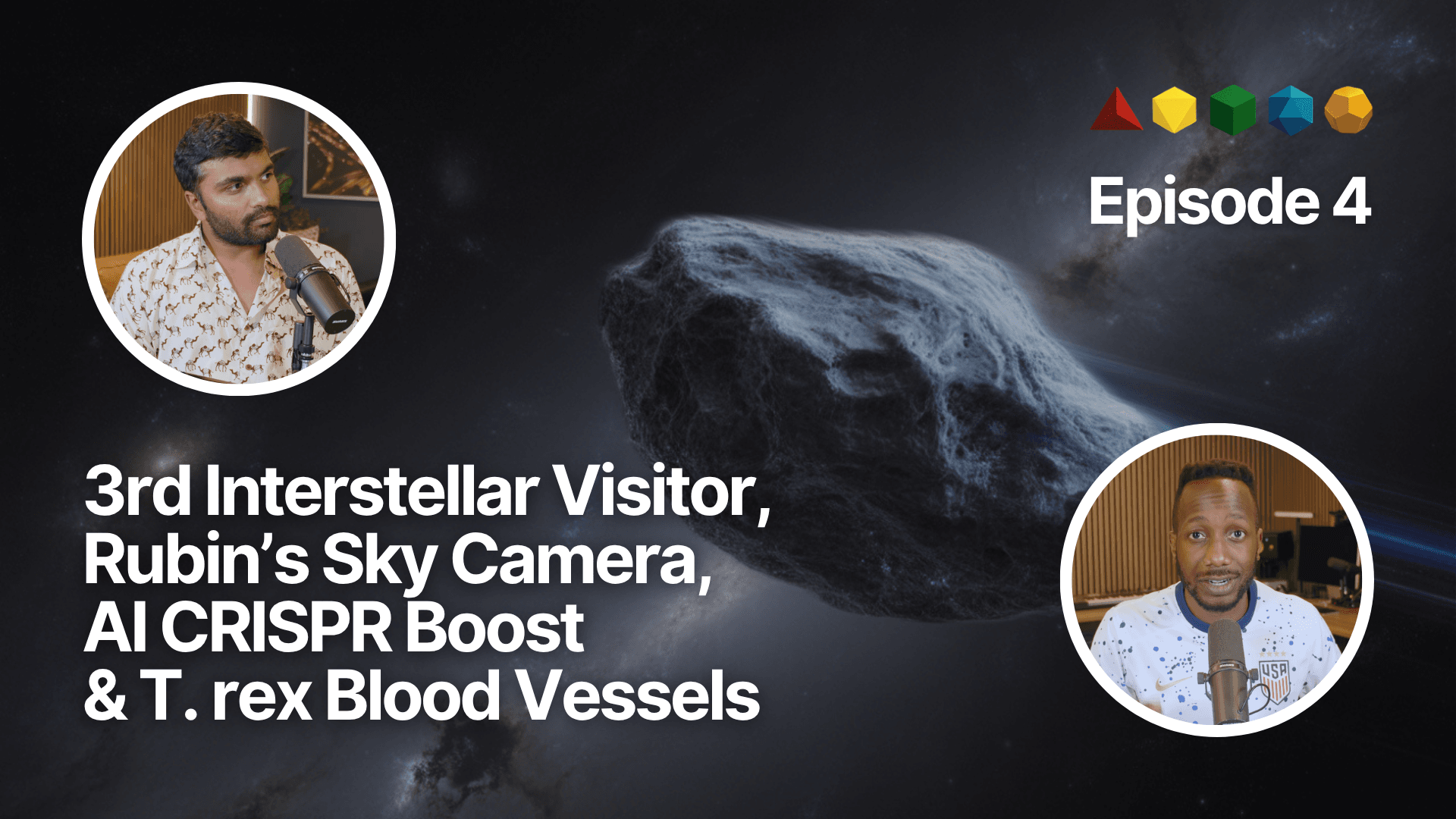
Interstellar 3I ATLAS, Rubin, safer CRISPR, and T. rex vessels.
The Rubin Observatory discussed in this episode is a joint NSF–Department of Energy project. Here's where DOE's research money goes.
Energy research peaked during the late-1970s energy crisis and took four decades to climb back — it finally passed its 1978 real-terms level in 2018.
Department of Energy · fiscal years 1976–2026
Transcript
Show →Hide15,841 words · auto-generated
0:00Hello internet. This is your captain speaking Lester Nar. I am joined as always by my co-host and our resident PhD Krishna Chowdery. This is from first principles. We have some great stories for you this week. Starting off with the third interstellar object to pass through our neighborhood threeey atlas. Is it an alien spacecraft? We'll soon see. We'll follow it up with a story about the Veracy Rubin Observatory, which is related to our initial first story on the third interstellar object. We will follow that up with moving into AI, AI meets crisper for precise gene editing. Maybe it can fix my knees a
0:41little bit, a little rusty. And we will end with a great story. Shout out to Jurassic Park for a rare T-Rex blood cell vessel found in fossils that show that dinosaurs had the ability to heal their own injuries. And we will end with a mystery box. This is from first principles.
1:15How are you, my friend? >> Doing pretty good. Episode four. >> Yay. Yay. >> We're still here. Shout out to everybody who's tuned in on YouTube, Tik Tok, Instagram. >> Yeah, we really do appreciate it. >> It's uh it's been a great great commentary, great discussion, and we're going to start off with a story that's near and dear to my heart. um which is about this interstellar visitor. >> That's right. >> So, just to kind of set the table for context because there's a certain Harvard physicist who has been used in a lot of the headlines around this story, Dr. Avi Loe, uh who's the professor of astrophysics at Harvard. And funny enough, for for those who might not
1:55know, I am the director of operations at a nonprofit called the UAP Disclosure Fund, where we are actively working with members of Congress and the executive branch to push for disclosure around these weird things that are flying around. And it just so happens that our favorite Harvard astrophysicist, Avi Lo, is one of our advisory board members. So, as soon as I saw the headlines of Harvard astrophysicist says, >> I knew it was Avi. >> Yeah. >> Um, and I know you've met him. >> Yeah. He's he's extremely he's hilarious. >> Yeah. >> He's just so funny, witty, charismatic. It's not a surprise he's been as successful as he has because in in, you
2:36know, in the industry, it's both. You have to do the work, but also be able to sell it. Y >> um but I think what's been interesting is how this story has cascaded >> all over the place. >> Yeah. >> Uh it started with an initial observation and it seems like we've had some follow-up observations from, you know, things like the Hubble Space Telescope. So, I'm really excited to kind of get your perspective on what what exactly is going on here. >> Yeah. So, um I hate to break it to you, man, but it's probably not aliens. I tell you this every time. >> We've known each other for a while, and every time it's been like, >> "Not this time." >> Yeah. Not this time. Um not this time again. It's probably an interstellar
3:18comet. >> Okay. >> But it is still really, really, really cool. >> Okay. >> And I want to see more pictures. Okay. >> Mhm. >> Putting it out there could be other stuff, but it is very likely just an interstellar comet. And so I think what's interesting about this whole concept of interstellar objects, yeah, >> you know, coming into our, you know, into a near earth or into our solar system, it's a relatively rare, >> at least from our ability to track it. >> Our ability to track it. That's the thing. >> It is. It is. It is. >> The first one was um Mua Mua, I believe it was called. Yes. >> That was in the late 2010s. >> Yes. >> So just maybe five, no, like probably less than 10 years ago.
3:59>> Yes. And then the next one that came out was two eye boris. >> Yes. >> And then this is the third one. >> Both of which uh Avi was, you know, one of the first early movers >> on on really working on them. And so we don't really have a lot of context or data. No. >> By which to sort of do analysis on this, which is why it's so important >> that we've had astronomers using Hubble >> uh to to sort of point at it and say, "Hey, what data can we gather around this?" Yeah, this one is this one is really nice because we caught it on its way in, >> right? >> Okay. Right. >> Mua Mua, we caught it on its way out. >> So, we can't get good data anyways. The data has really high error bars where we don't know if what we saw is like if the
4:41number that we got is the true number or if it's plus or minus some big thing. Um now we see it coming in. >> So, it's really nice that we can chart its trajectory. Yep. >> And we can like schedule observations. >> Yep. Okay. And that's I think going to be key to really understand what this thing is because, >> you know, this thing is most likely an interstellar object that is just like going through the Milky Way at an incredible speed. >> That's one of the things I think that's been pointed out in a lot of the news stories is that it's moving so quickly. >> Yeah. >> Um >> moving extremely quickly. And I I I guess one of the one of the questions becomes
5:21you ho how do we do analysis on you or or or or what are the characteristics that we would look for in an observation like this to distinguish it from just saying like or what are the attributes that make you sort of make that conclusion to say this has attributes that are similar to comets or other sort of rocky uh objects that we've seen. Yeah. Even locally. No, that's that's a good question. Um, to to really get into that, let's talk about sort of the history of how we like found this thing, right? So, we found this thing back when it was about four or five astronomical units away from the sun. An astronomical unit is the distance from the sun to the Earth. So, it's like four or five radi
6:03away from the Earth. Okay. >> That's when we first spotted it. It was like out at near the orbit of Jupiter. >> So, I mean, we spotted it relatively close. Relatively close. Yeah. Um it's moving extremely fast. 58 km/s. So that's one um earth orbit like one Yeah. one earth orbit radius a month. >> Okay. >> Which is like really fast. >> Like it takes us years to get to Jupiter and this thing is going to be here in like four months. >> And and I want to be specific. When you say orbit, you mean orbit around the sun, not the rotation of >> No. Yeah. Yeah. Yeah. This is the radius of our orbit around the sun. It's take it's it's doing that in a month. >> So what would take us 12? Yeah. What would take us like years? Yeah.
6:44>> Yeah. Yeah. Yeah. Makes sense. >> To get from here to Mars usually takes us a year. >> Fair. >> This thing is going to do it. >> That's true because you're talking about traveling through through through space at a target. So, >> and this thing is just coming at us like in a month. So, this thing is incredibly fast. >> Okay. Um, when it was really far away and it was first spotted, um, we thought it was like 20 km big. >> Okay. >> Which is massive. >> Yeah. >> Okay. That's like a big big comet, big asteroid. I think in the movie Deep Deep Impact, uh the the the asteroid that was hitting Earth or whatever was like one one to three K. It was significantly smaller. >> Significantly smaller. And that thing did damage, right? So this thing this thing is like a you know at least it's a
7:27life killer. It's a mass extinction type thing. Yep. If it came um especially at that speed like we just we'd just be wrecked. Um >> so >> it's incredibly fast and we thought it was incredibly big. Mhm. >> The other thing that we thought was um you know it was really far away. We couldn't see any gas coming out of it like what normal comets do when they come out from way out there. They usually have a buildup of ice and then when they get closer to the sun they should like you know start having this tail which is from all the ice >> famously known as the the commentary tail which was what was originally interesting about Amua Mua was and the problem was we were catching it late so we couldn't have enough data to tell but
8:08the lack of a commentary tale was one of the reasons by which it was like well it doesn't look like the other rocks that we've seen flying through space. >> Yeah. So this one it was similar, right? And um that's when Professor Loe came out and was like, you know, this could be something weird. U we should take a closer look. It could be um it could be aliens. And um a lot of astronomers at the time came out and said that well it's like too far away >> for us to really get good data. Okay, with astronomy that's always the name of the game. Like it's like it's hard to get data on these things. Um now I think it's been a month since since then. A month or two probably since then it's come closer. Now we see a tail. >> Mhm. >> We do we do see a tail. >> We do see a tail.
8:49>> We see um we also see a sunfacing tail. >> How How do you mean? >> Okay. So, if there's the sun, >> the comet is moving like this. >> You'd expect there to be a tail that's going in the back, right? Because it's like >> like leaving stuff going behind. There's also a tail facing towards the sun. >> Got it? >> And that is something that we know comets do. Okay. >> Because of something called sublimation. If you've ever seen dry ice, >> like dry ice just goes straight from solid to vapor carbon dioxide. Right. >> Right. It doesn't go in there's no liquid CO2, >> right? Because the the air pressure is actually just too low to to have that. So the phase changes go straight from
9:29solid to gas. >> Um same thing is happening on this comet. Like the water ice is getting bombarded by the sun's rays and then it's just boiling off. There's no like so it's it's called sublimation and that creates this like gaseous sort of water vapor halo around the comet. >> Um the Hubble Space Telescope made an observation of it not too not too long ago and it updated the size of this thing. >> The size of this thing we thought it was 20 km. It's now something like 0.3 to 5 km. >> Okay. >> Significantly smaller. And it is most likely >> smaller than 1 kilometer. >> Okay. >> Okay. Now you also what's interesting is
10:10the air bar is so massive. It's going from 0.3 km to 5 km, right? >> It's a pretty wide range. It's almost tenfold. Yes. In the in the variation and that's just because like with comets, >> the nucleus is shrouded now >> in this >> in like if you look at that photo, right? Yes. The nucleus is shrouded by this gas now, >> right? >> So now it's really hard to resolve like what's happening on the on the very inside. >> It's a force field, I promise. >> Yeah, it's something like that. It could be. But I think what's interesting here, I mean, this this kind of goes to why the instruments we use for detection uh really matter >> uh because it's what allows us to get sort of a high fidelity data set. >> Yeah. >> To then be able to do analysis and also
10:52being able to do so repeatedly over time >> such that we can continue to refine. Yeah. What that analysis is >> and as it gets closer and closer, we're going to be doing more and more because this is I mean at the end of the day, this is an incredibly interesting object. Okay. Right? If we were to run back the clock on where this object came from, this three atlas, okay, it's an interstellar object. And if we were to run back the clock on where it came from, it would come from the depths of the Milky Way. And especially in this region of the Milky Way that's like right above our disc, >> okay? >> Okay. It's called like the thick disc. Okay. So, the Milky Way is like this, right? You've you've seen the the Milky Way across the sky. Most of that stuff is in the thin disc. Okay? That's where
11:33the like stars and the and the gas sort of is. So when you look up at the night sky in a national park or in a really dark area, you'll see it going across the night sky. That's usually just the thin disc. Right above that thin disc is something called the thick disc, okay? And this has an old population of stars, >> okay? >> Really old, okay? >> Like older than our solar system. And if this object came from up there and it's like sort of, you know, crossing down into our neighborhood, then it came from those objects, which means that, you know, we're estimating this thing to be 7 billion years old. >> Wow. Okay. >> Which is older than our solar system, >> right? >> So, this is actually the oldest object
12:14that we that we've seen in our solar system, >> which is >> it's older than everything else >> else that's around it's it's basically like it's, you know, a quarter of the age of the No, about half the age >> half the age of the universe. Yeah. >> Uh, which is fascinating. I mean, >> we're about a third, right? But like, yeah, this thing's like >> half. >> Look, I'm not saying it's aliens, but they've had time. >> They have had time. And they they might live up there, you know? So, but we definitely know that it's old. Like, if it's a naturally occurring rock and it came from up there, it's probably really old. Very old, >> right? >> Fascinating. >> The other thing that's kind of kind of crazy is like how fast it's going. So, how do we explain that, right? Well, that can be explained by just close
12:55encounters of the gravitational kind, right? >> Okay. Um, >> so it was passing through, you know, through from the thick disc through the thin disc and at some point it passed a very very massive object. >> Yeah, it passed a very massive object in exactly the right I mean, this thing's been around for seven billion years, right? So, and if it's like out here, who knows how long it's been roaming the cosmos right? >> Right. So, um, you know, in in the threebody problem, if you remember, right? like tiny little deflections can cause something to just shoot out, right? You can imagine the same thing here. Like spacecraft, NASA uses these things called gravity assists to boost the speed of spacecraft all the time.
13:35This thing could have had a very close encounter with a massive object, let's say another star, and it was just like shot >> Yep. out >> and then ended up being shot out in our direction. >> In our direction. Now, the direction that it was shot out in is very peculiar. >> Okay. Because um the sun and the planets form an ecliptic plane. >> Yep. >> Where we all sort of like this is the primordial angular momentum of the solar system coming to fruition as like one plate where all this all the planets reside. And this thing is coming in at like a really shallow angle. Right? Of all the angles that it could have chosen, it did choose this weird shallow angle. That's a little weird. Okay. Um
14:16Awamua did not do that. >> Okay. >> Right. So it's, you know, you could say, well, you you didn't use it for that one and then now you're using, you know, so like it's it again, it could just be coincidence. This is the first three that we've done and this is one that like it's um as as people are saying it's like taking a tour of the solar system, right? It's going through Jupiter. It's going to visit Jupiter. It's going to see Mars and Venus. It's not going to see Earth. We're actually going to be on the other side of the sun. >> Got it. So, it's going to like if the sun is here and we're here, it's going to like move over there. >> It'll pass through generally where our orbit would be. We're just in the wrong place. >> Yeah. We're in just in the wrong place at that time. Um but but then it's going to go see Jupiter.
14:57>> Mhm. >> Um later and actually there's a there's a proposal out in astrophysical letters. Yes. >> I think by professor Avi that um >> wants to get the Juno spacecraft which is around Jupiter. >> Yes. >> They they just want to like boost it a little. >> Yes. and they calculated how to do it. You boost a little, you get it into a higher orbit around Jupiter and then it'll make a really close encounter. Yeah, it'll make a real close encounter. I think that would be really cool actually. Personally, I think that would be a great use of Juno. >> What's so I mean it seems like and this is a call to those who may be watching that are in the annals at NASA making decisions. Uh given we don't have a lot
15:38of historical data about interstellar objects passing through our solar system, it seems like and the fact that there are always chance opportunities. >> Yeah, >> this seems like an incredible opportunity with relatively low lift. >> Yeah, >> we've done the math. >> We've done the math. Yeah, >> it can be done. Do we want to waste the fuel? Hey, look, when's the next time we're going to get a chance to capture an interstellar object at that proximity? Yeah. Especially given where our orbit is. That means like on Earth observatories. >> Yeah. We're not going to be able to because we can't like point at the sun, >> right? It's going to be behind the sun. So like what are we gonna do? >> Um already though like so many people have like imaged it. Hubble Space Telescope imaged it. The Very Large
16:20Telescope, the VT that we talked about in one of the previous episodes that imaged it. Um Gemini North, another telescope that we've talked about in previous episodes that imaged it um in Hawaii. So, we've had like tons of interest in this thing because it's obviously interesting. It's a seven billion year old object that's coming to visit us. >> Right. >> Right. That's it's incredible. >> We want we we have to have the door man to check to make sure security is tight. You know, hey, what who are you and what uh intentions do you have with our daughters? Yeah. Um and it appears that it's going to be making its closest sort of approach to us in the late October, early November 2025. Yeah.
17:01>> Time frame, which is why everyone's freaking out that there's an alien invasion. >> Yeah. >> In November. >> Yeah. >> I mean, it if if we find out it's it's aliens, then the stock market crashes. I don't know what happens to Bitcoin. >> Um, you know, >> but we we will we will find out soon. It's not too long away. >> Yeah, it's not too long away. And actually, you know what's hilarious? 6th of August. What's today's date? The 12th. Yeah. So, six days ago, the James Webb telescope imaged it. >> Oh, interesting. But they haven't released the data because there's a three-month embargo on whoever gets the time. Like so whoever whoever like had that time was like I'm gonna put it here and then like imaged it. And I'm sure that if like so like that's another thing that gives me like some security
17:42is like I'm sure if that dude >> like saw something weird it would have >> NASA would have been like okay we're Yeah. >> It would have it we would we would have like someone would have said something by now. So it's been six days. It's probably something extremely interesting and this guy's scrambling to get his paper out before the public gets the data. >> Right. That's >> But it was like six days ago and it's also going to image it again in December. Okay. >> So it's actually scheduled in December to do it. >> Perfect. Perfect. So So >> because that's when the Earth is going to be at exactly the right spot to like see it again because James Webb is also it's still tied to Earth. >> It's not like just out there. So >> it's it's out there. But but
18:22>> so it's like now and then we're going to have like a few months where we can't because we'd have to point it towards the sun, >> which is why Juno is so important. NASA, send Juno out there. Let's take some pictures. We want to see it. It does look really beautiful and brilliant in the in the imagery we do have from Hubble. >> Yeah. >> Um and it's >> and you can see it's clearly moving, right? Right. Because like the streaks that you see there Yes. those are stars, right? That are not moving. So the the the telescope had to like track it. >> Yes. >> And then as it was tracking it, the stars were like making streaks. >> Nice nice space long exposure. >> Yeah. >> So while it may not be aliens yet, >> it will give us more data to it's sort
19:03of like that in the sort of AI analogy. It's like that training data set of what we know as sort of prosaic data and such. It gives us a better way to then tune for future potential visitors. uh if they're not already here. >> Yeah. And it's it's going to be really interesting to see like once it gets closer and we take more data, it'll be really cool to see what this object is made of. Right. Right. Cuz like we know what solar system comets comets are made of, >> but like >> are these older solar systems somehow different? Do they have different characteristics? We've already found water on it, >> which is very characteristic of a comet. >> Um so, you know, in that respect, it's very similar. And we're expecting to
19:45find CO2 and carbon monoxide, but it'll be interesting to see what else comes out, right? Like maybe there's like some other exotic chemical that we didn't even think a comet would have. >> This actually ties to the story we previously covered about the importance of discovering the first molecule in the universe and how that then has this sort of um butterfly effect in terms of how everything forms downstream. And this would be great insight to understand those earlier solar system solar systems. Yeah. And and what's kind of going on there. >> Um this also makes me think we should do another episode on the idea of panspermia where it's the idea that life is seated from these
20:25>> comets traveling interstellar >> and carrying things like water. >> Yeah. >> Um >> like that would be that I mean this thing is carrying water, right? What else has it got? That be it' be so interesting to see. And like um you know the other thing I want to talk say is we've only seen three, >> right? And the reason we've only seen three is probably our inability to see the rest. >> Fair. >> Right. This is might be super common. We've only had like >> a giant network of telescopes doing this kind of stuff for not very long. Right. >> Right. Right. Um, so it's not like, you know, all of a sudden someone turned on, right, the interstellar >> button, right? Like in 2015 and now
21:06we're just starting to see stuff, right? >> And for that we need like telescopes that are dedicated to just like finding this kind of stuff, >> which means we need to fund science. >> Yes. Yes. And >> for that we actually have a telescope now. >> Right. And this is our second story which is this is an NSF National Science Foundation and DOE Department of Energy collaboration uh for the VeraC Rubin Observatory. So the sort of headline on the uh nsf.gov website is beginning in 2025, NSF DOE Ruben Observatory will embark on the legacy survey of space and time, a
21:4810-year survey of the night sky using the biggest camera ever made, capturing an ultra wide, ultra highdefin time-lapse record of the universe. Yeah, >> which sounds incredible. And so tell tell me let me help me understand the importance of of this new observatory and what it actually is. >> Um you know that previous story we were talking about. Yes. >> With um >> three Atlas. >> Yes. >> If Veracy Rubin Observatory had gone online a month ago, a month before it did. Yes. It went online in July. If it went online in June, >> it would have found
22:28this object within three within three days. >> That's incredible. Okay, that's what this observatory is doing. This observatory is American exceptionalism at its finest. >> Hurrah. It really is. Uh, nice shirt. Nice jersey. >> Good. Good. You see, you see these four stars that that means we're winners. >> How do we How do we get four? Wait, >> the women's team. >> Okay, got it. All right. Well, hey, >> we'll take what we can get. >> We'll take what we can get. Um yeah this this observatory is yeah it's it's like one of the greatest observatories that mankind has ever built. >> Um it is very different from other observatories very very different in
23:11that traditional observatories the whole point of the observatory is like like the way it works is you're an astronomer >> you got some idea for a bit of research that you want to do. So you write to the observatory funders or like whoever is in charge of like allocating time and you say this is what I want to look at. This is how many nights it's going to take. Um this is why it's important for science research blah blah blah. And then they get a bunch of proposals and then they allocate the yearly time budget to whatever you want to see. This observatory has no such thing. Okay. Okay. >> There's astronomers can't bid for time and yet astronomers are super excited about it. Okay. This observatory's only
23:53job is to take a picture of the night sky, the entire night sky >> every three nights >> and that's it. >> That's it. >> That's it. Like robotic clockwork. Okay. The the it's it's almost like just a robotic telescope. It takes a picture of the entire night sky >> every three nights. >> Now that is impossible with other telescopes. it what's in this thing had to be engineered >> specifically for that task. It it seems like a brilliant use of time and money because you know the it creates this baseline data set that's very robust that creates a treasure map effectively
24:36for people to then say okay if I look at what's going to come out of the Reuben Observatory you can get a baseline reference point and say hey this looks interesting over here and then we can zoom in with other tools that are maybe more specialized for any number of different of observations. >> Yeah, it's and it's not just a baseline. It's like >> it's actually going to find new things out >> out of the box >> actively, right? >> So people can just look at it and be like, "Oh, that's new." >> Yeah. And in fact, I mean, it's going to have so much data that like people can't afford to look at it, right? There's just too much data. They're actually going to have artificial intelligence looking through and combing through the data. Okay, so let's get into it because there's there's so much. This thing
25:18started 15 years ago, 15 to 20 years ago. There's these things called decadal surveys >> in astrophysics. Okay. So, I mean, you know, people might think that like scientists are just like they just have like ideas and then the government's like, "Oh, okay. Here's like $400 million, right? That's that's not how it works. A bunch of scientists have to come together because this is a lot of money. Observatories are incredibly expensive, right? Every little thing you're doing is at the cutting edge of science and technology. You're making the biggest camera. You're making the biggest lens. You're making the largest system for like distributing data and like finding
25:58stuff in data, right? All of this stuff is at the cutting edge, right? It's going to employ like hundreds and hundreds of researchers, right? Sometimes thousands. So in order to justify this kind of spending there has to be a consensus in the community to actually say look this is the total budget the NSF and the government are g giving us how are we going to make use of it with big projects because this stuff is big okay this is hundreds of millions of dollars >> and I want to make the note that >> I don't know if it's hundreds I don't know I don't know how many million this is actually >> this is also work that the private sector won't do >> no why would because there's there's no clear profit, you know, immediate profit
26:41value to investing that amount of capex. >> No, this one, this particular one was really nice because, you know, Congress has a mandate that I think by 20 2030, they want to catalog all like 90% of all near Earth objects that are bigger than 140 km. >> Okay? They want to just get a catalog of them all. >> And NASA was like, "All right, well, if you want that, >> we're going to need money to make an observatory exactly like this. This thing is going to catalog something like 65% of it." >> Okay. >> Okay. Um, and what was funny about this particular
27:22project is in 2018, Congress actually gave them more money than they asked for >> because they wanted it done faster. >> Yeah. But at that point, they weren't limited by money. >> They were just like, "No, we got the best people here. There's not anyone else who can do what we're trying to do." Like, like making a 32 gigapixel camera takes time. >> Grinding this lens takes time. Like you, this is not a throw money at the problem >> kind of problem. This is now >> we have the money, but it requires time to get this right. So that like when we see first light with the telescope, it's going to be banger. >> And it's so funny because it's the one time Congress was like at four
28:04scientists, they were like, you know what? Yeah, here have more. And and it's the one time that we we were like, uh, I wish you there's so many other >> I think what's interesting about this is is this idea, you know, how times change, right? You know, it's not a guarantee that the funding pool will always be there. >> And this is 2018, so this is during the first Trump administration, >> right? Right. So it's not like, you know, >> it's not a party type thing. It's just some like some sometimes we we really like science and then all of a sudden, I don't know, something happens. >> Co in this case. I I will note that on the nsf.gov website, they they mentioned the amount of data gathered by the Reuben Observatory in its first year alone will be greater than the colle uh
28:47the data collected by all other optical observatories combined. >> Yeah. uh which is a massive massive >> massive amount of it goes on to say countless discoveries in improving our understanding of the nature of dark matter, dark energy and other longstanding cosmic mysteries. >> Yeah. Yeah. Yeah. It's got it's got ma it's got four mandates. Okay. The first thing is so okay first actually let's get into let's get into what this thing is doing. Okay. Okay. So this this Vera Rubin telescope it's um it's an 8 meter telescope. Okay. >> It's It's not like the KEK or the James Web where it's a bunch of segmented
29:27mirrors. This is a single solid mirror. >> Wow. >> On the bottom. Okay. It was made in the University of Arizona. Okay. >> University of Arizona. There's a um a lab there that is the world's best at making single big mirrors. Okay. And so >> when time came to make this, it's like, okay, we all know University of Arizona is going to do that. That's your job. You do it. Okay. They they made this massive mirror. This mirror is extremely wide, right? Eight meters. But it's also like the the field of view of the camera, >> the way the mirror is shaped means that the field of view is extremely large.
30:09Okay. What does that mean? That means like so most telescopes when they look at the night sky, they're looking at a patch of the sky that's smaller than the full moon. >> They're looking at a very narrow >> very Yeah. very like like you know you hold your thumb out and it's like that big and they're looking like that. Okay, even sometimes smaller. Um same thing with James Webb, the KEK telescope in Hawaii, Hubble, same thing. This thing is going to move is going to look at um a spot in the sky that's like 45 full moons. >> Oh wow. >> At the same time, >> several orders of magnitude larger. >> It's almost like a palm. Okay. As big as a palm, >> right? Um, it's a thousand times the field of view of Hubble. >> Okay.
30:49>> Now, if I want to look at something really close for a really long time, this isn't the thing to do it. >> But if I want to see the whole night sky >> in three nights, this is the thing to do it. What this thing is going to do is 30 seconds, then it'll take 5 seconds to move, 30 seconds, then it'll take 5 seconds to move, 30 seconds, 5 seconds to move, 30 seconds, and it'll map out the entire night sky every three nights. >> So, in all of the filters, >> it's making almost this giant panorama is not the right word, but this giant mosaic of these 30 second snapshots that ultimately will create this sort of 3D >> Yeah. It'll be like the the Vegas
31:30sphere. >> Yeah. Yeah, yeah, yeah, yeah, yeah, yeah yeah yeah. >> But like every night. >> Every night. >> Okay. It's 60 pabytes of data over 10 years. >> I was literally going to say I don't thousand terabytes of data. Um, like every night it's going to it's going to be making like incredible incredible discoveries because it's observing the whole night sky, >> which is something we've never done in this way before. >> Yeah. Yeah. Yeah. And each of these each of these pictures is going to be 32 gigapixels, right? So that's 32,000 megapixels in my palm, right? That I'm like with a giant 8 meter aperture, >> right? >> Right. The camera actually the camera was built by Slack. >> Oh, really? >> Um Stanford Linear Accelerator Lab.
32:11>> Different Slack. >> Yeah. Yeah. Not not not the not the >> not the not the works work management software company. >> Yeah. Again, the private sector isn't going to do this, right? But the government and Slack Slack is part of the DOE. So Slack made this camera. The camera is like going to fit in this room. >> Okay. >> Okay. It's like as tall as you or you you or I. >> Okay. >> And it's like as as wide. You can imagine like it's the world's largest camera. Yes. >> 32 gigapixels. >> Right. >> I mean in 30 seconds we want an exposure on this small patch of the sky. >> It's incredibly detailed, dude. You see like galaxies you've never seen before. In the first two days it discovered like thousands of galaxies.
32:53>> Jesus. >> Right. In the first two days, it discovered 2,000 asteroids that we've never known existed. >> And it's like, wait, wait, wait, wait, wait. >> Like, >> yeah, right. >> Those are asteroids. Like, that could that could be bad, >> right? >> In the in the first two days, 2,000 asteroids that we should definitely know >> about and we don't. There's a million known asteroids right now. >> This thing is forecasted to get 5 million more in the next 10 years. So over the past 200 years, we've observed a million, >> right? >> And now in the next 10, we're going to observe 5 million because of this thing. Cuz all it's doing is taking a picture of the entire night sky every every night. >> Yes. >> And then it's going to look for it'll be
33:34super obvious, right, >> when an asteroid moves, right? When a point in the when a small point of light moves, >> we can literally track it over the whole year. This this seems like a perfect use case for you know AI detection and anomaly detection algorithms because we have a decent amount of data to create sort of structured algorithms as a starting point that will identify things like asteroids etc etc and then we'll put them >> and AI is really good at that kind of stuff right anomaly detection is like huge >> and and so we'll have these buckets of stars asteroids galaxies and then there'll be this fun other bucket where it'll just see I mean it's like it's
34:14like putting on glasses when you're like really blind or turning on the lights further further down into a room where it's like we've we've seen some stuff. >> Yeah. >> But we've not really seen it all >> and it is going to be an an incredible amount of the fidelity to me is what's crazy. Um >> yeah and and the the clarity of the images and the amount of light gathering power that we have here is going to be insane. Like the the first thing that like there have been um surveys in the past. >> Sure. >> Right. Like uh the harvard has like the Harvard plate archive which is like back when there were photographic plates. Palomar has one, Mount Palomar. Um you know about that one. And then um the
34:56most famous one before this was the Sloan digital sky survey that was in in New Mexico. And back then like you know um >> there's no I mean there's internet but for this amount of data there isn't. And so like dudes literally had like dudes literally had to like fill up luggage with like the data and then bring it to the university like physically. Right now, this thing takes a photo. Within a few seconds, it's to California to France. And then within another few within another like few seconds, it's going to be checked across every other photo that we've taken of that spot in the sky because the telescope's tracking where it looked, right? And then maybe Hubble looked there, maybe VT looked
35:37there like 5 years ago or 10 years ago. You check around there and then if there's anything different, it's going to flag and go across to all the astronomers everywhere being like, "Hey, there's something cool here. I want to be on that email. >> Every every like minute that it's observing, we're going to be we're going to be seeing these things. And the cool thing about this is there's no embargo on the data. >> Okay? You know how I was saying saying about like uh the James Web telescope? Yes. Three months, right? You get three months to massage your data, get your paper out. Here it's like it's out. >> It's out like that night. >> It's not only a a new technical innovation in and of itself. It's a first of its kind observatory, but also the workflow that is accompanying the
36:18observatory in terms of data access to a you know wide community of scientists is is also fundamentally different. >> It's fundamentally different and it's like it took like the software >> the the kind of software that was required to do this and the kind of electrical >> experience and and all of that stuff that could only happen in America. like the the amount of cloud computing that is happening because of this thing is like something that it's actually being handled by Fermy lab and the University of Illinois because like particle detectors they have experience with like ridiculous amounts of data and how to make sense of it. Yep. Right. This is a
36:59great problem that now they can solve. So, the University of Illinois is actually in charge of this whole data pipeline that's that's happening and they're still um massaging it out right now. Like the the telescope is live, but like this is a part of the pipeline that they couldn't really test until they started getting the photos, right? >> It's still in beta. >> Yeah. Like so everyone was focused on, okay, let's just get the photos. Now it's like, okay, how do we get the photos to everyone? And it's it's slowly coming about now. You know, I said something about how um the there's no embargo on these on this data. So the telescope takes a photo tonight, it's out. Um, now we have public access to this data through the Vera Rubin um,
37:40website. There's actually like citizen science efforts going on because as you said, right, machine learning is going to be really really powerful. >> Yes. >> For detecting anomalies and detecting new objects in this data. But what does machine learning need? >> Training data. >> Yeah. Training data sets. >> Training data. >> Yeah. And so how do how's the like all of the all of the training data like you know you know the LLMs yes the training data is coming from humans writing on Reddit and all this other crap right the internet the internet so like there's all this text on the internet >> that's your training data but that text fundamentally had to come from human beings for it to learn how to speak like a human being and like language and logic and all that other stuff >> right >> this we're going to have citizen
38:21scientists >> doing like training annotations Yeah. Yeah. >> On the data. So already something like a 100,000 images. It's only been like >> less than a month, >> but already 100,000 images >> um have been looked at and labeled for comets. >> Yep. >> Okay. Because comets look a little bit different from asteroids. So there's a bunch of people on their and you guys can like go and like be a part of this e effort like you basically identify is it an asteroid which is just a pointlike thing that is moving or does it have a little bit of fuzz around it right >> okay and that's your job >> we need more reinforcement learning from
39:02humans >> and so I actually didn't know that that's that's fascinating >> yeah so so these guys are just this is just uh yeah classic data annotation >> yep >> and then and then we can then train the machine learning learning algorithm and the AI for the future and then we won't need >> we we can have them >> like do other stuff like okay is this a spiral galaxy or an elliptical g you know all sorts of stuff >> this is I think one of the things that's so fascinating about that part of the story is it is this reminder we always talk about which is that science is is for everybody >> right and it should be accessible for everybody so it's actually really heartening to hear that >> yeah this one I I really like that that like you know they they got all this funding from the American taxpayer but
39:42they're giving it back Right. >> Not just to the American taxpayer, but to the world. >> Right. Right. >> It's kind of cool. >> Very cool. >> I I think I think I think it should make us very proud as Americans that we are still at the forefront of astronomy. Yes. You know, ever since the 1920s. Yes. >> Like we built the biggest telescope in the 1920s and we haven't stopped. >> One thing, the biggest, the best. >> Yeah. That I think we really do understand that adjective biggest. >> Biggest. >> It's like, okay, >> bigly. >> Yeah. We're going to make we're going to make the biggest. Although we didn't understand that when we tried to build a superconducting super collider in Texas. We almost built it and then >> then CERN was >> and then and then no and then we ran out of funding during the Clinton administration
40:22>> when we had the crazy budget surplus. >> Yeah. >> Interesting. >> Like like Reagan actually like gave money for it. >> But that okay fine that was during the cold war. So maybe, you know, one can. But basically, once the Cold War ended, >> yeah, >> even even the Democrats were like, "Oh, I guess I guess we don't need science anymore." >> You know, it's >> it's so annoying. Like now there's just a giant tunnel >> underground in Texas. There's a giant tunnel with graffiti and stuff. We bored we bored a tunnel, >> but we just didn't put the detectors in cuz like we ran out of money. >> It's this It's It would have been bigger than CERN. >> You understand? Yeah, it would have dude we would have found the Higs like 20
41:03years ago or something. this is why we need to fund >> it's it's incredible and like it would have it would have been a larger search space like we would have answered questions about super symmetry the fact that it doesn't like isn't there in in these like we would have answered all that because the luminosity for that Texas superconducting super collider was higher than CERNs is right now >> which when it's been ran >> like when we do stuff we planned to like it was going to be bright and it was going to be big >> and then and then and then and then money ran out and and we didn't give the money and then that's when I think we learned our lesson and that's when NSF was like no we're going to do with whatever limited budget we have
41:44>> we're going to take big risks and get big rewards and that's when LIGO sort of got in the mix and that's when people started asking okay can we make this gravitational observatory >> right well this is the gravitational >> gravitational wave observatory and and finally LIGO got LIGO got funding like I think it was sort of a backlash from like that failure that we had as American scientists. Yeah, we were just like ah like we really dropped and like now you know at CERN we're kind of like secondass citizens because >> to be like part of the fold you have to contribute something like 1% of your GDP which is fine for something like the Netherlands but like like the US is all of Europe plus more. It's like you want
42:251% of our GDP. No, >> you know, but it's like but they need our magnets. like CERN couldn't work without our magnets and like a lot of the tech and a lot of the like big electronics was coming from America. So yeah, I I think that we we didn't we didn't really like that. And then like we made Lego. I love that in astronomy we're still like at the forefront like we're making James Web, we made Vera Rubin, um the KEK telescopes in Hawaii. Like >> we're we're we're still going at it. >> Um >> there's a new one that's like planned. It's called the uh the Nancy Grace Roman telescope. >> Um that's going to be in space. It's going to be very similar to the Ver
43:05Rubin telescope. >> Um because it's going to have a really big field of view. Um but unfortunately I think that one is has been put on pause because it hasn't been launched yet, >> right? And the funding stop >> and the funding has stopped. So So that's something that like we clearly should like really like, you know, >> invest in. >> Invest in. Yeah. Oh, you're looking at the the photos. I I want I want people to understand and we we'll >> dude look at look at like all of those dots like like all of those dots are previously unknown galaxies. >> It is incredible. And it's it's what you can see >> that's a single like that's that's a single night >> and the it's it's basically this map view uh with part of it filled in from where the photos have been taken and
43:46it's just going to continue to expand and expand over time. Yeah. And you can just zoom in and it's pixelated for a little bit and then it gets high fidelity and you just keep zooming in and >> Yeah. And then finally you get to the signal the noise of the detector, >> right? >> Yeah. >> But I mean there is an incredible amount there already objects in this in this view. >> Yeah. Like you see you see some of these like diffuse galaxies here. >> Those like were so diffused that they weren't even caught in this lone digital sky survey. >> This is incredible. >> Right. But that's like a some of those are totally new galaxies that are pretty close to us >> and we just didn't even >> that we didn't even see because like they were they were just sort of like blobs of g like you know partic particulate stars with no real structure
44:28so they weren't bright enough. But now this thing this thing is incredible. And the thing is it's going to take pictures of the same spot in the sky, right? At the end of the day, it's over 10 years, right? You can start a not even looking at the movie aspect of this, right? Like the the time-lapse aspect of it, you can start averaging the same spot. >> Yep. >> Right. And then get insane signal to noise. >> Right. Right. >> And then start seeing really faint stuff. >> Yep. >> Right. >> Yep. And so, and this this is it's only been a month and already we have like thousands of new asteroids, thousands of new galaxies. >> This is incredible. I mean, this imagery is is unbelievable. >> It's unbelievable. And the amount, >> right, >> that we're getting the sheer amount
45:09like, you know, it's doing it's doing a whole night sky. >> And then the other thing we got to remember is like, you know, let's say the sun is here. >> Yeah. >> Uh Yeah. Let's say the sun is here and the earth is over here. Yeah. >> Okay. It's in the southern hemisphere. >> Yes. >> So, it's only going to be able to see like this part of the sky in one night, right? And then as the Earth rotates, it's going to basically see all of this all of this down here. So, there's going to be parts like near the equator >> that we're going to have like a movie for like we're going to have all the photos for 5 months and then we're not cuz it's going to be on the wrong side and then it'll be back. So then like you know we'll see like but then there's parts near the the South Pole that are
45:51just always going to be visible. >> So we'll just have like a 10-year fullon movie time lapse >> of the universe >> of like the universe in this in this like down here cuz we'll it'll always be nighttime down there. >> Right. >> Right. And so that'll be really cool. >> That's gonna I I mean the im like even already >> Yeah. >> It this is gonna be it's gonna be so awesome dude. >> This this is incredible. I want to end this story with this little bio snippet that the NSF put out on who was >> Vera Rubin. Yeah. >> Um the Reubin Observatory is named in honor of Vera Rubin, a pioneering American astronomer whose observations provided convincing evidence of dark matter. Yeah. An invisible substance
46:32that makes up over 80% of all the matter in the universe. Rubin's work in the 1970s showed that galaxies were rotating too fast to be held together by visible matter alone, suggesting the presence of an unseen mass. Her discovery reshaped our understanding of the universe. Dark matter is unlike any known type of matter and its true nature remains one of the greatest mysteries in science today inspiring generations of researchers and science lovers and one of the greatest observatories that humanity has ever created to date. Uh, and so in honor of Vera Rubin, uh, a
47:13woman in science, >> yeah, she was snubbed for the Nobel Prize, which is she should have gotten the Nobel Prize. That it's an incredible discovery. She did these, uh, what they're referring to is galaxy rotation curves. >> Okay. It was the first sort of real inkling that, okay, there's something real wrong like where where is everything? >> Where why can't we see it? Basically what she it's a very simple very simple observation okay that she was making which is that like stars that are like farther away from the galaxy center should be moving slower. >> Mhm. >> Right. Jupiter moves way slower than Earth. Mercury moves really fast around the sun because the closer you are the stronger the gravity and so the stronger the acceleration which means you're
47:54going to move faster. Okay fine. Um what she noticed was the galaxy rotation curves instead of doing this instead of trailing off as you go farther out they remain constant. >> So what does that mean? Means one of two things. Either Einstein is wrong. >> Mhm. >> Unlikely. >> No. Right. >> Or there's a bunch of mass there that is contributing to this gravitational pole that we're not seeing. >> Right. >> Okay. Right. And that's where sort of the dark matter debate started. Got it. It's like is it dark matter or is Einstein wrong? the Vera Rubin Observatory, which is named after her, one of the one of the key like pillars of its creation is this idea of answering that question. Okay, it's like it's, you know, I mean, you saw those
48:36photos, right? Galaxies upon galaxies of stuff. What it's going to be able to do is map out the entire universe from extremely large distances. >> Yes. >> And what we're looking for is um structure, large scale structure. What that means is like >> so it turns out the universe is not like completely isotropic >> in that it's not completely the same everywhere there's clumps of stuff >> there's clumps of galaxies and then there's giant voids that are like >> millions of galaxies big where there's nothing okay not you know you know I mean low density high density and so if we can map out that structure of like
49:18where the high density is that's you that's where the dark matter is and then where the low density is then we can start figuring out how much dark matter there is >> and how that dark matter evolved from the beginning of evolution. We can start making mo not evolution from the beginning of the big bang from the evolution of the universe from the big bang until now like how that dark matter evolved how it shaped the creation of this large structure. Yes. >> And all this other kind of stuff right that's one of the things it's doing. The other thing it's doing is because it's like just going through galaxy after galaxy, it's going to catch a lot of gravitational lensing, >> right? It's going to catch these like instances where the light is bending because of the mass in front of it. And
49:59then once we have that, we can have a better estimate on how much mass there is to bend that light. And then we can start discovering things about dark matter. The more data that we get, the more closely we can start scrutinizing stuff like Einstein's general relativity, which we sort of take for granted, >> but you know, we'd need something like >> thousands of of galaxies. I think it might honestly be somebody did the calculation. It's like on the order of millions of galaxies worth of data, right, to really start honing in on this question. And Vera Rubin, >> given that it's doing this, it's going to be able to do that. >> Yes. >> Yeah. It's going to it's going to be it's going to be awesome. Unbelievable. Um I I we're gonna come back to this.
50:41>> Oh yeah. This this thing is going to be in in our zeit guys for the next 10 years. It's it's going to be finding crazy stuff like um Yeah. It's going to be insane. Like Ice Cube and LIGO. We've talked about Ice Cube and LIGO on this podcast before. Um the only time like >> Vera Rubin is it's it's on a mandate, right? It's doing this. >> That's it. >> That's it. It's not gonna you got something nice to see? Go look somewhere else. Except for when Ice Cube or LIGO sees something crazy. Okay. If they see something crazy and Ice Cube is like, "Yo, there was a massive neutrino that just came out of there." >> Yeah. Yeah. Yeah. >> Then Vera Rubin's going to be like, "All right, I'll take a break.
51:22>> Point it there." And because of Vera Rubin's like big field of view because like when when stuff comes into Ice Cube, >> we kind of generally know the direction it came from, >> but it's not like other things where it's like, oh, you got to go to that star, look a little bit left, look a little bit down, you're good to go. No, this So Vera Rubin's got this giant field of view. It can just point and like start perusing that patch of the sky, waiting for the signal. >> It doesn't have to be super super specific. It can have a general region of the sky to look at. And because it's so high fidelity, it's going to just get everything both where those nutrinos are coming from. Yeah. And >> and it might see like and it'll have so the nutrino probably came from like a
52:02massive supernova or like like some giant, you know, quazar bursting or something like that. Um this thing can look and it'll have the image from the previous nights, right? >> So it'll just comp compare immediately be like, "Oh, that's different." >> Ah, yeah. You know, and then it could tell all the other observatories, yo, look over there. >> Yep. Cuz it'll actually get the like it'll have >> basically the direction of like, oh yeah, we we have all this historical data from the Ruben Observatory. >> We Ice Cube told us to look something is different and the different thing is right there. >> Yeah. Yeah. Like if we get if we if neutron stars create gravitational waves, LIGO is going to find out
52:42>> LIGO and Kagura and Virgo. But you know their resolution is also based on like whether the gravitational wave hit this thing first before this thing right their only resolution of direction is like the timing difference >> between the two >> between the two and so and so they're just like it's in this general direction >> ver Rubin can go and be like okay let's find it like this is this it's a long time coming that's what I was saying like in the decadal survey like 15 years ago the astronomers came together and were like we need something like a large survey telescope. Yes. Whose only job >> is to survey the night sky because we're tired of living in still pictures. Right. >> We want to we want to upgrade to movies.
53:24Right. >> Now, right. >> Right. And and so we need one telescope that does exactly that. >> That's actually a great analogy. We're moving from photography to videography in space. It's it's a loose analogy, but >> No, no, no. I mean, and so actually it was at first it was called a large synap large synoptic survey telescope. lame. And then and then and then they they renamed the observatory Vera Rubin Observatory and then the the program now they kept the L LSST and they they called it now the legacy survey of space and time which is >> that's that that is I love that >> shout out to the acronym creators. >> Yeah. Yeah. Yeah. Um they they loved their acronym so much they kept it but
54:04they just like upgraded like what it stood for. It's a great it's a great story. I mean I'm so glad this thing is up. You can go see it. It's It's up and running. >> Yeah. Like you can go right now to nf.gov and look at the Reuben Observatory page and literally see the >> the the field of view explorer of right now they have their first look first images on there from January 23rd. One day like I can't you guys have to go look at this. The amount of stuff Yeah. that it captured in one day is crazy. >> And it's the first time the humans have ever seen that. >> It's crazy stuff. A lot of that stuff. Right. There's also another spot. I don't know if you can find it, but like there's an asteroid like explorer where
54:46they map out like all the asteroids that Vera Rubin has seen. >> That's incred and and >> and so you can just go look. I mean, it's it's really awesome. Like it's these are your taxpayer dollars at work. >> You know, it'll be >> and it's it's an incredible gift. >> It is. I can't wait for There's this um there's this game video game. I think it's called Star Citizen. Um, that is a procedurally generated universe, but it's like highly, you know, >> Oh, dude, I think I've heard about this. >> It's like it's super high fidelity and like you travel at real space time, like, you know, real it's it's uh >> equivalent to like the actual traveling distances and stuff like that, modified a little bit. But what what I would love to eventually see is someone take this
55:27and then replicate a 3D explorable 3D environment. Yeah. with this as the backing data that >> yeah because now we have we'll have five million asteroids >> right right >> and they'll be cool to sort of anyway >> and they'll be like real >> right right >> you know with names and >> oh god I want to name one let's name one the uh Christian Lester asteroid >> yeah the first principles asta >> an amazing story about the brilliance again a little American exceptionalism in there we'll give the uh we'll give the old badge a nice kiss >> now we deserve That That's dope. >> That This is This This was This was a good one. This is a good one. >> We're going to go again like we normally
56:07do uh or regularly end up doing from very very large and very very far to very very small and very very close. >> Very very small. Now, yep. >> Uh with our next story out at the University of Zurich, uh which is headlined AI meets crisper for precise gene editing. And the by line is a research team headed by the University of Zurich has developed a powerful new method to precisely edit DNA by combining cutting edge genetic engineering with artificial intelligence. And the paper was recently published in Nature Biotechnology. >> Yeah. >> So we we've talked about crisper before. I think most viewers who have come
56:49across this video will be relatively familiar with what crisper is. So maybe we won't do a deep dive on the basics. Yeah, >> but we can touch on what is the the insight or improvement here that has allowed them to increase that precision of what has been a revolutionary discovery with the underlying crisper uh sort of uh work that has already been done. >> Yes. Yeah. So, crisper it's it's kind of an old technology now, right? Oh, it's almost 10 years old and and Okay, crisper. Okay, you guys happy? You know, you know, it's a like I' I've been getting all this from from from these Tik Tok comments. >> It it is spelled, you know, with it was
57:29Chris- R. It's an acronym. >> Yeah. Yeah. It's an acronym. It's it's an acronym that stands for clustered regularly interspaced short palendroic repeats. It's It's not a real word. I can say it however I want, but I'm going to say I'm going to say crisper. Now, >> it's it's >> I got bullied into it. Whatever. Um >> the peer pressure works. >> Yeah, the peer pressure works, dude. Um, so Christopher, it's pretty old technology now, almost 10 years old. U, maybe a little bit more. Um, basic idea, you get to cut DNA wherever you want >> in in like the the spot that you want. >> Um, before you could only cut DNA if you looked at certain base pairs and then recognize those um, with like restriction enzymes. Now you've got a
58:09custom restriction enzyme that you can be like, "Okay, I want you to look for ATC GGA >> and then wherever that is, find it and cut it." That's what crisper can do. Crisper only cuts. And once it's cuts, other stuff comes in to repair. >> Mhm. >> Okay. And so far, it's just been a sort of cut and hope. >> Okay. You cut it at the spot >> and you hope that whatever machinery is in the cell already is going to come and repair this DNA and there's not going to be any anything weird that happens. Of course, that's not always going to be the case. Of course, you're going to get lucky. Most of the time, you're going to
58:50get lucky if it's a healthy cell, but in certain situations, it's not going to go well, right? There's going to be um these repair mechanisms. What they're going to do is sometimes delete a nucleotide or two and then your whole gene is completely wrecked. Y >> um >> you might be working with something called um like non-prololiferating cells. So cells that don't actually cell divide like your neurons, skin cells cell divide. Most of the most of the cells in your body, muscle cells obviously cell divide. Your neurons do not cell divide. So they don't have half the machinery necessary for DNA repair >> that a dividing cell would have. Dividing cells, they're they're
59:31constantly like replicating DNA, checking to make sure the DNA is correct and all this stuff. But in your neurons, it's like >> you don't need that. This neuron is going to live until you die >> and it's not going to make anymore. Mhm. >> Um, so for those cells, if we want to use crisper and these new genetic technologies, we're going to need a more robust way to control for the repair >> after >> the cut. >> The cut. >> No more cut and hope. >> Yeah. No more cut and hope. We want to cut and then engineer. >> Right. >> Right. The cutting was an engineer. Before it was like the cutting was a hope, too. And then we upgraded. It's like, okay, now we can engineer the cut. Now, this is the this is like sort of
1:00:11going towards engineering the repair. >> Okay, they made this AI called Pytha. >> Okay, >> I hope I'm pronouncing that right. Okay, whatever. It's it's um it's named after the Oracle at the Temple of Apollo in Delelfi. Yep. You know, um have you seen 300? Yes. >> Remember when he goes to the oracle and he's like >> he's like, "Should I should I go to war?" And then like he's like, "No, you're going to lose or something like that." But turns out he was bribed by the Persians, right? Anyways, the Oracle of Delelfi >> is supposed to tell the future. >> Okay. >> And predict the future. So this thing is predicting how the repair is going to go. >> Oh, >> okay.
1:00:51>> Because the repair mechanisms in cells is extremely complicated, but at the end of the day, there is a hidden pattern, >> right? >> Okay. And that's what AI is all about. It's got to be Yes. It's got to be a complicated set of data, but there has to be some hidden pattern. And AI is really good at picking out those those hidden patterns. The the pattern could be based on the cellular environment. It could be based on like where along the genome that this cut is that we need this cut to happen or like how the chromatin, which is like the the the proteins that wrap the DNA around, how that stuff works, right? So all of those things are what go into this this AI and
1:01:33what comes out is a way to predict how the repair is going to go >> where we should even do the cut so that the repair is besth >> right and like minimal amount of work and the other cool thing is they've made this kind of like >> um glue this repair glue what it does is it's it's it's a custom piece of DNA that guides the cell's DNA repair mechanisms to come and do it Right. >> So, we're not just like hoping it's not, >> right? It's now it's like it's like, "Nope, it's over here." It's like a runway for the the the enzymes to like come in and be like, "Oh, okay, cool. I'm going to I'm going to do this repair over here." >> It's it's it's it's going to be really
1:02:14nice. There's going to be no more scars. That's what we call them. Like when when when crisper like makes a cut and then like some random crap happens, it's called a scar in your gene. And it's it's not a good thing, right? It'll it might even kill the the whole project itself. >> This makes me think of the scene in Foundation. If there's any Foundation fans out there, the Apple TV show Isaac Azimov uh books. >> Um there's a there's spoiler alert, uh the one of the people that serves the the main, you know, royal family is this like sentient robot. And anytime she gets injured, it's just the the healing
1:02:55kind of happens in real time. And just the visual of that makes me think of this this this kind of >> this new glue that the ability to basically control at a molecular level at a at a molecular level. Uh >> which is incredible in its own right. And and so it's what we're sort of expanding the toolkit for gene editing to not just be able to we kind of we have the map of DNA like we know what different aspects of our DNA do. So we can be like oh like if we were to cut here certain outcomes are going to happen. We then created the tool to do the cut and now we are beginning to develop
1:03:36a a sort of planning tool with the AI AI system that helps us simulate what are the outcomes going to be to a cut and how the body will respond as one aspect. >> But as a second as aspect we've also created some helpers to guide that process in addition to being able to sort of look at how that process is going to transpire. Yeah. Um so it's not only a planning uh benefit but there's also an execution. >> There's yeah there's a part of this that is execution itself at the molecular level >> which which is >> and so now when you can cut and heal and have some level of efficacy >> in the entire top down process >> in the entire top down process >> uh from from identification to
1:04:18extraction to repair. Um obviously my mind goes to the implications be you can now have more consistency in expected outcome to changes made by crisper. >> That's exactly the point. Yeah. >> Which obviously makes it more viable as a therapeutic tool or whatever you want to call it for any number of of reasons. >> Yeah. Now we can now we can actually start like really targeting and in in a in a safe way. Right. >> Right. it it wasn't safe before. crisper it's I mean it's it obviously has its applications but if we want to go into like real clinical therapies right where
1:04:58we're we're we're starting to like now go into trials like human trials and things like that we needed this kind of mechanism yes >> that would control for the aftermath of that DNA cut right not just because you know biology if if you just do one part it's biology is a nested somebody somebody in molecular biology once told Biology is nested for loops and if statements >> okay >> and you don't know where there's a random break >> that's just written that'll just like crash your whole program. >> Right. Right. >> And so you need to be extremely careful when you start editing this program. Right. >> Right. To make sure you like don't get
1:05:39to that break point. Right. Right. >> And so this is extremely important for that reason. It's it's it's paving the way to >> these targeted gene therapies. It's paving the way for clinical application. We need it to be safe and this this is this is definitely like on the road to that right? >> At least in the US. We can't speak for other massive nation states and they're >> right. Of course. Of course. >> On where the ethical line is. >> Yeah. >> To start implementing this in humans. >> Yeah. >> But here in the US in this country >> where we make big beautiful stuff. >> Yeah. >> Um although this was in Zurich, but whatever. We we're gonna we're gonna
1:06:20we're gonna take we're good at borrowing and we'll make it better. But this is this is I think a really important story though because >> science always feels to me like you know you're you're sort of it's you're playing with God, right? Like like you're starting we're starting to get to a place where we're sufficiently advanced >> um in what we can in what we can manipulate and what we can engineer. >> Yeah. It's getting insane. >> It it we're getting into weird Yeah. >> into sort of weird territory. Um because again it's it's the tool scales like once it exists and it gets that level of efficiency and efficacy >> it can be applied to a number of different use cases. This is not like just for X or Y. It's like it is a
1:07:02fundamental concept. >> Yeah. Actually on that note on that note one of the so they tested it on three working models. Um human cell cultures. Okay. >> It worked. So this is in the petri dish. We we grow human cells. um on the tropical frog, which is a model organism. Um I think it's called xenopus. Yeah, it's the xenopus frog. Um >> it's a model organism that's used for generational studies. >> Yep. >> Okay. So they messed around with the DNA here and then the kids and it was passed down and it was like, okay, everything's good there. And then so it's like called germline studies. Yes. >> Um and then it also worked on non-dividing adult mouse neurons from
1:07:44the brain. Wow. >> Which is this thing where like you know these these cells don't have that >> right >> as robust of a DNA repair mechanism as cells that do divide and we'll need that on a day-to-day and it worked in those cells as well. So now you can start targeting therapies like >> in neurodeenerative diseases >> diseases which would be an unbelievable would be unbelievable. >> Yeah. Like this is this >> that's actually a really important small note that it does work on those non-dividing neural >> like this this sort of like guide this this you know scar edit that it does where it's like guiding whatever the DNA repair me because there's some obviously
1:08:25every every cell has some it's just not as robust but like with this guide >> even that can now can now can now do the work >> that is fascinating >> um really really important story out of >> just came out just this is uh we're looking at uh August 12th Literally, I mean, today >> it came out today. >> Came out today. >> Um, >> an unbelievable story that's going to have major implications. Um, it's funny being biotech continues to be super fascinating to me. And while Jurassic Park did involve uh manipulating amphibian DNA,
1:09:07>> Yeah. >> in order to bring back the dinosaurs. Our final story of the day is not quite as salacious. No. >> Um but interesting nonetheless. >> I think it's cute. >> Um and and the story headline here is rare T-Rex blood cells found in fossils show how dinosaurs healed injuries. The by line uh blood uh blood vessel structures found preserved in a famous T-Rex fossil are helping scientists understand how dinosaurs healed from injuries. So there's no inen involved. There's no Isla sorna is nublar. No, >> we're not sending mercenaries. >> There's no there's not even any um
1:09:48dinosaur DNA. >> No dinosaur DNA. This is blood vessels. >> Yeah. >> And so so help help me understand. It looks like this uh study was published in scientific reports um from this well-known T-Rex uh that was unearthed in Saskatchewan, Canada in the 1990s. >> Yes. Um, I like the story because I really like dinosaurs. You both >> one I really like dinosaurs and I really like physics. Particle physics. And this is a combination of dinosaurs and particle physics. Take it. Okay. I was like, whoa, what? Okay. Uh, let's start with the dinosaur. Yes. >> Okay. His name is Scotty. >> He's the largest T-Rex ever found. He
1:10:29was found in um Saskatchewan um Canada in the 1990s. He's named Scotty because once they found him, the paleontologists opened a bottle of scotch to celebrate that they had found um this T-Rex. >> I thought they were going to name him Scotty because he doesn't know. >> Don't tell him. Um he probably died 66 million years ago. >> Okay, >> so just before the Great Mass extinction. >> Um late Cretaceous era. He was probably about 20,000 pounds. Lived until his 30s, which is pretty old for a T-Rex. Um, this guy had a crazy life back 65 million years ago, 66 million years ago. There's, um, like all of his bones have
1:11:10like scar tissue, which means he got in a lot of fights. >> Um, he was pretty big, so, you know, he's probably like one of the alphas. Yep. A lot of injuries. Um, in 2019, they were doing scans of his bones and they found an anomaly in his ribs. >> Okay. >> Okay. where it seemed that something like angioenesis has had happened. Do you know what angioenesis is? It's um it's basically the formation of new blood vessels, okay, >> during healing. >> So if we break a bone or something like that and we're like trying to heal, new blood vessels will form in that spot to bring the repair mechanisms to that spot to create new bone and things like that. So it seems that like in this part of
1:11:51the ribs maybe fractured a rib and then it healed >> and there was scar tissue from new blood vessels forming within that rib. >> Um and that's very interesting because in the fossil record it's incredibly difficult to preserve soft tissue, >> right? >> Okay. Like the stuff that gets preserved are like shells, teeth, and bone. >> Why? Because they have like these like higher elements, right? they've got like calcium basically and calcium >> is easy to preserve because it doesn't really decompose. The calcium just sort of stays there and it becomes part of the fossil and then that's it. With soft tissue, you can have like bacteria,
1:12:32fungus, whatnot eating you up. Yep. >> And so you're not going to get it. Um but this was this was blood blood vessels. And because the blood vessels have a high bit of iron, there's a chance that this got preserved because of that iron. >> Oh, because the high level >> because the high level of iron in there. Now, the question is why why haven't we seen this kind of stuff before? Well, it was sort of just assumed that blood vessels would not be preserved because they were soft tissue. But this has sort of been encased inside of a bone, >> right? So, it's this rare glimpse into the vascule of a T-Rex, which I think is
1:13:13like incredible. >> Okay, so now the question is this stuff is inside bone. How do we get to it? This is where the particle physics comes in. Okay, so this group at um the University of Regina in Canada, they used particle physics to look inside the bone and identify the blood vessels, identify like the kinds of compounds in the fossil. It was through particle physics. >> This is fascinating. >> It's incredible. So they I mean basically what they want to do is they want to X-ray this thing. >> But you can't use like lab grade X-rays because X-rays are too dim. And this this fossil is huge. >> Okay. It's not going to like go through that bone. >> Yep.
1:13:53>> So what they did was they got a synretron from the Canada light source also in Saskatchewan. That synretron is used for like all sorts of stuff like you know if you want to send if you want to send like electronics into space you want to see that it can handle space weather. Yeah like space radiation. So you stick it in there you blow it up and then see if the electronics last. So I don't know I don't know what it must have looked been like when they got a email from like the museum being like we want to we want to put a T-Rex bone and they're like what are what are you talking about? But yeah, they got this synretron. A synretron is basically um it's like a a way to accelerate electrons really fast
1:14:35>> round and around in a circle extremely fast with magnets alternating magnets. Um and then what you do is when the electron accelerates because of electromagnetism there's a charged particle accelerating. So it's going to give off radiation. Yep. And that radiation is in the X-ray. It can actually be in like a very broad range but you can tune it extremely precisely by tuning the way in which these electrons the speed and the curvature of the path of the electrons. Yep. Right. So >> this particle detector is really nice because you get like sort of monochromatic X-rays. >> Okay. >> Mono like the same color in some sense,
1:15:16right? It's the same frequency of light and it's an incredibly powerful beam. So the first thing they did was they just put it there. They x-rayed it. Then you rotate the fossil, x-ray it again, rotate the fossil, x-ray it again. You get a 2D projections each time. And then with a sophisticated computer algorithm, you put it together and you can reconstruct >> the the 3D structure and you can see inside because this X-ray beam is so powerful that you can actually see inside. And you can actually >> start like looking at T-Rex blood vessels, which is pretty cool. Like we're we're seeing blood vessels from an injury that happened 66 million years ago using like electrons and X-rays. It's I mean it's a clever it's a great
1:15:57story. >> Yeah. No, very very clever. Yeah. Dr. Hammond uh the founder and creator of Jurassic Park would be very proud. >> He would be very proud. Yeah. Yeah. It'd be like this is this is good oldfashioned science, you know. Um, and the other thing that they can do is they can they can use the X-rays to talk about like X-ray fluoresence and get into like what are the compounds that are in there. Okay. >> Okay. Because what you can do is you can tune an X-ray to like start kicking out um whatever like let's say there's like some atoms in there like heavy atoms you can kick out an electron it's in its lower shell and then now you've created a hole in its lower shell. In order to fill that, the atom borrows an electron
1:16:38from the very top and sticks it in there. Now, that's going to release an X-ray >> and the the the color >> or the the frequency of that X-ray is going to tell you what kind of element did that, >> right? And then from that, you can tell the ratios of the elements and from that you can then tell stuff about the fossilization >> process of how exactly this thing got preserved. Because if we can tell that then when we find new dinosaur bones, right, we can like be more careful >> about like not just like, you know, manhandling it in some way that like destroys this kind of evidence that we could be looking for later. >> Yes. Yes. Th this is so there's almost this bumper cars thing where by shooting
1:17:19the X-rays in we dislodge an electron and we use that detection of that dislodged electron to understand the underlying chemical composition that makes up >> that's right >> what's in what's in the blood vessels which I'm assuming is >> how we understood that it's had high iron. >> Yeah. Yeah. And it had a high iron. We also detected calcium. We detected iron and manganese in the blood vessels. M >> um like just really cool stuff like stuff that we could never have done without >> this marriage of particle physics and paleontology. >> I I was going to say this is kind of like a crossover episode. Yeah, >> cuz I imagine it's not necessarily super frequent that we are utilizing this
1:18:00methodology for >> No, but now it certainly is going to be used a lot more, you know, and so I think I think I think it's a really cool story about how we can we can take techniques that we use for one thing and then in a completely random scenario, you know, discover stuff about dinosaurs. >> Who said science wasn't created? >> Yeah. Yeah. I thought that was really cool. >> And this is a really I I as you know, huge Jurassic Park fan. The new one with Scarlett Johansson and Mahashi. >> I haven't watched it. I probably will. >> It was I saw it in theaters. Okay. >> I love Jurassic Park. It was okay. >> Uh yeah, >> it was okay. The film was a little annoying, but um I I >> I love the original Jurassic Parks. The new ones I've just
1:18:41>> It's the original's classic. I think Lost World is underrated. Um >> that's the second one, right? That's an amazing one. >> I think that that one's underrated. But fascinating story. And we're going to wrap up here uh with a a special little mystery box, which uh means that one of us doesn't know what the story is. And this is not really a story. It's just the headline. Okay. >> And I'm bringing this up because of our initial first story around three Atlas, the third interstellar object we've detected. And I thought this was hilarious because uh I saw this come up on my Tik Tok as people making memes about it. Okay. And I didn't really understand what was going on. >> Okay.
1:19:21>> And so the the headline of the story >> is NASA's scientist says he saw 7 foot tall black skined aliens that looked like African-Americans stepping out of a mileong ship. So the by line, a former NASA scientist is making explosive claims about an alien encounter at an Air Force base. He describes a mileong ship landing and hundreds of beings getting off who were a black race. Looked like African-Americans. Africanameans. Where's my There's my Africanamean. He's on a ship.
1:20:02>> He came from outer space. and were around seven feet tall. He said they had an arrogant look of conquerors that had never been conquered. >> Oh my god. >> So, the only reason I brought this up is the memes are fantastic. >> I got to see these. >> The memes are so So, it's you're now basically having bunch of black people like me, right? >> Acting as if the >> the the African-American aliens are landing and they're usually playing loud music. The sub is just going crazy. the guy in a repair shop like me like, "Come here. Come here." You just hear this booming subwoofer music in the background. >> It's not a real story. >> That's so funny.
1:20:43>> It's The memes are fantastic. Please keep them coming. If you see any of them and you want to send them to me, send them to me. It makes me laugh every time. Um, obviously, uh, this is not an official NASA position. >> No, of course not. >> So NASA did not say >> If it was white people though, they'd be like, "Oh, maybe I don't know." So, so this the the the joke is this is why we can't get disclosure about UFOs because all the aliens are black. >> All the aliens are black. >> So, look everybody, we can't get disclosure. The aliens are black. Um I hate to break it to you. Uh this another fantastic episode, Interstellar Objects, the Vera Rubin Observatory, another
1:21:25followup on Crisper, which continues to just have updates constantly. Uh, and a little fun with our T-Rex blood vessels and the intersection of paleontology and particle physics. >> Yep. >> Uh, with this we will end another fantastic episode of From First Principles. I am your host Lester Nar joined again as always by my co-host, fellow Princeton Tiger and our resident PhD Krishna Chowy. We'll see you guys next week.
- EP 63
Nobel Prize in Chemistry 2026 Explained: Mirror Molecules
Why does life favor one molecular mirror image? We explain Kagan and Soai's Chemistry Nobel, chirality, autocatalysis, medicines and mirror-life risks.
- EP 62
Nobel Prize in Physics 2026 Explained: IceCube & Neutrinos
How does a telescope buried in Antarctic ice detect ghost particles from space? We explain Francis Halzen's 2026 Physics Nobel, IceCube and neutrino astronomy.
- EP 61
Nobel Prize in Medicine 2026 Explained: Optogenetics
How did proteins from algae give scientists control over brain cells? We explain the 2026 Medicine Nobel, optogenetics, memory experiments and early medical applications.
- EP 60
2026 Nobel Prize Predictions: Medicine, Physics & Chemistry
Our 2026 Nobel predictions: the science behind GLP-1, light-controlled neurons, quantum interference, cellular droplets and more.